EditorialWD 409 · p. 1
Jes Bickham welcomes the new Tyranid range and revisits the struggle between his Hive Fleet Eumenides and Dan Harden’s T’au, now reinforced by Glenn More’s Farsight Enclaves. He also introduces Christian Byrne’s linked Blood Angels and Dark Angels collection, converted Mournfang cavalry and Jervis Johnson’s return to large random tables.
Tyranids
ShowcaseWD 409 · pp. 6–7
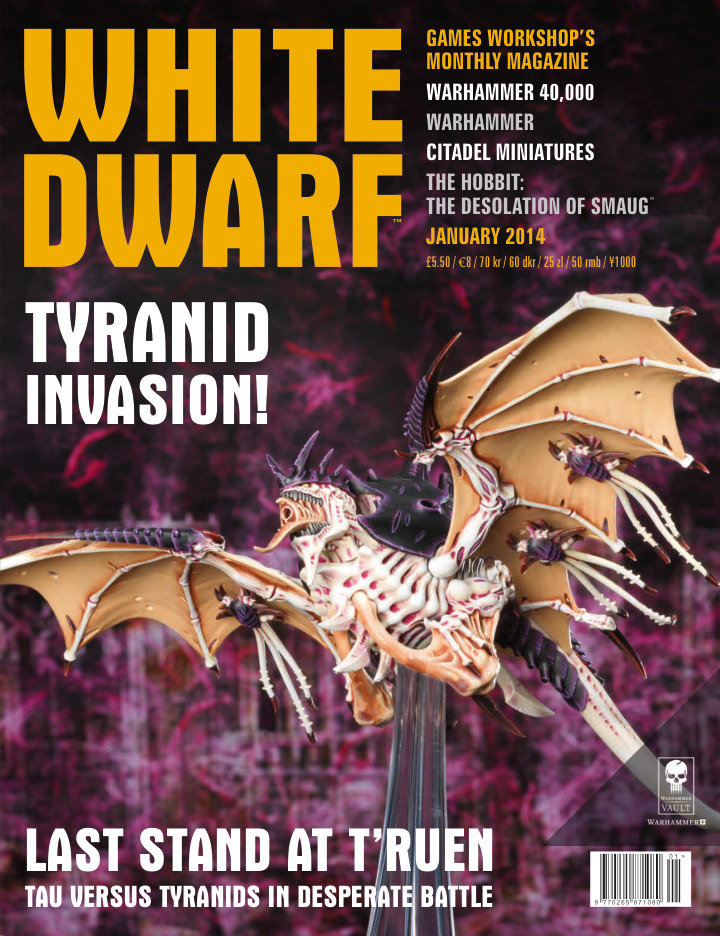
The new plastic Harpy carries stranglethorn or heavy venom cannons and produces spore mines for attacks on infantry below. The feature draws attention to its large wingspan, rear-facing dorsal vanes and three supplied spore mines, contrasting its swept-back silhouette with the Hive Crone made from the same kit.
Warhammer 40,000Tyranids
ShowcaseWD 409 · pp. 6–9
Built from the Harpy’s core components, the Hive Crone changes its outline with dorsal chimneys, a different head and downward-facing spikes. Its four tentaclids are living anti-aircraft missiles; digestive sacs feed the drool cannon for ground attacks once the skies are clear. Close-up captions distinguish the two creatures’ weapons and heat vents.
Warhammer 40,000Tyranids
ShowcaseWD 409 · pp. 10–11
Mark Harrison’s Haruspex turns the Tyranid harvesting process into a large centrepiece monster. The article examines its distended mouth, grasping tongue and crushing claws, explaining how the feeding beast breaks down both prey and hard material during the final consumption of a world.
Warhammer 40,000Tyranids
ShowcaseWD 409 · pp. 12–13
The alternative build from the Haruspex kit is a living artillery platform whose gun symbiote is presented as more intelligent than its carrier. Enlarged middle limbs brace its squat body, while a multi-chambered bio-plasmic cannon fires either separate streams or one large blast. The photographs emphasise the weapon’s many eyes and the creature’s supporting anatomy.
Warhammer 40,000Tyranids
ShowcaseWD 409 · pp. 14–15
The plastic Hive Guard are shown as armoured gun-beasts adapted from the Warrior genus to defend Tyranid harvesting structures. Their eyes have disappeared beneath protective crests, and lower limbs support the heavy weapons. The kit supplies impaler cannons and shockcannons, the latter firing a spine linked to bio-electric tendrils.
Warhammer 40,000Tyranids
ShowcaseWD 409 · pp. 16–17
Heavy segmented armour and eyeless faces make the new Tyrant Guard a living barrier around their leader. The article examines their battle-scarred protective plates and the interchangeable scything talons, crushing claws, lashwhips and boneswords in the three-model kit, with ball-and-socket joints allowing varied poses.
Warhammer 40,000Tyranids
ShowcaseWD 409 · pp. 18–21
The reworked Warrior kit updates the 2001 plastics with three different leg poses, head crests and a much broader selection of weapons. The feature explains Warriors’ role as synaptic links and surveys their ranged symbiotes, paired boneswords, lashwhips, rending claws and optional biological upgrades. Captioned examples show how those parts change the finished brood.
Warhammer 40,000Tyranids
ShowcaseWD 409 · p. 22
One Warrior can instead become a Tyranid Prime using the box’s enlarged chest, back carapace, shoulder guards and head crest. A pincer-tipped tail echoes the Hive Tyrant and distinguishes this synaptic lieutenant from its brood. The article links those visual changes to the Prime’s place in the Tyranid command hierarchy.
Warhammer 40,000Tyranids
ShowcaseWD 409 · p. 23
The Tyranid Swarm collection combines forty Hormagaunts, forty Termagants, ten Gargoyles, four Ripper Swarms and a Carnifex that can represent Old One Eye. The notice presents the set as a massed vanguard for a new or expanding Hive Fleet, explaining how its fast infantry and aerial creatures overwhelm defenders through numbers.
Warhammer 40,000Tyranids
RulesWD 409 · pp. 24–27
The new Tyranid army book combines the histories of the major Hive Fleets, a creature bestiary and a painted-model showcase with updated army rules. The review highlights the Fall of Shadowbrink, Warlord Traits, bio-artefacts, expanded Instinctive Behaviour tables and a dedicated psychic discipline. It also introduces the battlefield roles of the Exocrine, Haruspex and Hive Crone.
Warhammer 40,000Tyranids
ShowcaseWD 409 · p. 28
The limited edition retains the standard Codex’s contents but changes the presentation: a recoloured Raymond Swanland cover, reversible Paul Dainton battle scene, soft-touch cover and numbered endpapers. The feature identifies the run of two thousand copies and distinguishes its artwork and binding from additional gaming material.
Warhammer 40,000Tyranids
ShowcaseWD 409 · p. 29
The Ravener notice describes subterranean shock troops bursting into an enemy position. It lists the three-model kit’s rending claws, scything talons and thorax-mounted weapons, and points out the optional emerging-from-the-ground pose with rubble that supports the brood’s surprise-attack theme.
Warhammer 40,000Tyranids
ShowcaseWD 409 · p. 29
Eight Genestealers are presented as infiltrating assault creatures with long-reaching claws and aggressive running poses. The notice surveys the alternative heads, armour plates and scything talons, and identifies two included spore clusters as useful details for scenic bases or battlefield objectives.
Warhammer 40,000Tyranids
ShowcaseWD 409 · p. 30
The two-Carnifex set offers a wide range of ranged and close-combat symbiotes alongside spine banks and adrenal glands. A damaged facial component can suggest a regenerating monster or the named beast Old One Eye, giving collectors a specific character option as well as ordinary brood members.
Warhammer 40,000Tyranids
RulesWD 409 · p. 30
A companion card deck collects the seven psychic powers available to the new Tyranid army. The notice contrasts supportive Catalyst, weakening Paroxysm and destructive Warp Blast, presenting the cards as play aids for the Codex rather than printing the complete discipline in the magazine.
Warhammer 40,000Tyranids
ShowcaseWD 409 · p. 31
Two infantry-box notices contrast the shooting Termagants with the fast, leaping Hormagaunts. The Termagant set supplies fleshborers, devourers or spinefists and three Ripper Swarms, while the Hormagaunt set provides twenty creatures modelled in an all-out taloned charge. Both are framed as the numerous first wave of an invasion.
Warhammer 40,000Tyranids
ShowcaseWD 409 · p. 32
Gaku Matsubayashi’s new Gandalf model captures a thoughtful pause, with one hand on his hip and his face turned into the distance. The feature relates that restrained pose to Gandalf’s role as the organiser of Thorin’s journey and his growing concern about the Necromancer, illustrating character through posture rather than combat action.
Middle-earth Strategy Battle GameThorin’s Company
ShowcaseWD 409 · p. 33
Bard’s model is described through the contrast between his royal ancestry and the worn clothing of a practical Lake-town bowman. His longbow, quiver and determined expression establish a working hunter rather than an elaborately equipped lord, matching his first encounter with Thorin’s waterlogged company.
Middle-earth Strategy Battle GameLake-town
ShowcaseWD 409 · p. 34
The Master’s rings, feathered hat and straining jerkin communicate his wealth and self-importance. The article connects his hopes for prestige from Thorin’s expedition with the model’s flamboyant appearance and briefly notes the incentive his presence gives Lake-town’s soldiers to fight for a reward.
Middle-earth Strategy Battle GameLake-town
ShowcaseWD 409 · p. 34
The Master’s gaunt assistant is portrayed as flattering the powerful and mistreating those beneath him. His Finecast miniature carries a ledger and quill instead of an obvious weapon; the notice uses that contrast with his expansive employer to explain the character’s suspicious, administrative role in Lake-town.
Middle-earth Strategy Battle GameLake-town
ShowcaseWD 409 · p. 35
The Lake-town Captain strides forward with a raised sword to rally the settlement’s militia. His fur-trimmed leather over mail and fish-tail helmet combine winter practicality with the town’s ornamental style. The accompanying scene places him beside the Master and Alfrid as they watch the western approaches.
Middle-earth Strategy Battle GameLake-town
ShowcaseWD 409 · pp. 36–37
Swordsmen, spearmen and bowmen are introduced as three separate groups of Lake-town defenders. Close-ups examine their fish-tail helmets, padded jerkins, fur trim and distinct faces, while weapon descriptions explain the plain swords, practical spear crosspieces and bows carried with reserve blades. The design balances ceremonial dress with defence against raiders and cold weather.
Middle-earth Strategy Battle GameLake-town
ShowcaseWD 409 · p. 38
The digital Codex is announced for eBook devices and iPad, with the same core material as the printed book. The enhanced iPad version adds audio, linked rules, rotating model views and a Force Requisition collection manager that organises owned units and their equipment before a game.
Warhammer 40,000Tyranids
RulesWD 409 · p. 38
This digital mission collection follows the stages of a Tyranid invasion through six scenarios. The notice moves from securing an initial planetary foothold to the final harvesting of the defeated world, explaining the supplement’s narrative scope without reproducing its separate scenario rules.
Warhammer 40,000Tyranids
PaintingWD 409 · p. 39
The digital painting announcements distinguish a larger army guide covering Hive Fleets Behemoth and Kraken from individual model guides. Tyrant Guard, Haruspex, Harpy, Warriors and Hormagaunts receive focused treatments. These are notices for separate publications; this page does not itself supply their paint recipes.
Warhammer 40,000Tyranids
RulesWD 409 · p. 39
Two dataslates approach the Tyranid wars from opposite sides. Tyranid Vanguard focuses on first-strike organisms such as Lictors and Genestealers, while Tyrannic War Veterans follows Cassius’s specialised defenders after the Battle for Macragge. The paired notices explain their background and gaming purpose without including the downloaded rules.
Warhammer 40,000Tyranids
InterviewWD 409 · p. 40
Gav Thorpe explains how three linked novels revisit the same events through Warrior, Seer and Outcast perspectives. Their intertwined lives let him explore how Eldar choices reshape both the future and their own society. He contrasts the first two books’ constrained introspection with the third’s freedom to leave established lore behind and explore the stars.
Warhammer 40,000Aeldari
ShowcaseWD 409 · p. 41
The anthology notice surveys forty-one short stories drawn from more than a decade of Warhammer 40,000 fiction. Adam Troke singles out William King’s Khârn story and Nick Kyme’s Marines Malevolent tale, using those contrasting examples to convey the volume’s breadth and its recurring themes of violence and judgment.
Warhammer 40,000Chaos Space Marines
ShowcaseWD 409 · p. 41
The review follows Yasu Nagasena’s pursuit of Severian on Terra, continuing the conspiracy introduced in The Outcast Dead. It contrasts the hunter’s discipline with his quarry’s violent pragmatism and praises the audio drama’s detailed combat, voice acting and effects. A reading sidebar links the drama to the related novel and Garro stories.
The Horus HeresySons of Horus
ShowcaseWD 409 · p. 42
Dan Harden welcomes a sustained look at the White Scars through the campaign on Chondax. Alongside jetbike attacks on Orks, he emphasises the quieter passages that establish the Legion’s culture and the impression Jaghatai Khan makes on Ilya Ravallion. The notice treats those encounters as the novella’s introduction to an elusive Legion.
The Horus HeresyWhite Scars
ShowcaseWD 409 · p. 42
Ben Counter’s novel is introduced through Lysander’s disappearance, enslavement by the Iron Warriors and eventual return for revenge. The review stresses both the brutality of the daemon world and the difficulty of returning to a company that has endured without him, presenting Malodrax itself as a pervasive antagonist.
Warhammer 40,000Imperial Fists
ShowcaseWD 409 · p. 43
Rodeo Games’ mobile adaptation expands into Averland’s Fire Caverns with The Brutal Tribe, adding new enemies and heroes such as a Shadow Warrior, Bright Wizard and Ogre Irongut. The feature also previews an Undead expansion and Witch Hunter, while captions point out purchasable legendary weapons for existing adventurers.
Warhammer Quest
ShowcaseWD 409 · pp. 44–45
Stuart Williamson’s Fire Raptor trades the Storm Eagle’s transport space for infantry-support weapons. The feature identifies its nose-mounted Avenger cannon and ball turrets, including alternative reaper batteries, and shows Sons of Horus and Iron Warriors examples. It directs players to Imperial Armour Volume Two for the aircraft’s separate rules.
Warhammer 40,000The Horus HeresySpace Marines
ShowcaseWD 409 · pp. 50–57
Christian Byrne traces his Blood Angels collection back to Space Crusade and the 1996 Angels of Death book, then describes adding Dark Vengeance’s Dark Angels. Shared red accents, blue blades and green details bind the two Chapters together. Freehand angels, weathered vehicles and selected conversions make the expanding force a sustained painting project rather than a fixed army list.
Warhammer 40,000Blood Angels
EditorialWD 409 · pp. 58–59
Jervis recalls the sprawling tables in Realm of Chaos and distinguishes their narrative appeal from the frustration of having dice dictate which models a player could field. His campaign experiment gives each character a random family heirloom as an optional extra. He argues that unpredictability works best when it enriches a game’s story without controlling the collector’s choices.
Warhammer Fantasy BattlesWarhammer 40,000
RulesWD 409 · pp. 60–61
The accompanying campaign aid first selects a category and then uses a D66 roll to award a weapon, talisman, armour, enchanted item, arcane item or standard. Results range from modest saving-throw aids to very powerful combat bonuses. Jervis offers either a free heirloom or paid rolls as a friendly campaign experiment, with its deliberately uneven rewards forming part of the appeal.
Warhammer Fantasy Battles
Battle reportWD 409 · pp. 62–81
Jes Bickham’s monster-heavy Hive Fleet Eumenides attacks an alliance of Dan Harden’s D’yanoi T’au and Glenn More’s Farsight Enclaves. The defenders protect three nova shield generators while hunting the Tyranid leaders, and each destroyed generator draws in another monster. Their deliberately unrestricted collections produce six Riptides against a force including the Swarmlord and a Hierodule.
Warhammer 40,000Tyranids
RulesWD 409 · pp. 68–69
The battle’s custom objectives give the Tyranids physical targets and the T’au a reason to defend their position. Destroying a generator releases a randomly selected aerial, subterranean or ground-based monster; the defenders instead seek to kill three Hive Tyrants. Glenn’s generators are built from spare Riptide components, linking the scenario’s mechanics to purpose-made scenery.
Warhammer 40,000Tyranids
InterviewWD 409 · pp. 82–83
Steve Whitehead nominates Juan Diaz’s Techmarine for combining Mechanicus and Space Marine imagery without losing the recognisable warrior underneath. Neil Green discusses painting the servo-harness in separate subassemblies and using red mechanical equipment to frame blue Ultramarines armour. Clean artificer plate and worn tools provide contrasting textures and suggest the figure’s duties.
Warhammer 40,000Space Marines
ModellingWD 409 · pp. 84–87
John Blanche introduces Johan Egerkrans’s exploration of the Imperium’s dirty margins through Witch Hunter Orff and his entourage. Captioned conversions reveal a Cairn Wraith transformed into a Mechanicus adept, Goblin-bodied mutants, the Chrono-gladiator Cleetus and the Red Lady assassin. Reused heads, weapons and power plants are unified by restrained colour, grime and minute devotional details.
Warhammer 40,000Inquisition
ShowcaseWD 409 · pp. 88–89
A procession of priests, altered servitors and machines turns the Armies on Parade format into a literal parade. Nearly every model is converted, while the gallery emphasises that the individual miniatures retain a competition standard of painting even within the crowded procession.
Warhammer 40,000Adeptus Mechanicus
ShowcaseWD 409 · pp. 90–91
Colin Wilson’s display stages a city overwhelmed by Plague Zombies. Small scenes give the attack a narrative, from a Heldrake burning the cathedral roof to Cadians struggling to hold a door against the horde. The gallery shows how those separate incidents guide the eye through a large army.
Warhammer 40,000Chaos Space Marines
ShowcaseWD 409 · p. 92
The Iron Wolves hold a shattered city behind an Aegis Defence Line with a Warhound Titan towering above. A broken roadway and carefully modelled Realm of Battle tile give the vehicles a convincing route through the position and turn the force into a coherent defensive scene.
Warhammer 40,000Space Marines
ShowcaseWD 409 · p. 93
Cadians and Dark Angels advance across a scenic river crossing, combining scratch-built terrain with understated miniature conversions. Cadian bodies and command parts on Scout bikes create mechanised Rough Riders, illustrating how a shared setting can integrate infantry, mounted troops and allied Space Marines.
Warhammer 40,000Astra Militarum
ShowcaseWD 409 · p. 94
A cliffside fortress frames an extensively converted Chaos army. The gallery concentrates on three Land Raiders fitted with Arcane Fulcrum skulls and stripped-down Heldrakes, showing how repeated aggressive shapes carry the Chosen of Khorne’s theme across both the vehicles and their elaborate display.
Warhammer 40,000Chaos Space Marines
ShowcaseWD 409 · p. 95
Michael Brent’s High Elves combine precise blue and purple painting with non-metallic gold armour. A mounted Flamespyre Phoenix provides the centrepiece, its carefully highlighted feathers illustrating the same exacting finish as the troops below. The display places surface treatment and controlled colour at the heart of the army.
Warhammer Fantasy BattlesHigh Elves
ShowcaseWD 409 · pp. 96–99
An underground display sends Night Goblin regiments, squigs and Fanatics through fields of stalagmites. Red squigs and yellow moon details stand out against grey rock, while converted bases suggest bouncing movement. Close-ups show Skarsnik, a Squig Gobba and magical smoke shifting from green to yellow as it forms a bad moon.
Warhammer Fantasy BattlesOrcs & Goblins
ShowcaseWD 409 · pp. 100–101
Ash Barker depicts Logan Grimnar’s force during the first Armageddon war, including a younger version of the Great Wolf. Scenic slate bases, a Lone Wolf on a ruined Rhino and a converted Venerable Dreadnought support the setting, while transports and the Beast of Fenris Stormraven make the army feel like a complete strike force.
Warhammer 40,000Space Wolves
ModellingWD 409 · pp. 102–103
Carl Dafforn extends the off-white beasts of his existing Ogre display into a Mournfang unit. Thundertusk and Giant parts, a lookout platform, chain reins and embedded arrows make the riders look like members of one battle-worn tribe. An entire Thundertusk saddle and rider become the unit’s distinctive Crusher.
Warhammer Fantasy BattlesOgre Kingdoms
ModellingWD 409 · pp. 104–105
James Bragg creates two contrasting Mournfang characters: a veteran would-be hunter and his hung-over brother. Thundertusk weapons and trophies define the first, while Fortified Manor woodwork, barrels and a reposed seated Ogre build the second’s improvised sleeping platform. Green Stuff fills the altered legs and supports the comic story.
Warhammer Fantasy BattlesOgre Kingdoms
ModellingWD 409 · pp. 106–107
Michael Knight develops pirate Ogres into cannon-carrying cavalry, suspending an Ironblaster barrel between two Mournfangs. Leadbelcher parts, Green Stuff saddle straps and twisted brass-wire rope make the heavy weapon appear supported. A Gnoblar tasked with lighting the charge completes the miniature scene.
Warhammer Fantasy BattlesOgre Kingdoms
ModellingWD 409 · pp. 108–109
Anthony Saliba gives Marienburg’s Ogre mercenaries stolen Empire artillery on Mournfang mounts. One rider operates a Helblaster and tows ammunition on an Ironblaster chassis; another carries a rocket battery held by a Stonehorn seat. Pirate details and human crew tie the machines into the wider mercenary force.
Warhammer Fantasy BattlesOgre Kingdoms
PaintingWD 409 · pp. 110–111
Dan Harden builds pale, pink-tinged skin over a white undercoat, leaving limbs separate to reach the Haruspex’s hidden surfaces. Layered purple striations distinguish the black carapace, red claws receive a final glaze and bright green vents provide a small contrasting colour. The vivid stomach repeats the flesh’s crimson shading to keep the grotesque mouth within one palette.
Warhammer 40,000Tyranids22 paint colours
PaintingWD 409 · pp. 112–113
The Hive Crone guide paints recessed flesh before the outer plates so later colours conceal stray brushwork. Red skin, blue-green chitin highlights, grey-edged black claws and warm wings form the Behemoth scheme. A separate sequence explains irregular carapace striations: progressively narrower strokes preserve each darker layer and finish with an edge highlight.
Warhammer 40,000Tyranids15 paint colours
PaintingWD 409 · pp. 114–115
A diluted sepia wash over a white undercoat establishes the Hive Guard’s pale skin without a conventional opaque basecoat. Red carapace, fleshy weapon symbiotes and electric-blue shock tendrils are treated separately to keep the creature’s functions readable. The guide also gives a small yellow-eye recipe and refers back to the previous page’s black-claw sequence.
Warhammer 40,000Tyranids23 paint colours
PaintingWD 409 · pp. 116–117
Glenn More works through assembly, spraying, a test miniature and manageable batches rather than trying to finish twenty models individually. Three principal base colours share one diluted wash, reducing repeated work while preserving definition. He then adds carapace highlights, base drybrushing and final details, reporting a small brood completed over three evenings.
Warhammer 40,000Tyranids7 paint colours
EditorialWD 409 · pp. 118–119
Jeremy Vetock reflects on the satisfaction of having an absorbing hobby and friends to share it with. Painting and planning a battle may require work, yet that effort can itself be relaxing. He then describes the range of reactions from visitors who discover his collection and considers how to explain its worlds and activities without overwhelming a newcomer.
CommunityWD 409 · p. 126
The January activity notice encourages new hobbyists to turn holiday miniatures into a first painted and playable force. It connects introductory painting help with opportunities to learn the games in local stores, framing the month as a chance to establish useful habits and begin an army rather than simply accumulate new models.
CommunityWD 409 · p. 127
The local-news feature introduces the new Amsterdam South hobby centre and its role as a place to meet other collectors. Its opening is presented alongside the practical support stores offer for painting, building and organising games, giving nearby readers a new venue for developing their hobby.
CommunityWD 409 · p. 127
The School League notice looks ahead to a second round of heats after the first November events. Existing entrants are encouraged to refine their armies with help from local hobby centres, while new participants are directed to the community coordinator. The feature presents store support and school gaming as linked routes into organised play.
ShowcaseWD 409 · p. 128
Philip Henderson’s guest collection uses object-source lighting across Chaos Daemons and conversions that show psychic powers manifesting around Thousand Sons. A heavily altered Helbrute is caught devouring a Space Marine. The feature invites readers to inspect the painting and modelling of the temporary exhibition in person.
Warhammer 40,000Chaos Daemons
ShowcaseWD 409 · p. 129
A new feature table recreates the disastrous drop landings of the 22nd Elysian Regiment on Skopios. Heavy defences and craters establish the battlefield, while skeletal Imperial Guard remains preserve signs of its earlier fighting. The notice presents the large themed board as a setting for group battles in the events hall.
Warhammer 40,000Astra Militarum
CommunityWD 409 · pp. 138–139
The team reports projects ranging from Jes’s new Tyranid monsters to Rebecca Ferguson’s Empire army and Glenn More’s rapidly expanding T’au. Dan’s Ork “Forktress”, Matt’s Space Marines and Erik’s weekend Giant illustrate the variety of work sharing the bunker’s painting desks. Short progress notes preserve the personal aims behind each collection.
Warhammer 40,000Warhammer Fantasy Battles
CommunityWD 409 · p. 139
Jes and Erik prepare an Ogre and Orcs & Goblins alliance for a Battle Brothers weekend through noisy practice games against their colleagues. Their event report values a painting nomination and repeated favourite-opponent votes alongside the games themselves, showing how shared preparation and a themed partnership make the weekend memorable.
Warhammer Fantasy BattlesOgre Kingdoms
ShowcaseWD 409 · pp. 140–141
The team’s finished work ranges from a Bloodwrack Medusa and Warhammer Giant to a chequered Magos Dominus and newly painted Empire troops. Dan Harden’s Ork conversion of the Fortress of Redemption is a prominent centrepiece. Captions connect those results to lunch-break painting, relaxed weekend sessions and preparation for future events.
Warhammer 40,000Warhammer Fantasy Battles
InterviewWD 409 · pp. 142–145
Mark Harrison and Matt Holland explain how shared anatomy links new Tyranids to existing creature families. Gargoyles inform the Harpy, while the Hive Crone’s silhouette and parasites advertise another role. They discuss the Exocrine’s bracing limbs and dominant gun symbiote, the Haruspex’s harvesting mouth and the Guard creatures’ protective anatomy, showing how biological purpose shapes the sculpt.
Warhammer 40,000Tyranids
InterviewWD 409 · pp. 146–147
Robin Cruddace describes the Tyranids as an unknown, intentionally adapting intelligence whose full scale cannot be measured by Imperial observers. Their inability to negotiate and their purposeful redesign of organisms make them different from more familiar enemies. Mark Holmes and Kevin Chin explain how their artwork conveys consumption, encirclement and the apparent hopelessness of resisting the Hive Fleets.
Warhammer 40,000Tyranids
InterviewWD 409 · p. 148
Phil Stutcinskas revisits the Sicaran chassis as a dedicated tank destroyer. A neutron laser replaces the turret’s flexibility, with visible power relays conveying the weapon’s energy demands. The short design preview also points out retained pintle and sponson weapons that give the specialised vehicle some close-support capability.
The Horus HeresySpace Marine Legions
InterviewWD 409 · p. 149
Mark Bedford previews power-armoured Myrmidon priests still undergoing finishing changes. The feature distinguishes the close-quarter Secutors from the heavy-weapon Destructors and shows the sinister machinery used to communicate their role as battle priests, including an irradiation weapon on one unfinished example.
The Horus HeresyMechanicum
ShowcaseWD 409 · p. 149
An unfinished Dread Saurian realises a monster from Monstrous Arcanum at an enormous physical scale. The preview uses the jaws’ size relative to an Empire soldier to demonstrate the beast’s proportions and presents it as an ambitious Lustrian centrepiece still being developed in the Forge World studio.
Warhammer Fantasy BattlesLizardmen
InterviewWD 409 · pp. 150–151
Raymond Swanland traces his Games Workshop commissions from The Emperor’s Mercy to novels and Codex covers. His long-standing interest in Space Marines and Rogue Trader informs the work, while Eldar imagery remains a particular attraction. He explains how he combines earlier visual references with new design choices to contribute to the setting’s continuing storytelling.
Warhammer 40,000Warhammer Fantasy BattlesSpace Marines
Contents features, separately titled release notices, showcases, painting guides and studio subsections are indexed. Roman-numbered foldout artwork, contents, price listings, advertisements, store directories, bare event schedules and the parting photograph are excluded.