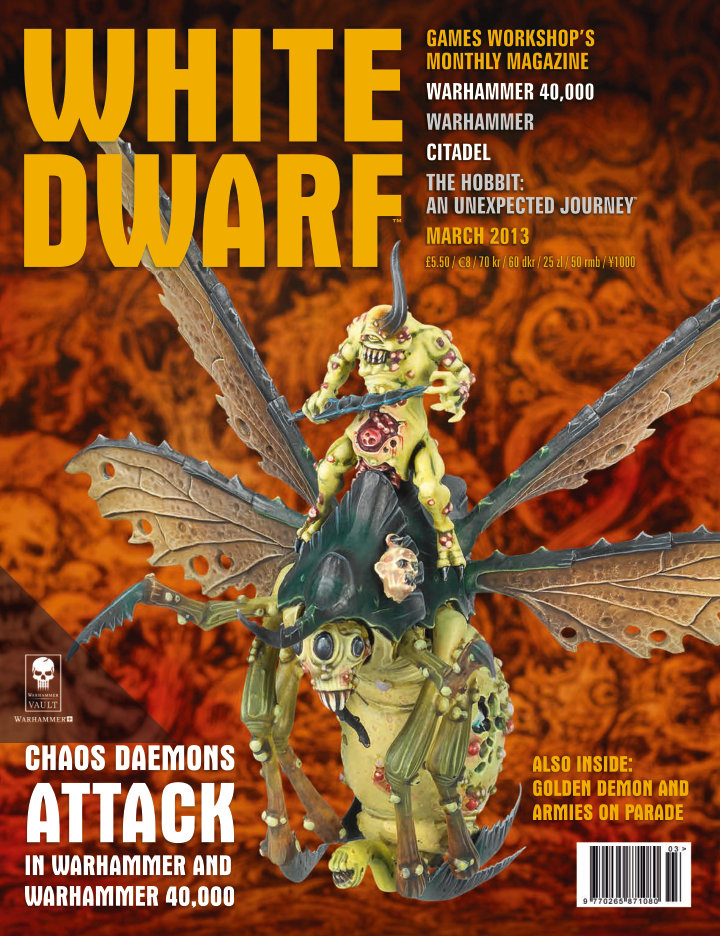
EditorialWD 399 · p. 1
Jes Bickham introduces a Daemon release shared by Warhammer and 40K. New miniatures arrive alongside both an army book and a codex, giving the issue two related sets of background and rules to explore. Adam Troke paints a substantial force to test against Matt Hutson’s Imperial Fists and contributes its painting methods. Bickham also looks ahead to the magazine’s four-hundredth issue and its planned celebrations.
Warhammer Fantasy BattlesWarhammer 40,000Daemons of Chaos
ReviewWD 399 · pp. 6–7
Three Plaguebearers ride bloated Rot Flies in this new plastic cavalry set. Optional command parts give the riders a distinctive banner, bell and leader. Alternative fly heads and tails vary the creatures, while swallowed victims and damaged bodies make their origins visibly unpleasant. The review identifies extras that can personalise the unit beyond the basic three builds.
Warhammer Fantasy BattlesWarhammer 40,000Daemons of Chaos
ReviewWD 399 · pp. 8–11
The Burning Chariot balances an ornate disc above magical flames, pulled by two Screamers. An Exalted Flamer and accompanying Blue Horrors make one version, while an extensively customisable Herald offers the alternative. Spare arms, heads, books and weapons expand the possibilities for other characters. Building the Flamer version can also leave enough components for a separate Herald, extending the kit’s usefulness.
Warhammer Fantasy BattlesWarhammer 40,000Daemons of Chaos
ReviewWD 399 · pp. 12–15
Khorne’s new machine combines wheels, pistons and a visibly daemonic body. The Blood Throne carries an imposing Herald above chained Bloodletters. Its alternative Skull Cannon build turns the same brutal visual language into mobile artillery, digesting victims and firing their skulls. The review links both forms to the established mixture of flesh and mechanism seen in Juggernauts.
Warhammer Fantasy BattlesWarhammer 40,000Daemons of Chaos
ReviewWD 399 · pp. 16–17
Gavin Newton’s plastic Herald towers over ordinary Plaguebearers with a distorted, open-bodied silhouette. A hanging Nurgling, stretched skin and asymmetric legs provide numerous repulsive details. The way the parts assemble gives the exposed abdomen real depth. The review presents those construction choices as central to the miniature’s disturbing character.
Warhammer Fantasy BattlesWarhammer 40,000Daemons of Chaos
ReviewWD 399 · pp. 18–19
The Finecast Herald lunges forwards with a raised hellblade, standing out from the Bloodletters around him. Partial armour and metal bands add ornament without softening the aggressive anatomy. A chain of skulls reaches down to the base and reinforces his devotional purpose. Close photographs show the details that distinguish the character from the rank and file.
Warhammer Fantasy BattlesWarhammer 40,000Daemons of Chaos
ReviewWD 399 · p. 20
Flowing skirts and an armoured corset give the Herald the poise of a dancer. Claws, fangs and a snarling expression complicate that apparent elegance. Jewellery and a brow icon make the figure ornate while maintaining the contradictions associated with Slaanesh. The review focuses on how those elements combine beauty and threat in one silhouette.
Warhammer Fantasy BattlesWarhammer 40,000Daemons of Chaos
ReviewWD 399 · p. 21
A shared Battleforce or Battalion assembles followers of all four Chaos gods. Bloodletters, Plaguebearers, Nurglings, Seekers and Screamers give a new collection varied units rather than one allegiance. Separate card packs support the Warhammer magic lores and 40K psychic disciplines. The notice frames both the box and reference aids as companions to the newly released books.
Warhammer Fantasy BattlesWarhammer 40,000Daemons of Chaos
ReviewWD 399 · pp. 22–25
Jes Bickham praises the new army book’s imaginative treatment of the Realm of Chaos. Each god’s domain receives a different atmosphere, supported by John Michelbach’s map and John Blanche’s bestiary art. The model galleries and army list allow both single-god forces and mixed collections. The background inspires Bickham to plan a Nurgle army modelled around the Plaguefather’s garden.
Warhammer Fantasy BattlesDaemons of Chaos
ReviewWD 399 · pp. 23–27
Andrew Kenrick examines a codex whose changing page designs reflect the four gods. Phil Kelly’s background places Daemons within conflicts involving the other peoples of the galaxy rather than isolating them in their own realm. New gifts, artifacts and Warp Storm effects aim to convey an unpredictable invasion in play. Distinct bestiary illustrations and a fold-out reference sheet reinforce the book’s combination of atmosphere and practical navigation.
Warhammer 40,000Daemons of Chaos
ReviewWD 399 · pp. 28–29
The Erebor warriors wear a mixture of plate, mail and leather that suggests a well-equipped fighting force. Raised weapons and forward movement prevent them looking like purely static defenders. Individual faces and varied beards offer opportunities to distinguish the Dwarves through painting. Adam Troke particularly values the character conveyed by those small sculpted differences.
Middle-earth Strategy Battle GameErebor
ReviewWD 399 · pp. 30–31
Ten warriors recreate Dale’s soldiers from the film’s historical scenes. Their mail, fur-lined helmets and large cloaks distinguish them from other human armies in the range. Swords, spears and bows divide their battlefield equipment, with shields available for the melee fighters. Close views highlight expressions and the ornamental fittings that give the force a recognisable identity.
Middle-earth Strategy Battle GameDale
ReviewWD 399 · pp. 32–34
Three character releases show different forms of authority. The Grim Hammer Captain’s bare head and pointing arm make him easy to identify among enclosed helmets. Thror’s ornate armour and protected beard establish the splendour of Erebor’s king. Lindir instead conveys advice and warning through a gesture, detailed clothing and a weapon still at his side.
Middle-earth Strategy Battle GameErebor
ReviewWD 399 · pp. 35–37
The hardback manual brings the expanded Hobbit rules, film characters, scenarios and hobby guidance into one volume. The accompanying starter-box overview describes Thorin’s Company, Goblin opponents and the scenery needed for their escape. A compact rulebook, introductory guide and gaming accessories make the box a self-contained entry point. The feature records these existing products alongside the month’s new miniatures.
Middle-earth Strategy Battle GameThorin’s Company
ReviewWD 399 · p. 38
Adam Troke reviews David Annandale’s exploration of the Black Dragons’ suspect appearance and contested loyalty. The viewpoints of Volos and Toharan place internal disputes alongside the war against Chaos. Apparently saintly enemies complicate any easy association between physical beauty and virtue. Troke values the set-piece battles but sees the chapter’s moral examination as the novel’s centre.
Warhammer 40,000Black Dragons
ReviewWD 399 · p. 39
Andy Chambers’ sequel follows the consequences of Commorragh’s catastrophic Dysjunction. Jes Bickham finds particular strength in the relationship between the austere Incubus Morr and the verbose Harlequin Motley. A wider cast makes the city’s schemes involving even when their participants remain overtly cruel. The review praises Chambers’ ability to give a villainous society convincing motives and absorbing political conflicts.
Warhammer 40,000Drukhari
ReviewWD 399 · p. 40
Andrew Kenrick reviews Ben Counter’s account of Egrimm van Horstmann’s rise and betrayal of the Light College. The story fills in his earlier life while retaining the familiar release of Baudros and smaller background references. Jes Bickham examines Andy Chambers’ Harlequin novella, which places Motley at a Dark Eldar gathering. Its enclosed setting and theatrical revenge draw on Poe’s masquerade story, with related Gotrek and Felix releases noted alongside the reviews.
Warhammer Fantasy BattlesWarhammer 40,000The Empire
ReviewWD 399 · p. 41
The digital Daemon books accompany their paper releases with searchable navigation and model galleries. New psychic disciplines also become available within the contemporary 40K app. White Dwarf’s iPad edition adds rotating views and video battle debriefs. The notice identifies digital extras without implying that those materials are contained in the supplied magazine.
Warhammer Fantasy BattlesWarhammer 40,000
ReviewWD 399 · pp. 42–43
Deathshroud Terminators combine practical armour with Mortarion’s characteristic scythes and wrist weapons. The Justaerin instead wear decorated Cataphractii suits and distinctive helmets associated with the Sons of Horus elite. A caliver upgrade pack extends the range of support weapons available to Legion infantry. The reviews compare sculpted equipment and identity rather than printing complete unit rules.
The Horus HeresyDeath Guard
InterviewWD 399 · pp. 44–45
Rodeo Games explains its digital adaptation of the classic dungeon game. The developers retain familiar skills, equipment and the original four roles while updating presentation and planning further downloadable warriors. Random dungeons sit alongside scripted locations, and journeys and settlement events continue the adventure between expeditions. A short accompanying notice previews Ruinous Hordes cards for Warhammer: Invasion.
Warhammer QuestWarhammer: Invasion
ShowcaseWD 399 · pp. 50–55
Dave Roberts combines Lamenters, Grey Knights and three Warhound Titans in a rapidly expanding collection. Airbrushed basecoats, shadows and overhead highlights allow him to complete armour efficiently. Sponge weathering gives the Lamenters a campaign-worn identity, while blue glow effects provide focal points for the Grey Knights. Slate bases and selected older equipment unify the display without requiring every model to be painted by a slow individual method.
Warhammer 40,000Lamenters
EditorialWD 399 · pp. 56–57
Jervis distinguishes official FAQ work from the practical choices made during a friendly game. Instant designer answers can spread contradictions, so formal questions need collation, thought and translation. At the table he prefers to resolve an uncertain edge case with a die roll and continue playing. He argues that this approach reflects the designers’ own play rather than replacing their ongoing effort to write clearer rules.
Battle reportWD 399 · pp. 58–73
Adam Troke’s new Daemon host faces Matt Hutson’s shooting-heavy Imperial Fists in The Scouring. Null Zone and early fire destroy several important Daemon units, but killing the Librarian allows Adam to regain momentum. Plague Drones and Beasts of Nurgle disrupt the Marines while surviving troops contest the objectives. Lysander denies a late high-value objective, leaving the Daemons a narrow 3–1 victory; the debrief weighs their resilience and the new units’ vulnerabilities.
Warhammer 40,000Daemons of Chaos
ShowcaseWD 399 · pp. 74–77
Kari Hernesniemi begins with painted illustrations, then finds or creates miniature components to realise them. His radical Inquisitor Marius Cassar leads a deliberately unusual collection of followers with clashing personalities. A floating tech-deacon, biomechanical familiar and severe Rifleman establish different roles without relying only on familiar archetypes. The warband is intended for a story-driven game against a rival Inquisitor, with the artwork remaining an active guide throughout construction.
Warhammer 40,000Inquisition
InterviewWD 399 · pp. 78–79
Neil Green nominates Urien Rakarth for the range of textures that made painting him especially satisfying. He also values the miniature’s fidelity to Jes Goodwin’s concept. Juan Diaz recalls a difficult collaborative sculpting process, including new drawings for the back and adjustments needed for casting. The account presents the result as a shared design whose tightly controlled pose required unusual care from the beginning.
Warhammer 40,000Drukhari
ShowcaseWD 399 · pp. 80–95
The UK gallery continues with competition work ranging from small characters to elaborate displays. Martin Footit’s Bag-end scene recreates both interior and exterior, while Fabrice Tran’s Hive Tyrant uses fine veins and smoothly blended carapace. Other close views explain weathered metal, complex conversions and unusual duel pairings. Named entrants and award captions document a broad range of approaches without supplying individual paint recipes.
Warhammer Fantasy BattlesWarhammer 40,000
ModellingWD 399 · pp. 96–97
Dale Stringer turns two aircraft kits into a jet-powered biplane inspired by Deff Skwadron. A relocated cockpit changes the profile, while spare tail parts support the upper wing. Corrugated plasticard disguises joins and extended gun barrels run beside the fuselage. A Manticore missile tip completes the intake, producing an ambitious conversion for only his second painted vehicle.
Warhammer 40,000Orks
ModellingWD 399 · pp. 98–100
Dave Cross redistributes parts from three Bommer kits into markedly different aircraft. One gains a long hull, extra turrets and an immense bomb load, while another becomes a compact stunt-like Dakkajet. The Blitza-Bommer takes a biplane form with numerous wing guns. Using the discarded sections across the other builds reinforces the ramshackle variety of an Ork squadron.
Warhammer 40,000Orks
ModellingWD 399 · p. 101
Jon Grifflow and Paul Gayner bring two contrasting aircraft to their Doubles army. A Death Skull Dakkajet gains painted flames, while the Bad Moon plane carries a Stompa’s enormous gun. Dark undersides suggest a night-fighting role on the latter. The short gallery records practical conversions spotted during play, alongside the owners’ admission that impressive armament did not guarantee accuracy.
Warhammer 40,000Orks
ShowcaseWD 399 · pp. 102–103
Chris Gregory’s display brings a large Empire collection before a substantial castle. Numerous regiments contain individual characters, giving the massed ranks smaller points of interest. An observation tower built with Skullvane Manse parts strengthens the backdrop. The result uses both quantity and varied leadership figures to convey an organised army gathering beneath its fortifications.
Warhammer Fantasy BattlesThe Empire
ShowcaseWD 399 · pp. 104–105
Richard Webb’s Tau advance over dusty ground scattered with Imperial wreckage. A Kroot squad emerges from a sewage opening while a concealed enemy sniper watches nearby. The landing pad supports a heavily weathered Devilfish rather than a pristine display vehicle. These details turn the base into a contested battlefield with action at several levels.
Warhammer 40,000T’au Empire
ShowcaseWD 399 · pp. 106–107
Rebecca Page’s Ork display makes aircraft and improbable construction its main attractions. A Fighta tows a flying bomb whose Grot crew continue working in mid-air. A converted Stormraven occupies a large landing pad and appears still to be under modification. Oversized guns and active workshop details give the collection the sense of technology being continually improvised.
Warhammer 40,000Orks
ShowcaseWD 399 · pp. 108–109
Matt Garside arranges his Imperial Fists around a customised Skyshield landing pad. Chapter and company markings establish the identity of the force. An altered Ironclad carries a large siege hammer, while a helmeted Captain leads the army. Scenic flagstones extend beneath a Land Raider, tying vehicles and infantry to the same constructed environment.
Warhammer 40,000Imperial Fists
PaintingWD 399 · p. 110
The Studio Hobby Team identifies the principal colours on its new Plague Drones. Putrid greens keep the riders recognisably Nurgle, while pale flesh and beige distinguish their enormous mounts. Dark wings and contrasting limbs separate the main surfaces without losing the diseased overall effect. This is a colour-reference breakdown rather than a complete ordered recipe.
Warhammer Fantasy BattlesWarhammer 40,000Daemons of Chaos9 paint colours
PaintingWD 399 · p. 111
The studio chariot combines differently coloured daemonic bodies, metallic fittings and flames. Deep red fire suggests soot and ash rather than requiring a conventional bright flame sequence. The varied surfaces make it a useful project for trying different painting techniques. Named colour references identify the Flamer, Horrors, Screamers, disc and metalwork without presenting every intermediate stage.
Warhammer Fantasy BattlesWarhammer 40,000Daemons of Chaos9 paint colours
PaintingWD 399 · p. 111
Black machinery and red Bloodletters tie the Skull Cannon to the studio’s other Khornate models. Bronze metalwork supplies a third major material without competing with the crew. Painting the Bloodletters separately preserves access to both figures and chassis. The team recommends pinning the crew temporarily so they can be held securely while their basecoat and details are applied.
Warhammer Fantasy BattlesWarhammer 40,000Daemons of Chaos9 paint colours
PaintingWD 399 · p. 112
Adam Troke uses a white undercoat beneath a compact red-skin sequence. A strong basecoat and brighter layer establish definition before an earth wash settles the shadows. A final red glaze restores intensity and unifies the finish. The method is intended to be fast and forgiving across a sizeable infantry unit.
Warhammer Fantasy BattlesWarhammer 40,000Daemons of Chaos5 paint colours
PaintingWD 399 · p. 112
A pink basecoat and violet wash supply the principal colour of Adam’s Horrors. White areas shaded blue add contrasting details without an elaborate series of highlights. The limited process allowed him to finish a twenty-model unit in an afternoon. The example shows how carefully chosen washes can produce an effective group quickly.
Warhammer Fantasy BattlesWarhammer 40,000Daemons of Chaos4 paint colours
PaintingWD 399 · p. 113
Adam’s Plaguebearers begin with warm flesh before successive washes turn it into a sickly surface. Green and blue-green staining supply much of the definition without conventional layered highlights. A red glaze picks out the exposed intestines. The approach enabled him to paint more than thirty models over several evenings while retaining the army’s unhealthy character.
Warhammer Fantasy BattlesWarhammer 40,000Daemons of Chaos4 paint colours
PaintingWD 399 · p. 113
Adam establishes metallic, purple and green areas before applying one violet wash over the model. This ties the materials into a shared cold palette while keeping the process short. He suggests changing hair colours when expanding the collection so different units remain identifiable. The sequence illustrates another way of placing details before an overall shade.
Warhammer Fantasy BattlesWarhammer 40,000Daemons of Chaos4 paint colours
PaintingWD 399 · p. 114
Five parallel recipes cover green fire, horns and claws, hellblades, red fire and gold trim. Shared bone and metal details help unify Daemons whose bodies have very different god-specific colours. Layering moves the flames towards sharply contrasting extremes, while a wash settles the horn shading. The page provides reusable finishing methods for the force rather than another complete model scheme.
Warhammer Fantasy BattlesWarhammer 40,000Daemons of Chaos16 paint colours
PaintingWD 399 · p. 115
Dan Harden gives Dale’s warriors deep red clothing and burnished gold armour. A shared red basecoat speeds the opening stages, after which separate highlights distinguish cloak and garments. Pale trim and subdued leather keep the force formal without making every surface bright. The parallel tables cover the major materials so the method can be repeated across the unit.
Middle-earth Strategy Battle GameDale12 paint colours
PaintingWD 399 · p. 116
Inspired by Dave Roberts’ army, Dan tries spraying a yellow basecoat on his Imperial Fists. The guide focuses on small tests, controlled dilution and checking whether paint flows through the feed tube. Adjusting the nozzle changes the coverage from a single figure to a larger group. A successful spare model becomes the signal to line up the rest of the unit, with no specific yellow product named.
PaintingWD 399 · p. 117
Matt shares the yellow-armour sequence used on the battle-report army. Sepia shading settles the initial basecoat before increasingly pale yellow layers sharpen its definition. A separate red sequence supplies the contrasting markings and details. The restrained pair of recipes explains the army’s crisp consistency against Adam’s much more varied Daemons.
Warhammer 40,000Imperial Fists8 paint colours
EditorialWD 399 · pp. 118–119
A lost Battlesuit foot sends Jeremy into an increasingly obsessive search and prompts a catalogue of familiar frustrations. Dried supplies, misplaced glue and dropped models can derail an otherwise enjoyable evening. At the gaming table, mismatched expectations and angry dice-throwing are more serious obstacles to having fun together. The column treats minor disasters with humour while drawing a firm distinction between bad luck and poor behaviour.
CommunityWD 399 · pp. 138–140
Matt challenges the team to paint a fresh force and play with it in the next issue. Projects range from Dark Eldar and Beastmen to Thousand Sons, Ogres and Middle-earth wizards. The report also revisits a five-hundred-point Halloween event, where the team wins sporting and painting awards. Progress photographs and candid accounts of slow projects show several different approaches to meeting a hobby deadline.
Warhammer Fantasy BattlesWarhammer 40,000Drukhari1 paint colour
ShowcaseWD 399 · p. 141
Adam extends his Plague Drone unit using the Plaguebearer method with additional brown carapaces and green wings. Jes finally completes a long-waiting Doomsday Ark, while Matt adds a heavily armed Predator. A short gaming account records a 5–5 rematch between Death Guard and Grey Knights. The page connects new collection pieces with their intended next games and links back to the issue’s painting instructions.
Warhammer 40,000Daemons of Chaos3 paint colours
InterviewWD 399 · pp. 142–143
John Blanche traces Daemon imagery from the original Realm of Chaos drawings to the current plastic ranges. Early themes, punk influences and collaboration with sculptors gradually establish the gods’ followers. Distinct colours reinforce their anatomy, while full battle scenes communicate a scale that individual figures cannot. The interview explains how old concept sketches still shape both books and miniatures decades later.
Warhammer Fantasy BattlesWarhammer 40,000Daemons of Chaos
InterviewWD 399 · p. 144
Aly Morrison and Colin Grayson divide the Burning Chariot between creatures, magical support and the disc. Surfing on a wave of energy solves the awkward problem of physically yoking Screamers. Compatibility with existing Horrors and Screamers encourages further conversions. Spare frame space becomes an opportunity for additional heads and accessories, including the returning moon face from earlier Chaos imagery.
Warhammer Fantasy BattlesWarhammer 40,000Daemons of Chaos
InterviewWD 399 · p. 145
Dave Thomas draws on Juggernauts and the Maulerfiend to develop the cannon’s armoured exterior. A shovel-like shape unlocks the idea of a lower jaw collecting bodies as the machine advances. Its mouth stretches around the wheel rather than following normal animal anatomy. Leaving out eyes makes its tongue and appetite central to the impression that the machine is alive.
Warhammer Fantasy BattlesWarhammer 40,000Daemons of Chaos
InterviewWD 399 · p. 145
Mike Anderson turns the large flies in Adrian Smith’s Nurgle artwork into mounts. Existing monsters and real diseases provide references for a creature intended to be convincingly revolting. The proboscis and stinger suggest how the fly captures and partially digests its victims. That imagined process also supplies an origin for the death’s heads carried by the riders.
Warhammer Fantasy BattlesWarhammer 40,000Daemons of Chaos
InterviewWD 399 · p. 146
John Michelbach describes his Realm of Chaos map as an impression formed by a mortal mind. Impossible relationships between paths deliberately undermine ordinary navigation. Familiar locations from earlier Realm of Chaos books preserve links to established imagery. Small, ambiguous details invite viewers to interpret the map for themselves rather than treating it as literal geography.
Warhammer Fantasy BattlesWarhammer 40,000
ShowcaseWD 399 · p. 147
Chris Peach adds green-washed Hexwraiths to his Vampire Counts, while Phil Cowey sculpts further corruption onto Chaos Space Marines. Tammy Nicholls displays a growing collection alongside curios and paints Haradrim as the Saffron Immortals. Fine-line pen work supplies some of their small markings. The short survey shows different ways that personal collections develop beside professional studio work.
Warhammer Fantasy BattlesWarhammer 40,000Vampire Counts
InterviewWD 399 · pp. 148–149
Will Hayes and Mark Bedford preview a Mechanicum Thallax and Legion Reconnaissance figures. Ead Brown’s converted Minotaurs supply an example of the team’s personal collecting. Edgar Skomorowski develops Orc command models for Blackfire Pass, including a wing-built banner. Blake Spence’s new battlefield tile adds defensive positions compatible with existing hills and suitable for artillery crews.
The Horus HeresyWarhammer Fantasy BattlesMechanicum
InterviewWD 399 · p. 150
Ben Counter explains why Egrimm van Horstmann makes a compelling subject. His enormous power conceals dependence on Tzeentch, and his betrayal corrupts the order intended to resist Daemons. The lack of detail about his earlier life gives the novelist room to build a meticulous, sardonic personality. Counter’s central challenge is making that character drive the story while fulfilling the roles established by the setting.
Warhammer Fantasy BattlesThe Empire
ShowcaseWD 399 · p. 151
Black Library fiction inspires two staff Space Marine collections. Eddie Eccles builds a Raven Guard force after recent stories and bases a Chaplain on George Mann’s character Cordae. Michael Knight begins Ultramarines after reading Know No Fear. The examples show novels acting as prompts for both an army choice and specific miniature conversions.
Warhammer 40,000Raven Guard
All substantive editorial, review, interview, showcase and painting articles in the supplied March 2013 issue are indexed. Release-price lists, store advertising, directories, routine event notices, subscription forms and the closing quotation are excluded. Advertised digital extras are not assumed present.