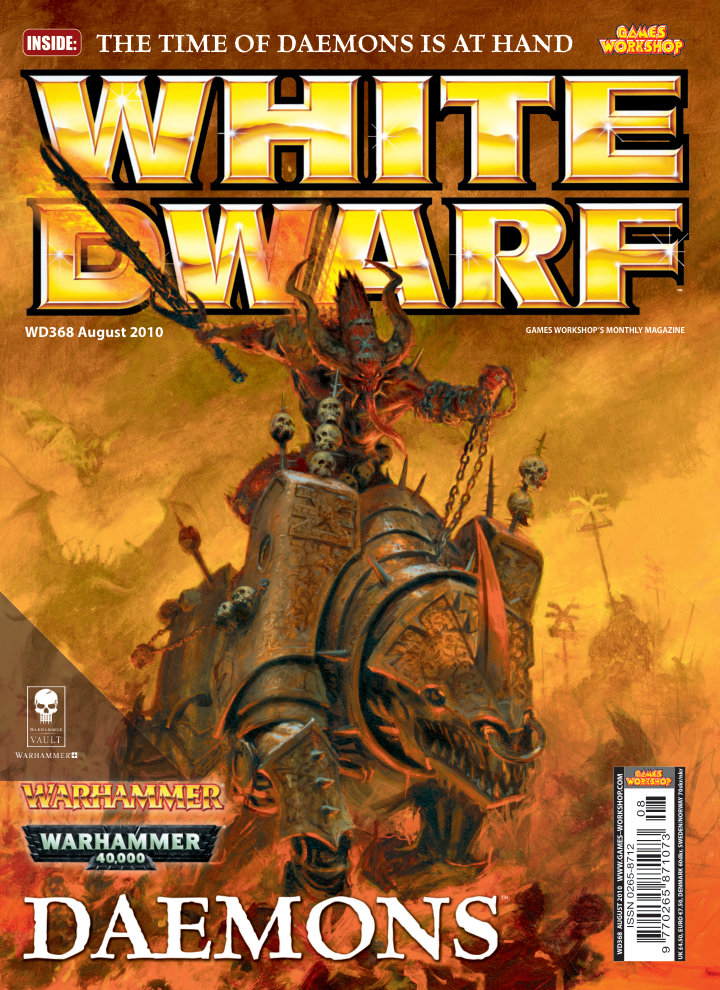
EditorialWD 368 · p. 1
Andrew Kenrick welcomes the new daemon models and considers how the Realm of Chaos shapes both Warhammer settings. The issue combines miniature design, daemon histories and tactics with magic, strange scenery and John Blanche’s interpretation of Chaos. Personal plans to elevate existing army leaders into Daemon Princes connect the releases to the studio’s own collections.
Warhammer Fantasy BattlesWarhammer 40,000Daemons of Chaos1 paint colour
FictionWD 368 · p. 11
After an assassination attempt on Horus, Luc Sedirae argues that the Warmaster should be told and questions the slow advance towards Terra. Erebus dismisses the dead attacker as a distraction and insists that hidden preparations must take their course. The exchange turns a battlefield victory into a glimpse of manipulation within the rebellion, ending with the suggestion that assassination can become their own weapon.
The Horus HeresySons of Horus
CommunityWD 368 · pp. 13–14
Space Hulk receives two community-voted Golden Geek awards for its 2009 edition, while the forthcoming Deathwatch roleplaying game is introduced through elite missions in the Jericho Reach. The web round-up points to Daemon Prince histories, naming tools, tactics and miniature galleries, and previews the remaining Games Day coverage. Together these items capture the wider hobby activity accompanying the daemon release.
Warhammer 40,000Space HulkDeathwatch
InterviewWD 368 · pp. 15–27
Adam Troke explores the new plastic daemon kits and the alliances that let rival gods’ servants invade together. Designers explain how the Daemon Prince serves four different armies, how older Horror and Steed concepts return in plastic and how posing distinguishes a unit of Juggernauts. Historical accounts and named host galleries then show grudges, bargains and shared enemies temporarily overcoming daemonic rivalry in both settings.
Warhammer Fantasy BattlesWarhammer 40,000Daemons of Chaos
InterviewWD 368 · pp. 16–19
Mark Harrison balances fantasy and science-fiction options in a single Daemon Prince kit, drawing on earlier Juan Diaz models and providing enough variety for multiple centrepieces. He and Giorgio revisit Pink Horrors’ huge mouths, ornaments and restless movement. Alex Hedström preserves Jes Goodwin’s Juggernaut shapes while varying detail and stance, and blends old seahorse-like and later sleek Steeds with longer-clawed, windswept riders.
Warhammer Fantasy BattlesWarhammer 40,000Daemons of Chaos
LoreWD 368 · pp. 21–23
Accounts of Montfort and Karak Kadrin show daemon armies using different gods’ strengths in coordinated assaults. Fateweaver’s aerial invasion overwhelms Bretonnian defences, while Nurgle’s underground attack distracts Dwarfs as Bloodthirsters destroy a Runelord’s works. A timeline and Ru’kaab’s Tachenwald host reveal that these coalitions are held together by debts, humiliation and future insults as much as immediate military goals.
Warhammer Fantasy BattlesDaemons of Chaos
LoreWD 368 · pp. 25–27
Imperial records identify recurring daemonic warbands despite unreliable survivors and shifting loyalties. The Soulmaw chronology suggests a campaign directed against the Silver Skulls, while the Gore Lord’s Brazen Host binds rival daemons through conquest and skull-tithes. An invasion of Lohiac adds a larger alliance brokered by Slaanesh, stopped only when Harlequins and the Eldar’s dark kin give the seers time to seal a Webway portal.
Warhammer 40,000Chaos Daemons
TacticsWD 368 · pp. 30–35
Phil Kelly builds a daemon battle plan around the army’s two-wave Deep Strike deployment. He favours early shooting and durable icon carriers, using Plaguebearers as screens, Tzeentch units for ranged damage and Soul Grinders as versatile threats. Icons then guide precise follow-up arrivals, while running disperses vulnerable formations before blast weapons can exploit them.
Warhammer 40,000Chaos Daemons
TacticsWD 368 · p. 32
Phil recommends flight to keep an expensive Daemon Prince actively involved, additional Strength to make armour-piercing attacks reliable and Soporific Musk to escape and redirect combats. The suggested partnership with a Keeper of Secrets uses Hit and Run to regain initiative and disrupt enemy objective plans. The advice treats customisation as a way to define a clear battlefield job.
Warhammer 40,000Chaos Daemons
TacticsWD 368 · pp. 38–43
Mat Ward reassesses Daemons of Chaos for the newly released Warhammer rules. Immunity to psychology and Instability make them dependable but remove the option to flee, while Fear and ward saves help without compensating for small expensive units. He compares each god’s battlefield strengths and explains why supporting ranks make some lesser daemons better horde candidates than others.
Warhammer Fantasy BattlesDaemons of Chaos
TacticsWD 368 · p. 43
The example 1,996-point army combines a large Plaguebearer block, Daemonettes and Bloodcrushers with Horror fire support and fast units to threaten archers and war machines. Epidemius’s large footprint helps form a forty-position horde with fewer actual Plaguebearers. Mat explains how to shrink the force for smaller games or add a Great Unclean One and further combat units as the points limit grows.
Warhammer Fantasy BattlesDaemons of Chaos
TacticsWD 368 · pp. 44–49
Simon Grant divides Epic Heroes into Fighters, Leaders and Support Heroes, explaining when to move them between formations and when to spend their precious Might. Fighters should seek decisive combat and duels, leaders maintain a coherent advance and support characters need careful range and protection. More versatile heroes must balance these duties rather than being treated as independent armies.
War of the RingRohan
InterviewWD 368 · pp. 50–55
John Blanche describes Chaos as an unknowable realm given shape by intelligent minds, negative emotions and inherited superstition. Its supposedly fixed domains are metaphors rather than mappable places, and different observers would perceive them differently. He explains how strong themes and recognisable silhouettes let the art remain coherent while frantic painting and mutable details convey unstable energy, using Bloodletters and the four gods as examples.
Warhammer Fantasy BattlesWarhammer 40,000Daemons of Chaos
LoreWD 368 · pp. 56–63
Andy Hall traces magic to the collapse of the Old Ones’ polar portals and the catastrophic blending of the mortal world with Chaos. Teclis’s teaching gives the Empire a controlled route into eight disciplines, without making untrained sorcery safe or ending the Witch Hunters’ suspicion. The feature compares human colleges with Elven, Slann, Dwarf and greenskin practices, then uses Kairos’s impossible knowledge to contrast disciplined mortal learning with daemonic power.
Warhammer Fantasy BattlesThe Empire
TacticsWD 368 · p. 57
Mark Latham presents Fire as direct magical artillery, using repeated attacks and Kindleflame to intensify pressure on a target. Flammable or regenerating enemies make particularly rewarding victims, while Fulminating Flame Cage can restrict movement instead of merely adding casualties. The surrounding lore ties Aqshy’s heat and volatility to the temperament of Bright Wizards.
Warhammer Fantasy BattlesThe Empire
TacticsWD 368 · p. 58
Tom Hutchings recommends Beasts for improving modest troops as well as elite fighters, with Wyssan’s Wildform supplying a broadly useful augment. The Curse of Anraheir disrupts an enemy offensive and Transformation of Kadon can radically change a fight even without its strongest version. Wildheart’s affinity with animals and cavalry links the rules to Ghur’s instinctive character.
Warhammer Fantasy BattlesThe Empire
TacticsWD 368 · p. 59
Jervis Johnson jokes that a Gold Wizard’s alchemy guarantees comfort, then turns to Metal’s effectiveness against heavily armoured enemies. Metalshifting makes strong armour itself a source of vulnerability, with Searing Doom as the defining attack. Chamon’s dense attraction to mineral deposits connects the discipline’s battlefield role to its background.
Warhammer Fantasy BattlesThe Empire
TacticsWD 368 · p. 60
Adam Troke chooses Light for its protective role and its focused effectiveness against daemons and undead. Exorcism increases the damage of relevant spells against supernatural enemies, while Shem’s Burning Gaze embodies the cleansing attack. His humorous enthusiasm for the college’s robes, attendants and ceremonial equipment sits beside the practical explanation of Hysh’s battlefield purpose.
Warhammer Fantasy BattlesThe Empire
TacticsWD 368 · p. 60
Andy Hall uses Life to make resilient troops even harder to remove, combining Flesh to Stone with well-armoured Knights and healing nearby heroes through Lifebloom. The Dwellers Below supplies an offensive alternative to the lore’s defensive emphasis. Ghyran’s association with rain, rivers and roots gives the regeneration effects a consistent natural identity.
Warhammer Fantasy BattlesThe Empire
TacticsWD 368 · p. 61
Matt Hutson values Heavens for combining powerful destructive spells with control and probability effects. Harmonic Convergence and Curse of the Midnight Wind improve one side’s rolls while undermining the other, and Wind Blast or Iceshard Blizzard can delay combat or weaken shooting. Roiling Skies adds a specific advantage against flyers beyond the lore’s general versatility.
Warhammer Fantasy BattlesHigh Elves
TacticsWD 368 · p. 62
Mat Ward describes Grey Wizards as wandering illusionists whose phantasms and hexes undermine the enemy’s capabilities. Their attacks exploit weak minds rather than ordinary physical force, and Smoke and Mirrors lets the caster reposition after successful magic. Melkoth’s Mystifying Miasma provides the representative fog of confusion and reduced performance.
Warhammer Fantasy BattlesThe Empire
TacticsWD 368 · p. 62
Andrew Kenrick favours Death’s cycle of removing enemy wounds and gaining power dice through Life Leeching. Short-ranged spells pick out characters and champions, while Purple Sun threatens larger groups and can generate a surge of further magical energy. The destructive rewards require the caster to approach danger, reflecting Shyish’s unsettling connection to mortality and time.
Warhammer Fantasy BattlesThe Empire
LoreWD 368 · p. 63
Tzeentch throws Kairos into the Well of Eternity to obtain knowledge he will not risk seeking himself. The altered daemon returns with one head seeing the past and the other possible futures, but both blind to the present. His unparalleled sorcery and carefully arranged schemes compensate for that immediate vulnerability, making him both uniquely valuable and physically exposed.
Warhammer Fantasy BattlesDaemons of Chaos
Battle reportWD 368 · pp. 64–85
Mat Ward’s Daemons face Matt Hutson’s Dark Elves in a 3,000-point battle after the Changeling sabotages Morathi’s attempt to bind Kairos. Dawn Attack deployment and a simultaneous smaller fight make the arrival of reinforcements depend on another battlefield. Early daemon success comes from durable Bloodcrushers and Kairos’s healing magic, while the side battle delays the Dark Elf relief force.
Warhammer Fantasy BattlesDaemons of Chaos
RulesWD 368 · p. 65
Players allocate up to 600 points from their 3,000-point armies to a side battle representing the road from a watch tower. Turns alternate between that board and the main Dawn Attack game, with separate magic rolls. Once one side eliminates or routs all opponents on the smaller board, its survivors can enter the main battle later, giving an ordinary pitched battle a clear narrative consequence.
Warhammer Fantasy BattlesDaemons of Chaos
CampaignWD 368 · pp. 86–87
Jervis Johnson recommends naming characters, selected units and the army itself as the first step towards a personal narrative. Questions raised by those names can generate histories and influence how models are used. Named locations, purposeful terrain and a reason for each battle extend the story beyond the roster, while rolls of honour or illustrated journals preserve past events and seed future games.
Warhammer Fantasy BattlesWarhammer 40,000
ModellingWD 368 · pp. 88–95
Mark Jones and Chad Mierzwa build Chaos scenery to mix with existing tables rather than replace them with a wholly daemonic world. Oversized bones, floating ruins, sacrificial pits and corrupt portals suggest either invaders bringing their realm with them or terrain erupting under magical influence. Adam Troke explains the kit combinations and possible battlefield identities, then a short Elven tragedy shows those same scenery pieces operating within a story.
Warhammer Fantasy BattlesDaemons of Chaos
ModellingWD 368 · p. 89
Mark flattens the top of an oversized skull so miniatures can stand on it and adds a rough stairway from foamcard and cork bark. Giant, tank-accessory and skull-pack details turn it into a sacrificial monument. A sculpted filler pool finished with Water Effects supplies the gore, while the article suggests several different terrain identities for the same physical build.
Warhammer Fantasy Battles
ModellingWD 368 · pp. 90–91
Bath-plug chain changes the Temple of Skulls’ silhouette by linking its pillars. Mark cuts a hole through the central Chaos star and sinks a small pot into it, lining the sacrificial pit with spiked vehicle panels. Additional heaps of skulls make the existing kit feel like a heavily used execution site rather than a newly assembled ruin.
Warhammer Fantasy Battles
ModellingWD 368 · p. 92
The floating altar combines Arcane Ruins with Chaos vehicle details and a cork-textured underside, presenting a simple way to make familiar ruins appear torn out of reality. Chad’s barricades instead join graveyard and Gothic pieces on hardboard strips with spiked railings and skulls. Their sharply different silhouettes let both pieces communicate the same hostile magical environment.
Warhammer Fantasy Battles
ModellingWD 368 · p. 93
A brass icon, skull offerings and bubbling blood wells define Khorne’s shrine, while corroded stone, pockmarks and encroaching vines identify Nurgle’s gateway. The article links their appearances to existing terrain effects—nearby frenzy for the shrine and uncontrolled spells from the portal—and directs readers to longer online construction guides. These themed examples extend the table’s visual narrative through recognisable environmental hazards.
Warhammer Fantasy BattlesDaemons of Khorne
LoreWD 368 · pp. 94–95
Lauraen mistakes manipulated visions for a threat to the Everqueen and leads her Glittering Host into a trap near Salzenmund. The Howling Coven’s daemons turn the newly presented terrain into active instruments of ruin: monuments strengthen champions, barricades curse defenders and portals pour out corruption. Lauraen realises too late that the murdered Elven figure in her vision was herself, and only a few survivors escape.
Warhammer Fantasy BattlesHigh Elves
PaintingWD 368 · pp. 96–103
Kornel Kozak uses the new Daemon Prince to demonstrate smooth colour fades rather than a conventional single skin tone. Pale flesh darkens through successive blue-purple glazes on the limbs, while cool armour, golden trim, glowing details and dark membranes give each surface a distinct role. Adam Troke follows the stages and Kornel explains why minor base details must remain subordinate to the model’s overall composition.
Warhammer Fantasy BattlesWarhammer 40,000Daemons of Chaos27 paint colours
PaintingWD 368 · p. 97
A Dheneb Stone and Ice Blue base gives the Daemon Prince a pale, unnatural complexion. Blue and purple-brown shadows define muscles before increasingly light bone-white mixes restore the raised forms. Green washes around the eyes and red around the mouth add selective temperature contrasts without abandoning the central cool flesh palette.
Warhammer Fantasy BattlesWarhammer 40,000Daemons of Chaos12 paint colours
PaintingWD 368 · p. 98
Successive thin glazes turn the pale lower legs blue, purple and finally black towards the feet, always leaving part of the earlier colour visible. Kornel stresses staining with translucent layers rather than covering each stage completely. The final dark recesses and pale raised details preserve the sculpt’s definition across the gradual change in hue.
Warhammer Fantasy BattlesWarhammer 40,00013 paint colours
PaintingWD 368 · p. 99
The plates begin as deep blue-black, with blue-purple-grey edges building a cool highlight that is shaded back before the brightest finish. Gold trim uses brown-metal mixtures, purple and flesh washes, deeper brown recesses and pale metallic edges. The two recipes create a clear temperature and reflectivity contrast without introducing unrelated colours.
Warhammer Fantasy BattlesWarhammer 40,00011 paint colours
PaintingWD 368 · p. 100
Green recesses and edges grow progressively lighter through turquoise, blue and white so the brightest points sit inside the armour’s details. The sword instead uses a dark purple base, layered purple edges and pale inner symbols, finished with a unifying glaze. Both methods create unnatural illumination by carefully placing brightness rather than making the entire object light.
Warhammer Fantasy BattlesWarhammer 40,0006 paint colours
PaintingWD 368 · p. 101
The grey loincloth is washed into deep folds and rebuilt with increasingly white mixtures, separating it from the coloured flesh. Purple-black membranes receive khaki lightening and darker shading beside the wing spars, keeping their organic texture visible. These quieter surfaces frame the daemon’s body without competing with its brighter skin and glow.
Warhammer Fantasy BattlesWarhammer 40,0007 paint colours
PaintingWD 368 · pp. 102–103
Kornel restrains the discarded Marine helmet and other base details so they do not dominate the finished daemon or imply an unnecessary specific opponent. Bone, red-washed sword details and cool silver pipes echo existing colours elsewhere on the model. Other studio miniatures demonstrate the same fading techniques on smoke, spectral clothing and shifting Tzeentch skin, extending the lesson beyond a single kit.
Warhammer Fantasy BattlesWarhammer 40,0006 paint colours
PaintingWD 368 · p. 103
Kornel explains that the studio often leaves display models unvarnished to preserve colour and subtle effects, accepting occasional chip repairs. Keith Robertson gives a practical alternative for gaming pieces: protective varnish, potentially a gloss layer followed by matt Purity Seal, with selected shiny areas restored by hand. The answer frames finish choice around use and the desired appearance.
2 paint colours
CommunityWD 368 · pp. 106–107
Rik Turner previews the Design Studio and licensed-partner areas at Games Day 2010. A large Island of Blood battlefield accompanies opportunities to discuss sculpture, painting and rules with studio staff, while partner demonstrations include board and roleplaying games and previews of digital projects. The feature captures the event’s focus on the new Warhammer edition and the forthcoming High Elf releases.
Warhammer Fantasy BattlesWarhammer 40,000