EditorialWD 319 · Inside cover
Grombrindal calls on players to join the struggle over a planet whose destruction is already certain. The approaching warp storm supplies a common deadline, but each army can still win glory or achieve its own purpose before the end. He also introduces the new Gotrek and Felix collector’s models as a celebration of characters whose adventures have earned a particularly dramatic treatment.
Warhammer 40,000Warhammer Fantasy Battles
CommunityWD 319 · pp. 14–15
The next Warhammer boxed game is previewed as an encounter between Dwarf miners and an invading Night Goblin force. Alongside more than a hundred miniatures, scenery and measuring equipment, the set combines an illustrated starter booklet with a compact complete rulebook. The announcement reassures existing players that their army books will remain usable in the new edition while giving newcomers a self-contained beginning.
Warhammer Fantasy BattlesDwarfs
CampaignWD 319 · pp. 19–21
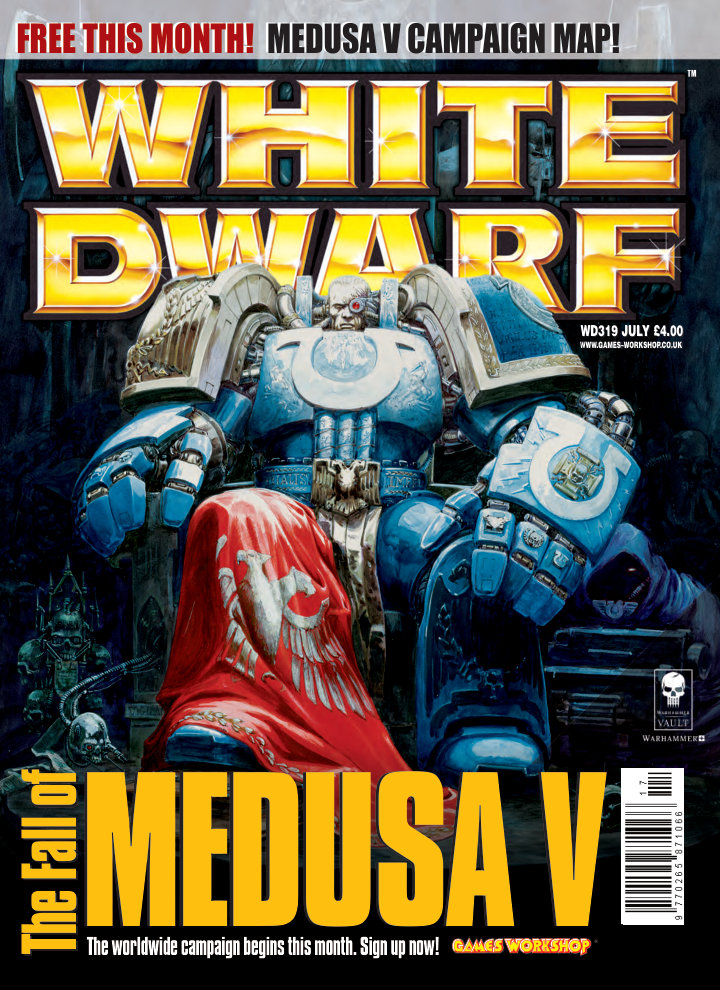
The campaign connects games played at home, in clubs and at organised events through a shared account of Medusa V’s final weeks. Its industrial importance derives from the swift warp route of Van Grothe’s Rapidity, but that same phenomenon is now producing the storm that will kill the planet. Players report results for their factions and pursue objectives across varied battlefields, with the outcome determining who secures their aims before the deadline rather than whether the world survives.
Warhammer 40,000
RulesWD 319 · pp. 22–23
The custom four-player rescue places Governor Soloman and two aides between a Vostroyan defence and an advancing Death Guard force. Black Legion and Ultramarine reinforcements arrive later, while the officials require escorts and may be captured in assault rather than shot. Different rewards for capture, reaching the shuttle and actually escaping force the teams to decide how much risk and time to spend on each passenger, using Cities of Death on a large purpose-built board.
Warhammer 40,000Astra Militarum
Battle reportWD 319 · pp. 22–39
Adam Troke and Graham McNeill defend the Imperial officials against Andy Hoare’s Death Guard and Mat Ward’s Black Legion. Prepared firing positions wreck the initial Chaos artillery, but a destroyed Chimera slows the rescue and Grulgor kills the Ultramarines Librarian before the Terminators tear down the Daemon Prince. Sicarius ultimately fights through the airborne attackers to deliver the Governor to the shuttle. Leaving the aides behind secures an Imperial victory of 500 to 250 points, while the players reflect on objective discipline, resilient cityfighting infantry and the equipment that might have stopped the escape.
Warhammer 40,000Astra Militarum
EditorialWD 319 · pp. 40–41
Watching his children choose miniatures reminds Jervis Johnson that collecting can be a complete pleasure before any army is ready for a game. His son is drawn to striking characters and monsters, while his daughter enjoys the making and painting; attempts to steer either child towards an efficient starting force miss what excites them. He recognises the same impulse in adults’ unfinished collections and argues that the models themselves are the shared foundation of an unusually varied hobby.
LoreWD 319 · pp. 42–47
The collector’s set becomes a tour of the unlikely companions and their long-running adventures. Gotrek’s mysterious past, apparently unstoppable rune axe and frustrated search for a worthy death contrast with Felix’s oath to record the Slayer’s end, while Ulrika, Max and Snorri bring their own loyalties and rivalries. Thanquol and successive Bonerippers illustrate how their enemies also develop across the novels. Close photographs explain selected finishes on the new models and connect the character descriptions to the sculpted details.
Warhammer Fantasy BattlesDwarfs18 paint colours
PaintingWD 319 · p. 48
Kirsten Williams demonstrates how thin intermediate layers can remove visible boundaries between highlights on Gotrek’s skin. The sequence combines carefully placed Flesh Wash, progressively paler flesh mixes and a final unifying glaze, with extra contrast for scars and restrained blue tattoos. Companion recipes develop the axe, fiery hair, trousers and gold, showing how the same controlled layering and selective glazing can serve very different surfaces.
Warhammer Fantasy BattlesDwarfs25 paint colours
PaintingWD 319 · p. 49
Neil Green builds the large red cloak with multiple thin coats, deliberately returning to the recesses with shading before completing the bright edge highlights. A larger brush helps avoid streaking on the broad surface and repeated Red Ink glazes tie the progression together. Additional recipes cover Felix’s flesh, layered blond hair, striped trousers and worn boots, maintaining definition while allowing the cloak to remain the model’s focal point.
Warhammer Fantasy BattlesEmpire15 paint colours
InterviewWD 319 · p. 50
Aly Morrison and Alex Hedstrom discuss creating models whose main purpose is display rather than conformity to gaming poses. Established artwork, Paul Jeacock’s concepts and the novels guide recognisable but more dynamic interpretations of the characters. The separate miniatures also have to function as one scene, so temporary bases and a shared final rocky setting ensure that their attacks, footing and composition work together.
Warhammer Fantasy Battles
FictionWD 319 · p. 51
Gotrek and Felix accompany a Dwarf expedition that must fight its way through a greenskin blockade to reclaim a lost hold. Prince Hamnir’s anxiety steadies into the practical rhythm of battle as the Dwarf line begins to repel its attackers, only for an enormous Orc warboss to rally the retreat. Gotrek immediately seeks out the new threat, drawing Felix and the watching Dwarfs towards a confrontation that tests the Slayer’s formidable reputation.
Warhammer Fantasy BattlesDwarfs
TacticsWD 319 · pp. 52–55
Mat Ward explains why lightly protected Wood Elves need to exploit their high Fight and Courage rather than exchange casualties in a prolonged contest. Elven cloaks make nearby cover useful against distant threats, while Wood Elf spears permit shielding when survival matters more than striking. Three escalating plans combine those abilities with archery, Captains, Sentinels and mobile heroes to disrupt the opponent before committing fragile warriors.
Middle-earth Strategy Battle GameElves
TacticsWD 319 · p. 53
The straightforward Wood Elf force spends its points on sufficient warriors and several Captains rather than treating every Elf as an expensive specialist. Archers first reduce dangerous enemies such as Trolls and powerful heroes; throwing weapons then punish the approach before spear-supported fighters engage. Repeated Heroic actions provide the control needed to bring those elements together without letting the low-Defence troops become overwhelmed.
Middle-earth Strategy Battle GameElves
TacticsWD 319 · p. 54
Mirkwood Sentinels use their songs to interrupt the enemy’s formation and control the timing of its arrival. Pulling a model away or delaying part of the advance gives the archers more opportunities to thin the threat and opens a favourable counter-attack for the main body. The plan rewards coordination between the unusual musical abilities and the ordinary warriors rather than asking the elite models to win by themselves.
Middle-earth Strategy Battle GameElves
TacticsWD 319 · p. 55
The advanced approach divides the army into small, well-equipped groups around Legolas and Thranduil. Sentinels draw opposing heroes out of position, freeing the Elven leaders to dictate movement, strike a weak point and withdraw into woodland before a larger response arrives. It demands careful use of Heroic moves and terrain, since a successful raid must include a route out as well as a vulnerable target.
Middle-earth Strategy Battle GameElves
ModellingWD 319 · p. 57
Three methods turn a coil of model razor wire into durable linear obstacles: doubling the coils, adding a supported base and stacking multiple rolls between posts. The painting instructions create rust over a black undercoat with successive browns and orange, followed by small areas of exposed metal. A simpler Brown Ink stain offers a quick alternative when the bare wire is already a suitable starting surface.
Warhammer 40,0006 paint colours
LoreWD 319 · pp. 58–59
The Beastmen are described as a brutal society with its own hierarchy rather than an undifferentiated mass of forest monsters. Powerful Gor judge status by their horns, weaker Ungor compensate with malice and Bray-Shamans turn the forces of nature towards corruption. Minotaurs, Centigors, Trolls and ancient Dragon Ogres broaden the host, while the violation of the woodland itself explains the depth of the Beasts’ hatred with the Wood Elves.
Warhammer Fantasy BattlesBeasts of Chaos
TacticsWD 319 · p. 60
Mark Havener’s 2,000-point force anchors its centre with two Beast Herds and two substantial Bestigor units. A Nurgle-marked regiment, enhanced by its characters and poisoned attacks, provides a particularly threatening Fear-causing centre. Warhounds and chariots supply the speed to interfere with the enemy’s movement and arrange combined charges, while large monsters add the destructive force needed to exploit the opening.
Warhammer Fantasy BattlesBeasts of Chaos
TacticsWD 319 · p. 61
Pete Scholey’s compact Khorne-themed force trades some of the usual Beastman numbers for frenzied striking power and numerous monsters. Careful positioning is essential to prevent the Khorngors being drawn into an unwanted charge. Hounds and Centigors impede enemy marches and protect the manoeuvre, while Minotaurs, Dragon Ogres and Bloodletters supply several hard-hitting threats instead of leaving the whole plan dependent on one regiment.
Warhammer Fantasy BattlesBeasts of Chaos
TacticsWD 319 · pp. 62–63
The clash between Beastmen and Wood Elves is examined through both their opposed relationships with the forest and the abilities of their armies. Beast Herds share the mobility of skirmishers but can form ranks in combat, giving them an advantage over fragile Elven formations if they make contact. Wood Elf shooting and redeployment challenge that advance, while a Treeman can withstand a charge and hold the attackers for a flanking force—provided the manoeuvrable Beasts cannot simply avoid it.
Warhammer Fantasy BattlesBeasts of Chaos
PaintingWD 319 · pp. 66–69
The Wood Elf heroes are shown through details that link armour, clothing and decoration to their forest home. Layered hair, carefully painted tattoos, leaf patterns and dark wood support the distinctive silhouettes of the Highborns and Waywatcher Noble, while the Sisters of Twilight provide a much larger canvas on their Forest Dragon. Seasonal alternatives demonstrate how spring greens, autumn browns and stark winter tones can transform the identity of the same range of models.
Warhammer Fantasy BattlesWood Elves11 paint colours
PaintingWD 319 · p. 67
Anja Wettergren demonstrates a layered horn finish on the Forest Dragon that can also serve antlers and other Wood Elf models. A dark Scorched Brown base is developed through brown and yellow-brown highlights, then increasingly fine lines of bone and white. Narrowing the marks as the colours brighten preserves the darker grooves and creates the appearance of a naturally ridged surface.
Warhammer Fantasy BattlesWood Elves6 paint colours
ModellingWD 319 · pp. 70–73
Chad Mierzwa builds a fully modelled battlefield around the Spider Queen scenario rather than assembling loose terrain for each game. Polystyrene contours, slate and an embedded tomb create the landscape, with gentle slopes chosen so models remain stable during play. Earth and rock painting, different sources of trees, dried leaves and robust kapok webs unify the board; the guide also shows how cutting and bending the spiders’ legs produces a varied set of threatening poses.
Middle-earth Strategy Battle GameSpiders11 paint colours
ModellingWD 319 · p. 72
The tree-making tutorial deliberately mixes collected twigs, model railway trees and Citadel trees so the forest does not repeat one silhouette. Dark undercoats, successive grey drybrushes and selective green tones help the different materials belong together. Cutting into the plastic canopy breaks up its regular outline, and pinning the finished trees to the board gives the scenic arrangement enough strength for gaming.
Middle-earth Strategy Battle Game8 paint colours
ModellingWD 319 · p. 73
The metal spiders are reposed by separating or notching the legs before bending them into a new position. Different cuts allow the Queen to spread into an aggressive stance and the smaller spiders to rear, strike or scuttle at different heights. Filling the opened gaps restores the sculpted surface, while changing the points that touch the ground makes the group look less like identical miniatures arranged on one board.
Middle-earth Strategy Battle GameSpiders
ModellingWD 319 · pp. 74–77
The Guardian heavy-weapon kit is assembled with particular attention to the crew’s trigger connection and the choice of five weapons. Shared scenic bases turn the gun team into a small desert, winter or urban diorama, and a flying stand can lift the platform if the trigger is extended with wire. Leaving the guns removable and pinning them securely preserves the kit’s flexibility without forcing the modeller to build a separate platform for every loadout.
Warhammer 40,000Aeldari
RulesWD 319 · p. 77
A compact profile panel compares the platform’s missile launcher, starcannon, shuriken cannon, bright lance and scatter laser. The range, armour penetration, firing rate and special characteristics explain why an interchangeable gun is useful beyond the modelling exercise: each option serves a different target or engagement distance. These are the contemporary weapon profiles shown alongside the kit, including the missile launcher’s separate krak and plasma ammunition.
Warhammer 40,000Aeldari
ModellingWD 319 · pp. 78–80
The XV25 kit’s assembly diagrams distinguish the ordinary Shas’ui from the Shas’vre and identify the fusion blaster, drone and equipment options. Neil Hodgson then demonstrates an unusually demanding camouflage display: he paints the suit to continue the scenery behind it from one fixed viewing angle. Reference photographs and a keyed position on the base keep the model aligned through repeated painting sessions, with the apparent straight lines following the armour’s curved surfaces.
Warhammer 40,000T’au Empire
RulesWD 319 · p. 81
The Stealth team entry describes an independent ambush force of three to six battlesuits with burst cannons and optional fusion firepower. Team-wide support-system selection, leader upgrades, markerlights and drones shape its equipment, while infiltration, acute senses and deep striking support its role away from the main Tau formation. The accompanying background explains the broad freedom given to commanders who specialise in attacking from an unexpected quarter.
Warhammer 40,000T’au Empire
CommunityWD 319 · pp. 82–86
The category guide explains where single figures, units, vehicles, monsters, duels and dioramas belong, using previous winning pieces as illustrations. It also distinguishes large-scale entries, the returning Lord of the Rings single-miniature class, Young Bloods and the unrestricted Open competition. Requirements for legal units, suitable bases and display dimensions show how the organisers balance gaming identity with painting and composition, while the gallery ranges from restrained individual models to elaborate narrative scenes.
Warhammer 40,000Warhammer Fantasy Battles
TacticsWD 319 · pp. 87–90
Christian Byrne prepares a 1,499-point Black Legion army serving the Daemon Prince Iadaphael, whose interest in the expanding warp phenomenon gives the collection a Medusa V purpose. Its usual plan combines an infiltrating daemonhost and fast bikes with covering fire and advancing small squads. Cities of Death prompts him to reconsider that single infiltrator in favour of Sewer Rats and useful defended buildings, while a Terminator Lord, additional infantry and convertible vehicles keep the campaign linked to attainable hobby projects.
Warhammer 40,000Black Legion
PaintingWD 319 · p. 90
The army’s black armour uses a restrained grey highlight, leaving the brighter metal trims and Chaos icons to define each miniature. Separate gold and brass progressions distinguish decorative surfaces, while several flesh recipes use brown and purple shading to suggest varied corruption. Bone, a turquoise plasma glow and neutral rubble bases finish a scheme designed to unify otherwise diverse Black Legion squads.
Warhammer 40,000Black Legion17 paint colours