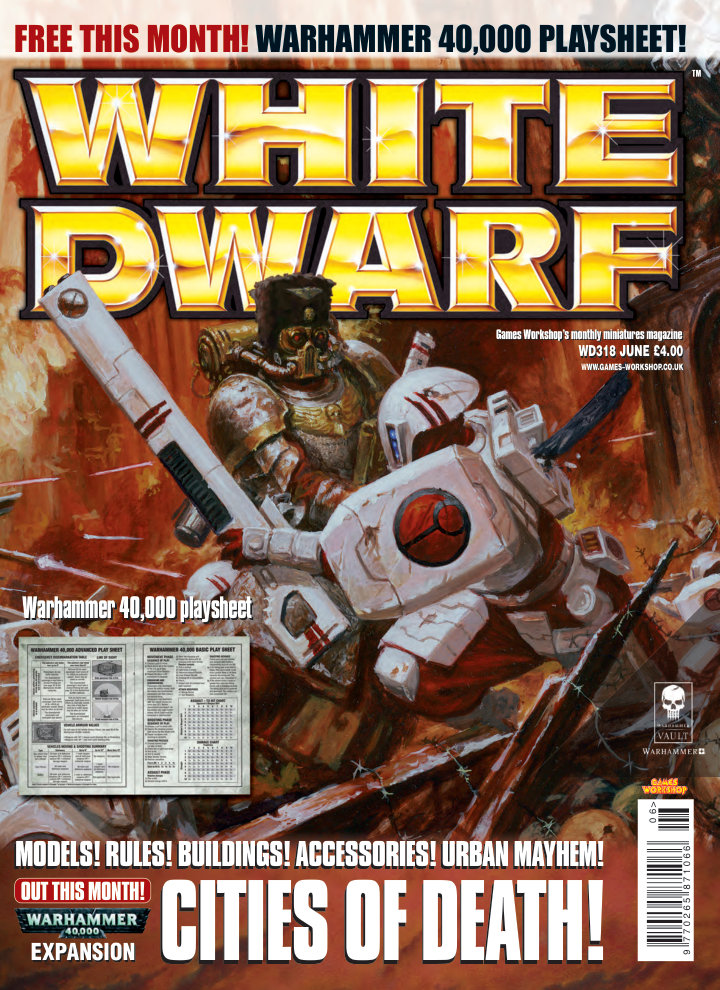
EditorialWD 318 · Inside cover
Grombrindal introduces a month of warfare among the buildings that embody the power and wealth of the Imperium. His enthusiasm centres on the new modular ruins: a city can now grow from a few manageable pieces into a substantial battlefield, giving the urban rules and the modeller’s imagination something practical to work with.
Warhammer 40,000
CommunityWD 318 · pp. 18–19
The forthcoming Eldar release is previewed through an expanded range of Aspect Warriors, vehicles and leaders. Plastic Dire Avengers, War Walkers and Wraithlords sit alongside revised Fire Dragons and Howling Banshees, while the Autarch promises a new way to represent a commander shaped by the warrior paths. The feature presents the plans for the October codex and miniatures rather than supplying their eventual rules.
Warhammer 40,000Aeldari
InterviewWD 318 · pp. 23–27
Andy Hoare explains how Cities of Death creates a distinctive urban game while retaining the existing Warhammer 40,000 rules. Unlike the earlier Cityfight approach, the predictable dimensions of the new plastic buildings let normal templates, coherency and movement do much of the work. Players then select a small number of stratagems to shape their own methods of fighting, from prepared positions to deployment tricks, with missions and hobby material supporting a themed battlefield without requiring an entirely new army.
Warhammer 40,000
InterviewWD 318 · pp. 28–33
Dave Andrews describes the design decisions behind the interchangeable city buildings, from a recognisably Gothic architectural language to floor heights and openings that leave models accessible during play. The team first imagined intact structures and then worked out how to ruin them convincingly; digital design and shared floor and accessory frames made three distinct building styles compatible. The result aims to make constructing and storing a useful gaming city much easier than assembling a collection of elaborate scratch-built showpieces.
Warhammer 40,000
ModellingWD 318 · pp. 30–33
Studio hobbyists adapt their armies to the streets through practical equipment and bases as well as more dramatic conversions. Blood Ravens Scouts gain communications and survival gear, Necron Flayed Ones emerge through a sewer, and Imperial troops carry the equipment for prolonged urban operations. Wrecking Dreadnought and Carnifex conversions, a reinforced Vindicator and rebased Black Legion models show how a common terrain theme can tie very different armies into the same campaign.
Warhammer 40,000Blood Ravens
Battle reportWD 318 · pp. 34–46
Andy Hoare’s Imperial Guard and Adam Troke’s Orks contest six ruined buildings in a Gamma-level Firesweep. Guard firepower initially devastates exposed Orks, but cover protects the growing central mob, sewer-borne Burnas strike behind the line and a fleeing Tankbusta achieves an improbable kill on the Leman Russ. The final fighting includes a dramatic mutual death between the Warboss and a force-weapon-armed sanctioned psyker. The Orks win on the objectives, leaving Andy to reconsider his cautious advance and Adam to value the protection and alternative approaches offered by the city.
Warhammer 40,000Astra Militarum
ModellingWD 318 · p. 47
Neil Hodgson’s Space Marine command post demonstrates how the physical representation of a stratagem can become a small terrain project in its own right. Power and observation equipment are arranged as a coherent installation rather than left as isolated counters, making the objective readable on the table while giving the army another piece of narrative scenery.
Warhammer 40,000Space Marines
EditorialWD 318 · pp. 48–49
Jervis Johnson likens an expanding game collection to a child’s toy box: new pieces become more interesting through their relationships with the things already owned. Cities of Death exemplifies that principle through reusable buildings, optional stratagems and games that can begin with only a few ruins. He argues that the expansion’s lasting value lies both in the urban games themselves and in the terrain and modelling ideas it adds to ordinary Warhammer 40,000.
Warhammer 40,000
RulesWD 318 · p. 50
Three Wizards enter a small Mirkwood battlefield while Castellans approach from the wooded east and Wargs threaten from the west. The scenario specifies deployment, forces and competing victory thresholds: Evil must kill two Wizards before its own force falls too far, while Good must eliminate half the opposition and keep two Wizards alive. The restricted space and separated starting positions turn the meeting into a test of spell timing, protection and escape routes rather than a conventional battle line.
Middle-earth Strategy Battle GameWhite Council
Battle reportWD 318 · pp. 50–56
Mat Ward commands Gandalf, Saruman and Radagast against Graham McNeill’s Castellans, Warg Riders and Wild Wargs. Early expenditure on spectacular magic delivers fewer casualties than hoped, while the Evil force exploits the Wizards’ separated positions; Saruman falls and Gandalf eventually exhausts the Will supporting his protection. Castellan Morgul blades finish Gandalf to secure Evil’s victory. The players’ reflections emphasise conserving Might and coordinating the Wizards, while Graham recognises that his Castellans lost valuable time negotiating the woods.
Middle-earth Strategy Battle GameWhite Council
ModellingWD 318 · p. 57
The urban basing set is used to combine sculpted rubble, different grades of slate and coils of razor wire. The guide recommends testing the model’s position before fixing the larger pieces, blending their edges into finer debris and returning loose slate to the container rather than blowing it away. Leaving razor wire until the painting is finished protects access to the base and makes the final assembly easier to control.
Warhammer 40,000
LoreWD 318 · pp. 60–62
An Inquisitorial surveillance report and captured Gretchin plans introduce the danger posed by Nazdreg’s crashed space hulk and the machinery gathering around it. Nazdreg’s Meks intend to turn the available industrial and agricultural equipment into the means of escaping the doomed world, drawing Orks into a vast salvage operation. Blood Axe Kommandos provide a quieter counterpart to the main Waaagh!, striking communications and fuel supplies and seeking the next worthwhile fight.
Warhammer 40,000Orks
ModellingWD 318 · p. 63
Marco Schulze and Katja Schimmel turn a Lictor into an ambush emerging through a sewer. A section of plumbing provides the shaft, small sprue pieces become rivets and concealed nails help counterbalance the projecting model. The positioning of the lid and the transition from a dark interior to the lighter exposed creature give the conversion both a believable structure and the impression of a predator revealing itself from camouflage.
Warhammer 40,000Tyranids
TacticsWD 318 · pp. 64–71
The feature assesses mercenaries as ways to fill a specific gap in an army rather than as an assortment of exotic additions. Named Regiments of Renown bring distinctive leaders, equipment and restrictions, while ordinary Dogs of War can supply capabilities missing from the employer’s own list. Examples range from mobile artillery and hidden shooting to reliable flank guards and hard-hitting Ogres, with attention to the weaknesses and special behaviour that accompany each apparent advantage.
Warhammer Fantasy BattlesDogs of War
TacticsWD 318 · p. 65
A hired Giant provides Terror, an imposing target and attacks capable of disrupting an enemy’s plans, but its random combat behaviour prevents it from becoming a precise answer to every problem. The discussion treats that uncertainty as part of the purchase: an army can exploit the attention the Giant attracts and the pressure it creates while retaining other units able to finish the job when its own attacks disappoint.
Warhammer Fantasy BattlesDogs of War
TacticsWD 318 · p. 66
Alessio Cavatore uses the Galloper Guns’ mobility to create firing angles that a conventional cannon cannot easily reach. Marching into an enfilading position, threatening chariots or heavy cavalry and escaping a dangerous approach all make the small gun more than a static artillery substitute. Bronzino also offers a separate means of interfering with attackers, while the unit can supply either missing ranged power or unusual mobility according to the army hiring it.
Warhammer Fantasy BattlesDogs of War
TacticsWD 318 · p. 67
The Manflayers combine scouting, skirmishing and repeated crossbow fire with the ability to strike hard in combat. Their suggested work includes harrying exposed leaders and war machines and manoeuvring onto a flank rather than simply exchanging shots with the opposing line. The article also draws attention to their unusual pursuit behaviour and the protection provided by their banner, since those details determine where the unit can safely commit itself.
Warhammer Fantasy BattlesDogs of War
TacticsWD 318 · p. 68
Ruglud’s crossbow-armed Orcs are recommended as a tough flank guard or a screen for vulnerable artillery, especially in armies that otherwise lack their combination of armour and ranged reach. Their animosity carries a real risk of firing at friends, yet their particular behaviour also makes them less likely to abandon a guarding position in an uncontrolled charge. The choice therefore depends on the surrounding army and on whether the player can accommodate the regiment’s unpredictable moments.
Warhammer Fantasy BattlesDogs of War
TacticsWD 318 · p. 69
Graham McNeill values the Slayer Pirates as a dependable piece of the battle plan: Toughness, unbreakable resolve and pistol attacks let them guard a flank without demanding the same leadership support as ordinary mercenaries. Their shooting and combat strength also give them an active role when an enemy approaches. Long Drong’s own fighting ability makes the regiment particularly attractive to an Empire force seeking a resilient independent unit.
Warhammer Fantasy BattlesDogs of War
TacticsWD 318 · pp. 70–71
The different Ogre units are compared by the job they perform in an employer’s army. Bulls offer a straightforward charge and flexible equipment, Ironguts add high-Strength attacks and improved protection, and Leadbelchers threaten a flank with concentrated gunfire. Maneaters cost more but bring the combination of stubbornness, psychological reliability and specialised weapon choices that can justify a genuinely independent assignment.
Warhammer Fantasy BattlesDogs of War
TacticsWD 318 · pp. 72–75
The Tomb Kings’ army is presented as an extension of the hierarchy and ambitions its rulers possessed in life. Skeleton regiments, royal chariots and animated constructs depend on the priesthood and the characters directing them, with magic restoring casualties and enabling manoeuvres the army cannot accomplish by ordinary movement alone. Two contrasting plans demonstrate how the same collection can emphasise rapid flanking pressure or a durable infantry centre without neglecting the essential protection of its Hierophant.
Warhammer Fantasy BattlesTomb Kings
TacticsWD 318 · p. 74
A mobile Tomb Kings plan uses the Incantation of Urgency to make chariots and light cavalry reach the positions their opponents thought were safe. Burrowing Scorpions and Swarms threaten the rear while Carrion interfere with war machines and protect the advancing flanks. The article balances this disruptive speed against its fragility: failed charges and exposed characters are costly, and fast elements still need infantry and mutual support to turn intimidation into a winning combat.
Warhammer Fantasy BattlesTomb Kings
TacticsWD 318 · p. 75
The alternative army anchors its plan around Skeleton infantry, Tomb Guard and powerful animated constructs. Fear, numbers and magical restoration let the line endure while Ushabti or a Bone Giant add the decisive blows; archers can contribute before joining a later fight. This approach protects the characters more naturally than a scattered mobile force, but its slow advance gives the opponent time to shoot and makes guarding the flanks and sustaining the units with magic especially important.
Warhammer Fantasy BattlesTomb Kings
ModellingWD 318 · pp. 78–81
The plastic Scout kit is assembled with attention to the matching torsos, legs and weapon arms before the guide moves into personalised Blood Angels and other Chapter examples. Equipment, head swaps, ropes and scenic cover make the lightly armoured Marines look prepared for a particular mission. A kneeling boltgun conversion shows how cutting and pinning the hands and forearms can produce a convincing pose rather than forcing a mismatched weapon onto an otherwise finished body.
Warhammer 40,000Space Marines
PaintingWD 318 · p. 80
The Blood Angels scheme builds red armour from Blood Red with a Dark Flesh and Red Ink shade, then sharpens it through Blazing Orange towards a pale mixed highlight. Two camouflage alternatives show how the same Scouts can be adapted to their environment: green patches over a yellow-brown field for woodland, or darker grey and black shapes over a pale grey field. Model branches and foliage complete the relationship between the clothing and the base.
Warhammer 40,000Blood Angels11 paint colours
PaintingWD 318 · pp. 82–83
Middle-earth banners are treated as miniature pieces of history as well as focal points for an army. Elven designs can distinguish the Second Age, a woodland realm or a particular house, while Dwarf banners evoke ancestral identity and the standards of Gondor and Rohan identify their great captains. Neil Langdown’s worked Wood Elf example establishes the main geometric areas first, adds controlled shading and highlights to the cloth, and only then develops the trim, small symbols and freehand decoration.
Middle-earth Strategy Battle GameElves
TacticsWD 318 · pp. 86–90
Jeff Leong questions successful Skaven general Matthew York about controlling an army of hundreds of individually unimpressive troops. Redundant ranked units, deliberately sacrificed Slaves and a carefully positioned general turn numbers and leadership into advantages, while weapon teams and shooting shape the routes available to an opponent. The interview also explains how to attack such an army: threaten its leadership, anchor a flank on terrain, present separated dangers and avoid pursuing a tempting sacrifice into the next prepared trap.
Warhammer Fantasy BattlesSkaven
ShowcaseWD 318 · pp. 92–100
The UK team prepares two personal armies for the Fall of Medusa V and considers what fighting in a ruined city will change. Owen Rees’s Tahnelian drop troops emphasise numbers, portable firepower and a history of costly deployments, while Rik Turner’s Blood Ravens carry their encounters with the Eldar into a new investigation near Sybilla Tertius. Army rosters, colour recipes and planned reinforcements make the campaign a practical reason to complete collections as well as a framework for their stories.
Warhammer 40,000Astra Militarum
TacticsWD 318 · pp. 94–96
Owen Rees introduces the Tahnelian 374th Firebolts as a veteran drop regiment whose survivors earn the right to serve in its Valkyrie-borne special companies. His roster retains the massed infantry and portable weapons of that background, but city cover encourages high volumes of fire over reliance on a few armour-piercing shots. Prepared buildings, a Power Generator and Tank Traps support the infantry, while further Commissars, campaign markers and specialist troops provide concrete goals for finishing the company.
Warhammer 40,000Astra Militarum
PaintingWD 318 · p. 96
The Tahnelian recipe separates brown armour and webbing from green clothing, giving a large infantry regiment a consistent and readable palette. Scorched Brown is developed through Bestial Brown to Vermin Brown, while Catachan Green is progressively mixed with and replaced by Camo Green. A four-stage flesh sequence, ink-shaded metal, restrained grey highlights on black casings and pale drybrushed bases complete the campaign-ready scheme.
Warhammer 40,000Astra Militarum16 paint colours
ModellingWD 318 · p. 97
Owen Rees reconstructs his wheeled Imperial vehicle from a Chimera lower hull and front joined to a Leman Russ upper hull. Traced plasticard closes the sides, donor truck tyres provide suitably large wheels, and trimmed track guards and Chimera doors finish the bodywork. The example uses a Forge World turret but permits the standard plastic version, making the conversion a repeatable method inspired by an older Citadel Journal project rather than a requirement for one rare set of parts.
Warhammer 40,000Astra Militarum
TacticsWD 318 · pp. 98–100
Rik Turner gives his Blood Ravens a Medusa V mission investigating an Eldar structure, then considers how their Chapter traits interact with the urban stratagem system. Retaining infiltration means spending a stratagem on it, whereas dropping the ability or the entire trait package would free other options. He chooses to preserve the army’s identity, adding more Terminators and bolter-armed Tactical Marines for close fighting while planning a plasma-heavy Kill-team and further vehicles for the wider campaign.
Warhammer 40,000Blood Ravens
PaintingWD 318 · p. 100
The Blood Ravens palette layers Scab Red, Red Gore and Blood Red for the armour, contrasting it with shoulder pads and robes developed from Snakebite Leather through Bubonic Brown to Bleached Bone. Green lenses and seals provide small bright accents. Brown weapon details and a related progression across the bases keep the completed infantry coherent without allowing the scenery to compete with the red armour.
Warhammer 40,000Blood Ravens12 paint colours
ShowcaseWD 318 · pp. 104–107
Golden Demon winner Joe Tomaszewski explains his progression from gaming to competition painting and the lesson that a manageable project can receive more convincing attention than an overambitious set of entries. His Ork ambush diorama is packed with small narrative conversions, while Marneus Calgar’s Honour Guard uses Codex art and painstaking cloak decoration to create a unified display. A non-metallic Pegasus Knight and a softly lit Goldberry illustrate his interest in different painting challenges without providing named colour recipes.
Warhammer 40,000Warhammer Fantasy BattlesOrks
CommunityWD 318 · pp. 118–119
Readers discuss the place of submitted miniatures, the balance between print and online support for Specialist Games, and the division of work between the Studio and UK magazine teams. The accompanying team update follows Owen’s disappointing tournament result and Rik’s new Elven heroes, while Christian Byrne develops urban bases for his Black Legion. Christian also gives the named brown, green and red washes used over a metal basecoat to make a Nurgle champion’s armour look worn and unhealthy.
Warhammer 40,000Middle-earth Strategy Battle GameBlack Legion4 paint colours