EditorialWD 291 · p. 2
Paul Sawyer announces the coming revision of Warhammer 40,000, describing it as a refinement focused on assault and vehicles rather than a complete redesign. Existing codexes are intended to remain compatible. His own planned Ultramarines project changes direction after researching their Tyranid enemies, and the editorial illustrates the colour tests for the swarm he now wants to collect.
Warhammer 40,000Ultramarines
CommunityWD 291 · pp. 4–5
Tournament results celebrate the second heats of the 2003–2004 season and point readers towards armies featured in this issue. A report on Gothenburg’s Battle Bunker describes its gaming tables, painting space and themed terrain. Other notices introduce Deff Skwadron, Forge World’s Orca and Drone Sentry Turrets, and replica artefacts and art prints. Together they record the month’s competition, store and release activity.
Warhammer 40,000Warhammer Fantasy BattlesT’au Empire
LoreWD 291 · pp. 14–17
Techmarines train on Mars before returning to maintain their Chapter’s weapons, vehicles and sacred artefacts. Their divided loyalties and specialised knowledge set them apart from other Marines, while servo-arms, servitors and bionic tools support their work. Accounts of Paullian Blantar and Sevano Tomasin illustrate contrasting traditions. The feature also explains the Space Wolves’ Iron Priests and the ritual language surrounding Imperial technology.
Warhammer 40,000Space Marines
PaintingWD 291 · pp. 18–21
Matt Parkes builds elaborate heraldry from simple construction lines, explaining how repeated fleur-de-lys and interwoven borders become manageable patterns. Darkened red and blue cloth supports bright yellow detail without competing with the Hippogryph’s muted natural colours. Separate demonstrations cover the shield, cloak, reins, lance and pennant. Premixed highlights and careful repairs keep the many repeated designs consistent across the finished king.
Warhammer Fantasy BattlesBretonnia15 paint colours
ModellingWD 291 · pp. 22–25
Steve Cumiskey follows Dave Andrews’ method for a peasant farmhouse. An irregular polystyrene core and separate blocks create rough walls, while balsa doors, shutters and timbers provide contrast. Glue-combed fake fur becomes thatch. Textured paint, muted stone drybrushes and small details such as a garden wall turn the basic construction into terrain with a recognisable Bretonnian setting.
Warhammer Fantasy BattlesBretonnia8 paint colours
ModellingWD 291 · p. 27
A short illustrated tutorial shows the basic sequence of painting a base, applying glue and adding texture. Its advanced example replaces loose flock with painted sand or gravel, using successive brown and pale drybrushes to reveal the surface. The four stages provide a simple way to improve tabletop bases using ordinary materials and a small palette.
3 paint colours
FictionWD 291 · pp. 28–29
Nick Kyme’s story begins with Imperial Guardsmen enjoying a brief victory before a vast fly swarm engulfs their position. Plague Marines emerge through the corruption with weapons designed to destroy armour. Sealed tanks prove vulnerable to contaminated systems and concentrated fire, while the infantry succumb to disease and panic. The attack transforms the defenders’ confidence into helplessness before the Death Guard’s silent advance.
Warhammer 40,000Death Guard
TacticsWD 291 · pp. 30–37
Ryan Powell explains how a restricted Death Guard force can combine resilience with focused support. Plague Marines form the core, transports and infiltration help them reach useful positions, and summoned Daemons supply strength at the right moment. He compares expensive elite units, heavy support and Nurglings before discussing deployment and defence. The recurring advice is to concentrate the army, remove threats to its durable infantry and remain focused on the mission.
Warhammer 40,000Death Guard
ModellingWD 291 · pp. 38–39
Tammy Haye opens up Typhus’s pose by rebuilding his arms, moving the scythe and replacing his helmet with a Nurgle Champion’s head. Pinning and sculpted pipework restore strength and detail after cutting. A severed trophy and a resin-covered pool give the model a new focal point. Glass beads, sculpted bubbles and slate make the scenic base look diseased and wet.
Warhammer 40,000Death Guard5 paint colours
PaintingWD 291 · pp. 40–41
The converted Typhus receives green armour shaded with a reddish brown and highlighted through warmer tones. Glazes recover colour after pale highlights, while several inks make the face appear unhealthy. Warm brass contrasts with the armour, and striped blood, pale bone spikes and a bright Nurgle symbol finish the details. Tammy describes experimentation and observation as the sources of the scheme rather than following a fixed recipe from the outset.
Warhammer 40,000Death Guard23 paint colours
RulesWD 291 · pp. 44–49
Jervis Johnson presents the Burning Death Speed Freeks list and explains why Epic uses specific army organisations rather than one continually expanding generic list. Background and profiles introduce Mekboy bike leaders, protected Speedstas and fast Trukks. Formations can grow in size and add specialised support, but every slow unit needs suitable transport. The list models an army built around mobility while remaining usable with other appropriate Ork collections.
EpicOrks
RulesWD 291 · p. 49
Speed Freeks raid an Imperial supply column on the road to Tartarus. Ork battle groups enter from randomly selected edges while a smaller Steel Legion force escorts seven supply Chimeras. The convoy must remain on the road and cannot make the fastest action, making its escape a contest of interception and protection. Destroying all the transports before the time limit gives the Orks victory.
EpicOrks
ShowcaseWD 291 · pp. 50–53
This gallery collects winning figures from Golden Demon events in Canada, Australia, Baltimore and France. Entries range from individual characters to mounted heroes and vehicles, including a Goblin chariot, Ravenwing bike and Nuadhu conversion. Captions identify painters and awards, offering comparisons across subjects and competition categories. The selection celebrates finished work without supplying named paint recipes.
Warhammer 40,000Warhammer Fantasy Battles
TacticsWD 291 · pp. 54–55
Jeff Leong introduces a tactics series through five principles: mass, manoeuvre, initiative, objective and simplicity. He connects them to deployment and each phase of the game, arguing that concentrating strength and controlling the enemy matter more than isolated tricks. Army selection follows from knowing how the force should operate. The overview offers a framework for evaluating later, more detailed tactical examples.
Warhammer Fantasy Battles
Battle reportWD 291 · pp. 56–77
Gary Marsh’s Slaaneshi Castigators defend a summoning ritual from Nick Simmerson’s awakened Necrons. Screening Rhinos, a destructive Defiler and close-combat defenders protect the circles while Necron reserves suffer an unfortunate Monolith arrival. Scarabs threaten the objective, but the Necrons ultimately phase out and the ritual succeeds. The players’ conclusions stress coherent deployment, backup plans and the difference between an apparently ideal unit and its actual performance.
Warhammer 40,000Chaos Space Marines
RulesWD 291 · p. 57
An attacker must disrupt every summoning circle before the defenders finish opening a gateway to the Warp. Ritual units remain in formation and sacrifice movement and shooting while protected by the gathering energies. Sentries, reserves and a variable game length create an uncertain approach and deadline. The accompanying battle adapts the Daemonhunters mission to Necrons attacking Slaaneshi intruders, showing how its premise can suit other factions.
Warhammer 40,000Chaos Space Marines
ShowcaseWD 291 · pp. 66–67
A closer gallery examines the converted Slaaneshi army used in Ancient Awakenings. Shel’das combines components from different scales and ranges, while Rhinos carry trapped souls and interiors painted to resemble flayed flesh. Champions, possessed Marines and a Defiler repeat the force’s imagery. The feature explains component choices and visual motifs without giving a named painting recipe.
Warhammer 40,000Chaos Space Marines
LoreWD 291 · pp. 82–87
Olde Weirde responds sceptically to reports of Mannfred’s return by researching Sylvania’s older armies. An obscure account of the Battle of the Old Forest Road describes Vlad’s revenge against Jerek Kruger and the destruction of his own living soldiers. Uniform and banner sketches trace the change from von Drak to von Carstein rule. The narrator’s insistence on rational explanations becomes increasingly strained by the evidence before him.
Warhammer Fantasy BattlesVampire Counts
CampaignWD 291 · pp. 90–97
Graham McNeill and Phil Kelly scale the worldwide Eye of Terror campaign down for a local gaming group. Players divide warzones, challenge opponents and turn battlefield victory-point margins into changes in Imperial control. Instability ratings make some planets easier to influence than others, while a Games Master tracks results and the eight-week outcome. Maps and scoring tables support the system; the event cards needed for its full form are promised for the following issue.
Warhammer 40,000Imperium
ShowcaseWD 291 · pp. 100–105
John Thompson’s Emperor’s Children combine tournament success with conversions across nearly the whole force. Runes identify squads, chained Predator hatches suggest possession, and mutated lieutenants embody Slaaneshi excess. Fine highlights and blue eyes give the pink armour a cold, weathered appearance. The gallery explains how small repeated details unite individual models without supplying specific paint names.
Warhammer 40,000Emperor’s Children
CommunityWD 291 · pp. 108–111
Iain Miller replaces the Death Spectres’ Land Raider with jump packs, a Chaplain and a Whirlwind before the Grand Tournament final. The revised force wins useful practice games but struggles against specialised competitive armies. A victory and final draw improve a difficult weekend, leaving him in 108th place. He reflects on the distinction between friendly and tournament play while retaining the enjoyment of developing and fielding a personal Chapter.
Warhammer 40,000Space Marines
LoreWD 291 · pp. 114–117
An introduction to the Ordo Hereticus presents its Inquisitors and Sisters of Battle as hunters of threats hidden within Imperial society. Miniature photographs and concept art establish the new army’s imagery. In the accompanying story, Inquisitor Porfundis uncovers a minister’s witchcraft, then has the relieved governor arrested as well. The sequence conveys an institution whose suspicion does not end when the obvious enemy is destroyed.
Warhammer 40,000Inquisition
RulesWD 291 · pp. 122–123
Boromir and Beregond shelter in a ruined fort after escaping an Orc ambush, hoping Faramir’s mounted reinforcements arrive in time. Loaded but uncrewed trebuchets offer single emergency shots, and roaming Trolls obey whichever side holds priority. Decayed walls and fragile walkways make the terrain part of the struggle. The Evil side must kill two Good heroes before its force is reduced too far.
Middle-earth Strategy Battle GameGondor
RulesWD 291 · pp. 124–125
Gandalf’s defenders must hold the city through a twelve-turn assault. Mordor can win by establishing enough warriors inside the defences or combining other objectives, while the Witch-king may leave when Rohan arrives. Both armies fight on despite losses. A points-match version allows new forces to attempt the siege, with different attacker and defender budgets and specified assault equipment.
Middle-earth Strategy Battle GameGondor
Battle reportWD 291 · pp. 124–135
Alessio Cavatore defends Minas Tirith against Mat Ward using independently selected points-match forces. Catapults, a trebuchet and an Avenger trade fire as siege towers deliver Easterlings to the battlements. The final turn hinges on a single attacker reaching the wall. Mat forgets to move that model, but Alessio permits the correction after their closely fought game, granting Evil victory and leaving both players with lessons about siege targets and defending banners.
Middle-earth Strategy Battle GameGondor
PaintingWD 291 · p. 136
Steve Cumiskey adds Rangers after discovering that his existing Gondor troops struggle against larger Orc forces. Their bases place them among the dusty ruins of Osgiliath rather than in a woodland setting. Muted green cloaks receive earthy highlights and weathering around the feet. The new archers support his plan to weaken the enemy at range before launching a counterattack.
Middle-earth Strategy Battle GameGondor3 paint colours
PaintingWD 291 · p. 137
Adrian Wood paints four Uruk-hai together, varying where the same colours appear to make each warrior distinct. A raised base and converted banner create a Captain and standard bearer from ordinary models. The resulting reinforcements give his Mordor force more strength while retaining the earlier collection’s palette and rubble setting.
Middle-earth Strategy Battle GameMordor1 paint colour
InterviewWD 291 · pp. 138–143
Mat Ward explains why the supplement extends beyond Minas Tirith to cover the wider struggle along the Anduin. Linked scenarios follow individual characters and gradually introduce siege mechanics. Existing rules are expanded with more destructible structures, towers, engines and revised assault equipment rather than replaced wholesale. New heroes and warriors support both siege and open battles, while an appendix returns to Helm’s Deep with refreshed scenarios and demolition rules.
Middle-earth Strategy Battle GameGondor
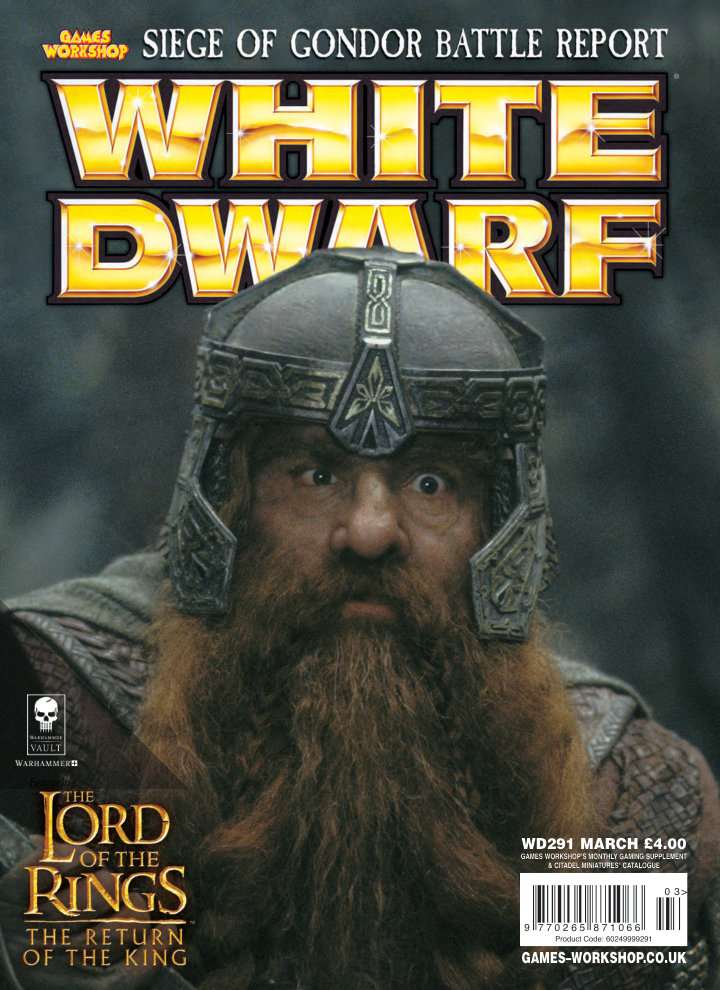
Imprint confirms issue 291, March 2004. Main features, separately titled scenarios, painting and terrain tutorials are indexed. Paint catalogue listings are excluded; the actual basing tutorial embedded in that section is included. Advertisements, store directories and art-only dividers are excluded.