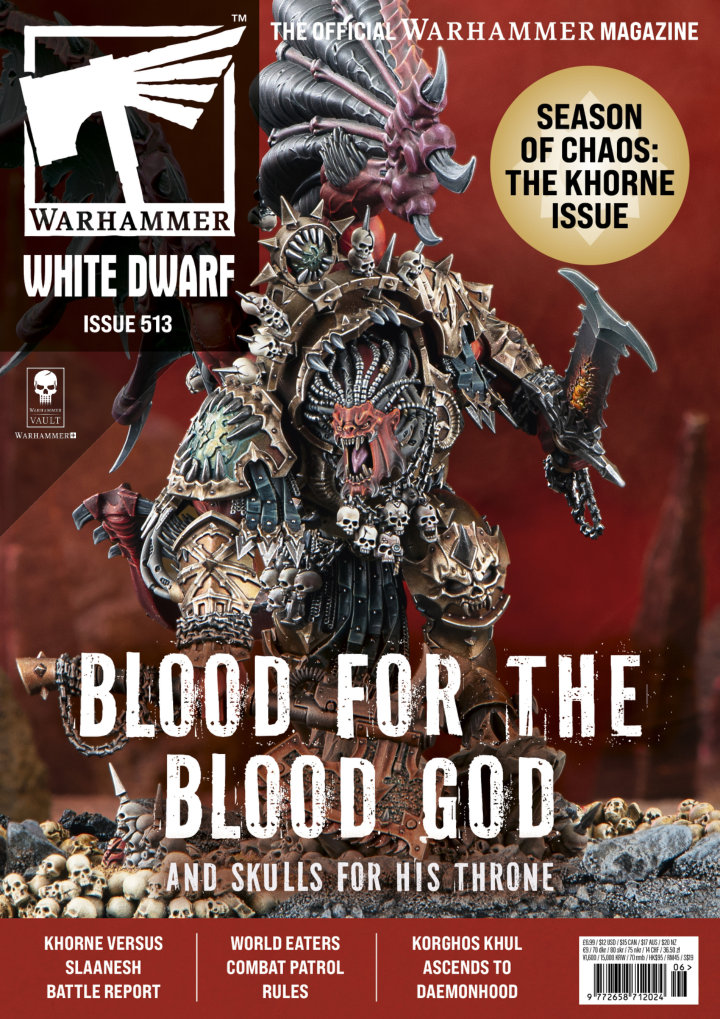
CommunityWD 513 · pp. 2–7
A reader recreates the long-lost 1985 Grombrindal knitting pattern, while other letters explore hobby motivation, fiery Sylvaneth conversions and rediscovered games and magazines. The team clarifies that Bunker activities may repeat within the monthly limit, but a single game counts only once. Reader models include White Lions, Gandalf, Abaddon and Kham, connecting nostalgic stories with present-day painting projects.
Warhammer 40,000Age of Sigmar
PaintingWD 513 · p. 4
Piotr Podolski describes a two-month Be’lakor project combining airbrushed transitions and non-metallic metal. Brown-to-bone wings are unified with crimson and violet glazes, the sword moves through successive blues towards near-white magical light, and cool grey-violet rocks frame the lava beneath him. The named colours explain how he built contrast between the vast wings, supernatural blade and iridescent base.
Age of SigmarWarhammer 40,000Chaos Daemons15 paint colours
LoreWD 513 · pp. 8–11
Nick uses Sigmar’s elite assassins to explain how viewpoint characters make the Mortal Realms understandable through their personal aims and relationships. Neave’s urgency, Shakana’s protectiveness and Rostus’s easy manner conceal different costs of war and Reforging, while Hendrick and the Idoneth soul-mage Lorai share secrets the others do not understand. Their ties to Bastian Carthalos, Be’lakor’s interest in Neave and adventures alongside the Twin-Tailed Crusade place the small team inside the setting’s larger conflicts.
Age of SigmarStormcast Eternals
ModellingWD 513 · pp. 12–15
Dan argues that a base should establish where a miniature belongs and suggest an event beyond its pose. Six worked environments use spare terrain, cork, sprue, coffee stirrers, slate and modelling putty to turn ordinary bases into small scenes. An accompanying reader question explains Kieran’s softly glazed and weathered Knight-Errant armour, showing how subdued colours and streaks can support a convincing setting.
Warhammer 40,000Age of Sigmar8 paint colours
ModellingWD 513 · p. 13
A daemon-ravaged Imperial street is built from clipped Sector Imperialis fragments, with texture heaped around the rubble so the masonry appears partly buried. A dying Space Marine from Be’lakor’s base remains an optional narrative focal point. The paint sequence works from a dark undercoat through grey and white drybrushing, using brown and black washes to break up the ruins and reinforce accumulated grime.
Warhammer 40,0008 paint colours
ModellingWD 513 · p. 13
Inspired by Callis & Toll and Mordheim, Dan makes a cramped city gutter from sprue-cut cobbles, raised cork and a drain cover from the Void War Basing Kit. A sliced paintbrush protector becomes the channel leading into the drain. Separate washes give individual bricks distinct colours before drybrushing ties them together, while a darker wash between the stones suggests the dirt trapped in a lived-in street.
Age of Sigmar8 paint colours
ModellingWD 513 · p. 14
Slate gives this snowy hero base height, Citadel skulls supply its trophy mound, and several texture paints create the uneven surface before it is painted as cracked ice. Cool transparent blues over white contrast with warm bone, while gloss reinforces the frozen areas and Valhallan Blizzard supplies the snow. The example shows how familiar basing materials can be repurposed through colour rather than used only for their usual earth effects.
12 paint colours
ModellingWD 513 · p. 14
Troggoth stories inspire a small waterside scene made from cork, sculpted putty waves, coffee-stirrer planks and mushrooms from Gloomspite kits. Building the jetty while the putty is still soft lets the components sit naturally in the terrain. Pale sand and green-blue water establish distinct surfaces, with a tinted gloss wash helping the painted wave shapes read as wet rather than solid scenery.
Age of SigmarGloomspite Gitz9 paint colours
ModellingWD 513 · p. 15
This base depicts the late stage of a Tyranid invasion, where alien growth is consuming the ground itself. A spare Tervigon belly and Carnifex claws form the fleshy centre, while Barbed Bracken is painted separately before attachment. Red-pink growth, yellow earth and green plants create contrasting biological layers, giving a miniature an explicit place in the Leviathan invasion narrative.
Warhammer 40,000Tyranids9 paint colours
ModellingWD 513 · p. 15
A statue and scaffold create an intentionally ambiguous Vermindoom scene: restoration work and fresh destruction are both plausible. Cork lifts the platform, a Rockgut Troggoth supplies the statue, trimmed square bases become floor tiles, and sand is painted as thick moss. Layered washes differentiate grey masonry, green growth and dark timber, allowing the base to tell a story without fixing a single interpretation.
Age of Sigmar10 paint colours
LoreWD 513 · pp. 16–21
The hostility between Khorne and Slaanesh is explored through myth, geography and campaigns. Khorne rejects the distractions of excess, while Slaanesh can feed on the intensity of the very passions driving his rival. At their border, the Vale of Creatures becomes a contested hunting ground where grotesque life and daemonic carnivals meet repeated Khornate invasions. Across the Mortal Realms, rival cults erect monuments whose cruelty expresses their opposing forms of devotion.
Age of SigmarBlades of Khorne
LoreWD 513 · pp. 22–25
Khul’s history begins with Athol, champion and ambassador of a threatened tribe, whose embrace of a bloody war-god culminates in the Red Feast and a daemonic invasion of Aqshy. The Goretide grows under a warlord able to direct thousands of killers outwards instead of letting them destroy one another. His gifts and atrocities lead to the rivalry with Vandus Hammerhand, once an enemy Khul failed to kill before Sigmar claimed him.
Age of SigmarBlades of Khorne
RulesWD 513 · pp. 26–29
Three Legends warscrolls let players follow Khul from mortal champion to ascended warlord. Athol supports Darkoath warriors through an early Khornate allegiance and earns protection by killing heroes; Korghos commands the Goretide, returns fallen Bloodbound and bears his reality-splitting axe alongside Grizzlemaw. Khul Ascended draws strength from nearby Khornate units and reacts to enemy spells. Suggested Darkoath, Mighty Lord and Daemon Prince models make each historical version playable.
Age of SigmarSlaves to Darkness
RulesWD 513 · pp. 30–31
This narrative battleplan recreates the gladiatorial gathering that became a catastrophic offering to Khorne. Athol Khul leads the Tribes of the Snow Peaks around a central monolith, where holding ground and destroying nearby enemies both generate points. An underdog benefit makes heroes more accurate near the stone, and exceptionally heavy losses can end the battle early. The scoring encourages players to reproduce the ritual’s spiral from contest into massacre.
Age of SigmarSlaves to Darkness
Battle reportWD 513 · pp. 32–51
Dan’s Blades of Khorne attempt to stop Matt’s Hedonites from completing The Summoning. Korghos Khul receives an agreed mid-battle route to daemonhood, while the Infernal Enrapturess conducts a ritual supported by contested arcane repositories. Skullcrushers and a Keeper of Secrets occupy one another for much of the battle, and the faster Slaaneshi units repeatedly recover the flanks even as Blood Warriors force their way towards the ritual site.
Age of SigmarBlades of Khorne
TacticsWD 513 · pp. 52–57
Louis builds two opposing Nemesis decks around this issue’s divine rivalry. The Khornate approach combines Blazing Assault with Wrack & Ruin for reliable early scoring and upgrades that turn a chosen fighter into an efficient killer. The Slaaneshi alternative joins Emberstone Sentinels with Countdown to Cataclysm, stacking treasure-token objectives and using board control to advance the tracker. He explains the scoring ceilings, conditional risks and positional habits behind both lists, including why the Cataclysm tracker need not always be pushed upwards.
Warhammer UnderworldsBlades of Khorne
LoreWD 513 · pp. 58–65
A collection framed as writings held in the Grey Knights’ vaults considers Khorne through fearful Imperial observers. Accounts describe Angron as an instrument of the god, warn that ten millennia of warfare have refined rather than diminished the World Eaters, and uncover blood cults behind martial lodges and engineered aggression. Other fragments trace daemon incursions, Flesh Hound hunting and the extraordinary fury of Bloodthirsters.
Warhammer 40,000Grey Knights
LoreWD 513 · pp. 66–69
Chainblades are surveyed as weapons of intimidation, status and spectacular close-range violence, from human chainswords and World Eater axes to chainfists, Knight weapons and Titan-scale engines of destruction. Famous examples include Spinegrinder, Gorechild and Coward’s Bane, while the text asks whether even loyal users might unwittingly feed Khorne. Aeldari versions favour precision, psychic activation and clean-running mechanisms; Ork choppas instead prize brute durability, noise and vibration.
Warhammer 40,000World Eaters
RulesWD 513 · pp. 70–77
This World Eaters Combat Patrol combines the possessed Slaughterbound Arkoth Skorgardt with two Goremonger units, Bloodletters and Flesh Hounds. A five-dice Blessings roll grants a restricted selection of Khornate benefits, while alternative enhancements make Arkoth personally tougher or protect the advancing force from fire. Splitting Bloodletters trades concentrated stratagem value for wider objective coverage, and the hounds can repeatedly return to reserves. Secondary objectives reward destruction on either side or taking objectives previously held by the enemy.
Warhammer 40,000World Eaters
RulesWD 513 · pp. 78–79
Debt of Blood adds optional battle rage to ordinary games, representing a battlefield under Khorne’s influence. A unit can take one, two or three randomly generated melee benefits, ranging from improved attacks to battle-shock pressure. The gamble comes after fighting: surviving enemies cause the enraged unit to suffer increasingly severe mortal wounds. Players must judge whether extra violence will finish the combat or leave their own warriors exposed to the price.
Warhammer 40,000
TacticsWD 513 · pp. 80–83
Stephen Box proposes a short, reciprocal pre-game conversation to prevent avoidable surprises. His questions cover detachments, unusual Deep Strike ranges, indirect fire, fight-first and fight-on-death abilities, objective bonuses, movement tricks, damage reduction and command-point generation. Concrete examples explain how each answer affects screening, deployment, target priority and threat ranges. A reusable sheet at the back of the issue leaves room for a player’s own questions and a clear account of the rules their opponent should know.
Warhammer 40,000
InterviewWD 513 · pp. 84–91
Snooker champion Neil Robertson explains how early Chaos artwork, Kham and a Bloodthirster drew him into Warhammer, and how a gift organised by his mother brought him back after decades away. His World Eaters grow from a love of the background and the ability to combine distinct warbands, with Angron providing a favourite model and a dramatic presence in games. The interview connects travelling, building in hotel rooms and tournament play with the camaraderie of his Dice Down team.
Warhammer 40,000World Eaters
PaintingWD 513 · p. 90
Neil Robertson uses an airbrush to make red power armour practical across an army. A black undercoat and grey zenithal highlight establish natural shadows before increasingly bright reds are sprayed over the upper surfaces; he reserves extra brush highlights for characters and focal models. Recipes keep the trim and working metal comparatively simple, using washed brass and silver to frame the main colour rather than compete with it.
Warhammer 40,000World Eaters11 paint colours
ShowcaseWD 513 · pp. 92–97
Miniatures designer Luke presents World Eaters at the beginning of the Heresy, retaining the Legion’s striking white and blue while hinting at its descent into slaughter. Tactical and Assault units use restrained fresh blood and damage, Inductii replace blue with red, and black-armoured Red Hand Destroyers add another distinct element. The collection uses heraldry and wear to show different stages of corruption without making every model an indistinguishable mass of gore.
The Horus HeresyWorld Eaters
PaintingWD 513 · p. 96
Luke airbrushes warm shaded white armour and paints blue parts separately or masks them on vehicles. Once the main colours are complete, satin varnish protects them from a heavily thinned burnt-umber oil wash; wet and dry ends of a cotton bud remove excess and blend staining into the surface. Separate recipes distinguish white and blue Legion armour, red Inductii, black Destroyers and bronze details, making the oil process a unifying finish across differently marked units.
The Horus HeresyWorld Eaters16 paint colours
FictionWD 513 · pp. 98–107
During Grungni’s Day preparations, a missing shipment of prized ale threatens Warden King Mazur’s hospitality to visiting Lofnir Fyreslayers. Albarak volunteers to retrieve it, and Beratak accompanies him while explaining why generosity and alliances matter as much as military strength. The search leads through a devastated caravan site to drunken Bonesplitterz; a successful raid for a remaining keg turns into disaster when ogors seize Albarak and his prize.
Age of SigmarDispossessed
CommunityWD 513 · pp. 108–109
With the six-week Kill Team league concluded, the Bunker prepares for its first informal Underworlds league using Embergard. Practice games and demonstrations introduce newcomers while fresh warbands appear on painting desks. The article recommends compact event schedules that preserve momentum, then supplies the familiar achievement tracker and this month’s Gods of War painting challenge.
Kill TeamWarhammer Underworlds
CommunityWD 513 · pp. 110–115
Leila reports on the last rounds of a studio league that generated 146 games and brought staff from many departments to the tables. Nyle and Elliot finish their remaining matches unbeaten after drawing with one another, setting up a final rematch. Elliot changes approach, secures an early advantage with an Aquilon alpha strike and wins 14–10 while Nyle’s Nemesis Claw presses back late. Parade Day recognises elaborately presented teams alongside the gaming results.
Kill Team
PaintingWD 513 · p. 112
Elliot paints his Aquilons as if they are undertaking a night-fighting mission. A grey undercoat supports Contrast base colours, followed by simple highlights and darkening shades; an umber oil wash across the models, cleaned back with white spirit, ties the surfaces together. The blue-armour recipe uses a turquoise shade to cool the finish, while nearly black fatigues keep attention on the armour and faces.
Kill TeamAstra Militarum7 paint colours
PaintingWD 513 · p. 113
Pete gives his Shrouded Skulls a red camouflage scheme matching a suspended Beta-Decima display. The scene fits inside a transparent display cube, with water texture gel and Valhallan Blizzard suggesting waves around its pillars. Red terrain and grey structural recipes also provide the colours for the Marines’ camouflage, changing drybrushed scenery highlights into layered marks on their cloaks.
Kill TeamSpace Marines9 paint colours
PaintingWD 513 · pp. 114–115
The Parade Day winning team combines versatile Inquisition and Arbites kits with modelling putty to produce distinctive agents. Maxime singles out a priest inspired by an Inquisitor sketchbook illustration, then uses expressive brushwork and Contrast over a shaded undercoat for a dark, textured atmosphere. A black-metal armour recipe and red gun casings give the converted figures enough common colour to read as a coherent retinue.
Kill TeamImperial Agents7 paint colours
RulesWD 513 · pp. 116–117
Khorne’s Boon overlays a normal Kill Team mission with eight cards arranged as the god’s symbol. Close-range violence earns points on chosen cards, some still hidden, and an operative can gamble for healing and a permanent team-wide benefit. More accumulated points improve the success chance but increase the injury caused by failure, while the kill grade limits how many benefits can be taken. The pack encourages direct action without requiring either player to field a Khornate team.
Kill Team
ShowcaseWD 513 · pp. 118–123
The Gods of War gallery brings together a Bretonnian Duchess, a Daemon Prince, Guilliman, a Lamenter, a Dark Angels Judiciar and a Warmaster Iconoclast Titan. Studio submissions add Leila’s urban-camouflaged Banehammer and John’s experimental Katakros, whose magnetised companions can step into narrative games. Painting notes explain weathered tank camouflage, freehand markings and the use of purple shadows to retain orange saturation.
Warhammer 40,000Age of Sigmar9 paint colours
CommunityWD 513 · p. 120
Daniel Randon introduces a group that began when new father Luke Stone wanted other dads to discuss parenting with. Local communities now use games and painting challenges as a reason to meet, while the group’s central purpose remains supportive conversation about fatherhood. An October 2024 gathering at Warhammer World brought members together for Combat Patrol, Kill Team and social time, illustrating how the hobby can sustain relationships beyond the gaming table.
Warhammer 40,000Kill Team
CommunityWD 513 · pp. 124–125
Lyle adds Tome Keepers Eradicators and explains a simple glazed heat-discolouration effect for their weapons, while Sophie shows Moon Eaters Aggressors with a rune and contrasting sergeant markings. Ben and Matt test the explosive objectives of Volatile Materials with Genestealer Cults and Imperial Fists. The team’s grids and short notes chart ongoing projects, games and a change of team as Sophie moves to partworks.
Warhammer 40,000Age of Sigmar3 paint colours
TacticsWD 513 · p. 126
A photocopiable pre-game worksheet collects Stephen Box’s ten core questions beside space for ten personalised alternatives and notes about the user’s own army. It turns the preceding article’s conversation advice into a practical reminder covering deployment tricks, combat sequencing, objective interactions and resource generation. Preparing both questions and disclosures helps players establish a shared understanding before the first turn.
Warhammer 40,000