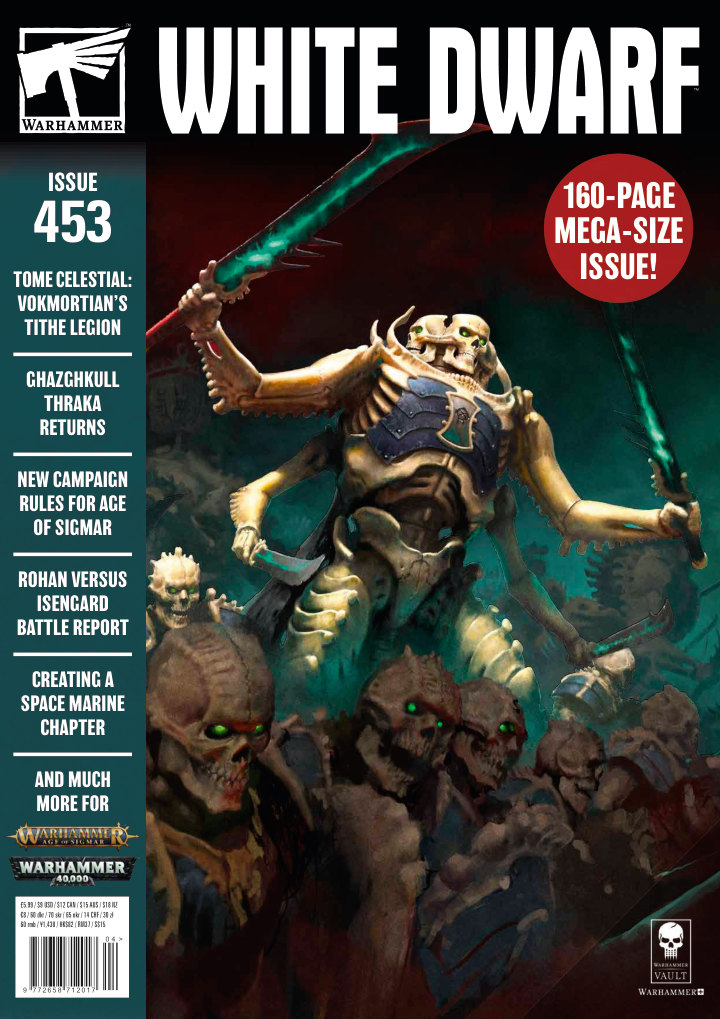
EditorialWD 453 · p. 1
White Dwarf introduces its own canonical Space Marine Chapter, the Tome Keepers, and invites readers to follow the creative process. The editor hopes that seeing background and imagery developed together will make inventing a personal Chapter more approachable and encourage others to begin their own.
CommunityWD 453 · pp. 4–7
Readers share long experience in the hobby, photographs and questions about painting, background and games. The replies include efficient Dark Angels colours, a detailed green-tiled basing recipe and discussion of Genestealers, while Walter Nunziati’s dark-armoured Stormcasts receive the month’s model award.
Warhammer 40,000Age of Sigmar18 paint colours
ModellingWD 453 · pp. 8–9
Lars Sammet builds distinctive kill teams by combining kits and creating a strong identity for each group. Raptors receive military camouflage, Aeldari borrow Harlequin weapons, Chaos cultists use eclectic character conversions and custom Voidsmen combine Imperial infantry parts around a converted Rogue Trader.
Kill TeamWarhammer 40,000Raptors
LoreWD 453 · pp. 10–13
Phil Kelly collects unusual fragments of 41st Millennium lore, ranging from time-travelling Orks and the Kraken’s Egg of Fenris to Aeldari traditions and the Ynnari’s missing swords. The selection emphasises the setting’s mysteries, contradictions and scale rather than providing a single continuous history.
Warhammer 40,000
LoreWD 453 · pp. 16–23
Vokmortian’s relentless collection of bone underpins the Ossiarch empire and its expansion across Hallost. His contracts, layered legends and campaigns show both the administrative cruelty of the bone-tithe and the force behind it, including a costly confrontation with the Tarkan ogors and plans to exploit the Beastmaw Realmgate.
Age of SigmarOssiarch Bonereapers
RulesWD 453 · pp. 24–25
Three formations represent Vokmortian’s army, his personal retinue and coordinated Harvester packs. The rules give the larger legion access to spectral allies, protect its emissary through an ancestral contract and reward Gothizzar Harvesters attacking alongside Kavalos Deathriders, with restrictions tying the formations to Mortis Praetorians.
Age of SigmarOssiarch Bonereapers
PaintingWD 453 · pp. 26–27
A Mortek Guard guide treats the construct as several different kinds of bone rather than a single skeleton. Keeping the shield separate makes drybrushing and recess work easier, while staged recipes add purple armour, teal cloth, metal, red leather, glowing eyes and a dry desert base.
Age of SigmarOssiarch Bonereapers28 paint colours
PaintingWD 453 · pp. 28–29
The alternative Mortek Guard scheme uses Wraithbone on the body and a cooler Grey Seer foundation on the separate shield. Contrast colours quickly establish the different bones and materials, after which selected conventional highlights sharpen the armour, clothing and magical details without losing the speed of the initial method.
Age of SigmarOssiarch Bonereapers25 paint colours
EditorialWD 453 · pp. 30–33
Jervis Johnson uses Meeting Engagement deployment rules, points values and revised warscroll wording to explain how repeated testing changes a design. Large bases, undesirable edge cases and reader feedback lead to successive refinements; deadlines pause the process rather than ending it, and published wording continues to evolve as lessons accumulate.
Age of Sigmar
LoreWD 453 · pp. 34–37
The campaign’s second region is dominated by greenskin warlords, the Beastmaw route to Ghur and the terrible soul-fed Stalagog released from a Stormvault. Competing gods and armies seek Hallost’s resources as the continent slides towards the Shyish Nadir, giving the canyon and its ruined fortress strategic and supernatural importance.
Age of SigmarOrruk Warclans
CampaignWD 453 · pp. 38–39
The Hallost map campaign expands with a three-player contest in the Booming Scar. New key-location benefits support different approaches to conquest, while a five-round limit and control of pivotal strongholds determine the outcome; the accompanying regional map provides starting positions and terrain values.
Age of Sigmar
RulesWD 453 · p. 40
Armies compete for a central place where the attention of spectral chieftains grants powerful oaths. Lesser seats around the field provide additional scoring opportunities, forcing generals to weigh immediate objectives against the changing advantages bestowed by control of the main gathering site.
Age of Sigmar
RulesWD 453 · p. 41
An attacker approaches under darkness to destroy six valuable locations placed by the defender. Burning an objective removes it from play, creating a race between protecting vulnerable sites and hunting down the raiders before too much of the battlefield has been irretrievably lost.
Age of Sigmar
RulesWD 453 · p. 42
Hallost’s death magic lets the attacking army replace destroyed units and keep pressing a defended line. The defender must withstand recurring waves, while final model positions in successive defensive territories decide whether the attacker has achieved a minor advance or a decisive breakthrough.
Age of Sigmar
RulesWD 453 · p. 43
The attack begins with a lone hero’s challenge that can force an immediate duel before the armies deploy. Thereafter the battle rewards martial success and heroes entering hostile territory, connecting the opening boast with a wider contest for prestige and battlefield domination.
Age of Sigmar
PaintingWD 453 · pp. 44–45
Dan Harden creates a Hyshian Cypher Lords warband secretly devoted to Tzeentch, using a jade identity and individually named warriors. Choosing the Spy in the House of Talons quest in Champion Mode gives the group a difficult route into Carngrad’s upper circles and a clear narrative goal.
WarcryCypher Lords3 paint colours
PaintingWD 453 · p. 46
Jonathan Stapleton embraces the Unmade’s disturbing aesthetic with a warband that equates mutilation with enlightenment. A light undercoat and contrasting red details define the look, while the Path of the Flayed Prince campaign gives his named fighters a prophet’s example to follow.
WarcryThe Unmade3 paint colours
PaintingWD 453 · p. 47
Matt Hutson’s Corvus Cabal arrive from Ulgu as hired assassins, with a deliberately elusive emblem and paired fighter names. Their War of Talons campaign conceals an opportunistic plan: convince rival leaders that each hired the band to kill the other, then murder both and keep the profits.
WarcryCorvus Cabal3 paint colours
PaintingWD 453 · p. 48
Lyle Lowery builds the Venomborn around reptilian armour, poison and pit-fighting deception. The Splintered Fang’s bright colours sit over dark and zenithal undercoats, while Venom of the Gods provides an appropriately venomous campaign path for their individually named gladiators.
WarcrySplintered Fang4 paint colours
CampaignWD 453 · pp. 49–53
The four new warbands learn how movement, damage and objectives interact across early campaign battles. Close games, misplaced commitments and desperate treasure runs produce vivid setbacks, and none of the four completes their first convergence; campaign sheets preserve the fighters, rewards and progress for the next instalment.
WarcryCypher Lords
CommunityWD 453 · pp. 56–59
Robin Cruddace and fellow rules writers report on a team tournament, including the pairing process and lessons from their games. Individual combat highlights sit alongside the recurring importance of mission scoring, showing how spectacular kills and personal rivalries can coexist with disciplined objective play.
Warhammer 40,000
FictionWD 453 · pp. 60–61
A sanctioned fortune-teller under arrest hears the sounds around him merge into an irresistible song. Despite warnings against looking at the Great Rift, he turns skyward; the psychic call becomes a scream, and a daemonic birth turns one ordinary prisoner transfer into another disaster in Imperium Nihilus.
Warhammer 40,000
FictionWD 453 · pp. 62–63
Guilliman considers the gulf between the certainty of his crusade declaration and the broken Imperium before him. Reports of psychic catastrophe, lost worlds and even unfamiliar language underline his isolation, but a precarious passage through the Rift offers the only possible course, and he orders his fleet forward.
Warhammer 40,000Ultramarines
LoreWD 453 · pp. 64–69
Rumours of the Silent Seventh, the ill-starred Fleet Quintus and impossible interventions complicate the crusade’s official triumphal story. Logs, redacted incidents and testimony describe ghostly ships, mysterious rescuers and forbidden beliefs, presenting an Imperium that hides troubling phenomena even while depending on them.
Warhammer 40,000Imperium
RulesWD 453 · pp. 70–75
The Deathwatch receive an update aligned with the revised Space Marine rules: Angels of Death, combat doctrines, Intercessor Sergeant options and Chaplain litanies. Fourteen stratagems broaden the veterans’ battlefield tools, while the rules explain how special-issue ammunition interacts with doctrine bonuses.
Warhammer 40,000Deathwatch
InterviewWD 453 · pp. 76–81
Maxime Pastourel and Max Faleij describe rebuilding Ghazghkull Thraka at a scale worthy of the galaxy’s greatest Ork. Older models and artwork guide the enlarged silhouette, red jaw, trophies and textures, while Makari’s return, alternative posing and the updated banner preserve recognisable details within a much more imposing kit.
Warhammer 40,000Orks
PaintingWD 453 · pp. 82–83
Max Faleij explains the carefully differentiated blacks and metallic finishes used on Ghazghkull’s huge armour, alongside red details and worn surfaces. Recipes and practical advice on glazes, rust and verdigris help reproduce the studio effect while keeping each material visually distinct on an otherwise dark model.
Warhammer 40,000Orks33 paint colours
LoreWD 453 · pp. 84–89
The team compares starfaring protectors with archivist-warriors before selecting the Tome Keepers as White Dwarf’s Chapter. Short-lived homeworld inhabitants inspire a culture of recording knowledge, while colour tests and a simplified book-and-star icon lead into practical prompts for readers developing names, origins, doctrines and flaws of their own.
Warhammer 40,000Tome Keepers11 paint colours
PaintingWD 453 · pp. 90–95
Neil Hollis documents preparing Berek the Indomitable for a planned Golden Demon entry, from a stepped scenic base to carefully blended non-metallic armour. Reflected colours, soft cloth and a hidden green light enrich the composition, while earlier award-winning pieces illustrate the same concern for materials, storytelling and presentation.
Age of SigmarThe Horus HeresyStormcast Eternals10 paint colours
LoreWD 453 · pp. 96–97
Khorne’s realm supplies a visual language of brass, ash, bone and blood for followers in both settings. The article explains the skull rune and common martial imagery, then suggests broadening red-and-black traditions through different hues and unexpected converted armies dedicated to the Blood God.
Warhammer 40,000Age of SigmarKhorne
ModellingWD 453 · pp. 98–101
A varied fantasy gallery shows that Khorne’s followers need not share one standard appearance. A tainted Steam Tank, blood-leashed Warshrine and corrupted Eidolon sit beside Maxime Pastourel’s cold-toned, snow-based army, where repeated spiked collars and converted heads unite mortals, beasts and unusual allies.
Age of SigmarBlades of Khorne7 paint colours
ModellingWD 453 · pp. 102–105
The far-future gallery explores different World Eater and daemon palettes, a heavily mechanised Bloodthirster and a kill team built from Blood Warriors. Repeated skulls, axes and trophies establish allegiance, while blue hellblades, pale helmets and black armour provide contrast against red skin and gore.
Warhammer 40,000World Eaters11 paint colours
ModellingWD 453 · pp. 106–107
Several stage-by-stage bases evoke Khorne’s conquered landscapes with skulls, jagged rock and channels of blood. Shattered Dominion flooring becomes a city of slaughter, while a larger scenic composition layers earth, pale bones and metallic fragments before glossy blood ties the scene together.
Warhammer 40,000Age of Sigmar27 paint colours
PaintingWD 453 · pp. 108–109
James Perry uses Targor from Garrek’s Reavers to demonstrate the many materials on a Bloodreaver. A warm light undercoat supports flesh and pale armour that will show gore clearly, while contrasting cloth, dark straps, polished metal and optional highlights take the model from Battle Ready to Parade Ready.
Age of SigmarWarhammer UnderworldsBlades of Khorne27 paint colours
PaintingWD 453 · pp. 110–111
James distinguishes wet blood from dried, accumulated gore and considers how each mark arrived on the model. Demonstrations cover directional splatter, stained cloth, glossy red armour over gold and layered flowing blood, combining Technical and Contrast colours with conventional highlights for depth and convincing texture.
Warhammer 40,000Age of Sigmar13 paint colours
Battle reportWD 453 · pp. 112–125
Jay Clare’s Rohan defenders face Rob Alderman’s larger Isengard army in a stronghold siege. Uruk-hai and Dunlendings raise ladders and break the gate, Théoden falls to enemy heroes and the remaining Rohirrim nearly repel the attackers, but a final desperate struggle ends with the fortress in Saruman’s hands.
Middle-earth Strategy Battle GameRohan
EditorialWD 453 · pp. 126–129
Dave Sanders reflects on the lessons learned since Shadespire, from clarifying cards and improving setup choices to rotating the card pool. Magic, lethal terrain, scatter and generic counters open new design space, while playtester feedback and organised events expose interactions that development games could not reveal.
Warhammer Underworlds
FictionWD 453 · pp. 130–133
Fecula’s Wurmspat travel inside a vast plague creature to Beastgrave, intent on ending a curse that denies proper decay. Hrothgorn’s hunters mistake the newcomers for suitable prey, only to discover how little their traps and blows matter to Nurgle’s servants within the living mountain.
Warhammer UnderworldsThe Wurmspat
RulesWD 453 · pp. 134–137
A Deathwatch Watch Master takes on a one-off Blackstone Fortress expedition alone. Six activation dice, special ammunition and formidable defensive rules support the solo variant, while a replacement event table and adjusted setup remove challenges that require multiple explorers; accompanying lore explains the Watch Masters’ authority and equipment.
Warhammer QuestDeathwatch
CampaignWD 453 · pp. 138–139
Optional resurrection packages let a Necromunda Arbitrator return an important dead fighter to a campaign. Every return combines benefits, an ongoing price and an eventual end game, making resurrection a source of further stories rather than a simple reversal of an unlucky casualty roll.
Necromunda
RulesWD 453 · p. 140
Forbidden technology preserves a fighter and prevents several lasting injuries, but every avoided injury deepens its hold on the body and mind. Increasing insanity eventually gives way to the fighter’s permanent disappearance into the underhive, turning continued survival into a steadily advancing loss of humanity.
Necromunda
RulesWD 453 · p. 140
A powerful patron saves a dying fighter in return for an unbreakable alliance. The gang adopts the patron’s alignment and gains more integrated allied fighters, but each victory demands the surrender of another gang member until the resurrected debtor finally gives themselves up.
Necromunda
RulesWD 453 · p. 141
A daemon inhabits a dead ganger, granting fearsome presence and psychic power. Its vessel must feed it through killings or sacrifices to avoid physical decline, and every consumed soul increases the chance that the creature will finally break free and destroy its host.
Necromunda
RulesWD 453 · p. 141
A bargain with the Dark Gods restores a fighter with psychic gifts and access to dark rituals. The gang becomes outlawed and must sacrifice captives rather than sell them, eventually transforming the resurrected servant into a Chaos Spawn when the agreed bloody tribute has been paid.
Necromunda
RulesWD 453 · p. 142
A resurrected zombie ignores pain and fear but becomes a slow, compulsive predator with little use for ranged weapons. The curse spreads through another gang member after every battle until the entire group has become undead and disperses into the underhive in search of flesh.
Necromunda
RulesWD 453 · p. 142
An avenger returns with potent rerolls against the fighter responsible for their death. Neglecting the pursuit steadily drains their strength, and completing the revenge ends their career; if another person kills the target first, a new enemy within the same gang inherits the vendetta.
Necromunda
RulesWD 453 · p. 143
Alien intervention keeps a fighter alive through injuries that should have lasting consequences, but repeated survival makes them increasingly inhuman and isolated. Eventually the accumulated changes risk a final transformation into a hostile creature, permanently removing the former ganger from their companions.
Necromunda
RulesWD 453 · p. 143
A shape-changing replacement wears a dead fighter’s identity, allowing their learned skills to be rebuilt from a far wider range. Fellow gangers remain suspicious, preventing normal leadership cooperation, and post-battle rolls can send the impostor away temporarily or end the deception through permanent disappearance.
Necromunda
FictionWD 453 · pp. 144–157
Neva’s Games of Penance horrify Verity when children reenact holy battles with real weapons. Her attempt to save a victim pulls Miriya into the spectacle before Vaun launches a violent assault on the city’s leaders; the resulting fires and confrontations expose the personal hatred between the fugitive and Lord LaHayn.
Warhammer 40,000Adepta Sororitas
CommunityWD 453 · pp. 158–160
Staff projects range from golden-armoured orruks and a rapidly painted Tempest’s Eye army to Aeronautica aircraft and new Custodians. Thomas Elliott’s converted Wraithlords and Wraithseer conclude the gallery, showing how broad armour plates, custom weapons and carefully painted freehand can turn familiar kits into individual characters.
Warhammer 40,000Age of Sigmar5 paint colours