EditorialWD 401 · p. 1
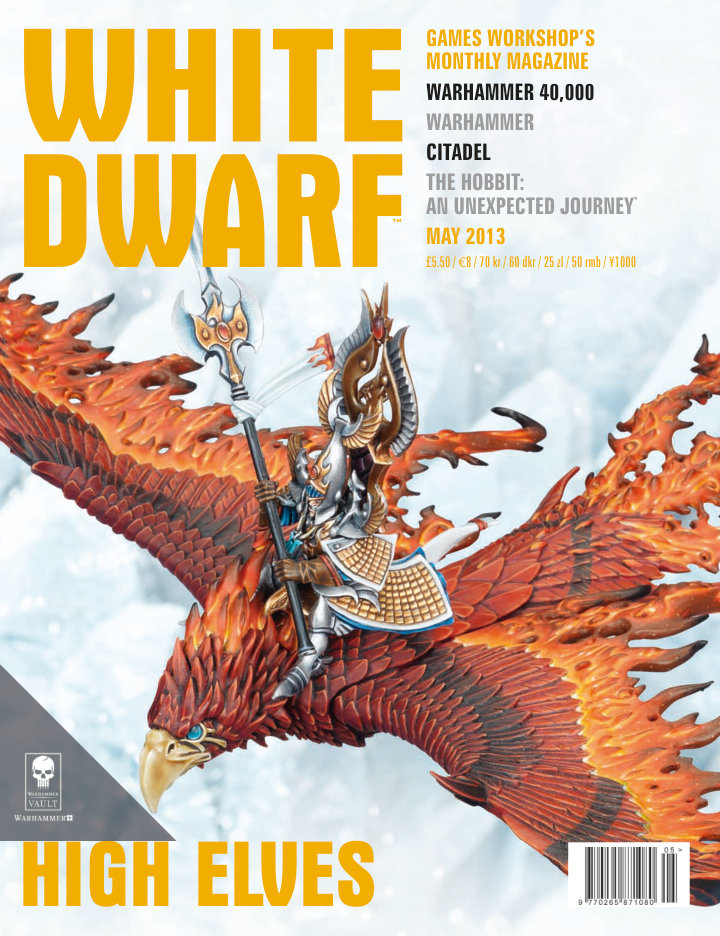
Jes Bickham introduces a High Elf release led by flying monsters and an airborne chariot. Matt Hutson brings the new army against Ogres in the battle report. Dragon history and sculpting interviews place those models in a wider fantasy tradition. Dreadnought and Titan collections supply a contrasting mechanical theme elsewhere in the issue.
Warhammer Fantasy BattlesHigh Elves
ReviewWD 401 · pp. 6–9
Mark Harrison’s Phoenix kit turns one creature into two different stages of a magical life cycle. The younger Flamespyre burns with vigorous magic, while the older Frostheart draws heat from its surroundings. Alternative parts, a mounted Anointed and a foot model offer several ways to use the kit. Extended fold-out descriptions also introduce Caradryan’s named Frostheart mount, Ashtari.
Warhammer Fantasy BattlesHigh Elves
ReviewWD 401 · pp. 10–13
The Skycutter combines an elegant boat-like chariot with a large Swiftfeather Roc. Alternative positions for the bird’s legs, head and wings help vary the assembled model. Three crew and an optional bolt thrower distinguish its transport and weapons arrangements. A Sea Helm can command from aboard the craft or stand separately on foot.
Warhammer Fantasy BattlesHigh Elves
ReviewWD 401 · pp. 14–15
Ten plastic warriors carry longbows and swords with the restrained appearance of experienced scouts. Enclosed helmets and subdued equipment reinforce their anonymous identity. Facial scars and the Shadow Walker’s expression hint at the long conflict with the Dark Elves. The review emphasises how the shared kit establishes a different character from conventional ranked High Elf infantry.
Warhammer Fantasy BattlesHigh Elves
ReviewWD 401 · pp. 16–17
The alternate build from the Shadow Warrior kit creates ten guardians of Avelorn. Their magical bows require no ordinary quivers and make an immediate visual distinction from the other unit. Flowing clothing and open faces give the figures a lighter appearance. The High Sister leads a force tied to the Everqueen’s sacred homeland.
Warhammer Fantasy BattlesHigh Elves
ReviewWD 401 · p. 18
A raised sword and a spell forming in the free hand establish the Loremaster as both warrior and magician. His costume connects him to the Swordmasters rather than an ordinary robed wizard. The plastic character’s compact pose brings those identities together on a small base. Adam presents the figure as a particularly clear expression of High Elf martial scholarship.
Warhammer Fantasy BattlesHigh Elves
ReviewWD 401 · p. 19
Darren Latham’s Handmaiden carries an ornate magical bow and ceremonial spear. Her equipment connects her to the Sisters while giving her the prominence of an individual leader. Fine details in the clothing and ornaments reinforce the model’s courtly role. The review introduces the Finecast character as a protector of the Everqueen rather than an interchangeable archer.
Warhammer Fantasy BattlesHigh Elves
ReviewWD 401 · p. 20
Edgar Ramos depicts Alarielle barefoot among growing flowers, making her bond with living Ulthuan visible. Roses, flowing robes and a ceremonial staff communicate authority without heavy armour. The figure’s elaborate headdress and restrained stance establish a different kind of hero from the Loremaster or mounted princes. Adam connects those details to the Everqueen’s nurturing magical character.
Warhammer Fantasy BattlesHigh Elves
ReviewWD 401 · p. 21
The battalion combines twenty Spearmen, twenty Archers, eight Silver Helms and a chariot with alternative builds. It gives collectors a conventional army core alongside the new specialist releases. Eight spell cards provide a convenient reference for High Magic. The notices describe the contents without reproducing the complete rules associated with them.
Warhammer Fantasy BattlesHigh Elves
ReviewWD 401 · pp. 22–25
Mat Ward’s army book links the new units to an expanded account of Ulthuan and its Phoenix Kings. Heraldry, regional identities and historical conflicts make the army more varied than a single white-and-blue scheme. The miniature gallery shows how those themes can guide collecting and painting. Adam also introduces the organisation of the rules and the range of new options available to an army.
Warhammer Fantasy BattlesHigh Elves
ReviewWD 401 · pp. 26–27
The illustrated reference explores the ten realms of Ulthuan through uniforms, banners and identifying marks. Dragons, Phoenixes and magical symbols provide recurring motifs. Runes and other decorative elements connect those designs to the setting’s history. Jes presents the book as a source of practical army themes as well as background reading.
Warhammer Fantasy BattlesHigh Elves
ReviewWD 401 · pp. 28–29
Michael Perry’s model places Radagast behind twelve rabbits pulling a curved woodland sleigh. The base, runners and animals create a sweeping sense of movement. Windfall and other forest details connect the vehicle to the wizard’s unusual surroundings. Adam describes the sculpt’s character and construction rather than providing a painting recipe.
Middle-earth Strategy Battle GameRadagast
ReviewWD 401 · pp. 30–31
The clothing release uses a Catachan Devils emblem to turn regimental identity into a wearable design. Its imagery draws on the jungle fighters’ aggressive military reputation. The feature illustrates the front and details of the contemporary product. It records a historical release rather than implying that the shirt remains available.
Warhammer 40,000Astra Militarum
CommunityWD 401 · pp. 32–33
Four events are announced for Memphis, Birmingham, Modena and Bochum. The preview highlights new venues, Golden Demon and Armies on Parade qualification. An exclusive miniature is promised without being revealed in this feature. Together the notices establish the international shape of that year’s Games Day programme.
ReviewWD 401 · p. 34
Guy Haley’s novel follows the Mars Triumphant and its Paragonian crew through the brutal fighting on Kalidar IV. Jes praises the relationship between the tank’s physical scale and the soldiers’ more personal fears. Lieutenant Bannick’s earlier life emerges through flashbacks, while the Ork warlord Greeneye supplies a powerful opposing presence. Brief interstitial passages widen the sense of the campaign beyond the tank crew.
Warhammer 40,000Astra Militarum
ReviewWD 401 · p. 35
Steve Parker’s novel moves between an infiltrating asset, an Inquisitorial operative and a Deathwatch Librarian. Lyandro Karras’s training and his eventual mission introduce the tensions within an elite squad assembled from different Chapters. Chiaro and Damaroth provide linked mysteries behind the action. Andrew finds the military detail effective, with occasional jargon demanding closer attention.
Warhammer 40,000Deathwatch
ReviewWD 401 · p. 36
Gilead’s latest story places the cursed wanderer amid human cities, vampires and Skaven rather than presenting an uncomplicated noble hero. Andrew describes the harder characterisation developed by Nik Vincent and Dan Abnett. Graham McNeill’s Elves omnibus collects three novels about Ulthuan, Ellyrion and Athel Loren. The accompanying notices connect those books to earlier Gilead fiction and further tales of Elven conflict.
Warhammer Fantasy BattlesHigh Elves
ReviewWD 401 · p. 37
Eight contributors explore the aftermath of Calth through stories ranging from Oll Persson’s journey to Erebus’s schemes. Andrew highlights the anthology’s varied viewpoints and David Annandale’s unsettling Traveller. Two audio releases follow different covert strands of the Heresy: Garro’s work aboard the Phalanx and Iacton Qruze’s investigation on Caliban. Both raise questions of loyalty away from the main battlefronts.
The Horus HeresyUltramarines
ReviewWD 401 · pp. 38–39
Simon Egan’s duel captures the confrontation in Isstvan III’s Choral City. Abaddon’s aggressive pose and Loken’s braced response make the shared scenic base part of the storytelling. The miniatures can be removed for individual use. An alternative combi-bolter arm gives Abaddon a further display or gaming option.
The Horus HeresySons of Horus
ReviewWD 401 · p. 40
Palatine decoration and Legion insignia give the Contemptor an unmistakable Emperor’s Children identity. An eagle motif and the numeral III link the armour to the Legion’s favoured symbols. Its mechanical form remains compatible with the established Contemptor range. The review concentrates on the personalised sculpted details available to a collector.
The Horus HeresyEmperor’s Children
ReviewWD 401 · p. 41
The High Elf army book joins the contemporary iPad range. Interactive presentation and miniature views accompany its digital contents. White Dwarf’s electronic edition provides another way to view the month’s photography and release coverage. The notice describes those formats without treating their additional digital media as pages present in the scan.
Warhammer Fantasy BattlesHigh Elves
ShowcaseWD 401 · pp. 46–51
Mark Bedford builds a substantial Blood Angels collection around an affection for Dreadnoughts. Painting deadlines and tournament plans turn a battleforce into a much larger force, with around thirty walkers among its models. Airbrushed zenithal work helps unify the red armour. Heresy-era vehicles and infantry broaden the project, while a converted Captain and varied details preserve individual character.
Warhammer 40,000Blood Angels
EditorialWD 401 · pp. 52–53
Jervis explains how a gamesmaster can prepare armies, surprises and independent characters without manipulating the result mid-game. Non-player forces need motives and limited roles so that the players remain central. Victory conditions should reward the story fairly rather than force a predetermined ending. Listening to participants and carrying consequences into a campaign can inspire later modelling and battles.
Battle reportWD 401 · pp. 54–71
Matt Hutson’s High Elves confront Jes Bickham’s Ogres near Kubelstadt in a battle centred on a magical stairway. Mournfangs and the Scraplauncher devastate the Elven centre, killing Loremaster Korhedron as supporting units collapse. Dragons, the Frostheart and two Skycutters keep other parts of the battlefield contested. A Flamespyre Phoenix returns to life at the end and denies the Ogres the objective, producing a draw.
Warhammer Fantasy BattlesHigh Elves
RulesWD 401 · pp. 56–57
The battle adapts the Dark Monoliths of Zhulgozar scenario around an Eternity Stair. Wizards close to the stair gain powerful magical protection and additional resources, alongside access to Dark Whirlwind. An unopposed, non-fleeing unit near the objective can claim the battle. This makes control of the centre and the survival of small contesting units more important than a simple count of casualties.
Warhammer Fantasy BattlesHigh Elves
TacticsWD 401 · pp. 72–75
Adam Troke uses the Dark Angels’ secretive character to shape how his army fights. Ravenwing undertake dangerous reconnaissance and help bring the Deathwing into decisive positions. Tactical squads and a command banner form a more dependable main line, while the Dreadnought provides a central response to threats. Scouts serve as valuable intelligence gatherers rather than disposable casualties, linking tactical choices to the Chapter’s background.
Warhammer 40,000Dark Angels
ShowcaseWD 401 · pp. 76–77
Julian Bayliss develops a group of female Chaos followers from Daemonette, Wych and other parts. Sorting components by potential character leads to ideas rather than following a fixed gaming list. Muted greys with red accents keep the varied figures coherent. Older Chaos Amazon imagery, a recycled rocker’s hat and small narrative details give the collection its particular identity.
Warhammer 40,000Chaos
InterviewWD 401 · pp. 78–79
Oliver Norman nominates the Dark Vengeance Helbrute for its disturbing mixture of armour and living flesh. Edgar Skomorowski discusses its relationship with the other contemporary Chaos models. Asymmetry, chains and layered mechanical details create depth despite the compact assembly. The result suggests a tortured creature whose physical aggression is inseparable from its weapons.
Warhammer 40,000Chaos Space Marines
InterviewWD 401 · pp. 80–83
Mat Ward traces dragons from an ancient dominance to their alliances with the Elves. Draugnir and the influence of Asuryan help explain their place in Ulthuan’s legends. Chaos changes the balance of power and makes cooperation between dragons and Elves increasingly important. Enslavement, corruption and necromancy demonstrate how other factions twist those relationships.
Warhammer Fantasy BattlesHigh Elves
BackgroundWD 401 · p. 83
A remote dragon graveyard becomes a source of dark legends and dangerous magical ambition. Ancient remains attract those seeking more than ordinary treasure. Vampires can raise the bones as monstrous mounts, turning the dragons’ resting place into a battlefield resource. The short account explains why this landscape matters to necromancers and the wider history of dragons.
Warhammer Fantasy BattlesVampire Counts
InterviewWD 401 · pp. 84–87
Trish Carden discusses sculpting dragons as intelligent beings with distinct cultural identities. High Elf, Wood Elf, Dark Elf and Chaos examples differ in posture, scales and ornament rather than merely in size. Earlier metal models required careful engineering, while plastic and larger resin projects permit different tails and poses. Adam connects those design decisions to memorable dragons and their riders from the setting.
Warhammer Fantasy BattlesHigh Elves
PaintingWD 401 · p. 88
Christian Byrne gives the Death Company walker dark armour with vivid blood-red decoration. Metallic edges and carefully placed red highlights keep the large shape readable. The discussion connects the finish to the model’s aggressive character rather than treating it as a uniform black block. Selected named paints provide references, with a fuller guide located outside this article.
Warhammer 40,000Blood Angels3 paint colours
PaintingWD 401 · p. 89
Duncan Rhodes develops subdued green armour by glazing a grey foundation. The restrained colour distinguishes the Legion without overwhelming its markings. A half-bead eye and transferred insignia add character and scale. The short guide shows how a small set of paints and a medium can create the larger model’s distinctive finish.
The Horus HeresySons of Horus4 paint colours
ShowcaseWD 401 · p. 90
Paul Gayner adapts a Venerable Dreadnought front for an Ironclad in his Crimson Heralds collection. Decorative panels and scrolls make the walker fit the Chapter’s established visual identity. The construction retains a recognisable heavy combat role while adding more ceremonial detail. The feature highlights those component choices without supplying a named paint recipe.
Warhammer 40,000Space Marines
PaintingWD 401 · p. 91
Dave Roberts balances the Lamenters’ yellow with blue elements identifying a Librarian. Red details help focus attention on the larger armour surfaces. Separate assembly allows the airbrushed colours to remain clean around awkward recesses. The discussion describes the approach and chapter identity without naming individual paint products.
Warhammer 40,000Lamenters
PaintingWD 401 · p. 92
Mark Bedford applies the Imperial Fists’ yellow to a Contemptor Mortis. Transfers establish its Legion identity before weathering settles it into the collection. The large armour plates provide room for wear and contrasting markings. The feature concentrates on the finished effect and does not supply named paint products.
The Horus HeresyImperial Fists
PaintingWD 401 · p. 93
Mark Bedford gives this Contemptor metallic armour with blue identifying panels. Transfers tie it to the Astral Claws, while shading and weathering prevent the metal from looking uniform. Forge World powders provide a further layer of wear. No individual powder or paint colours are named in the discussion.
Warhammer 40,000Astral Claws
ModellingWD 401 · p. 94
Will Hayes personalises a Contemptor with added torso plates and small half-bead studs. The construction changes its texture without losing the original mechanical silhouette. Red spattering gives the subdued armour a brutal battlefield character. The description identifies techniques and components but leaves the paints unnamed.
Warhammer 40,000Carcharodons
ShowcaseWD 401 · p. 95
Rasmus Rask assembles a Death Guard walker from an unusually broad collection of components. A Defiler skull, Hive Tyrant jaw and Sentinel legs help change its proportions. Killa Kan pipes and Daemon Prince armour add further mechanical and corrupted detail. The resulting model demonstrates the reader gallery’s interest in substantial conversions as well as painting.
Warhammer 40,000Death Guard
ModellingWD 401 · pp. 96–97
Mark Farr places a Warshrine altar on a Maulerfiend to create a mobile Chaos centrepiece. The two major shapes fit together surprisingly well. Chains form reins, while shield bosses, a spear and putty complete the connection between shrine and monster. The build preserves both kits’ identities within a more elaborate combined model.
Warhammer Fantasy BattlesWarriors of Chaos
ModellingWD 401 · pp. 98–99
Chris Peach turns forty Spearmen into troops with a clear Chracian origin. Spare White Lion heads, shields and decorative pieces carry the province’s identity across a large ranked unit. Horns and a matching banner reinforce the theme. The relatively modest conversions show how repeated details can transform an ordinary army core.
Warhammer Fantasy BattlesHigh Elves
ModellingWD 401 · pp. 100–101
Mark Bedford changes the familiar Cultist figures with small substitutions and sculpted mutations. Corpse Cart heads provide different expressions and a Screamer tail creates a more unnatural silhouette. A Nurgle Lord’s flail supplies another distinctive weapon. The examples favour accessible individual alterations over rebuilding every model from scratch.
Warhammer 40,000Chaos Cultists
ShowcaseWD 401 · pp. 102–103
Rik Turner’s Ira Di Dominatus carries the yellow-and-black warning patterns of Legio Ignatum. Three banners and jewellery chains make it a strongly individual engine. Kill records can be updated as it fights, connecting the decoration to its gaming history. A finished interior gives the crew and machinery attention alongside the exterior armour.
Warhammer 40,000Adeptus Titanicus
PaintingWD 401 · p. 104
Chad Mierzwa airbrushes the Warhound’s red armour through progressively brighter tones. The finish creates a forceful contrast with its mechanical body. Neil Hodgson contributes a banner that gives the engine a further personal mark. The feature names the central reds while leaving other details outside the short recipe.
Warhammer 40,000Chaos Titans3 paint colours
PaintingWD 401 · p. 105
Dave Roberts combines black and white armour for a Legio Crucius engine. Rust beneath the finish makes the large surfaces appear aged and used. Careful weathering connects the contrasting plates to the same machine. The feature describes the effect without identifying individual paint products.
Warhammer 40,000Adeptus Titanicus
ShowcaseWD 401 · p. 106
Matt Murphy-Kane gives a Reaver a custom Legio identity combining Ultramarine and Mechanicus influences. Flames provide an emphatic decorative motif across its large armour plates. The palette allows the engine to sit beside existing forces while retaining its own heraldry. The showcase explains the theme rather than supplying a staged painting method.
Warhammer 40,000Adeptus Titanicus
PaintingWD 401 · p. 107
Phil Stutcinskas finishes the Reaver’s glossy red armour with remarkable speed. Matching the rest of his engines provides an established direction for the project. Large mechanical areas and dark recesses frame the reflective plates. The account emphasises an efficient collection-building approach but names no individual colours.
Warhammer 40,000Chaos Titans
ShowcaseWD 401 · pp. 108–109
The first Japanese Golden Demon produces a varied selection of winning miniatures and scenes. Christoph Blumenthal receives the Slayer Sword for his large 40K entry. Takayuki Muroi earns two gold awards, while other featured painters demonstrate strong narrative work in dioramas. The gallery records the winners and presents the emerging competition’s range of approaches.
Warhammer Fantasy BattlesWarhammer 40,000
PaintingWD 401 · p. 110
The Phoenix begins with a red foundation that establishes the overall warmth of its plumage. Brighter orange, yellow and white build the suggestion of heat towards the feather tips. A medium makes those transitions easier to control. Painting the underside first and letting it dry before turning the model helps prevent pooling on the opposite surface.
Warhammer Fantasy BattlesHigh Elves8 paint colours
PaintingWD 401 · p. 111
Three feather treatments create dark, medium and pale areas within the same fiery bird. Brown and bone-coloured stages distinguish the beak from the plumage. Thin paint and medium support gradual transitions rather than heavy stripes. A sidebar explains the intended milk-like consistency and a starting dilution for the glazes.
Warhammer Fantasy BattlesHigh Elves12 paint colours
PaintingWD 401 · p. 112
Cool grey stages produce white cloth that retains visible folds. Green edging and blue magical bows distinguish the Sisters from ordinary High Elf archers. Separate guides cover glossy red gems, blonde hair and cool silver metal. The collection of small recipes supports the full figure rather than focusing only on its dominant garment.
Warhammer Fantasy BattlesHigh Elves19 paint colours
PaintingWD 401 · p. 113
Chrace receives rich red shields, bright silver armour and warm gold fittings. Eataine instead uses a white foundation with yellow shields and a red Phoenix emblem. Weathering and different spear and cloth treatments keep the schemes from becoming flat colour blocks. The guide shows how regional identity can influence a whole regiment’s appearance.
Warhammer Fantasy BattlesHigh Elves18 paint colours
PaintingWD 401 · p. 114
Matt shares selected methods from the army used in the battle report. Warm wood on the Skycutter contrasts with brown, grey and blue feathers. The Loremaster receives a bright blue cloak and shaded metallic equipment. Cooler robes and a grey jerkin give the Archers a restrained foundation beside those centrepieces.
Warhammer Fantasy BattlesHigh Elves17 paint colours
PaintingWD 401 · p. 115
A white undercoat supports the bird’s icy appearance. Blue washes and a green glaze give the pale feathers depth before white restores the raised areas. Stronger blue sections use a darker shade and successive blue highlights. The two treatments create contrast within a creature that still reads as predominantly cold and luminous.
Warhammer Fantasy BattlesHigh Elves8 paint colours
PaintingWD 401 · pp. 116–117
Eight recipes cover black, palomino, dun, dark bay, dapple grey, appaloosa, light bay and white horses. Different manes, muzzles and lower legs prevent each coat from looking like a single flat colour. Dappled and spotted patterns require more local attention than the simpler coats. Reference to real markings helps add blazes and socks consistently across cavalry models.
Warhammer Fantasy BattlesMiddle-earth Strategy Battle Game21 paint colours
EditorialWD 401 · pp. 118–119
Jeremy compares steady small painting sessions with the sudden bursts that accompany a new army idea. A Christmas Hobbit project shows how limited time can still produce a usable force. Friends and campaigns can redirect a collection, as they once did towards Space Marines. Keeping a record of projects and games makes that long hobby history easier to appreciate.
CommunityWD 401 · p. 128
Ray Dranfield introduces a new city battlefield built around Forge World sector tiles. Every building receives extensive changes using plastic scenery and resin components. The five-week project aims to produce a distinctive setting rather than a standard arrangement of kits. The completed board enters the Warhammer World gaming hall as a playable feature table.
Warhammer 40,000
CommunityWD 401 · pp. 138–141
The staff continue a broad spread of armies alongside the month’s High Elf work. Beth advances Lizardmen, Dan paints Empire and Andrew returns to Middle-earth, while other desks accumulate Daemons and Orcs. Adam recounts a Dark Angels victory over Orks in the Relic mission, helped by a costly Ravenwing action. The department mixes completed models with plans that will carry into later months.
Warhammer Fantasy BattlesWarhammer 40,000Lizardmen
Battle reportWD 401 · p. 139
Matt’s High Elves face Andrew’s Warriors of Chaos in a Storm of Magic game. Ribauld’s Retroactive Illusion changes the position of a fulcrum and the shape of the fight. The Frostheart survives a succession of large threats, including a Slaughterbrute, Sun Dragon and Dragon Ogres. The short account celebrates those incidents without reporting a complete final result.
Warhammer Fantasy BattlesHigh Elves
PaintingWD 401 · p. 140
Jes develops pale Nurgle flesh through a light foundation, greenish shading and a final pallid tone. Erik’s Dakkajet uses two reds to establish its main armour colour. Beth also experiments with blood effects on her models. The brief project update provides selected named colours rather than a full start-to-finish recipe for every model.
Warhammer Fantasy BattlesWarhammer 40,000Daemons of Chaos5 paint colours
ModellingWD 401 · p. 141
Three staff walkers demonstrate different ways to personalise familiar kits. Glenn combines a Librarian body with Aegis weapon components for Grey Knights. Adam adds a large banner to a Dark Angels model, while Matt adapts Chaos details into a Black Templars halo. Freehand and selective component changes help each machine match its army.
Warhammer 40,000Grey Knights
InterviewWD 401 · pp. 142–145
Neil Langdown, Martin Footitt and Mark Harrison explain the visual logic behind the new High Elves. A levitating Skycutter needs to feel like crafted wood, while the Phoenix kit contrasts heat, ice and advancing age. Anonymous Shadow Warriors and magical Sisters require different characters within a shared plastic design. Details such as snowflake shapes and a spare seagull reveal the attention given to small parts as well as major silhouettes.
Warhammer Fantasy BattlesHigh Elves
InterviewWD 401 · p. 146
Mat Ward describes writing the army book and heraldry volume together. Ulthuan’s magical geography gives its realms identities beyond ordinary provincial borders. Gods, local histories and individual heroes provide hooks for collectors to develop their own forces. Expanded material on figures such as Aislinn connects those regional themes to events beyond the island.
Warhammer Fantasy BattlesHigh Elves
PaintingWD 401 · p. 147
Tammy Nicholls paints a Mumak with a light foundation and contrasting washes. Crimson and dark shading give the skin an illustrative quality, especially around the underside. Simon Grant builds Rivendell Knights to accompany an existing Second Age collection. The update links current releases to longer-running personal armies.
Middle-earth Strategy Battle GameHarad3 paint colours
InterviewWD 401 · pp. 148–149
Stuart Williamson develops the Fellglaive and its enormous volkite weapon. Phil Stutcinskas’s Outriders share design cues with the Scimitar jetbikes and offer several weapon arrangements. Personal projects include Kenton Mills’s Imperial Fists and Will Hayes’s Night Lords. The studio tour records work in progress alongside those individual modelling interests.
The Horus HeresySpace Marine Legions
InterviewWD 401 · pp. 150–151
Guy Haley explains how a long interest in Warhammer informs Baneblade. The tank’s enormous power contrasts with the vulnerability and motives of its crew. Flashbacks and interstitial passages let the story move between personal history and a much larger war. Haley also discusses making Greeneye threatening rather than merely comic, before turning to forthcoming fiction projects.
Warhammer 40,000Astra Militarum
All substantive features, release reviews, painting recipes, interviews, battle material and staff projects in the supplied May 2013 issue are indexed. Both unusual historical paint names on printed 111–112 were checked visually and retained with notes. Routine prices, directories, advertisements, event calendars and the closing quotation are excluded. Substantive School League, terrain-display and campaign background features within the back matter are included where present; routine calendars and venue details remain excluded.