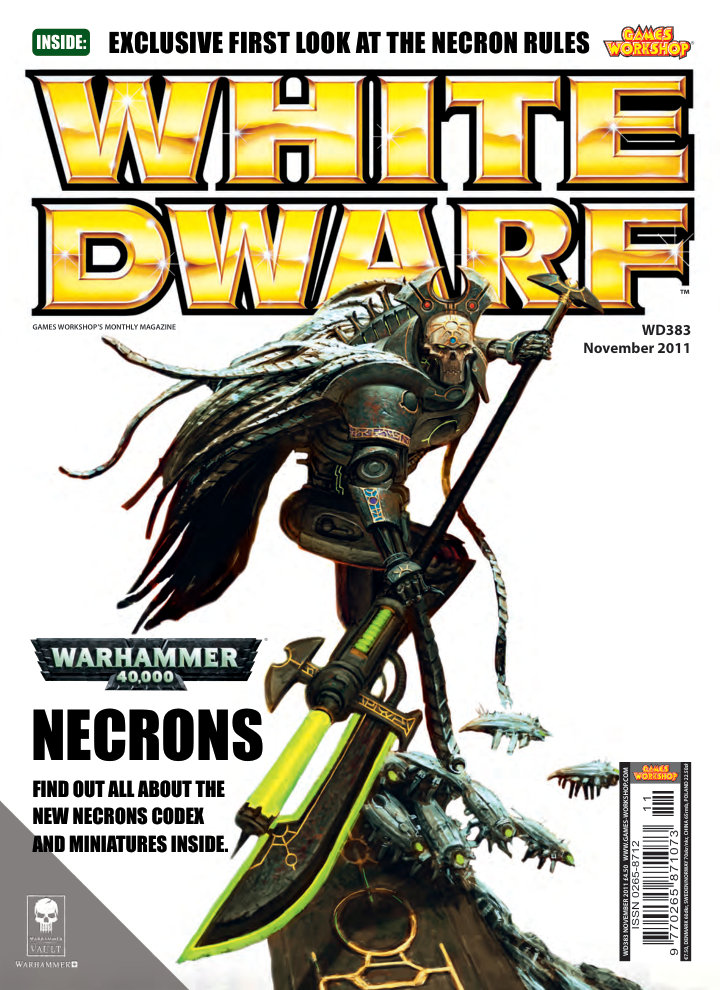
EditorialWD 383 · Inside cover
Andrew Kenrick recalls the first Necron miniature arriving with White Dwarf 217 and introduces the race’s much larger return. A new Codex, elite infantry and elaborate vehicles lead into interviews, a painting showcase and a battle against Sicarius. The editorial connects that original surprise with the imagined terror of a tomb world awakening beneath its unsuspecting inhabitants.
Warhammer 40,000Necrons
InterviewWD 383 · p. 22
Sarah Cawkwell discusses The Gildar Rift, in which the Silver Skulls confront Huron Blackheart’s Red Corsairs through naval war, ground fighting and politics. Their powerful Prognosticators and willingness to obey unfavourable omens distinguish the Chapter without removing it from Imperial conformity. She also previews Accursed Eternity’s investigation of a suspected daemon ship and her first stories set in the Warhammer world.
Warhammer 40,000Silver Skulls
LoreWD 383 · pp. 24–29
The Necrontyr’s short lives and bitter dynastic wars lead to the War in Heaven and the C’tan’s offer of immortality. Biotransference gives them enduring metal bodies but consumes their souls; the Silent King later shatters their former gods and orders the long sleep. The awakening now places reconquest in the hands of individual Overlords, with differing fortunes, personalities and losses making the surviving dynasties more than a uniform army of machines.
Warhammer 40,000Necrons
LoreWD 383 · pp. 28–29
Four dynasties illustrate the diversity of the returning empire. Charnovokh rebuilds escape routes after Tyranid devastation, Nihilakh remains isolated but relentless in retaliation, and distrusted Nekthyst nobles barter military service. Sautekh’s comparatively intact worlds make it the most powerful expansionist realm, and an organisation chart places Imotekh, his royal court, subordinate lords and client dynasties within that hierarchy.
Warhammer 40,000Necrons
LoreWD 383 · p. 28
Three tomb worlds demonstrate what time and eccentric rulers have made of Necron power. Valgûl sends Drazak’s Flayed Ones out to gather flesh, while corrupted navigation at Seidon launches another legion on a random course every thirty-three weeks. Thanatos contains the Celestial Orrery, whose model stars can destroy their real counterparts, making apparent treasures and administrative routines sources of galactic danger.
Warhammer 40,000Necrons
InterviewWD 383 · pp. 30–35
Simon Grant interviews Dave Thomas, Dale Stringer and Tom Walton about translating Necron hierarchy into silhouettes, size and ornament. Shared plastic kits still distinguish snipers, bodyguards and Praetorians, while Flayed Ones deliberately break the army’s ordered appearance. Coffin shapes, crescents and visible power sources connect the vehicles; the Command Barge stays visually restrained so its Overlord remains the focus.
Warhammer 40,000Necrons
ShowcaseWD 383 · pp. 36–39
The studio painters use dynastic identity to move beyond an entirely metallic Necron army. Marble, ceramic plating, rust and varied energy effects distinguish individuals, while gold and ornate panels indicate rank. The commentary explains pale Immortal markings, sinister Deathmarks, gory Flayed Ones and the difference between metallic bodies and dark green vehicle material. It describes artistic choices without supplying named Citadel recipes.
Warhammer 40,000Necrons
TacticsWD 383 · pp. 40–43
Andy Hall and Mat Ward discuss a resilient army built around damaging shooting and repeated self-repair. Gauss, tesla and particle weapons offer different ways to threaten troops and vehicles, while Deathmarks, elite melee units and Crypteks broaden the choices. Ghost Arks combine transport and replacement Warriors, and new vehicle rules turn the visual ideas of hovering command and immense energy weapons into practical battlefield roles.
Warhammer 40,000Necrons
RulesWD 383 · p. 42
The Command Barge carries one independent character as a fast open-topped skimmer. An embarked character can make three sweep attacks against a unit passed over, with speed affecting accuracy and vehicle hits striking rear armour. Symbiotic Repair lets the rider sacrifice a remaining wound to cancel an immobilised or weapon-destroyed result, provided doing so would not kill him.
Warhammer 40,000Necrons
RulesWD 383 · p. 43
The Doomsday Ark’s cannon reaches its full long-range, Strength 9 large-blast potential only if the vehicle remains stationary. Moving at combat speed leaves a shorter-ranged, weaker blast, while independent flank gauss arrays can engage different targets. The page also defines quantum shielding as extra front and side armour that disappears after the first penetrating hit.
Warhammer 40,000Necrons
Battle reportWD 383 · pp. 46–65
Mat Ward and Robin Cruddace bring almost 4,000 points of Necrons against Andrew Kenrick’s Ultramarines and Simon Grant’s Alaitoc Eldar. Imotekh’s lightning, resilient infantry and the new vehicles devastate the defenders of Fort Halstadt before reinforcements and close assaults begin to reverse the damage. On the final turn, a Dire Avenger Exarch and Farseer rout the Warriors on the central objective, producing an Alliance victory by three objectives to two.
Warhammer 40,000Necrons
RulesWD 383 · pp. 46–52
The narrative mission gives defenders a broad fortified deployment area and lets Necrons approach from three sides and take the first turn unless the initiative is seized. Five objectives determine the result after five turns, with an additional reward if the Eldar kill Imotekh in assault. Mat Ward explains how lowering the bastions’ armour and adjusting an existing mission supports the story without requiring a wholly new game system.
Warhammer 40,000
EditorialWD 383 · pp. 68–69
Jervis Johnson describes losing his Vampire Lord and Zombie Dragon to cannon fire on the first turn, then discovering that the ensuing battle remained close and memorable. He connects that experience to deliberately unequal scenarios: an unexpected disaster can create the same interesting challenge as a planned last stand. Continuing with good humour respects an opponent and leaves room for a satisfying comeback even when victory ultimately escapes.
InterviewWD 383 · pp. 70–75
Simon Grant explores Dave Andrews’ latest piece of Imperial architecture, a patched and precarious observatory that records generations of repairs. Skulls, heraldry and a ruined viaduct place it firmly in the Warhammer world, while alternate battlements permit a military rather than magical summit. Rules suggestions and an illustrated feud between neighbouring Wizards show how that character can feed into games.
Warhammer Fantasy Battles
RulesWD 383 · p. 73
Suggested rules treat the main house and elevated tower as separate building sections joined by the walkway. Ordinary troops must occupy the lower section before reaching or assaulting the tower, and only one model fights on each side during that restricted assault. Players can additionally classify it as arcane architecture or a Storm of Magic fulcrum, with the article presenting these as agreed options rather than a compulsory universal profile.
Warhammer Fantasy Battles
LoreWD 383 · pp. 74–75
Astromancer Heinrich Schweinkopf summons a comet to punish the rival who builds a tower beside his observatory. The omen instead draws migrating Ogres, forcing both Wizards to aid the Empire troops defending their homes. The Empire wins a costly fight only for the original revenge to arrive afterwards, burying von Kellhofer beneath his own tower.
Warhammer Fantasy BattlesThe Empire
TacticsWD 383 · pp. 78–83
Simon Grant concludes his Strategy Battle Game series by treating infantry as the foundation of effective combined armies. He separates fighters from archers, then connects heroes, protected flanks and carefully arranged rear ranks to a stable battleline. Shieldwalls, smaller warrior blocks and enveloping attacks offer alternatives according to an army’s equipment and numbers, while the archery advice stresses clear shots and purposeful targets over speculative volleys.
Middle-earth Strategy Battle Game
TacticsWD 383 · p. 79
Affordable heroes can support an infantry army through Might, Courage and protective abilities without consuming the points needed for its ranks. Simon Grant recommends guarding the flanks and leaving room behind defeated models so their own formation does not trap them. Smaller infantry bases can also place several fighters and supporting spears against each charging cavalry model, reducing the rider’s numerical advantage.
Middle-earth Strategy Battle Game
TacticsWD 383 · pp. 80–81
A shieldwall works best with durable front-rank fighters and enough spear or pike support to win their fights. Terrain and shielding models protect its ends, while banners or drums remain behind the line. Smaller independent warrior blocks avoid excessive investment in support troops, and a numerically strong army can instead hold the centre while spare fighters lap around and trap the enemy flanks.
Middle-earth Strategy Battle Game
TacticsWD 383 · pp. 82–83
Archers need safe positions and clear sightlines, with inexpensive shooting heroes offering useful support when protection is limited. Normal shots are preferred to inaccurate volleys whenever a target is available, and Strength and Defence thresholds should guide target choice. Simon Grant also reminds players that archers can fight with their ordinary hand weapons, while stones and throwing weapons are useful opportunities rather than a complete battle plan.
Middle-earth Strategy Battle Game
TacticsWD 383 · p. 83
Two illustrated examples show how an infantry line can win by controlling where an enemy is allowed to fight. Dwarfs shield in the centre while enveloping an Orc formation, forcing it either to break ranks or accept trapping. Adam Troke’s Cannae-inspired arrangement places tougher High Elf spearmen forward so that the weaker blade-armed models face fewer Corsairs.
Middle-earth Strategy Battle GameDwarfs
InterviewWD 383 · pp. 84–85
Colin Grayson nominates the Carnifex as a concept spanning its original Screamer-Killer and current plastic form. The first model turned his interest into a collection of armies, terrain and imagined monster hunts. Jes Goodwin explains the shared six-limbed anatomy and how plastic technology permits a larger, more configurable creature while ordinary heroic opponents remain small enough to preserve the drama of facing it.
Warhammer 40,000Tyranids
TacticsWD 383 · pp. 86–91
Jeremy Vetock builds an Ogre battle plan around the army’s impact hits, attacks and stomps while accounting for its low numbers and broad frontage. Units must be large enough to survive but small enough to manoeuvre, with characters and augmenting magic reinforcing the key combats. Monsters, cavalry, mobile artillery and inexpensive support units create several threats at once, preventing an experienced opponent from simply delaying the most dangerous block.
Warhammer Fantasy BattlesOgre Kingdoms
TacticsWD 383 · pp. 87–88
Units of six or eight Ogres exploit monstrous-infantry ranks and supporting attacks without becoming excessively unwieldy. Champions are useful both for an extra attack and for challenges, while weapon choices balance more damage against an ironfist’s protection. Ironguts and attached Bruisers or Tyrants strengthen the decisive units; Jervis also suggests a much larger Ogre horde when the battle size supports it.
Warhammer Fantasy BattlesOgre Kingdoms
TacticsWD 383 · p. 89
Butchers supply the Great Maw’s short-range augmentations without being as fragile as conventional Wizards, while a Firebelly adds ranged spells and a close-combat breath attack. Mournfangs and the two giant beasts then multiply the threats. Jervis distinguishes a Stonehorn rushing down a flank from a Thundertusk advancing beside the main line, where its chill benefits other Ogres.
Warhammer Fantasy BattlesOgre Kingdoms
TacticsWD 383 · p. 90
The Scraplauncher and Ironblaster combine artillery with a chariot’s ability to advance and fight. Smaller units, including Gnoblars, Sabretusks, Yhetees and Gorgers, prevent enemy flankers from wasting the main blocks’ time, while Maneaters can be tailored to missing roles. Jervis recommends bringing Ironblasters forward so they can exploit grapeshot or a charge instead of remaining static in the rear.
Warhammer Fantasy BattlesOgre Kingdoms
TacticsWD 383 · p. 91
Matthew Hobday shares playtest combinations that improve an Ogre force’s efficiency. Swiftstriding Maneaters are more likely to gain the stronger charge impact, cheap Gnoblars can add ranks and flanks beside the larger fighters, and a poison-resistant Butcher can hunt troublesome skirmishers behind the lines. Each suggestion answers a specific weakness rather than simply adding more expensive combat power.
Warhammer Fantasy BattlesOgre Kingdoms
TacticsWD 383 · p. 91
Phil Kelly proposes a shooting-focused Ogre army built around paired Leadbelcher units, Ironblasters and Scraplaunchers, possibly backed by a Hunter’s harpoon. The plan targets cavalry and monsters before the weakened infantry closes. At that point the supposedly ranged force charges downhill together, using monstrous bodies and chariots to deliver a second form of attack.
Warhammer Fantasy BattlesOgre Kingdoms
ShowcaseWD 383 · pp. 92–93
Mark Bedford’s Evil Sunz use a neatly applied scheme shaded down with washes and weathering powders to reach a finished army efficiently. A converted Realm of Battle section becomes an overrun Imperial outpost turned shantytown, while an altered Deffkopta and the Supa Kannon he designed provide personal centrepieces. He plans further clans and another moving saw conversion, treating the display as a growing collection rather than a final endpoint.
Warhammer 40,000Orks
ModellingWD 383 · pp. 94–101
Duncan Rhodes begins with a planned army list so that the Ecclesiarchy’s unusual models appear alongside its armoured Sisters. The Argent Shroud’s bright silver suits his imagined angelic charge, with red and white repeated across the infantry and darker vehicles. Converted Command Squad fittings, a restrained Battle Conclave palette and carefully posed Retributors show how small choices can tie a varied force together.
Warhammer 40,000Adepta Sororitas
RulesWD 383 · p. 95
The sample force combines Canoness Sabine and a Command Squad with Kyrinov’s mixed Battle Conclave and three Preachers. Two Battle Sister squads specialise in flamers or meltaguns, while Seraphim, heavy-flamer Retributors and two Immolators provide support. Duncan explains the Conclave as a counterassault force and identifies a Penitent Engine as the next addition to the collection.
Warhammer 40,000Adepta Sororitas
PaintingWD 383 · p. 97
Duncan Rhodes sprays the armour silver before picking out red lining and weapons, pale outer robes, dark gloves and hair, and flesh. Different washes shade the metal, face and gold icon before clean layers restore colour and sharp highlights. The same repeatable scheme is applied to ordinary Sisters, squad leaders, Retributors and Seraphim, giving the whole Argent Shroud force a common finish.
Warhammer 40,000Adepta Sororitas15 paint colours
PaintingWD 383 · p. 99
The Immolators use broad, light grey drybrushing over black instead of individually highlighting every panel. Thin Scorched Brown is worked into recesses and more heavily towards the tracks, then the grey is reapplied and finished with a paler pass. The approach produces readable dark hulls and road dirt quickly while leaving room for the vehicles’ religious decoration.
Warhammer 40,000Adepta Sororitas4 paint colours
LoreWD 383 · p. 100
An organisation chart places the Sisterhood beneath the Ecclesiarch and Abbess, divided between Convent Sanctorum on Ophelia VII and Convent Prioris on Terra. Each convent includes major military orders alongside Hospitaller, Famulous and Dialogus branches and smaller orders. The chart supplies the institutional background Duncan used to plan his collection rather than imposing an army-selection rule.
Warhammer 40,000Adepta Sororitas
LoreWD 383 · p. 101
The six great military orders are explained through their patron saints and inherited ideals. Mina’s aggression shapes the Bloody Rose, Arabella’s composure the Sacred Rose, Katherine’s martyrdom a tradition of vengeance and Dominica the Ebon Chalice’s ancient discipline. Lucia’s penitence informs the Valorous Heart, while Silvana’s quiet selflessness and the image left on her shroud define the Argent Shroud.
Warhammer 40,000Adepta Sororitas