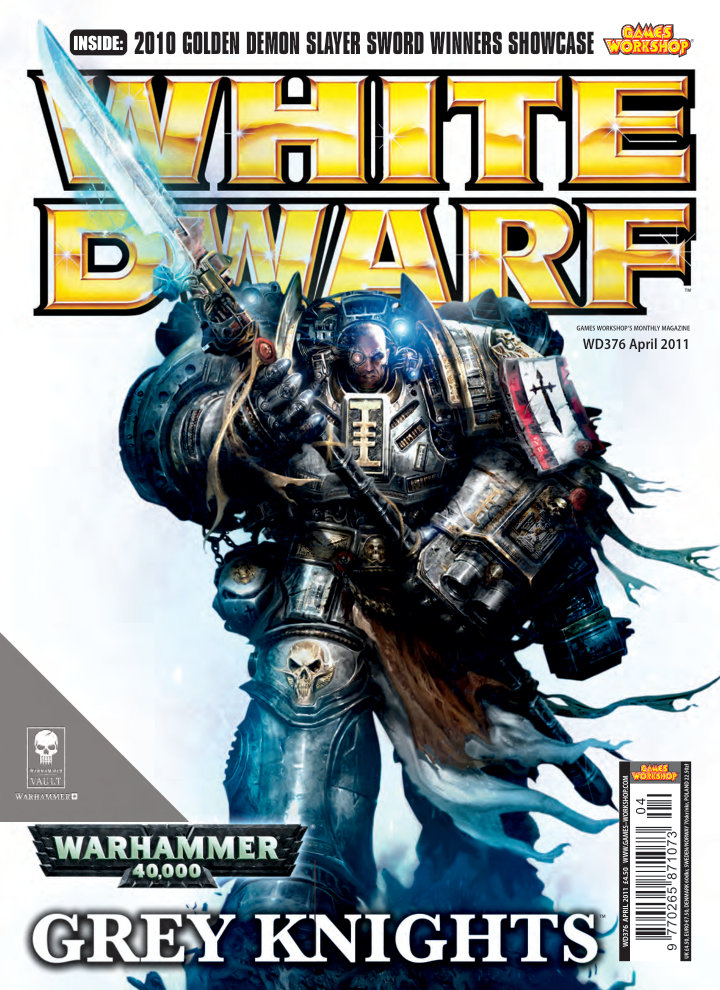
EditorialWD 376 · Inside cover
Andrew Kenrick introduces a Grey Knights release that greatly expands a long-established Chapter with Paladins, Dreadknights, teleporters and new weaponry. The issue follows those ideas through sculptor interviews, modelling demonstrations and a battle between two first-time report participants. Kenrick also welcomes Simon Grant as a staff writer after his earlier contributions to the magazine.
Warhammer 40,000Grey Knights
FictionWD 376 · p. 11
Scipio Vorolanus leads his Ultramarines through an ice-choked refinery under relentless Necron fire, but Tigurius orders them to halt before their final advance. The Librarian exposes Flayed Ones buried beneath the courtyard, revealing a living minefield intended to catch the charging Marines. The warning saves the squad from surprise, yet the ensuing fight still costs Naceon his life and leaves Scipio confronting the killer at close quarters.
Warhammer 40,000Ultramarines
CommunityWD 376 · pp. 12–13
An Easter campaign sends the Grey Knights to Thalassocres to prevent Ghargatuloth’s awakening, alongside related building and gaming activities. Roleplaying previews cover Deathwatch’s Rites of Battle, with Chapter creation and an expanded armoury, and Dark Heresy’s The Black Sepulchre, the beginning of the Apostasy Gambit. School League finalists and the growing online rules archive round out the issue’s news.
Warhammer 40,000DeathwatchGrey Knights
InterviewWD 376 · pp. 14–27
Andy Hall gathers the designers of the new Grey Knights plastics to explain how knightly heraldry, engraved script and wrist-mounted guns preserve the Chapter’s identity while increasing posing freedom. Separate wrists release sword blades from moulding constraints, and shared weapon designs connect the infantry to the Dreadknight. The latter grows around its exposed Terminator pilot, with matching limb positions, fine mechanical detail and a coherent internal logic keeping the huge rig part of the miniature range.
Warhammer 40,000Grey Knights
LoreWD 376 · p. 20
The Dreadknight gives a single Grey Knight the strength and resilience to meet a Greater Daemon on equal terms. Synaptic connections make its limbs an extension of the pilot’s own body, while a powerful force field protects the apparently exposed warrior. Its technology remains secret and its demanding control system means only a few exceptional Battle-Brothers can master it.
Warhammer 40,000Grey Knights
RulesWD 376 · p. 21
The reproduced profile establishes the Dreadknight as a heavily armoured Monstrous Creature with psychic powers, a protective invulnerable save and the ability to arrive by Deep Strike. Dark Excommunication temporarily disables the Daemonic Gifts of a unit in contact, allowing the pilot to strip a dangerous enemy of its supernatural advantages before blows are struck. A brief Bray-Nexus account illustrates its intended role against the greatest Daemons.
Warhammer 40,000Grey Knights
InterviewWD 376 · pp. 22–25
Mat Ward describes the Grey Knights as incorruptible sorcerers whose advanced equipment and mystical rites belong equally to Warhammer 40,000. The new Codex places scattered older facts into a fuller framework while presenting the Chapter as ruthless pragmatists prepared to sacrifice innocents for secrecy or victory. On the battlefield its specialised squads receive complementary powers, and the return of Inquisitors, Assassins and Jokaero adds an eccentric Imperial counterpoint to the silver-armoured warriors.
Warhammer 40,000Grey Knights
TacticsWD 376 · p. 26
This 1,998-point force uses a Stormraven to insert a Brother-Captain, Paladins and a Venerable Dreadnought while a large Terminator squad teleports onto an objective. A Rhino-mounted Purgation Squad supplies mobile fire support and can use Astral Aim against hidden enemies. An attached Ordo Hereticus Inquisitor brings a flexible Jokaero-led henchman unit, broadening the elite force’s available tools.
Warhammer 40,000Grey Knights
TacticsWD 376 · p. 27
Castellan Crowe’s 1,497-point army takes Purifiers as Troops and supports its small infantry force with two differently equipped Dreadknights. Cleansing Flame helps the Purifiers resist massed enemies, while one giant rig specialises in ranged attacks and the other in assault. Keeping the machines in reserve or using their resilience to absorb attention are both options, but the list remains vulnerable to being overwhelmed by numbers.
Warhammer 40,000Grey Knights
LoreWD 376 · pp. 30–35
Jeremy Vetock traces how a successful Warboss attracts rival tribes until their shared urge for destruction becomes a Waaagh! Most collapse through infighting or poor direction, while exceptional leaders sustain enough momentum to devastate nations. Famous invasions and smaller eccentric examples provide themes for armies and linked battles, encouraging players to record their own Warboss’s rise, recruits and grudges.
Warhammer Fantasy BattlesOrcs & Goblins
LoreWD 376 · p. 31
Azhag’s sentient crown makes his invasion a struggle between Orc brutality and Nagash’s calculating influence. The article highlights the three-cohort attack and summoned dead at Butcher’s Hill, followed by Azhag’s defeat at Osterwald against Werner von Kriegstadt and two Steam Tanks. These contrasting battles offer ways to recreate both the Waaagh!’s tactical ingenuity and its final collapse.
Warhammer Fantasy BattlesOrcs & Goblins
LoreWD 376 · p. 32
Gorbad Ironclaw turns a small series of raids into an invasion numbering hundreds of thousands, destroying Solland and killing Emperor Sigismund. His victories span greenskin recruitment, Dwarf warfare, the burning Moot and attacks across the Empire. The piece proposes selecting key encounters from that enormous campaign rather than attempting to refight every engagement.
Warhammer Fantasy BattlesOrcs & Goblins
RulesWD 376 · p. 32
Funglus the Mad frees his Night Goblins from an Ogre tribute and attracts followers through spectacular mushroom-fuelled magic. The tabletop theme limits leadership to the Shaman’s own modest value and rewards Fanatics with a re-roll of their destructive hits. Funglus may also re-roll a mushroom test, but a second result of one kills him outright, recreating the disastrous end of his campaign.
Warhammer Fantasy BattlesOrcs & Goblins
LoreWD 376 · p. 33
After a Giant’s accidental blow, Uggah Skullkracker decides to pile enough severed heads to reach the sky and challenge Gork. His Savage Orcs raid from Numas into the Worlds Edge Mountains, shrinking and stacking trophies around a Barrier Idol. A matching army emphasises primitive infantry and cavalry, Wurrzag and warpainted Giants, with its commander eagerly accepting challenges to collect another skull.
Warhammer Fantasy BattlesOrcs & Goblins
LoreWD 376 · p. 34
Grimgor Ironhide seeks opponents worthy of his violence, accompanied by his scarred Black Orc bodyguard, da Immortulz. His destructive fury can fall on his own followers as easily as on an enemy, yet other greenskins flock to such obvious power. The article presents his Waaagh! as an ever-changing following around a force of nature rather than a carefully administered conquest.
Warhammer Fantasy BattlesOrcs & Goblins
LoreWD 376 · p. 35
Thokka Thump’s chariot-led invasion values speed and the impact of riding over a defeated enemy. Mounted Orcs and Goblins, massed chariots and enthusiastic Snotling Pump Wagons keep pace until an organised Nuln army halts the advance. Recreating the theme means gathering a multiplayer mounted horde and testing its charge against heavy Empire artillery.
Warhammer Fantasy BattlesOrcs & Goblins
LoreWD 376 · p. 35
Grok Blackscab’s Burning Skull tribe combines exhaustive looting with deliberate destruction, using flaming arrows to help leave nothing standing. Fortified mountain settlements slow its progress before the invaders descend on Bretonnian villages. Loot & Pillage and Raze & Ruin provide suggested scenario frameworks for turning this record of arson and plunder into a raiding campaign.
Warhammer Fantasy BattlesOrcs & Goblins
TacticsWD 376 · pp. 38–43
Simon Grant explains how allied formations and Epic Heroes can supply missing capabilities, support an army’s theme or simply give a favourite model a place in battle. He clarifies the quarter-points allowance, the rarity and legendary restrictions, and how battlehosts interact with those limits. Studio examples combine Dwarfs with cavalry, Elves with Ents and Gondor with Gandalf, while warning that excessive hero spending or too many unrelated factions can leave an army weak and incoherent.
War of the RingGondor
TacticsWD 376 · p. 43
The 1,980-point Rohan force adds Gandalf the White and the Three Hunters to Théoden’s Guard and a strong cavalry core. Its speed and Expert Riders favour flanking attacks rather than defence, while the allied heroes help win combats and stabilise Courage. Éomer can combine Epic Rage with the Bring it Down! fortune to turn a large rider formation into a dangerous monster-hunting unit.
War of the RingRohan
CommunityWD 376 · pp. 44–47
Andy Hall describes Games Day’s blend of participation games, designer conversations, displays and painting competition, tracing its growth from London events into an international gathering. Highlights from Italy, Spain, North America and the UK include live painting, conversion contests, enormous gaming displays and a life-sized Ultramarine. The article explains the exclusive annual miniatures and celebrates Australia’s returning event, placing Golden Demon within the wider hobby meeting.
ShowcaseWD 376 · pp. 48–51
The gallery brings together the international Slayer Sword winners, spanning diorama, monster, duel, squad and individual Warhammer entries. Matt Parkes explains that his fourth UK-winning diorama grew organically over four years from models he wanted to include, with the banner alone taking six weeks to paint. The other winners demonstrate the range of subjects and approaches recognised at the highest level of the competition.
Warhammer Fantasy BattlesWarhammer 40,000
Battle reportWD 376 · pp. 52–71
Kevin Chin’s 2,246-point Grey Knights meet Tom Hutchings’ 2,247-point Daemons in Fight to the Death, a Battle Missions struggle for total annihilation. Sanctuary stalls crucial charges and a Dreadknight holds one flank, but the Changeling repeatedly turns the Marines’ fire against their brothers and nearly reverses the battle. Draigo’s rapid banishment of Fateweaver removes the Daemons’ protective re-rolls; the unbroken Paladins and their Librarian then finish the enemy in a decisive Grey Knights victory.
Warhammer 40,000Grey Knights
EditorialWD 376 · pp. 72–73
Jervis Johnson adopts a writing maxim as a practical tool for design: decide what a project must achieve, then remove cherished elements that fail to serve it. He credits the approach with helping shape third-edition Blood Bowl and applies it to army choices, tactics and painting plans. Lelith Hesperax’s economical sculpt illustrates the same discipline, though Johnson stresses that cutting detail is a means to clarity rather than an objective of its own.
Blood Bowl
ShowcaseWD 376 · pp. 74–79
Darren Latham and Joe Tomaszewski discuss the team’s Grey Knights through silver armour, red-and-white heraldry and contrasting blue force weapons. Distinctive details identify Purifiers, Apothecaries and characters, while painted cloth banners use non-metallic effects to represent embroidery. Vehicles receive darker, duller silver so the infantry remain prominent, and the Dreadknight’s subdued workings draw attention to its pilot rather than competing with him.
Warhammer 40,000Grey Knights
InterviewWD 376 · pp. 82–83
Alan Merrett nominates Aly Morrison’s 1994 Daemon Slayer for its extravagant hair, beard, axe and unmistakably Warhammer personality. A companion gallery shows how the wider Slayer range varies that core image. Morrison recalls the earlier Alan Perry model that inspired him and explains his preference for aggressive, emotional poses, joking that a new version would have still larger hair and weaponry.
Warhammer Fantasy BattlesDwarfs
ModellingWD 376 · pp. 84–91
Matt Holland and Chad Mierzwa demonstrate how two plastic kits can create six distinct Grey Knight squad types. Matching weapon-arm letters, separate wrists, deliberate head direction and converging lines of stance and weapon establish natural movement before glue fixes the pose. Terminators exploit their larger bases and heavy weapons, while each power-armoured squad receives a recognisable combat attitude; accompanying painting guides finish the silver armour and white-helmeted Purifiers.
Warhammer 40,000Grey Knights13 paint colours
ModellingWD 376 · p. 85
Matt Holland uses the matched arm letters to establish a sound two-handed grip, then adjusts weapon axis, torso and head to suggest a specific action. Purity seals and shoulder pads reinforce that motion rather than fighting it. The examples range from braced counter-thrusts and parries to finishing a decapitation, showing how small rotations change the narrative of an otherwise familiar model.
Warhammer 40,000Grey Knights
PaintingWD 376 · p. 89
Chad’s fast tabletop method sprays Boltgun Metal over black before adding blue recess shade and a thinned black wash. Gold details receive sepia shade and brighter metallic highlights, while Chainmail and Mithril Silver restore the armour’s shine. A separate blade sequence combines black and repeated blue washes with sharp silver edges, making the force weapon look psychically charged while retaining a metallic finish.
Warhammer 40,000Grey Knights9 paint colours
PaintingWD 376 · p. 90
The Purifier’s white helmet begins with Astronomican Grey, a carefully placed black recess wash and progressively lighter grey-white layers. Blue lenses receive pale highlights and a tiny white reflection, while parchment starts in Bleached Bone, is shaded with sepia and restored with bone and white. Keeping the dark eye sockets and shaded recesses intact gives the pale helmet definition without dirtying its symbolism.
Warhammer 40,000Grey Knights6 paint colours
PaintingWD 376 · pp. 94–101
Duncan Rhodes and Nick Bayton choose the Flesh Tearers for their sinister crimson-and-black appearance and build forty Marines from two Blood Angels Battleforces. They prioritise the models’ character and aggressive movement, use a test figure to establish the scheme and paint the army together before finishing individual squads. Two Rhinos and a weathered Stormraven carry the same visual balance, with Gabriel Seth and a deliberately animated Assault Squad forming the centrepiece.
Warhammer 40,000Blood Angels13 paint colours
PaintingWD 376 · p. 95
Sprayed Mechrite Red followed by Red Gore establishes the armour, with black panels and metallic details added before shading. Pale bone edge highlights are toned back with Baal Red, leaving a deep crimson result, while black uses Codex Grey and metal uses Mithril Silver. The raised Chapter badge has its own short sequence: grey-to-white saw teeth surround a Mechrite Red blood drop brightened with Blood Red.
Warhammer 40,000Blood Angels12 paint colours
ModellingWD 376 · p. 96
Micah’s squad uses braced legs, twisted torsos and raised boltguns to capture the classic standing-and-firing Space Marine pose. Duncan places the helmet last because its direction completes the figure’s action. The accompanying workflow explains why applying the main colours to the whole army before finishing squads creates consistency, and why he saves tanks as a welcome change of pace after infantry.
Warhammer 40,000Blood Angels1 paint colour
PaintingWD 376 · p. 97
The Flesh Tearers’ Rhinos place broad black areas around selected crimson panels, mirroring the strongest visual elements of the infantry. Duncan replaces the infantry’s bone edge highlight with Kommando Khaki so he can avoid a wash pooling on flat armour. Etched brass supplies the Chapter icon, while a transfer and a hand-painted blood drop establish the company marking.
Warhammer 40,000Blood Angels3 paint colours
ModellingWD 376 · p. 98
Uziel contrasts with the firing squad by using running Assault Marine legs, twisted bodies and raised weapons to suggest a headlong advance. Even its missile-launcher bearer sprints, reinforcing the Marines’ superhuman strength. Spare Death Company components distribute Blood Angels imagery throughout the unit, while ready-made Flesh Tearers shoulder pads simplify the repeated Chapter markings.
Warhammer 40,000Blood Angels
ModellingWD 376 · p. 99
Duncan makes the Death Company more violent than the already aggressive Tactical and Assault squads by alternating running attacks with braced melee poses. The height and angle of each weapon imply a blow, a challenge or a swirling close fight. Brighter Blood Red highlights over Red Gore distinguish the red details against black armour, followed by the familiar wash that ties the unit into the army.
Warhammer 40,000Blood Angels4 paint colours
PaintingWD 376 · p. 100
Nick’s Stormraven repeats the Rhinos’ black-and-crimson arrangement and soft khaki edge highlights, building thin red coats for a smooth finish. Stippled Boltgun Metal along leading edges and the assault ramp makes the aircraft visibly battleworn. Etched brass and familiar blood-drop and wing motifs identify a gunship intended to deliver Seth and his bodyguard into the thickest fighting.
Warhammer 40,000Blood Angels4 paint colours
ModellingWD 376 · p. 101
Seth’s bodyguard uses an Assault Squad without jump packs so it can travel with him in the Stormraven. Duncan cuts and repositions wrists, twists waists and mixes running with braced legs to create sword blows, grenade throws and advancing attacks. Mark IV parts distinguish the Sergeant, while Seth is painted last with extra highlights using the army’s established method.
Warhammer 40,000Blood Angels