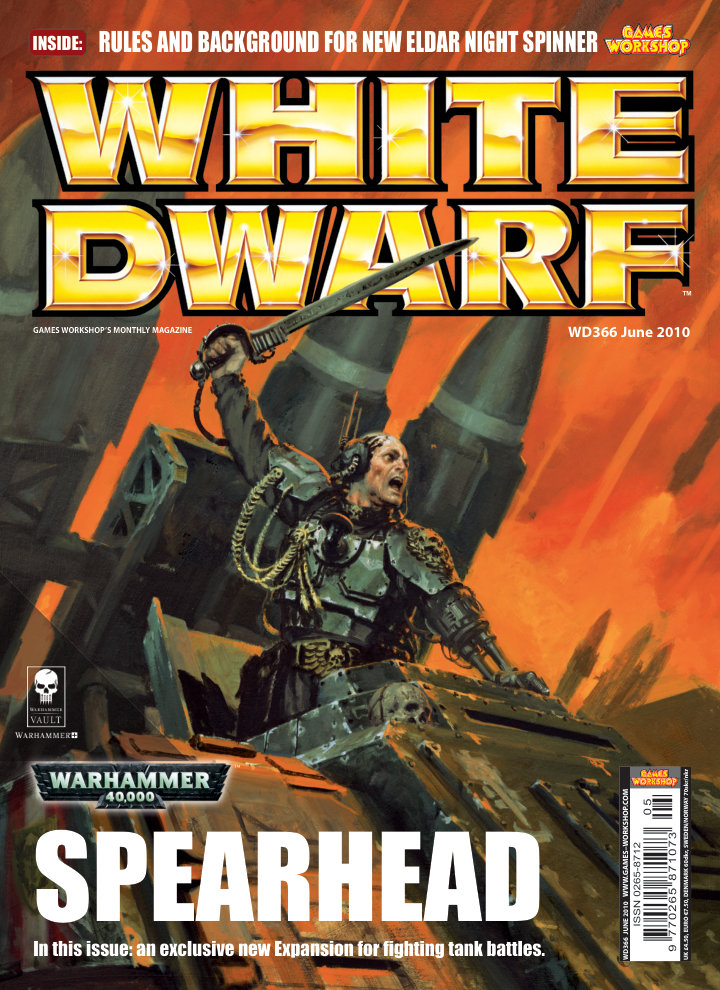
EditorialWD 366 · p. 1
Andrew Kenrick introduces his first issue as editor and the vehicle battles of Spearhead. He describes White Dwarf as a magazine to revisit, citing campaigns, battle reports and painting guides that remain useful on his desk. His recollection of attempting the cardboard Baneblade from his first issue contrasts with the plastic super-heavy tanks now available, connecting personal hobby history to the issue’s armoured theme.
Warhammer 40,000
CommunityWD 366 · pp. 12–15
The news announces William King’s return to Black Library with a Tyrion and Teclis trilogy and celebrates international competitors at the Strategy Battle Game Grand Tournament. A revised Throne of Skulls format emphasises enjoyable games and varied armies, while the School League approaches its national final. The web column points readers towards downloadable Spearhead formations, older Inquisition codexes and supporting modelling material, distinguishing those online resources from the rules printed in this issue.
Warhammer Fantasy BattlesWarhammer 40,000High Elves
InterviewWD 366 · pp. 16–27
Adam Troke talks to the designers behind the new Imperial Guard and Eldar vehicles. Dave Andrews explains the Imperium’s deliberately archaic tanks, while Tom Walton and Dale Stringer discuss interchangeable Leman Russ variants and the dual Manticore–Deathstrike kit. Jes Goodwin traces the Eldar’s flowing vehicle shapes back to the 1990s and describes the collaborative redesign of the Fire Prism and Night Spinner, accompanied by background and gaming notes on iconic tanks.
Warhammer 40,000Imperial Guard
TacticsWD 366 · pp. 18–21
The Leman Russ overview presents its combination of heavy protection, long range and variant weapons as the Imperial Guard’s armoured benchmark. The accompanying artillery discussion contrasts the Manticore’s repeated rocket salvos with the Deathstrike’s delayed but potentially overwhelming single missile. These introductory profiles explain why opponents must prioritise the artillery while confronting tanks able to support a wide range of battlefield roles.
Warhammer 40,000Imperial Guard
RulesWD 366 · p. 25
The official Heavy Support entry introduces the Night Spinner as a fast skimmer carrying a twin-linked doomweaver. Its long-range barrage uses Rending monofilament to threaten infantry and vehicles, while units it hits face difficult and dangerous terrain on their next movement. The entry supplies the complete profile, points and vehicle upgrades, explaining how an otherwise silent web becomes both an artillery attack and a temporary obstacle to the enemy’s advance.
Warhammer 40,000Aeldari
RulesWD 366 · pp. 30–37
Jervis Johnson presents an expansion for armoured battles fought along the length of the table. A flexible force organisation chart permits ordinary armies, combinations with specialist spearheads or forces composed entirely of formations. The printed framework explains selection, terrain, scoring, three missions and three deployment methods, while twelve formation types are supplied separately online; a Tank Hunter example shows how a formation changes the capabilities of its vehicles.
Warhammer 40,000
RulesWD 366 · p. 31
The printed example allows up to three Tank or Walker units to form a veteran hunting group for an additional formation cost. Each vehicle gains Tank Hunters, representing crews who study the battlefield and opposing vehicles before engaging. Background and modelling ideas connect the advantage to kill rings and other veteran markings, while demonstrating the format used for the broader selection of downloadable spearheads.
Warhammer 40,000
RulesWD 366 · pp. 32–34
Spearhead removes compulsory force slots and allows one formation of each type, encouraging higher points limits to accommodate armoured assets. The table runs between its short edges, so outflankers use the long edges and terrain should leave practical movement corridors. Troops, Tanks, Walkers and spearhead units can score, subject to stated exceptions, making surviving damaged vehicles valuable even when their guns or mobility have been lost.
Warhammer 40,000
RulesWD 366 · p. 35
Breakthrough turns the opposing half of the battlefield into the objective: each scoring unit that reaches it earns one point at the end. Players must balance destroying enemy spearheads against moving their own vehicles through the front line. Because Spearhead grants scoring status to many armoured units, the mission rewards the preservation and movement of tanks as well as the work of any accompanying infantry.
Warhammer 40,000
RulesWD 366 · p. 35
Lightning War places three objectives across the length of the table, separating them widely enough to demand an advancing force. Destroyed enemy super-heavy vehicles can add further objectives, turning wreckage into strategically useful ground. Control follows the presence of scoring units and the absence of enemy contesting units, so success requires both a swift attack and enough surviving formations to hold the gains when the random game length ends.
Warhammer 40,000
RulesWD 366 · p. 35
One side places a vital objective worth three points and the other three minor objectives worth one each. This asymmetry can initially balance the battlefield, but forces must cross the table or contest enemy positions to break the deadlock. Wrecked enemy super-heavies become additional objectives, while minimum spacing and edge restrictions prevent either player from concentrating all the important ground in an easily defended corner.
Warhammer 40,000
RulesWD 366 · p. 36
Opposing wedge-shaped deployment zones create an armoured point of contact rather than two broad lines across the table. Players may reserve deep-striking units and up to half the remainder, then deploy infiltrators and make Scout moves in the normal sequence. The framework retains Seize the Initiative and explicitly addresses disclosure of embarked troops and army lists, keeping unusual deployment compatible with ordinary fifth-edition conventions.
Warhammer 40,000
RulesWD 366 · p. 37
Cauldron begins with the armies at opposite short ends of the battlefield, each more than eighteen inches from the middle line. Units that can deep strike may reserve freely, with up to half the remaining force also held back. The separation gives long-ranged guns room to work and makes the first advance a significant commitment, while infiltrators and Scouts still provide ways to alter the initial confrontation.
Warhammer 40,000
RulesWD 366 · p. 37
Escalation starts with only one spearhead or three ordinary units on each side, deploying more than nine inches from the table’s centre. Everything else must arrive from reserve, so an initially small engagement develops into a larger armoured battle. The setup limits even infiltrating forces to the same starting allowance, making the choice of initial formation and the arrival of reinforcements central to the game.
Warhammer 40,000
RulesWD 366 · pp. 40–43
Mat Ward supplies Strategy Battle Game profiles for miniatures previously released with War of the Ring in mind. Faramir gains an inspiring mounted incarnation, Duinhir and his Blackroot Vale archers specialise in hunting monsters, Mauhúr accelerates his Uruk-hai scouts and the Dwimmerlaik drains enemy heroes’ resources. Existing Legions of Middle-earth lists determine where they fit, and a complete White Mountains ambush scenario puts several of the new arrivals into action.
Middle-earth Strategy Battle GameGondor
RulesWD 366 · p. 40
This mounted and heavily armoured version of Faramir represents his leadership during Gondor’s defence of Ithilien and the Anduin. His extended Stand Fast range helps steady a larger section of the army, and selected Gondorian troops nearby also benefit as though in range of a banner. The entry includes his complete characteristics and hero resources, and permits him in either the Tower of Ecthelion or Rangers of Ithilien list.
Middle-earth Strategy Battle GameGondor
RulesWD 366 · p. 41
Duinhir’s profile makes the lord of Morthond a specialised archer rather than simply another captain. Pathfinder lets him cross rocky difficult ground readily, while his monster-targeted shooting rerolls failed wounds and can cause multiple wounds with a successful hit. The entry identifies eligible large creatures, details Fate’s interaction with the extra wounds and places Duinhir in a Fiefdoms army.
Middle-earth Strategy Battle GameGondor
RulesWD 366 · p. 41
Blackroot Vale Archers bring reliable monster-hunting shots to the Fiefdoms list, rerolling failed wound rolls against a specified range of large creatures. Their entry includes basic equipment and optional banner and war horn, with the latter improving the army’s Courage while a hornblower survives. These rules translate the Blackroot Vale’s reputation for identifying weak points into a clear supporting role alongside Duinhir.
Middle-earth Strategy Battle GameGondor
RulesWD 366 · p. 42
The final named Ringwraith entry introduces a spirit especially feared in Rohan, equipped with a hand weapon and enchanted greatsword. Sap Fortitude can force nearby enemy heroes to spend additional Might, Will or Fate, cancelling an attempted deed if they cannot pay. A large Will reserve, a selection of familiar Nazgûl powers and several mounts give the model a resource-denial role despite having no Might of its own.
Middle-earth Strategy Battle GameMordor
RulesWD 366 · p. 42
Mauhúr is an aggressive Isengard Raider captain whose speed and woodland movement reflect his tireless pursuit of prey. Including him unlocks an inexpensive upgrade that gives Uruk-hai Scouts the same improved movement and ability to cross forests. The profile combines these distinctive pursuit rules with three attacks and normal hero resources, allowing a themed scouting force to manoeuvre faster without relying on cavalry.
Middle-earth Strategy Battle GameIsengard
RulesWD 366 · p. 43
The Dwimmerlaik directs Orcs and two Trolls against Faramir’s small bodyguard in wooded foothills. The attackers approach from opposite edges, while Duinhir and the remaining Gondorian force arrive as fourth-turn reinforcements. Victory points reward killing Faramir, banishing the Ringwraith, destroying the Trolls and breaking the enemy first, creating competing priorities beyond simply defeating the opposing army.
Middle-earth Strategy Battle GameGondor
LoreWD 366 · pp. 44–49
Andy Hall surveys the conflicts that define the Warhammer world before revealing that a new edition will arrive in July. The preview stresses larger formations, towering monsters, more dramatic magic and expanded background, artwork and army photography. Its centrepiece is the forthcoming 528-page rulebook, but detailed mechanics are deliberately deferred to the next issue, making this an introduction to the setting and the scale of the new release.
Warhammer Fantasy BattlesThe Empire
TacticsWD 366 · pp. 50–55
Codex author Mat Ward builds an assault-oriented Blood Angels army from its essential roles rather than filling it with every elite choice. Death Company provide a terrifying attack, ordinary Assault Squads secure objectives and specialist characters or veterans add focused advantages. Priests, transport choices and mobile supporting fire hold the plan together, with a closing warning that too many expensive units can leave the army short of the models needed to execute it.
Warhammer 40,000Blood Angels
TacticsWD 366 · pp. 50–51
Death Company selection begins with a decision about likely targets and delivery. Relentless boltguns help thin hordes, special melee weapons attack tougher enemies and a Chaplain dramatically improves the charge through rerolls. Mat compares inexpensive walking units with fast Rhinos, jump packs and Land Raiders, while explaining why even a small surviving squad can earn its place after absorbing enemy fire.
Warhammer 40,000Blood Angels
TacticsWD 366 · pp. 51–52
Ordinary Assault Squads supply the scoring bodies the Death Company cannot provide, and nearby Sanguinary Priests greatly increase their durability and charge strength. Sanguinary Guard, Assault Terminators, Vanguard Veterans and aggressive Dreadnoughts add specialised punch. The discussion emphasises matching those investments to a role, including the magna-grapple’s ability to pull a vehicle into a more favourable position and the Blood Angels’ unusually accurate arriving veterans.
Warhammer 40,000Blood Angels
TacticsWD 366 · pp. 52–54
Mat compares the flexible Captain and Librarian with the Chapter’s powerful named leaders. The Sanguinor specialises in hunting an enemy commander, Dante improves his own unit’s mobility, Mephiston acts as a fast independent threat and Astorath reshapes the incidence of the Red Thirst and Death Company selection. Tycho’s two incarnations illustrate the trade between army leadership and personal ferocity, encouraging a choice based on the army’s plan rather than reputation alone.
Warhammer 40,000Blood Angels
TacticsWD 366 · pp. 54–55
The support section starts by asking what the assault elements cannot handle, especially enemy armour and massed infantry. Tactical Squads can follow behind to claim ground, while fast Baal Predators and other tanks keep pace and suppress counterattacks. Bikes, Land Speeders, Dreadnoughts and Land Raiders offer alternative balances of mobility and protection, with transports serving both as delivery systems and tools for blocking enemy fire.
Warhammer 40,000Blood Angels
LoreWD 366 · pp. 56–61
Robin Cruddace recounts the two-year Dellerax campaign between Pask’s Cadians and Fell Winter’s Saim-Hann host. Their final battle unfolds in a metallic sandstorm that initially favours Eldar targeting systems; Pask destroys a Warlock Titan before a vortex missile tears apart the mysterious tower at the storm’s heart. Four formation datasheets translate the campaign’s coordinated artillery, command tanks and concealed Eldar strikes into Apocalypse play.
Warhammer 40,000Imperial Guard
RulesWD 366 · p. 58
Three Manticores deploy as a battery supported by Enginseers and Servitors. The Techpriests can attempt to reload stationary launchers instead of using their normal repair ability, with a risk of disrupting a weapon. An Alpha Strike combines multiple remaining rockets into an apocalyptic barrage, allowing the commander to trade sustained future fire for an immediate concentrated blow while respecting the ammunition each vehicle actually carries.
Warhammer 40,000Imperial Guard
RulesWD 366 · p. 59
Pask commands three full Leman Russ squadrons with veteran accuracy and an extended command radius. His special orders let squadrons surge forwards instead of firing, fire stationary turret weapons twice at one target or shoot with twin-linked accuracy. The formation represents a hand-picked armoured headquarters capable of coordinating different Russ variants, turning Pask’s command role into several practical choices rather than a single universal bonus.
Warhammer 40,000Imperial Guard
RulesWD 366 · p. 60
Three Night Spinners work with Rangers who locate targets beyond the tanks’ own effective view. Ranger Sight improves range and scatter when the spotters can see the victim, while prone targets become especially vulnerable to the descending web. Combining all three doomweavers creates a larger barrage with improved infantry Rending, translating the Dellerax ambush story into cooperation between concealed artillery and forward scouts.
Warhammer 40,000Aeldari
RulesWD 366 · p. 61
A pair of Fire Prisms and three Vyper squadrons form a concealed Titan-hunting group. Infiltration, camouflage and improved armour penetration help them reach a favourable position, while the Vypers support the Prisms by stripping shields and distracting the target. If both main tanks remain stationary and maintain sight of one another, they can combine fire into a devastating twin-linked Destroyer shot, trading movement for the killing strike.
Warhammer 40,000Aeldari
Battle reportWD 366 · pp. 62–81
Robin Cruddace’s Saim-Hann fights Graham Davey’s Imperial Guard in a 3,000-point Spearhead game around a fallen Titan. Early Imperial fire destroys the Eldar escorts and a Deathstrike hits all three Fire Prisms, but holo-fields keep the damaged tanks alive. Fuegan dismantles Pask’s armour, the Night Spinner disrupts the defenders and the surviving Prisms claim the vital ground, giving Robin a five-to-zero objective victory despite heavy losses.
Warhammer 40,000Aeldari
TacticsWD 366 · pp. 64–65
Robin’s 2,997-point Eldar list uses Tank Hunter Fire Prisms for the main ranged attack and an Outrider group to deliver Fuegan and his Fire Dragons. Archeotech War Walkers gain more potent weapons at a risk, while jetbikes, Shining Spears and Swooping Hawks supply rapid threats and objective reach. The plan recognises that closing quickly and exploiting weak armour is safer than trading fire directly with long-ranged Leman Russ squadrons.
Warhammer 40,000Aeldari
TacticsWD 366 · pp. 66–67
Graham’s 3,000-point Imperial Guard force exploits Spearhead’s freedom to omit a conventional headquarters and put Pask in command. Tank Hunters provide a durable centre, an Ambush group seeks advantageous firing positions, and protected Manticores and a Sentinel-escorted Deathstrike deliver artillery. Mechanised infantry, a Valkyrie and a Hellhound supply reserves and mobility, balancing the temptation to fill the whole force with battle tanks.
Warhammer 40,000Imperial Guard
TacticsWD 366 · pp. 68–69
The wrecked Phantom Titan is the three-point vital objective, balanced by three minor Eldar installations in the opposite half. Counter-attack wedges put each army’s more resilient spearhead at the front, while Pask’s Ambush formation begins outside the usual zone in cover. The report explains how the apparently balanced initial objective value compels an attack, and why Graham retains a mechanised platoon and Valkyrie for later intervention.
Warhammer 40,000Imperial Guard
EditorialWD 366 · pp. 82–83
Jervis Johnson traces his fascination with tanks to childhood model kits and the pleasure of adding stowage, commanders and signs of wear. He recalls how Adeptus Titanicus and Space Marine established a range of armoured machines before large plastic kits were practical. Although Spearhead provides a new way to use them, his central argument is that assembling, converting and painting a convincing vehicle can be a satisfying hobby in its own right.
Warhammer 40,000Epic
ModellingWD 366 · pp. 84–89
Andy Hall follows Duncan Rhodes as he explores different poses from the new Boar Boyz and River Troll kits. The Orc riders can look poised to strike or already charging, while Troll heads, hands and vomit pieces turn individual monsters into small narrative scenes. Painted examples explain focal points, shared colours and the influence of an aquatic habitat, with Duncan’s own Trolls showing several different green foundations.
Warhammer Fantasy BattlesOrcs & Goblins5 paint colours
ModellingWD 366 · pp. 85–86
Duncan alternates raised and lowered weapons to suggest different moments in the same chaotic cavalry charge. Extra armour identifies the boss, a higher banner uses a different arm and trailing skulls reinforce the illusion of speed. A two-rider scene captures the Orcs’ competition to reach the enemy first, while notes on the Studio painting explain how red accents and pale boar faces unify the unit without making the riders look disciplined.
Warhammer Fantasy BattlesOrcs & Goblins
ModellingWD 366 · p. 87
The River Troll examples use arm and head positions to establish an action for each monster, whether striking with a club, grabbing a foe or defending a prized fish while vomiting. A slight head tilt makes the model appear to react to its surroundings instead of posing rigidly. The showcase demonstrates how the kit’s characterful optional parts can produce individual stories with little alteration beyond thoughtful assembly.
Warhammer Fantasy BattlesOrcs & Goblins
PaintingWD 366 · pp. 88–89
Duncan experiments with several greens and uses silver accents on fish and scales to suggest the gleam of aquatic creatures. The Studio examples then compare murky two-tone hides, contrasting scales, warm facial details and an anglerfish-like luminous stalk. The discussion focuses on habitat, focal points and the distinction between hard and soft skin, with only a few named foundations supplied rather than complete recipes for every photographed Troll.
Warhammer Fantasy BattlesOrcs & Goblins5 paint colours
ModellingWD 366 · pp. 90–99
Adam Troke presents Studio vehicle formations as examples of making spearheads recognisable through modelling and heraldry. Painted hull runes, repeated badges, command accessories and carefully chosen transfers give each squadron a history and shared identity. Examples span Eldar, Imperial Guard, Space Marines, Tau and Orks, showing how an army’s character can shape the markings without relying on counters beside otherwise indistinguishable vehicles.
Warhammer 40,000Aeldari
ModellingWD 366 · p. 91
Eldar squadron identities are painted directly onto smooth hulls rather than added as raised insignia. The Wind Wraiths of Alaitoc and Storm Weavers of Saim-Hann demonstrate how fluid markings can communicate a formation’s name and craftworld allegiance. The accompanying Squadron Command Frame supplies optional accessories for several armies, offering another way to distinguish a command tank while respecting the Eldar’s particular visual language.
Warhammer 40,000Aeldari
ModellingWD 366 · p. 92
Chris Peach pairs a Valkyrie with a converted Vendetta and repeats strong yellow markings across both aircraft. A scythed-circle badge identifies their army and an internal skull their company, while snarling nose art gives the formation the character of veteran crews. The example shows how common graphic elements can link different vehicle types without erasing the individuality of each machine.
Warhammer 40,000Imperial Guard
ModellingWD 366 · p. 93
Nick Bayton’s Shadowsword becomes a personalised super-heavy centrepiece through carefully combined transfers and a converted commander. Existing lettering is rearranged into the tank’s name and that of Pious Korren, while kill tallies come from an older Ork sheet. Barrel markings, banners and a damaged skull emblem add service history, demonstrating how kit transfers can become a creative modelling resource rather than a fixed decoration scheme.
Warhammer 40,000Imperial Guard
ModellingWD 366 · pp. 94–95
Chris Peach builds the Swords of Macragge as a veteran tank escort for Marneus Calgar’s ornate Land Raider Maximus. Gold around fittings links the escort to its commander, but restrained hull decoration and worn paint distinguish hard-used combat vehicles from the elaborate centrepiece. Different pennants preserve individual crew identity, while repeated lightning-bolt symbols reinforce the formation’s shared role in rapid, decisive attacks.
Warhammer 40,000Space Marines
ModellingWD 366 · p. 96
Kornel Kozak repeats white geometric details on a Devilfish and its accompanying Fire Warriors to link transport and squad. The discussion distinguishes Sept markings from additional elite-squadron designs, noting that advanced recognition systems make them visual or motivational rather than technically necessary. A scanner accessory from the Squadron Command Frame provides a compact way to identify a specialised vehicle or leader.
Warhammer 40,000T’au Empire
ModellingWD 366 · p. 97
Chris Peach’s Red Axe Rammers exemplify a Crusher Spearhead built around the Orks’ enthusiasm for driving through the enemy. The background explains that like-minded mobs naturally develop shared fighting habits even without formal military organisation. Painted and modelled examples connect a formation’s identity to its preferred activity, offering a starting point for themed ramming vehicles alongside other Ork groups devoted to transports or tank hunting.
Warhammer 40,000Orks
ModellingWD 366 · pp. 98–99
Duncan Rhodes’s Dominator squadron combines paper command banners, adapted Empire shields and tank transfers into a clear regimental identity. Red, white and black markings contrast with the vehicle finish, while other examples show campaign expedients such as factory-grey tanks rushed into action. Command aerials, barrel markings and tolerated crew personalisation distinguish leaders and veterans within an army whose countless regiments allow wide creative freedom.
Warhammer 40,000Imperial Guard
InterviewWD 366 · pp. 102–103
Seb Perbet nominates Brian Nelson’s Bilbo for its tiny but recognisable likeness of Ian Holm and the character conveyed by his gentle grip on the Ring. Brian recalls the repeated sculpting, actor approvals and careful exaggeration needed to make film characters work as gaming figures. A gallery of the early Fellowship range supports the discussion, placing Bilbo’s quiet, non-martial pose alongside more conventional adventurers and warriors.
Middle-earth Strategy Battle GameThe Shire
CommunityWD 366 · pp. 104–107
The competition guide sets out the 2010 categories and their limits on model type, unit size, gaming bases and display dimensions. It distinguishes vehicles from monsters, legal squads and regiments from dioramas, and the Young Bloods and Open competitions from the main categories. Photographs of earlier award-winning entries illustrate the divisions, giving entrants a practical reference for choosing a category and presenting work consistent with the fictional setting.
Warhammer 40,000Warhammer Fantasy Battles