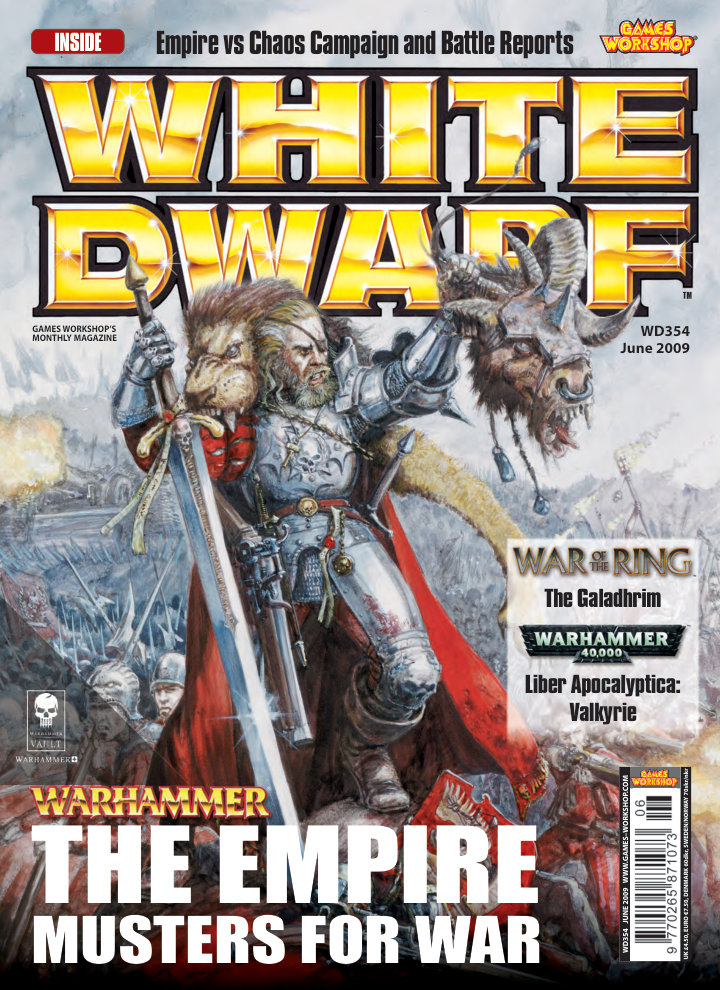
EditorialWD 354 · p. 1
Mark welcomes the Empire releases while admitting that his own army remains unfinished. Jervis’s column encourages him to revisit a substantial Vampire Counts collection assembled from older figures. Adding a few modern units makes that force usable again. He presents the month’s modelling and games as reasons to enjoy both new and familiar miniatures.
Warhammer Fantasy Battles
ReviewWD 354 · p. 3
The new plastic machine combines an armoured exterior with a detailed interior and Engineer. Alternative weapons and chimneys allow different appearances. Its construction brings a formerly imposing specialist model into the plastic range. The notice emphasises both the kit’s customisation and its distinctive place in an Empire army.
Warhammer Fantasy BattlesThe Empire
ReviewWD 354 · p. 4
Ten elite infantry form a regiment of heavily armoured veterans. Interchangeable heads, paired weapon arms and additional equipment provide variety. The components also mix with the surrounding Empire range. The release supplies useful material for the extensive conversion workshop later in the issue.
Warhammer Fantasy BattlesThe Empire
ReviewWD 354 · p. 4
The Mad Count receives a mounted figure that combines aristocratic display with evident eccentricity. His Runefang identifies an Elector Count rather than an ordinary noble. The notice introduces the character whose unusual behaviour shapes the campaign reports. Dave Thomas’s sculpt supplies a particularly colourful army centrepiece.
Warhammer Fantasy BattlesThe Empire
ReviewWD 354 · p. 5
Ten skirmishing archers offer options for ordinary troops or woodsmen. Small accessories, including game and a severed Orc head, give the figures individual histories. Their appearance supports the less regimented side of the Empire. Spare pieces also offer characterful additions to other plastic soldiers.
Warhammer Fantasy BattlesThe Empire
ReviewWD 354 · p. 5
Two foot officers provide different visual interpretations of command. One carries sword and shield while the other combines hammer and pistol. Their equipment and poses distinguish them from the massed rank and file. They can become focal points for provincial identities and personal heraldry.
Warhammer Fantasy BattlesThe Empire
ReviewWD 354 · p. 6
The seventy-two-page colour book surveys provincial uniforms, heraldic devices and military traditions. Its illustrations provide ideas for banners and unusual regiments. The authors present this richness as inspiration for collectors’ own forces. The later design feature explains how stories and visual motifs were developed together.
Warhammer Fantasy BattlesThe Empire
ReviewWD 354 · p. 6
A collection bundle combines Knights, State Troops, Greatswords and missile infantry. The mixture provides several battlefield roles rather than one specialised formation. It also brings together compatible plastic parts for conversions. The notice offers a starting force whose appearance can be adapted to a chosen province.
Warhammer Fantasy BattlesThe Empire
ReviewWD 354 · p. 7
An imposing ruined temple gives a battlefield a conspicuous central feature. Skull imagery makes it especially suitable for dark rituals and Chaos narratives. Its height and broad footprint encourage scenarios built around a contested landmark. The campaign finale demonstrates that use by placing a coveted relic beneath the shrine.
Warhammer Fantasy Battles
ReviewWD 354 · p. 7
The veteran Reavers star receives a new figure emphasising brute strength over agility. His history recalls the team’s famous Blood Bowl championship. The sculpt gives a painter substantial muscles and a battered face to work with. Keith Robertson’s gallery later shows a personal interpretation of the same model.
Blood BowlReikland Reavers
ReviewWD 354 · p. 8
Twenty-four plastic Elves form the core of a Lothlórien force. Different weapons allow the collector to assemble several infantry companies. The release expands the army beyond a small group of named heroes. It is presented for the newly released formation game, with skirmish updates promised for a later issue.
Middle-earth Strategy Battle GameWar of the RingLothlórien
ReviewWD 354 · p. 8
Two brothers offer distinct leadership and character options for the Galadhrim. Haldir revisits a familiar Elven commander, while Rúmil broadens the range of heroes. The figures complement the new plastic troops. Their formation-game uses are discussed in the main feature rather than supplied as complete skirmish profiles here.
Middle-earth Strategy Battle GameWar of the RingLothlórien
ReviewWD 354 · p. 9
Six mounted Elves add a new mobile arm to the army. Weapons, shields and command components allow different configurations. The notice celebrates the arrival of plastic Elven cavalry as a major expansion of the collection. The battle report and horse-painting workshop show the models in play and on the painting table.
Middle-earth Strategy Battle GameWar of the RingLothlórien
ReviewWD 354 · p. 9
Elite pike-armed guards stand alongside a dedicated banner bearer. Their equipment makes the guards visually distinct from ordinary warriors. They provide specialised support and a more formal courtly identity. The main article explains how their reach counters mounted enemies in War of the Ring.
Middle-earth Strategy Battle GameWar of the RingLothlórien
ReviewWD 354 · p. 10
Uriel Ventris returns from the Eye of Terror seeking redemption and renewed service. His path leads back to Pavonis, where a Tau invasion creates a new test. The notice frames the novel around restoring trust as well as battlefield duty. It follows the continuing fortunes of the Ultramarines captain.
Warhammer 40,000Ultramarines
ReviewWD 354 · p. 10
The paperback continues Uriel and Pasanius’s difficult journey home. Their return from exile brings dangers beyond a conventional military campaign. The notice positions the book within the ongoing Ultramarines sequence. It offers background reading for collectors interested in the personal consequences of service and disgrace.
Warhammer 40,000Ultramarines
ReviewWD 354 · p. 10
The first Empire Army novel follows Delmar von Reinhardt into an elite military institution. Training and service uncover tensions beneath its prestigious appearance. Kurt Helborg and a secretive order connect the recruit’s experience to larger events. The notice launches a series intended to explore different parts of the Empire’s armed forces.
Warhammer Fantasy BattlesThe Empire
ReviewWD 354 · p. 11
A large resin daemon engine expands the forces associated with the Vraks conflict. Its segmented body, legs and cabling create an elaborate mechanical silhouette. Assembly choices permit different poses. The notice introduces the model as a demanding centrepiece rather than printing its complete game rules.
Warhammer 40,000Chaos
NewsWD 354 · p. 12
Jervis previews a tile-based campaign system intended to link ordinary games with the wider range of Warhammer 40,000 expansions. Forty-eight tiles create a changing strategic map. A separately available hive-city tile offers another objective. The preview announces the campaign framework without reproducing the complete rules.
Warhammer 40,000
NewsWD 354 · p. 13
Creatures Anathema adds a collection of dangerous beings from the Calixis Sector. The Radical’s Handbook explores questionable methods and new character options. The Haarlock’s Legacy adventure sequence connects investigations to an enigmatic Rogue Trader dynasty. Together the notices expand both the opposition and the moral choices available in an Inquisition campaign.
Dark Heresy
FeatureWD 354 · pp. 16–25
The feature presents the Empire as a patchwork of provinces, military traditions and eccentric individuals. Andy and Jeremy discuss how the heraldry book turns local stories into visual ideas without prescribing every collector’s scheme. Dave’s sketches, regiment histories and the new plastic kits reinforce that variety. A Steam Tank explanation, sample force and Pete’s tactics connect the setting to collecting and play.
Warhammer Fantasy BattlesThe Empire
RulesWD 354 · pp. 22–23
The new machine generates steam to move and power its weapons, with excessive pressure putting a damaged tank at risk. The explanation distinguishes its cannon, steam gun and crushing impact. An annotated component guide then examines the plastic construction. This is a focused introduction within the Empire feature rather than a replacement for the army book.
Warhammer Fantasy BattlesThe Empire
TacticaWD 354 · pp. 24–25
Pete explains how varied troop types work together in a balanced force. Detachments support parent regiments and countercharge threats, while magic and artillery provide different answers to difficult opponents. Character equipment can solve particular weaknesses rather than simply increasing raw power. The accompanying army illustrates cooperation between ordinary soldiers and specialised support.
Warhammer Fantasy BattlesThe Empire
TacticaWD 354 · pp. 30–33
Mat introduces an expanded Lothlórien army with infantry, light troops, cavalry and elite guards. Movement through terrain and Terror make the Elves more flexible than their small numbers suggest. High fighting skill rewards choosing engagements carefully. Haldir, Rúmil and other heroes add leadership and particular abilities, while skirmish rules are explicitly deferred to the following issue.
War of the RingLothlórien
Battle ReportWD 354 · pp. 34–43
Mat’s Galadhrim face Adam’s Mordor host in a roughly three-thousand-point Battle for the Pass. Mordor initially gains ground through magic, monsters and sustained pressure. The deaths of the Necromancer and Balrog reverse the contest, with Glorfindel sacrificing himself in the decisive fighting. The players stop at a seventeen-to-seven Elven lead and assess Courage, Might and the cost of powerful individual models.
War of the RingLothlórien
FeatureWD 354 · pp. 44–49
Andy describes Valkyries as the carriers of large, coordinated infantry assaults. The Catachan 22nd develops unusually close ties between naval aircrew and Jungle Fighters. Formation rules, a command aircraft and an organisation diagram make that background usable in Apocalypse. Chad’s conversion then translates the regiment’s identity into crew, equipment, markings and camouflage.
Warhammer 40,000Astra Militarum7 paint colours
RulesWD 354 · pp. 46–47
A command flyer coordinates Valkyrie carriers and optional Vendetta support as one assault formation. Transported infantry and aircraft arrive together around the command aircraft’s entry point. A blind barrage screens the final approach. The accompanying Red Flight diagram illustrates the command and support structure of a typical airborne force.
Warhammer 40,000Astra Militarum
RulesWD 354 · p. 48
Paseski’s aircraft combines command support with the skills of two competing sniper twins. Their side-door fire operates separately from the Valkyrie’s main weapons. Nearby aircraft benefit from the command crew, while the vehicle also serves as a headquarters. The datasheet links those abilities to the Colonel’s concern for his infantry and the regiment’s airborne expertise.
Warhammer 40,000Astra Militarum
PaintingWD 354 · p. 49
Chad replaces the ordinary pilots with Catachan heads and adds a prominent searchlight. Two matching sniper models take the place of door gunners. Sprayed camouflage, metallic wear and scorched exhausts suggest a working combat aircraft. Transfers and freehand stripes identify its command role and adoption into the regiment.
Warhammer 40,000Astra Militarum7 paint colours
CampaignWD 354 · pp. 50–75
Jeremy links six journeys and battles to an Empire relief effort in Ostland. Survivors of the preliminary encounters determine the coalition available for the finale. Three games are reported here, with the remaining encounters directed to the website. Named regiments, secret briefings and unequal situations make the campaign a developing military story rather than a sequence of interchangeable pitched battles.
Warhammer Fantasy BattlesThe Empire
ScenarioWD 354 · pp. 52–53
An Empire column chooses between speed and caution before encountering a Beastmen ambush. That decision changes deployment and the arrival time of survivors in the final campaign battle. Recurring Beastmen reinforcements put pressure on a force that can win simply by enduring until dawn. Named officers and regiments receive small characterful rules.
Warhammer Fantasy BattlesThe Empire
Battle ReportWD 354 · pp. 54–56
Mark takes the quick march and finds his soldiers caught in a dangerous confined deployment. Panic and fleeing cavalry disrupt the artillery, while the Beastmen attempt to exploit their surprise. Greatswords and Flagellants hold critical ground despite the loss of the commander. The Empire survives to claim a costly victory, sending only a limited reinforcement contingent north.
Warhammer Fantasy BattlesThe Empire
ScenarioWD 354 · pp. 57–59
Leitdorf’s coalition encounters a Nuln army whose commander has been misled by a disguised Daemon. Each player receives a different explanation for the confrontation. Hidden deployment prevents either army from simply responding to the other’s positions. Killing the false wizard ends the fighting, making identification of the true enemy more consequential than ordinary victory points.
Warhammer Fantasy BattlesThe Empire
Battle ReportWD 354 · pp. 60–63
Robin’s coalition attacks Nick’s Nuln defenders amid unusually unreliable artillery. Early fire cripples the Steam Tank, but the central infantry battle remains dangerous. Leitdorf kills the Grand Marshal before eventually confronting the suspicious wizard. The revealed Changeling vanishes, stopping the civil clash and allowing the damaged forces to resume their common campaign.
Warhammer Fantasy BattlesThe Empire
Battle ReportWD 354 · pp. 64–74
Jeremy assembles the surviving relief forces against Phil’s Chaos host. A contested shrine shelters the relic sought by Sigvald, while delayed Empire units enter from earlier campaign journeys. Steam Tanks and Leitdorf’s repeated victories in challenges help the coalition hold the field. Chaos narrowly loses the battle even though Sigvald escapes with his prize, leaving a deliberately unresolved wider story.
Warhammer Fantasy BattlesThe Empire
CampaignWD 354 · p. 75
Jeremy reflects on the extra value created by naming units and giving each army a purpose. Small special rules make regiments memorable without needing to dominate the game. Linked consequences also justify unusual and unequal encounters. The surviving Talabheim troops demonstrate how a local story can matter to the final battle even when none return home.
Warhammer Fantasy Battles
ColumnWD 354 · pp. 76–78
An old Witch Hunter inspires Jervis to build a Vampire Counts army, with existing rules reinterpreted as a magical pistol. Examples from Rick and Alan show several generations of models sharing the same force. Jervis encourages reasonable agreement over obsolete equipment and troop types. Collecting and playing become ways to preserve personal memories rather than reasons to discard older figures.
Warhammer Fantasy BattlesWarhammer 40,000
ModellingWD 354 · p. 79
Mark decorates a Rhino using icons sized and trimmed to fit its panels. Split symbols and stepped skull arrangements integrate the additions into the vehicle. Remaining pieces become separate scenario objectives for two games. The examples show how a single collection of accessories can supply both army identity and useful battlefield counters.
Warhammer Fantasy BattlesWarhammer 40,000Chaos Space Marines
InterviewWD 354 · pp. 80–84
Keith describes learning within the studio and seeking feedback to improve. His personal projects favour restrained colour and bases that extend a miniature’s narrative. The gallery ranges from Gollum’s resin-water scene to a Skink, Harlequin, Zug, Ork, Marine, Ratling and Genestealer Hybrid. He explains why retaining a sculptor’s original figure can be as deliberate as making extensive conversions.
Warhammer Fantasy BattlesWarhammer 40,0001 paint colour
ModellingWD 354 · pp. 86–93
Compatible plastic kits let the contributors create distinctive heroes and entire regiments. New Archer and Greatsword parts mix with cavalry, militia and older components. The gallery traces individual officers, provincial soldiers and more ambitious personal collections. Heraldry and background give each conversion a reason to exist beyond merely changing its equipment.
Warhammer Fantasy BattlesThe Empire
ModellingWD 354 · pp. 90–91
Dave’s models develop through selecting appealing pieces from a large collection of frames. Helmut Feuerbach receives a custom shield, crest and sheathed Runefang. Halberdiers and a mixed group of dispossessed knights use personal heraldry to bind disparate parts together. Small scratch-built details complete the models without replacing their plastic foundations.
Warhammer Fantasy BattlesThe Empire
ModellingWD 354 · pp. 92–93
Mike extends his approach to elegant single figures into a whole army. Subtle modifications turn familiar Greatsword parts into veterans, while a scenic adventurer evokes Mordheim. A Stirland Vampire Hunter leads a militia assembled from several kits. The final wizard examples show how components from other armies can establish a particular magical identity.
Warhammer Fantasy BattlesMordheimThe Empire
ShowcaseWD 354 · pp. 94–95
Neil nominates Jes’s Shadowseer for balancing intricate detail with clear spaces for painting. Darren’s studio version illustrates the opportunities in its diamond patterns and flowing cloth. A related gallery places the figure within the wider Harlequin range. The discussion treats the sculpt as a collaboration that leaves room for the painter’s imagination.
Warhammer 40,000Harlequins
PaintingWD 354 · pp. 96–101
The workshop offers both rapid company painting and a more deliberate four-stage approach. Gold armour, contrasting cloth and pale horses follow the visual language of the films. Alternative schemes show how to depart from that palette. A final Haldir example rewards the completed troops with more carefully blended character painting.
Middle-earth Strategy Battle GameWar of the RingLothlórien35 paint colours
PaintingWD 354 · p. 97
Chris sprays gold and a dark wash to establish the army’s main colour quickly. Blue and brown cloth need only limited highlights. White horses and pale fur add contrast without requiring a wholly separate elaborate process. A light muddy drybrush gives the otherwise immaculate Elves a connection to the battlefield.
Middle-earth Strategy Battle GameWar of the RingLothlórien11 paint colours
PaintingWD 354 · pp. 98–99
Joe divides the warrior into base colours, shading, restored mid-tones and final highlights. Skin, hair, armour, tunic, cloak and arrows progress together across the stages. Simple two-colour mixtures keep the method manageable. Suggested Elven icons provide a further freehand option once the rank and file are complete.
Middle-earth Strategy Battle GameWar of the RingLothlórien14 paint colours
PaintingWD 354 · p. 100
Pale flesh and a darker mane distinguish the horses from their richly coloured riders. A dark wash establishes recesses before progressively lighter grey and white layers restore definition. The saddle cloth reuses the rider’s red and blue palette. The guide applies the same four-stage discipline to a different kind of surface.
Middle-earth Strategy Battle GameWar of the RingLothlórien12 paint colours
PaintingWD 354 · p. 101
Nick and Chris demonstrate four alternatives to the familiar gold and blue scheme. Bright silver, red lacquer, woodland greens and subdued metal create different identities from the same figures. Each example gives enough named colours to explain its principal effect. The gallery encourages a personal warhost rather than requiring a single film-derived uniform.
Middle-earth Strategy Battle GameWar of the RingLothlórien14 paint colours
PaintingWD 354 · p. 101
Keith builds the gold gradually, then uses different washes to distinguish mail from armour. Blond hair and a red cloak supply complementary focal areas. Blended highlights make the hero more refined than the batch-painted troops. The notes explain selected key surfaces rather than pretending to provide a complete recipe for every detail.
Middle-earth Strategy Battle GameWar of the RingLothlórien13 paint colours
CommunityWD 354 · pp. 102–105
The guide explains the competition’s categories through earlier winning entries. It distinguishes single models, units, vehicles, monsters, duels, dioramas and larger-scale work. Young Bloods and the Open competition have their own restrictions and opportunities. Base sizes, legal unit requirements and the treatment of specialist ranges help entrants choose an appropriate destination for a model.
Warhammer Fantasy BattlesWarhammer 40,000
All substantial articles, release reviews, campaign scenarios, rules, interviews, modelling and painting features in the supplied magazine are indexed. Three of the six Drums of War games are printed here; the other games and next month’s Galadhrim skirmish profiles are referenced rather than invented. Routine retail listings, price tables and event calendars are not separate articles.