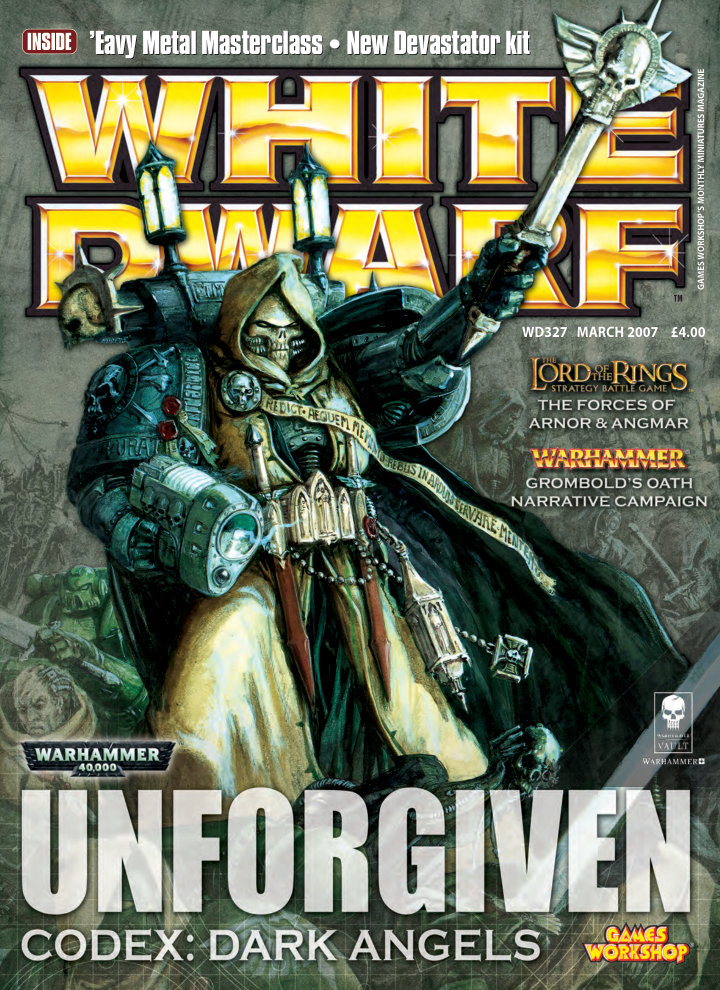
EditorialWD 327 · Inside cover
The editorial introduces the Dark Angels as an ancient and honoured Chapter whose loyalty is complicated by the treachery of part of its original Legion. Their private hunt can override other Imperial duties, making their motives suspect even when they serve the Emperor. New kits offer collectors ways to express that secretive identity through the Ravenwing, Deathwing and related Unforgiven Chapters.
Warhammer 40,000Dark Angels
LoreWD 327 · pp. 14–15
The preview presents Khazad-dûm as a setting spanning Durin’s kingdom, its survivors and the goblins occupying its abandoned halls. Five forthcoming scenarios promise to explore its contested history, from defending the Dwarven realm to devastation by the Balrog. New warriors, Rangers, Vault Wardens, heroes and a dragon suggest different collections for the battles beneath Middle-earth.
Middle-earth Strategy Battle GameKhazad-dûm
PaintingWD 327 · p. 16
Foundation paints are introduced as a heavily pigmented complement to the existing Citadel Colour range. The central promise is reliable coverage over black undercoats, including difficult reds and yellows. Painters can either complete an army with the eighteen colours or use them as quick basecoats beneath conventional highlights, while a redesigned pot incorporates a locking hinge and support tab.
InterviewWD 327 · pp. 22–33
Andy Hall interviews Jervis Johnson, Andy Hoare, the graphics team and sculptors about making a self-contained Dark Angels codex. Fixed squad sizes, standard equipment and prominent special characters translate Chapter organisation into a clearer army list. The feature also traces the Fallen’s deliberately incomplete history, explains the Deathwing and Ravenwing partnership, and follows the new plastic accessories and Sammael’s jetbike from concept to finished miniature.
Warhammer 40,000Dark Angels
ModellingWD 327 · pp. 24–33
Component diagrams show how the Dark Angels frames work with existing Space Marine kits to produce robed veterans, Terminators, command figures and distinctive vehicles. The sculptors explain why a few carefully distributed monastic details can establish a whole squad’s identity. Separate Ravenwing parts supply several bike and Land Speeder configurations, while the vehicle showcase demonstrates how icons and specialist fittings carry the theme across a collection.
Warhammer 40,000Dark Angels
Battle reportWD 327 · pp. 34–51
Owen Rees’s Dark Angels attack Andy Hall’s Tau over a crashed shuttle concealing a secret valuable to the Inner Circle. Ravenwing scouts guide an early Deathwing arrival and carry a protected flank attack into the Tau line, while Marines in cover absorb remarkable punishment. The Tau advance too soon and struggle to remove the assault threats; Sammael and the survivors eventually annihilate them, making the players’ reflections a lesson in mission timing, terrain and coordinated pressure.
Warhammer 40,000Dark Angels
TacticsWD 327 · pp. 52–61
Mat Ward considers how the fall of Arnor changed Middle-earth and how campaigns can explore a different outcome. Arnor’s high Fight values reward an early decisive struggle, but low Courage makes a prolonged battle dangerous. Angmar instead combines numerous inexpensive troops with spirits that disrupt enemy positions and combat ability. Sample armies, allies and a terrain-control scenario turn those contrasting identities into practical collecting and gaming plans.
Middle-earth Strategy Battle GameArnor
TacticsWD 327 · pp. 54–55
A 750-point force places Arvedui and Malbeth behind a disciplined core of armoured Warriors. The king’s extended leadership and the seer’s protection compensate for troops whose confidence deteriorates once the army breaks. Rangers provide both shooting and credible melee support, while inexpensive Hobbit archers remain away from the fighting. The guide emphasises winning through early pressure without exposing the heroes that keep the line intact.
Middle-earth Strategy Battle GameArnor
PaintingWD 327 · p. 55
A darkened metal base establishes the polished but strongly defined armour of Arnor’s soldiers. A brown-and-black wash shades the recesses without replacing the underlying metallic surface. Bright silver is then restricted to raised plates, preserving both the darker metal and the wash around joins and edges so the figure remains readable at gaming distance.
Middle-earth Strategy Battle GameArnor4 paint colours
TacticsWD 327 · pp. 56–57
Angmar’s example army pairs an orc horde with the Witch-king, wargs and a cluster of supernatural support. Spectres draw important models out of formation, Barrow-wights disable heroes and a Shade tilts nearby combats before the ordinary troops finish the work. The advice is to protect the spellcaster, support the horde and commit the wargs at the right moment rather than expecting any one element to win alone.
Middle-earth Strategy Battle GameAngmar
PaintingWD 327 · p. 57
Mark Jones uses a temporary cross to transfer a hand-drawn Angmar symbol accurately onto a miniature banner. Establishing its centre and proportions on paper makes the small painted version easier to position. White shapes are filled out after the outline is copied, and black covers the construction marks, providing a simple method for repeatable freehand devices.
Middle-earth Strategy Battle GameAngmar2 paint colours
TacticsWD 327 · pp. 58–59
Elven allies supply Arnor with the courage needed to confront terrifying creatures, while Dwarves can reinforce its battle line with exceptional defence. Angmar can draw on Barad-dûr for artillery and different orc formations, or enlist wraiths and monsters for greater heroic power. The selection is framed around remedying a weakness or strengthening an existing plan instead of simply adding another impressive model.
Middle-earth Strategy Battle GameArnor
RulesWD 327 · pp. 60–61
Two 750-point alliances contest a battlefield whose terrain features score alongside broken armies and slain leaders. Random conditions may impose darkness or reduce warriors’ Courage, making the same engagement play differently on a return visit. The game ends when either side falls to a quarter of its initial numbers, and powerful creatures count more heavily when determining terrain control, encouraging a balance between killing and occupation.
Middle-earth Strategy Battle GameArnor
CampaignWD 327 · pp. 62–67
Thane Grombold Kruddsson leads a rescue expedition into the Great Forest after Dwarf prospectors disappear near an ancestral mine. Forest Goblins attack the column before survivors discover Night Goblins and tortured captives underground. The opening campaign instalment provides a special character, linked battle results and historical rosters; the fate of the rescue party supplies advantages or penalties for the Empire’s intervention in the following issue.
Warhammer Fantasy BattlesDwarfs
RulesWD 327 · p. 65
Grombold’s thousand-point rearguard faces twice its strength in Goblins amid dense forest. The attackers deploy on several sides and take the first turn, forcing the Dwarfs to inflict damage while surrounded. Only destruction and reduced units score during the five-turn struggle. A Dwarf victory reinforces the next encounter, while a Goblin victory earns extra troops for the campaign’s final confrontation.
Warhammer Fantasy BattlesDwarfs
RulesWD 327 · pp. 66–67
A depleted Dwarf force fortifies the centre of an underground chamber against a much larger Night Goblin army. Panic immunity lets the defenders fight to the bitter end, and victory depends on causing sufficient enemy losses rather than necessarily surviving. Campaign rewards follow the outcome, while the accompanying fiction reveals a crazed prisoner escaping with knowledge of something even the goblins fear beneath the mine.
Warhammer Fantasy BattlesDwarfs
LoreWD 327 · pp. 70–72
Librarians combine the roles of battlefield psyker, communicator, examiner and custodian of a Chapter’s accumulated knowledge. The article follows recruitment, purity testing and the hierarchy from Lexicanium to Chief Librarian, then explains psychic hoods, force weapons and the Emperor’s Tarot. Portraits of Ezekiel, Mephiston and Tigurius show how this shared institution takes different forms in Chapters with distinct burdens and traditions.
Warhammer 40,000Space Marines
RulesWD 327 · p. 72
The three Chief Librarians receive contrasting equipment and psychic-power selections alongside their narrative descriptions. Ezekiel’s role in the Inner Circle is represented by distinctive relics and powers; Mephiston pairs formidable personal attributes with transfixing influence; Tigurius’s ancient hood supports flexible power selection after deployment. The profiles provide a compact contemporary comparison of celebrated psychic leaders from three Space Marine Chapters.
Warhammer 40,000Dark Angels
PaintingWD 327 · p. 73
Three short recipes establish the principal visual features of a Codex Librarian: blue armour, a skull badge and an icy force blade. Dark armour recesses remain visible as increasingly pale edges define the plates, while brown and bone layers give the skull its depth. An ink wash separates the sword’s raised decoration from its pale blade, linking bright focal details to a restrained uniform.
Warhammer 40,000Space Marines11 paint colours
EditorialWD 327 · pp. 74–75
Jervis compares the deadlines that make Studio products happen with the discipline needed to finish a personal army. Designers and artists could refine their work indefinitely without a stopping point, and collectors similarly risk abandoning one project whenever a tempting release appears. A fixed completion date turns enthusiasm into a playable painted force, making planning a practical creative aid rather than merely an administrative burden.
TacticsWD 327 · pp. 78–83
Adam Troke treats movement as the phase that determines whether an army’s expensive troops ever perform their intended task. His six principles cover planning routes, taking initiative, engineering charges, protecting flanks, negotiating terrain and controlling flight. Examples from several players show sacrificial screens, coordinated countercharges and building occupation, while warnings about traffic jams and Panic explain how careless positioning can unravel otherwise strong formations.
Warhammer Fantasy BattlesThe Empire
ModellingWD 327 · pp. 84–88
Assembly diagrams introduce the plastic Devastator kit’s heavy weapons and specialist backpacks. The showcase then compares a mixed Ultramarines unit, concentrated Raven Guard firepower, robed Dark Angels and adaptable Blood Angels squads. Combining kits or adding Tactical Marines lets collectors choose between specialised teams and a broader range of threats, showing how weapon choice and Chapter identity can be expressed through the same components.
Warhammer 40,000Space Marines
ModellingWD 327 · p. 89
The guide explains how to mix the two-part putty, remove cured fragments and fill seams without leaving abrupt edges. Allowing the putty to firm slightly before sculpting and keeping tools damp gives better control over surface detail. Spare material becomes individual sandbags for a small barricade, demonstrating how even leftovers can provide useful scenic work.
PaintingWD 327 · pp. 90–93
Pete Foley builds a sinister grey Gûlavhar through carefully blended dark skin, paler membranes and a flesh-toned abdomen. The lesson spends particular attention on the early transitions, since rough initial highlights would undermine later detail. Stippling supplies mottled wing texture, bright teeth and eyes create focal points, and selective gloss sharpens talons and horns. Fil Dunn’s red alternative shows how similar techniques can support a more extreme colour transition.
Middle-earth Strategy Battle GameAngmar15 paint colours
InterviewWD 327 · pp. 94–98
Kirsten describes learning from skilled store painters, persistent Golden Demon entries and the collection that led to her joining ’Eavy Metal. Her models combine ambitious conversions with patient surface work: a chained Slaaneshi chariot, a diseased champion, an airborne duel and a Cold One-mounted Rough Rider. Explanations of thin glazes, flat banner painting and sculpted scenic mutations reveal techniques developed through sustained practice rather than a single prize-winning project.
Warhammer Fantasy BattlesWarhammer 40,000Skaven6 paint colours
CommunityWD 327 · pp. 102–104
Andy Lewis recalls a campaign weekend with his converted Iron Hands, from paired Combat Patrol actions to larger battles shaped by earlier results. Extra event cards and a temporary fourth Dreadnought help one dramatic victory, but forgetting a Breakout objective turns another apparent triumph into defeat. The report values the evolving team narrative and unusual army choices, while drawing a clear distinction between destroying opponents and accomplishing the mission.
Warhammer 40,000Iron Hands
ModellingWD 327 · pp. 108–111
The modelling-day feature illustrates the versatility of the new Dark Angels and Devastator parts when mixed with older Space Marine plastics. Heavy weapons can reinforce Black Templar squads or form Space Wolf Long Fangs, while specialist vehicle components turn standard Land Speeders into Ravenwing craft. The examples encourage collectors to distribute distinctive heads, bodies and accessories across a force rather than treating each boxed set as a closed design.
Warhammer 40,000Space Marines