EditorialWD 323 · Inside cover
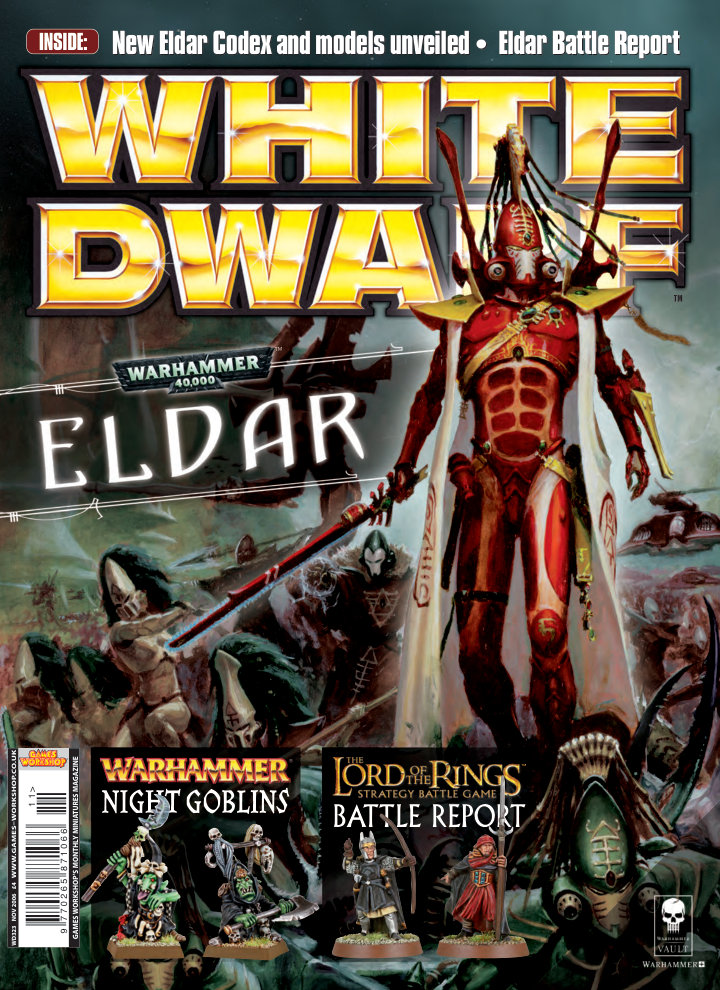
Grombrindal introduces the Eldar release through their ancient knowledge, struggle for survival and impressive new miniatures. He also points readers towards the Night Goblins’ continuing presence and the start of a broader tactics series, while the Middle-earth battle promises a contest between two experienced developers. His joking frustration at the lack of Dwarfs links the varied contents with the magazine’s familiar narrative voice.
Warhammer 40,000Warhammer Fantasy Battles
CommunityWD 323 · pp. 16–17
The forthcoming Empire release is previewed through a fuller account of its history, renewed characters and a fresh range of miniatures. Plastic State Troops and Ludwig Schwarzhelm demonstrate the visual direction, while the army book promises both familiar human soldiers and inventions such as clockwork horses and grenade-launching weapons. The announcement frames the Empire as a major human defence against Chaos ahead of the January release.
Warhammer Fantasy BattlesEmpire
RulesWD 323 · pp. 21–31
Phil Kelly explains how the new Eldar codex combines a much fuller presentation of the race with one flexible army list. Craftworld themes remain possible through unit choices rather than separate force charts, while more specialised Aspect Warriors, a new Autarch and revised support units reward coordinated play. The changes aim to give Guardians, jetbikes, walkers and grav-tanks clear jobs without allowing one exceptionally independent unit to replace the combined efforts of the rest of the host.
Warhammer 40,000Aeldari
TacticsWD 323 · p. 25
The Autarch applies experience of several warrior paths to commanding an entire host. Equipment borrowed from Aspect traditions allows the same entry to become a combat specialist, a mobile tank hunter or a fast threat to artillery, while strategic mastery helps the army’s reserves arrive. The feature presents the leader’s flexibility as a way to serve the wider battle plan rather than merely choosing the most elaborate combination of weapons.
Warhammer 40,000Aeldari
TacticsWD 323 · pp. 26–27
Revised Exarch powers reinforce each Aspect’s speciality, with improved Dire Avengers taking the front-line shuriken role that civilian Guardians had too often filled. Bladestorm, defensive equipment and longer-ranged catapults provide different ways to configure the Avengers. Guardians instead become mobile support and objective holders, using their platform and accompanying Warlock to contribute without being treated as an expendable screen for the more valuable warriors.
Warhammer 40,000Aeldari
TacticsWD 323 · pp. 28–29
The heavy walkers are redesigned around distinct forms of support. Wraithlords retain their formidable physical characteristics but require nearby psykers to guide their perception, tying them more closely to the army, while War Walkers offer inexpensive concentrated firepower and a useful scouting move. The discussion also connects the new kits’ shared Eldar design details and interchangeable weapons to the practical choice of battlefield role.
Warhammer 40,000Aeldari
TacticsWD 323 · pp. 30–31
Cheaper Guardian jetbikes in the Troops section let a Saim-Hann theme emerge naturally from the main list, with Vypers and grav-tanks supplying additional speed. The Wave Serpent, Falcon and Fire Prism are distinguished as transport, all-rounder and dedicated gun tank, including the option for Prisms to combine their fire. Fast late moves can secure objectives, but the article insists that transports, shooters and assault specialists must protect and enable one another.
Warhammer 40,000Aeldari
TacticsWD 323 · pp. 32–33
The sample 1,500-point warhost concentrates shooting on a Doomed target until it is destroyed, preserving assault units for the counter-attack when an enemy finally closes. Bright lances and transported Fire Dragons deal with armour, while jetbikes and skimmers provide the late objective moves that convert surviving units into victory. Adam Troke’s opposing perspective recommends flame weapons, heavier ranged fire and learning the Eldar’s particular combinations before trying to disrupt them.
Warhammer 40,000Aeldari
Battle reportWD 323 · pp. 34–49
Phil Kelly’s Biel-Tan host confronts Matt Hutson’s Black Templars on a devastated maiden world. Eldar firepower removes the bikes and mauls the fast assault units, but Righteous Zeal and a failed target-priority test bring a huge Crusader squad into the Wraithguard and Banshees earlier than planned. A Wraithlord then holds that formation long enough for the remaining Eldar to isolate other targets and regroup around the final melee. Phil wins decisively, while both players acknowledge the strength and limitations of Matt’s expensive concentrated units.
Warhammer 40,000Aeldari
EditorialWD 323 · pp. 50–52
Jervis Johnson profiles Dave Cross through the small hobby aids that emerge from an unusually busy desk and an enthusiast’s broad experience. Basing kits, counters, vehicle-damage dice and specialised cases answer practical needs that players may not have articulated beforehand. The collector’s rulebook represents the same impulse on a grander scale, and Jervis argues that such optional details help make the hobby richer and more personal.
TacticsWD 323 · pp. 54–59
The Night Goblin horde relies on numbers, leadership support and threats that make an opponent nervous before the fighting starts. Nets and Fanatics improve ordinary regiments, while Squig Herds and Hoppers supply the hitting power their handlers lack. Skarsnik offers a stronger general and disruptive schemes, and the Crooked Moons sample army adds Trolls for durability while warning that their own stupidity makes staying near the leader essential.
Warhammer Fantasy BattlesOrcs & Goblins
ModellingWD 323 · pp. 55–56
The illustrated guides identify the regiment’s body, weapon and command options and the separate components that give Fanatics their character. Spears, bows, nets and distinctive leaders allow the player to make the unit’s chosen role visible, while mushrooms, Snotlings and other small details personalise the spinning ball-and-chain models. The special launch figure provides another way to integrate a Fanatic into the regiment itself.
Warhammer Fantasy BattlesOrcs & Goblins
RulesWD 323 · pp. 60–61
The points-match scenario makes the opposing leader’s death the decisive objective. The introductory discussion weighs a powerful fighting king against a more protected commander whose abilities work at range, with the players agreeing for this game to resolve the leadership contest through combat rather than shooting. A randomly generated battlefield and an 850-point limit provide room for manoeuvre without postponing the central confrontation indefinitely.
Middle-earth Strategy Battle Game
Battle reportWD 323 · pp. 60–72
Adam Troke’s alliance of Númenóreans and Elves faces Mat Ward’s Harad and Mordor force. Elendil kills the Ringwraith that could have contained him, and Galadriel later fights through to rescue the king from two Hasharii. Well-timed Heroic moves then pin Evil’s leaders and expose their broken troops to Courage tests before Elendil finally defeats Gothmog. Good wins with its heroes intact, while Mat’s reflections focus on his isolated cavalry and Adam stresses how close several critical combats had been.
Middle-earth Strategy Battle GameNúmenor
TacticsWD 323 · pp. 74–77
Alessio Cavatore works through a 2,000-point Empire list to explain the value of complementary specialists. Each unit receives the equipment that improves its intended job, while characters strengthen leadership, combat, shooting or magical defence and cheap detachments buy time or create favourable positions. The finished list includes tools for flanks, artillery, screens and stubborn defence, showing how a balanced force can adapt when a strongly themed army meets the opponent it least wants to face.
Warhammer Fantasy BattlesEmpire
LoreWD 323 · pp. 80–87
Phil Kelly explores the Warrior Path as a means of containing the destructive emotions that helped cause the Eldar’s Fall. Armour and ritual allow a warrior to adopt and then leave a separate martial personality, while Exarchs represent those who can no longer escape it. The shrines preserve training, names and accumulated spirits, and the different Aspects translate facets of Khaine into distinctive traditions, appearances and methods of fighting.
Warhammer 40,000Aeldari
LoreWD 323 · pp. 82–83
The Dire Avengers embody Khaine’s noble warrior and are presented as the most widespread Aspect. A story from the ice fields of Articus describes a small group sacrificing itself to hold a Tyranid swarm away from the webway, linking their discipline to the protection of the whole people. Named shrines and their banners then show how different histories and honours can coexist within the familiar blue-armoured tradition.
Warhammer 40,000Aeldari
ModellingWD 323 · p. 83
The component guide sets out the plastic Dire Avengers’ heads, torsos, poses and equipment, then identifies the Exarch upgrades separately. Twin catapults, a diresword, a shimmershield and ceremonial accessories allow the squad leader to express a chosen role as well as the shrine’s visual identity. Banner designs below the kit reinforce that the same basic models can belong to distinct traditions.
Warhammer 40,000Aeldari
LoreWD 323 · p. 84
The two close-combat Aspects express different forms of violence. Banshees use amplified psychic cries to overwhelm the senses before their blades strike, while Scorpions stalk difficult ground and deliver an abrupt combination of mandiblasters and close attacks. Their bone and green armour traditions remain recognisable across different shrine examples, so variations in detail identify individual schools without obscuring the Aspect.
Warhammer 40,000Aeldari
LoreWD 323 · p. 85
The Fire Dragons’ fiery colours reflect their dedication to complete destruction at close range, especially against armour and fortifications. The Swooping Hawks instead embody aerial mastery through powered wings, lasblasters and grenade attacks from above. The paired profiles show how an Aspect’s equipment, appearance and battlefield behaviour grow from one governing image of the war god.
Warhammer 40,000Aeldari
LoreWD 323 · p. 86
Dark Reapers depend on heavy stabilising armour and linked targeting equipment to bring an enemy’s death from a distant firing position. Warp Spiders accept the opposite kind of danger, stepping through the Immaterium to appear unexpectedly and unleash monofilament weapons before withdrawing. Dark and red shrine variants illustrate two lethal traditions distinguished as much by the risks their warriors embrace as by their weapons.
Warhammer 40,000Aeldari
LoreWD 323 · p. 87
The Shining Spears express Khaine’s sudden, killing stroke through jetbike speed and the concentrated energy of their laser lances. The accompanying history of the Phoenix Lords reaches back to Asurmen and the first shrine, explaining how the founders’ skills became the enduring Aspect traditions. A Phoenix Lord’s armour carries a dominant identity across successive wearers, allowing a supposedly fallen hero to return when needed.
Warhammer 40,000Aeldari
TacticsWD 323 · pp. 88–92
Mat Ward divides mounted troops into light, versatile, shock and monstrous categories, each with a different way to exploit speed and mass. Their charge can turn a fight sharply, but the extra cost makes careless losses especially damaging. Examples and suggested manoeuvres explain harassment, flanking and repeated charges, while the heaviest mounts project a threat that can alter the opponent’s movement even before they attack.
Middle-earth Strategy Battle Game
TacticsWD 323 · p. 89
Light cavalry gain value from moving quickly and choosing when to exchange missile fire rather than pretending to be heavily protected knights. Haradrim Raiders can add bows or lances, while Khandish mercenaries offer inexpensive mobility with less certain loyalty. Keeping beyond an enemy’s charge and using other troops for support preserves the riders long enough for their harassment or a carefully timed charge to matter.
Middle-earth Strategy Battle GameHarad
TacticsWD 323 · p. 90
Riders of Rohan and Warg Riders combine enough protection with varied weapons to act as either skirmishers or an assault threat. Throwing spears are costly but add another way to affect the approach, and a Warg may remain dangerous after its rider falls. The suggested outflanking plan uses that flexibility to make spear-supported infantry either spread out or accept the threat of a rear attack.
Middle-earth Strategy Battle GameRohan
TacticsWD 323 · p. 91
The shock-cavalry comparison distinguishes the resilience of Easterling Kataphrakts from the more elaborate fighting advantages of Dol Amroth’s knights. Good leadership and a banner help the former turn durability into results, while lances and Imrahil’s support give the Swan-knights exceptional impact. Both still depend on arranging the charge and withdrawing or repositioning for another, because expensive armour does not remove the cost of a lost opportunity.
Middle-earth Strategy Battle GameEasterlings
TacticsWD 323 · p. 92
A Fell Beast lets a Ringwraith threaten other mounted troops with the same disruptive force cavalry normally brings to infantry. Its speed and high-Strength attacks create dangerous areas that an opponent may hesitate to enter, but exhausting the Nazgûl’s Will can remove the entire investment. Khandish chariots provide another combination of movement, protection and impact, while the Mûmak receives a separate reminder to preserve space for its essential trample.
Middle-earth Strategy Battle GameMordor
PaintingWD 323 · p. 92
The small recipe panel differentiates the Fell Beast’s cool outer skin from its warmer underbelly without breaking the overall dark appearance. Both begin with black and grey, but bone is added to the outer highlights while flesh tones enter the underside. Gradual mixed highlights preserve the creature’s subdued colour and bring out the changes in texture rather than turning it into a uniformly bright model.
Middle-earth Strategy Battle GameMordor4 paint colours
ModellingWD 323 · p. 93
The guide distinguishes three adhesives by the materials and jobs they suit. Super glue joins metal and mixed parts quickly, plastic glue creates a strong plastic-to-plastic bond through the surface itself and water-based PVA handles flock, sand and transparent pieces. Cleaning contact surfaces and using modest quantities improve control, while a converted Avatar’s dripping hand demonstrates that dried PVA can also become a modelling material.
PaintingWD 323 · pp. 94–97
Dark Elf characters and centrepieces demonstrate restrained dark cloth, precisely finished metal and contrasting pale flesh. The Cauldron of Blood combines green marble with the army’s purple clothing, Malekith’s Dragon receives carefully defined horns and the Cold One Chariot adds a larger field of decorative armour. Printed skin and cloth recipes and six reptile colour pairings provide practical ways to carry the showcase’s variety into a collection.
Warhammer Fantasy BattlesDark Elves18 paint colours
PaintingWD 323 · p. 97
Six examples demonstrate how a Cold One’s scales can either contrast with its skin or carry a separate reptilian pattern. The pairings range from red scales over pale grey through green over flesh to cool blue mixtures over dark bases, with a bright yellow-brown option for a more striking animal. Treating the creature as a distinct painting opportunity adds colour to an otherwise sombre Dark Elf army.
Warhammer Fantasy BattlesDark Elves10 paint colours
CommunityWD 323 · pp. 100–102
The Schools League is described as a year-long programme whose final tournament is only its most visible moment. Clubs choose systems, build and paint manageable armies, practise together and meet other schools, with teachers and local stores supporting the process. Reports from participating clubs show how preparation, confidence and sportsmanship can matter as much as the trophies and how the event gives students a reason to complete their projects.
Warhammer Fantasy BattlesWarhammer 40,000
CommunityWD 323 · p. 101
Redcar’s teachers and players reach the national final after using local events and repeated practice to prepare. A house rule penalising unpainted armies encourages everyone, including the teachers, to complete their models. The organisers’ nervousness gives way to surprise when Redcar wins two systems on its first appearance, presenting the trophies as the result of months of club activity rather than a lucky isolated day.
Warhammer 40,000Middle-earth Strategy Battle Game
CommunityWD 323 · p. 102
Librarian Paul Registar contrasts an improvised first entry with the club’s more organised second season. A challenge pyramid, familiar Combat Patrol games and explicit army checks improve confidence while preserving an emphasis on enjoyment and respectful opponents. Missing qualification by one point is disappointing, but the players recognise their progress and take consolation from having lost narrowly to the eventual national champions.
Warhammer 40,000
CommunityWD 323 · p. 102
Paul Gayner describes a club with enough interested students to hold selection games for its teams. The League motivates finished armies and regular practice, while the final provides impressive terrain, new models and friendly games for competitors and spectators alike. Winning the Warhammer competition is a welcome surprise after close results, and the club already intends to challenge across all three systems next year.
Warhammer Fantasy Battles
ShowcaseWD 323 · pp. 104–107
Matt Hooton’s Best Painted Army collection pairs richly equipped Dwarfs from Balin’s expedition with the gloomy invading forces of Minas Morgul. A reposed Fell Beast and a Troll gripping a statue create memorable centrepieces, while tightly grouped Dwarfs and supported monsters reflect the way he actually plays them. His mixed tournament results reinforce the distinction between a beautiful army and an easy win; the gallery also presents finalist Chris Pert Birks’s Gondorians.
Middle-earth Strategy Battle GameDwarves
InterviewWD 323 · p. 108
Andy Joyce explains the tournament’s move to Legions of Middle-earth army construction and two 700-point forces, one Good and one Evil. The larger allowance opens room for costly models and collections that previously stayed at home, while retaining both sides and the same game count preserves the rounded challenge of the event. Player feedback from several channels informs a format that also makes managing a larger army within limited time part of the test.
Middle-earth Strategy Battle Game
ShowcaseWD 323 · p. 111
Matthew Toone begins a Hawk Lords collection after a brief Codex image catches his attention. The purple Chapter scheme connects with a recurring personal preference already visible in his Blood Bowl and Empire projects. The gallery shows an expanding group of named Marines and a Chaplain, demonstrating how a small background reference can become the basis of a distinctive army without supplying a detailed paint recipe.
Warhammer 40,000Hawk Lords