EditorialWD 295 · p. 2
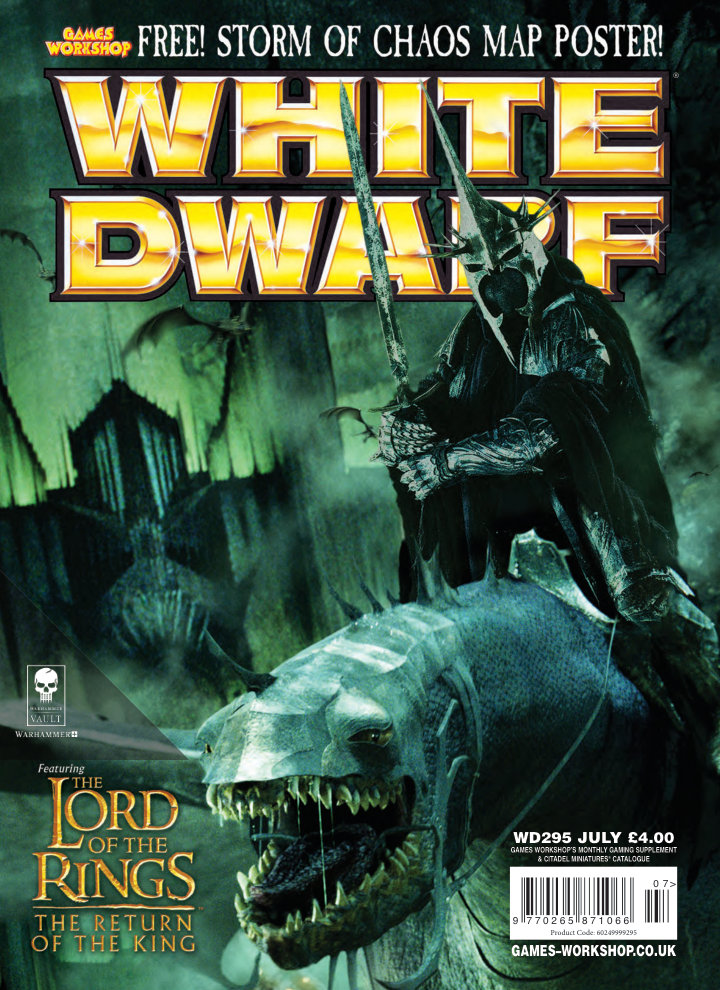
Paul Sawyer introduces limited models accompanying Storm of Chaos and previews forthcoming White Dwarf extras. Dismounted Archaon and Valten join a Marauder and Sorcerer offered through different events or subscription arrangements. A campaign map, army record booklet and paint-lid stickers are among the magazine’s planned additions. The editorial records how the summer campaign was supported with physical hobby items as well as articles.
Warhammer Fantasy Battles
CommunityWD 295 · p. 4
The campaign guide explains how reported battles influence Archaon’s progress towards Middenheim. Main battle sites determine the state and timing of his arrival, while local events can generate advantages elsewhere on the map. Online updates and discussion areas connect individual games to the wider conflict. The announced start date is 5 July, making this a record of the campaign’s launch arrangements rather than a current invitation.
Warhammer Fantasy BattlesWarriors of Chaos
CommunityWD 295 · pp. 5–7
Spartacus introduces a historical campaign supplement, while Imperial Armour Volume Two promises Space Marine and Inquisition vehicles in a large illustrated volume. Further notices cover Valten sculpture, the Gaming Club Network, Fanatic, Black Library and coming Pelennor Fields support. WarCry expansions let card-game players contribute to Storm of Chaos. Staff project updates describe continuing work on armies and terrain.
Warhammer Ancient BattlesWarhammer 40,000
RulesWD 295 · p. 5
The correction supplies the Might, Will and Fate values omitted from the Mirkwood Captain’s earlier profile. It completes that optional hero entry with two Might, one Will and one Fate. The notice is short but necessary for playing the previously published force. It does not revise the captain’s equipment or the surrounding Mirkwood rules.
Middle-earth Strategy Battle GameMirkwood
ShowcaseWD 295 · pp. 14–21
The White Dwarf team uses the approaching campaign to expand, finish or replace personal armies. Paul Sawyer rebuilds elements of Vradchuk’s horde, Guy Haley adds much-needed infantry to his Empire and Greg MacGregor begins a Lahmian force. Paul Rudge’s Sylvania army uses converted Grave Guard, levy and grave markers to change the way his Undead fight.
Warhammer Fantasy BattlesWarriors of Chaos
TacticsWD 295 · pp. 26–31
Phil Kelly explains how a defender can earn a result against an army twice its points value. Chosen troops, Flayerkin, Hellcannons and Archaon demand different responses, so target selection matters more than indiscriminate fire. Refused flanks, march blocking and controlled breakthroughs prevent the whole horde applying its strength at once. Smaller vulnerable units and Archaon’s mount offer achievable points, while the scenario’s panic immunity helps the defence remain deliberate.
Warhammer Fantasy BattlesWarriors of Chaos
Battle reportWD 295 · pp. 32–51
Graham McNeill and Ken Kennedy defend with 3,000 points of Empire and Kislev against Anthony Reynolds and Adam Troke’s 6,000-point Chaos horde. Artillery hurts the attackers, but Archaon and his followers eventually destroy the allied army. The defenders still secure a draw when Archaon wounds himself with his own sword in the final combat, conceding crucial points. The report shows how a heroic delaying action can succeed under the scenario despite total battlefield losses.
Warhammer Fantasy BattlesThe Empire
ModellingWD 295 · pp. 52–55
The ’Eavy Metal team builds one chariot for each Chaos god using existing components. Khorne’s machine uses an inverted Steam Tank hull, Slaanesh’s combines elegant Elven parts, and Tzeentch’s flies on a platform surrounded by Disc flames. Nurgle’s vehicle joins rough chariot parts to a massive beast and Plaguebearer crew. Component lists make the four examples useful starting points for modelling units without dedicated kits.
Warhammer Fantasy BattlesDaemons of Chaos
RulesWD 295 · pp. 58–62
Matt Keefe considers ways to create the feel of enormous battles without making every game impractically large. Multiplayer command, allied armies, divided deployments and expansive terrain each change the shape of the engagement. Contingents provide another option by breaking a normally selected army into subordinate forces with their own commanders and withdrawal conditions. The discussion links rules, collecting and scenery to a convincing sense of strategic scale.
Warmaster
RulesWD 295 · pp. 60–62
The contingent system divides an army after selection into fixed groups containing troops and at least one character. Ordinary characters command only their own contingent, while the general can still issue orders across the army. Brigades cannot mix the groups, and losses can force one contingent to withdraw without immediately removing the rest. The rules represent a grand alliance whose component armies do not act as a perfectly unified body.
Warmaster
ModellingWD 295 · pp. 60–62
Tony Hardy’s scenery applies familiar terrain methods at a smaller scale. Foam banks and textured card produce rivers and fords, while buildings and trees grouped on shared bases suggest villages or woodland rather than isolated objects. A ruined house includes an interior and painted cotton-wool smoke. Smaller pieces such as carts, a forge and roadside remains demonstrate that reduced scale need not mean abandoning narrative detail.
Warmaster
ShowcaseWD 295 · pp. 63–65
Thomas Webster-Deakin’s Dark Elves use aggressive short-range shooting, infantry brigades and mobile support. Rick Priestley’s Chaos and Lizardmen collections show contrasting masses of elite mortals and large reptiles. Erwin Jackson combines mortal and Daemonic Chaos forces in an intricately painted host. The accompanying commentary connects the collections to preferred tactics and the possibilities of themed or allied armies.
WarmasterDark Elves
FictionWD 295 · pp. 70–73
The Relictors’ theft from the Diamedes Archive prompts Inquisitor Cyarro to pursue the weakened chapter. Grey Knights board its fortress-monastery while the Marines insist that their forbidden knowledge protects the Imperium. The attack destroys the starfort and sends survivors fleeing, but the ending casts doubt on Cyarro’s own purity. The story develops the conflict between declared righteousness, practical desperation and the temptation of captured Chaos artefacts.
Warhammer 40,000Relictors
RulesWD 295 · p. 73
The Relictors select a Space Marine army with access to a limited Daemon weapon and captured Chaos standard. Random tables determine the particular relics available before battle. Their outcast status sharply restricts allies, with Radical Daemonhunters allowed only without Grey Knights. The rules draw on both Marine and Chaos equipment to represent a chapter still using Imperial organisation while turning forbidden weapons against its enemies.
Warhammer 40,000Relictors
RulesWD 295 · p. 74
Phil Kelly introduces six rare artefacts for Relictors and suitable Radical Inquisitors. The items manipulate pain, darkness, summoning or the bearer’s physical abilities, often coupling power to a dangerous condition. The Artekus Scourge and Blade of Phaedron provide specialised ways to harm enemies, while the Books of Pain can disrupt nearby units indiscriminately. Their restrictions reinforce the idea of unique treasures rather than standard army equipment.
Warhammer 40,000Relictors
RulesWD 295 · p. 75
An attacking force reaches a sacrificial site as a Greater Daemon is about to arrive. Destroying that entity is the sole objective, with an additional equipped Inquisitor helping the hunters. The central altar determines where the Daemon emerges, while the surrounding deployment allows an assault from opposite sides. The defender must preserve the summoned creature for the six-turn battle.
Warhammer 40,000Relictors
ModellingWD 295 · pp. 76–79
Guy Haley combines restrained grey armour with antique gold and carefully selected Chaos components to give the Relictors a conflicted identity. Individual honours, skull badges and handmade purity seals suggest relic-veneration rather than a uniform fall into Chaos. Dark Angels bodies support an elaborate command squad, and the Librarian and Dreadnought reinforce the chapter’s particular character. Named skin and blue-armour methods accompany the conversions.
Warhammer 40,000Relictors5 paint colours
ModellingWD 295 · p. 79
Nick Kyme supplies a Radical Inquisitor and a towering Daemonhost to accompany the Relictors. The Deceiver’s body, a Strigoi head and model-boat chains give the bound creature an imposing but recognisably humanoid form. The Inquisitor combines a Marine body, bionic arm, ancient-looking cloak and forbidden book. The two conversions express their dangerous alliance through donor parts rather than relying on a stock miniature.
Warhammer 40,000Inquisition
TacticsWD 295 · pp. 80–87
Corey Somavia develops a shooting-focused army around plentiful infantry, selected heavy weapons and a counter-assault reserve. His split deployment separates a sacrificial flank from the main position so enemy assaults create opportunities for crossfire. Diagrams adapt the approach to different deployment shapes and opponents, including Tau and Tyranids. Careful target priorities and disciplined fire matter more than trying to destroy every threat at once.
Warhammer 40,000Astra Militarum
ModellingWD 295 · pp. 90–93
Christian Byrne adds Havocs and a captured Basilisk to Vathek’s Iron Warriors. Older Marine components, modified weapons and restrained Chaos decoration maintain the army’s archaic appearance. Pinning and detachable crew solve practical assembly and transport problems. The instalment then recounts losses to Orks and Tau followed by a hard-earned win against Imperial Guard, using those games to identify changes to the tournament list.
Warhammer 40,000Iron Warriors
PaintingWD 295 · p. 92
Christian Byrne repeats the infantry’s metallic scheme on the vehicle, adding dust, rust and weathering to make it look used. Masking tape helps keep large chevrons straight, while successive pale drybrushes connect the tank to the army’s wasteland bases. Orange-and-brown stains descend from bolts, and brass shells add a distinct metallic accent. Railway weathering powder supplements the paint effects without being identified by a product colour.
Warhammer 40,000Iron Warriors7 paint colours
TacticsWD 295 · pp. 96–99
Jeff Leong makes combat resolution the basis for decisions during melee. Defensive weapon choices can deny an opponent more points than extra attacks would gain, while challenges may expose a unit to excessive overkill. Worked examples compare attacking rank-and-file troops with striking a vulnerable character. Standards, horses and corner contact all matter, encouraging players to assess the actual contribution of each attack rather than simply choose the most heroic-looking duel.
Warhammer Fantasy Battles
CommunityWD 295 · pp. 101–105
The competition guide explains the 2004 categories, entry conventions and judging emphasis. Dioramas replace the narrower battle-scene concept, while the Lord of the Rings category becomes a single miniature competition. Duel and Diorama admit Middle-earth subjects under the stated range restrictions. Young Bloods, the Open competition and additional Forge World and Fanatic prizes broaden participation, with model bases and removable display plinths receiving particular attention.
InterviewWD 295 · pp. 114–115
The preview introduces The Battle of the Pelennor Fields supplement and its focus on Harad’s invasion of Gondor. Imrahil and the Swan Knights oppose Suladân, Haradrim warriors and raiders, with the Hâsharii adding a more secretive threat. Mûmakil provide the largest new battlefield presence, while the Rangers of the North expand Good’s heroic options. The article outlines forthcoming material rather than supplies the new profiles.
Middle-earth Strategy Battle GameGondor
RulesWD 295 · pp. 116–117
Damrod’s ambush turns against him when Rangers become trapped between an Easterling column and pursuing Orcs. The Good player must escort Damrod and enough Rangers off a short table edge instead of winning a straightforward fight. Marshes can knock defeated warriors down, while a stealth move gives the surrounded force a small opening. Alternative point values retain the outnumbered escape challenge for other armies.
Middle-earth Strategy Battle GameGondor
ModellingWD 295 · pp. 118–119
Matthew Ward gathers examples of personalised heroes, warriors and siege engines. Small weapon swaps turn familiar Elves into Captains or spearmen, while more extensive head and limb changes reshape Thranduil, Gil-galad and Aragorn. A pale blue ghost provides an alternative Barrow-wight, and modified artillery displays its upgrades through extra magazines, flaming ammunition or severed heads. The gallery stresses clear visual changes rather than requiring every conversion to involve major sculpting.
Middle-earth Strategy Battle GameMirkwood1 paint colour
RulesWD 295 · pp. 120–123
Alessio Cavatore offers practical guidelines for themed armies rather than arbitrary mixtures of powerful models. Pure cultural lists and plausible alliances provide examples, with heroes helping each allied contingent feel like a real force. The tables cover both book and film interpretations of major battles and acknowledge characters who travel between cultures. Tournament composition points motivate the guidance, but the author encourages personal historical themes beyond the listed combinations.
Middle-earth Strategy Battle GameGondor
PaintingWD 295 · pp. 124–125
Steve Cumiskey adds named characters now that the growing armies can support more epic games. Boromir and Aragorn are personal favourites, while armoured Faramir and Pippin fit the Gondor theme directly. Painting choices distinguish different leathers and white surfaces without drawing attention away from faces. Legolas’s cloak and pale hair provide further examples of adapting restrained film colours to a small miniature.
Middle-earth Strategy Battle GameGondor10 paint colours
PaintingWD 295 · p. 126
Adrian Wood enjoys the contrast between uniformed Easterlings and his individually varied Orcs. Batches of four models keep the work manageable while reinforcing their regimented appearance. Red cloth, gold armour and shaded silver weapons establish the scheme, with extra care reserved for the command figures. Skin beneath the visor needs only a simple treatment, making the distinctive warriors comparatively quick to add.
Middle-earth Strategy Battle GameEasterlings10 paint colours
RulesWD 295 · p. 128
Matthew Ward portrays Lamedon as a harsh upland fief whose independent people resist both Orc raids and outside authority. Clansmen receive a rule limiting whose Stand Fast they accept, while Angbor provides the trusted local leader. Conversion examples combine Dunlending, Rohan and Gondor parts for the warriors and reshape Théoden into Angbor. The profiles are optional additions requiring an opponent’s permission.
Middle-earth Strategy Battle GameGondor
RulesWD 295 · p. 129
Anfalas is presented as a coastal land better accustomed to sea raids than organised warfare inland. Its fishing and trading communities rely partly on neighbouring protection, while skilled sailors resist Corsair boarding actions. The Hunter profile represents comparatively inexperienced bowmen rather than elite soldiers. A converted Rohan warrior, shortened weapon and sculpted hair suggest a way to model this less formal Gondorian force.
Middle-earth Strategy Battle GameGondor
RulesWD 295 · p. 130
The Blackroot valley supports a larger population than the harsher neighbouring uplands, enabling its people to resist Orcs from the mountains. Its Bowmen wear leather armour and carry longbows, represented here with Elf-bow rules. Sam Lee’s conversion removes the horse crest from a Rohan helmet before applying new colours. Background and profile together provide a distinct ranged contingent for a Gondor army.
Middle-earth Strategy Battle GameGondor
RulesWD 295 · p. 131
The wealthy Green Hills train warriors through the protection of trade routes rather than constant invasion. Good armour compensates for comparatively limited battlefield experience in the supplied profile. Hirluin’s doomed march to Minas Tirith gives the contingent its place in the larger war. A Minas Tirith body with a Rohan head creates a recognisable but locally distinct warrior.
Middle-earth Strategy Battle GameGondor
RulesWD 295 · p. 131
Lossarnach’s use of broad axes is linked to a founding tale in which Brandil saved Anárion from Orcs. The fief’s troops receive heavy armour and two-handed axes, with a banner option for a larger contingent. Matthew Ward converts a siege crewman using repositioned arms and a Khazâd Guard axe head. The page combines a local legend with practical rules and a matching model.
Middle-earth Strategy Battle GameGondor
RulesWD 295 · p. 132
Dol Amroth’s wealth, strong defences and maritime history establish its importance within Gondor. The account also records the tradition of Elven ancestry associated with its princes without treating the story as proven. Men-at-arms receive a stronger fighting profile and options for shield, spear or banner. Replacing the White Tree with ship heraldry distinguishes an ordinary Gondor warrior as a member of the haven’s forces.
Middle-earth Strategy Battle GameGondor
RulesWD 295 · p. 132
Ringló Vale’s long partnership with Dol Amroth is expressed through both its history and its troop rules. The valley feeds the haven and protects its inland approaches, while Dol Amroth trains its soldiers. Warrior Bond improves their Courage when the allied Men-at-arms are present. Gondor and Rohan components give the contingent a related but individual appearance.
Middle-earth Strategy Battle GameGondor
RulesWD 295 · p. 133
Pelargir’s old heraldry and inherited equipment preserve the memory of Gondor’s Númenórean foundation. Its Wardens receive a flexible set of weapon options, while Corinir supplies a local hero carrying a Númenórean longsword. Converted Rohan and Gondor figures reinforce the connection to earlier armour styles. The closing discussion encourages further exploration of fiefdoms and northern kingdoms beyond those covered in this feature.
Middle-earth Strategy Battle GameGondor
PaintingWD 295 · p. 134
Dave Taylor’s three-day Gondor warhost demonstrates a compact approach to army painting. Ink-shaded metal, quickly highlighted flesh and restrained leather colours cover the common areas efficiently. Model-specific notes adapt the palette for cavalry, Citadel Guard and Faramir, with a simple grey treatment beneath the banner design. The finished 400-point force shows how consistent methods can produce a coherent army without elaborate treatment of every figure.
Middle-earth Strategy Battle GameGondor15 paint colours
PaintingWD 295 · p. 135
The Glen Burnie Hobby Centre staff paint a Mordor force quickly by varying a shared selection of colours across the Orcs. Green skin, shaded armour and interchangeable dull cloth or leather recipes preserve their scavenged appearance without making every model a new project. Separate notes cover the Captain and Ringwraith. The resulting 365-point warhost demonstrates how an irregular army can still benefit from a planned, repeatable palette.
Middle-earth Strategy Battle GameMordor17 paint colours
Imprint confirms July 2004, issue 295. Some footers incorrectly repeat 56; printed references follow the magazine’s continuous page sequence. Main articles, all eight fiefdom sections, substantive tutorials and errata are included. The advertised physical campaign-map poster is not a separate page in this copy. Battle Companies is teased on the Lord of the Rings divider but the supplied pages instead contain the Muster of Middle-earth. Catalogues, advertising, store/event listings and art-only pages are excluded.