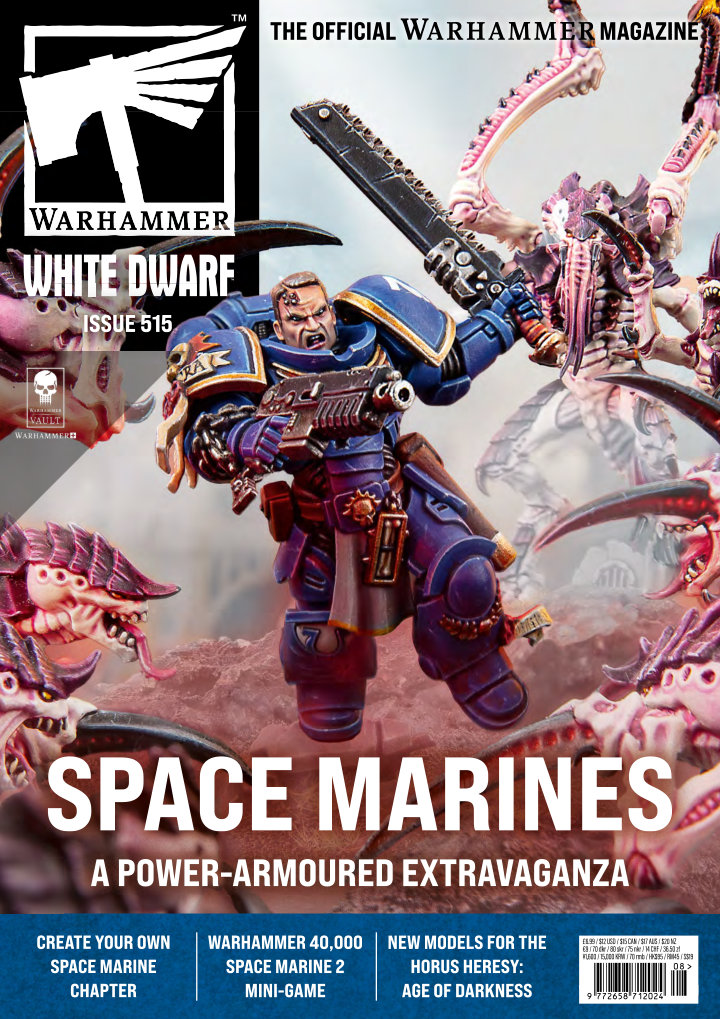
EditorialWD 515 · Inside cover
Lyle Lowery introduces an issue built around the enduring appeal of Space Marines and the first anniversary of Space Marine 2. The programme connects Chapter creation, a new transfer sheet, cooperative tabletop missions and an exploration of the Saturnine and MkII miniatures, making a common theme out of lore, modelling and play.
Warhammer 40,000Space Marines
CommunityWD 515 · pp. 2–5
Readers describe returning to the hobby through family painting sessions, sharing miniatures with children and discovering new games. Jerome Dobinson presents the Claws of the Lion, a converted Dark Angels successor force, while other contributions include an unusually unfortunate Hernkyn Yaegir and advice on starting an Astra Militarum collection.
Warhammer 40,000Middle-earth Strategy Battle GameSpace Marines1 paint colour
LoreWD 515 · pp. 6–9
Andy examines how ordinary inhabitants of the Imperium perceive the Adeptus Astartes. For many, Space Marines exist only in statues and religious stories; meeting one can replace comforting mythology with transhuman dread, even when the warrior is ostensibly a rescuer.
Warhammer 40,000Space Marines
LoreWD 515 · pp. 10–13
This background feature explains how mortally wounded Space Marines are interred in Dreadnought sarcophagi, turning surviving minds and nervous systems into the pilots of heavily armed walkers. It explores their long periods of dormancy, their value as living repositories of Chapter wisdom and the contrasting attitudes Chapters hold toward this final form of service.
Warhammer 40,000Space Marines
LoreWD 515 · pp. 14–17
The Recidious System is introduced through the three worlds familiar from Space Marine 2: jungle-covered Kadaku, industrial Avarax and the cemetery moon Demerium. Their economies are tightly linked, with Kadaku supplying food and promethium while Avarax’s immense workforce supports the Imperium’s manufacturing demands.
Warhammer 40,000Tyranids
RulesWD 515 · pp. 18–29
A self-contained cooperative mini-game translates Space Marine 2’s Operations mode into grid-based tabletop missions. Three Space Marines, chosen from different classes, must coordinate their movement and attacks while enemy groups arrive and act through a defined behaviour system.
Warhammer 40,000Space Marines
RulesWD 515 · pp. 30–31
The first Operations mission sends the squad to a promethium facility on Kadaku, where detonating fuel reserves can buy time for an Imperial withdrawal. Its mapped battlefield and mission instructions put the new cooperative rules into practice, forcing the Marines to balance progress toward their objective against waves of Tyranids.
Warhammer 40,000Space Marines
LoreWD 515 · pp. 32–41
A joint studio and ’Eavy Metal feature develops a method for inventing a Space Marine Chapter, starting with either a compelling colour scheme or a piece of background. It considers names, symbols, progenitors, home worlds, battlefield specialisms, rank markings, beliefs and battle cries as connected decisions rather than isolated decorations.
Warhammer 40,000Space Marines
PaintingWD 515 · pp. 36–37
Tom’s Penumbral Talons turn Raven Guard ancestry into a sinister armoured-ambush Chapter that uses allies as bait. Their cool dark teal armour, black pauldrons and stark white heads and weapons convey a disciplined, inhuman focus, with warmer copper and red details providing contrast. The accompanying recipes build the teal through mixed glazes and successive edge highlights, and keep the white controlled with grey recess shading.
Warhammer 40,000Space Marines10 paint colours
PaintingWD 515 · pp. 38–39
Connor presents the Keepers of the Chalice as relentless purgers of Chaos with a suspected secret in their own heritage. Their predominantly white armour suggests sanctity and endurance, while accumulated damage hints at unending warfare. Black equipment frames a bright red helmet, and the recipes explain how to shade and highlight the white and red without losing their visual contrast.
Warhammer 40,000Space Marines14 paint colours
PaintingWD 515 · p. 40
Gavin’s Illuminators carry their home world’s sun worship into an Ultramarines successor Chapter devoted to bringing Imperial light into the Halo Zone. Bright yellow armour and dark blue framing reinforce that identity while a white helmet and distinctive icon distinguish them from the Imperial Fists. Separate yellow and blue recipes use warm shading and cool highlights to preserve the bold heraldic effect.
Warhammer 40,000Space Marines10 paint colours
ShowcaseWD 515 · pp. 42–51
Members of the Warhammer Studio demonstrate how personally invented Chapters can be expressed through a single character or a much larger collection. Knights Encarmine, Rust Oxen, Celestial Hounds, Brotherhood of Dorn, Knights Oceanus and other examples combine kitbashes, borrowed transfers and freehand symbols with short accounts of their origins and customs.
Warhammer 40,000Space Marines40 paint colours
ShowcaseWD 515 · pp. 52–59
Adam Staincliffe’s Jade Talons trace a White Scars successor Chapter through misplaced faith in the War of the False Primarch and into renegade survival. Multiple incarnations of the same leaders and units show different stages of that fall, allowing the collection to serve as either a loyalist or Chaos army while retaining a recognisable hunter culture.
Warhammer 40,000Space Marines22 paint colours
PaintingWD 515 · pp. 60–63
Emily demonstrates ways to turn neatly painted Space Marines into veterans whose armour and cloth show the effects of battle. The stages cover deepening shadows, glazing mud streaks, applying irregular mud with a torn sponge, painting scratches with contrasting edges and building chipped paint from black and metallic stippling.
Warhammer 40,000Space Marines21 paint colours
PaintingWD 515 · pp. 64–65
Lyle explains his full transfer workflow, from preparing a smooth gloss surface and trimming the backing paper to positioning, softening and sealing a decal. Reverse-action tweezers, setting solution, solvent and paper towel help the transfer conform to curved armour rather than leaving a visible carrier-film edge. The final varnish stages protect the design and remove unwanted shine; washes and scratches can then integrate it into weathered paintwork.
Warhammer 40,000Space Marines2 paint colours
InterviewWD 515 · pp. 66–75
The designers behind the new Age of Darkness set explain how its Isstvan V theme informed Saturnine Terminators, a Saturnine Praetor and Dreadnought, MkII Legionaries, a Centurion and the Araknae weapons platform. The huge Saturnine shoulder silhouette remains a link to early Terminator imagery, while reactors, thermal systems and energy weapons make the new designs feel like rare technological peaks.
The Horus HeresySalamanders
LoreWD 515 · pp. 76–83
This historical account follows the Emperor’s enhanced warriors from the unstable Thunder Warriors to the twenty original Space Marine Legions. It explains gene-seed, surgical transformation and psychological conditioning, and describes how early common structures gave way to the cultures and military preferences of the rediscovered Primarchs.
The Horus HeresySpace Marines
LoreWD 515 · pp. 84–89
The Great Horned Rat is presented as the god of ruin, starvation and desperate survival, whose promise draws mortals into destroying the very lives they mean to protect. The feature distinguishes his apocalyptic appetite from Nurgle’s cycles of decay and regeneration and explores the spread of his influence after the Vermindoom.
Age of SigmarSkaven
FictionWD 515 · pp. 90–91
In the newly resettled Karak Zlat, Gjarna follows the respected elder Zugrom beneath the ancestor shrines in search of an answer to relentless Skaven raids. Their descent reveals an eighth, hidden level whose unnatural heat and unfamiliar script suggest that this solution lies outside the traditions she trusts. Zugrom removes his mask to reveal petrified flesh and introduces Hashut as the duardin’s concealed Father in Darkness, turning an appeal for survival into a revelation of corruption.
Age of SigmarDuardin
ModellingWD 515 · pp. 92–97
Ash and Daniel explain how the Warhammer World exhibition team built Hexeneste as a towering vertical diorama: a Skaven metropolis erupting from a chasm while Stormcast Eternals fight through its structures. Cardboard planning, resin-cast wooden textures, adapted scenery and real chains produce architecture that looks simultaneously industrial, substantial and dangerously improvised.
Age of SigmarSkaven10 paint colours
FictionWD 515 · pp. 98–107
Albarak’s recovered runespear becomes the focus of a dispute between the Frostfang duardin and the Lofnir Fyreslayers. When a former ally claims the weapon and threatens Erinbrok with a lava assault, Albarak tries to settle the matter through a personal challenge rather than allow another ruinous war between kin.
Age of SigmarDispossessed
CommunityWD 515 · pp. 108–109
The Bunker introduces a Space Marine 2-inspired cooperative Kill Team mission and celebrates the studio’s completed Underworlds league. Its next shared projects are a Middle-earth slow-grow league starting with 100-point warbands and a scenery-building event intended to improve the club’s terrain collection. The regular painting challenge and achievement tracker connect those projects with the worldwide Bunker.
Kill TeamWarhammer Underworlds
CommunityWD 515 · pp. 110–111
The studio’s eight-week Winter Underworlds league ends with Harry’s Zarbag’s Gitz facing Steve’s Jaws of Itzl. The final swings sharply after Gobbaluk kills the squig and Drizgit defeats Kro-Jax, and Harry secures an 18–8 victory. A standings table records the full league, while Carlos’s strong win rate and Kelly’s sporting and painting awards recognise other achievements.
Warhammer UnderworldsZarbag’s Gitz14 paint colours
RulesWD 515 · pp. 112–119
This one-to-six-player PvE mission adapts the Lieutenant Titus mission system to a beach assault on Kadaku. Six class-based Space Marines fight procedurally controlled Tyranid waves, collect upgraded weapons from armoury pods and reach a viral bomb inside the facility.
Kill TeamSpace Marines
ShowcaseWD 515 · pp. 120–123
Readers and the studio celebrate leaders and heroes, ranging from named Space Marine characters to an Alchemite Warforger and a Kelermorph. The studio selection includes a converted Ymgarl Broodlord and Norn Assimilator, a pirate-themed Beastboss and squigosaur, a weathered Phobos Captain and a reptile-mounted Space Marine commander. Painting notes explain pale Tyranid skin, darker carapace, a largely Contrast-painted assassin and textured stippling on power armour.
Warhammer 40,000Age of SigmarSpace Marines8 paint colours
CommunityWD 515 · pp. 124–125
The White Dwarf team records progress on its hobby bingo cards. Lyle finishes jumping Tome Keepers with a layered bone scheme, Matt adds a pair of War Dogs, and Ben reports an Intel Pickup game whose close score comes down to a missed objective. Short staff updates chart army-building, painting and terrain milestones, with Lyle completing his bingo card for the first time.
Warhammer 40,000The Horus HeresySpace Marines5 paint colours
ShowcaseWD 515 · p. 126
Four members of the White Dwarf team add their own successor Chapters to the issue’s creation theme. Matt’s Sanguine Knights use quartered red and bone, Adam’s Argent Hawks honour their Imperial Fists ancestry in yellow, Dan’s Guardians of the Abyss turn black armour toward green highlights, and Ben’s Beacons of Maar express Salamanders heritage through bright orange. Each entry records its core paint choices and explains how its transfer-based symbol supports the background.
Warhammer 40,000Space Marines10 paint colours