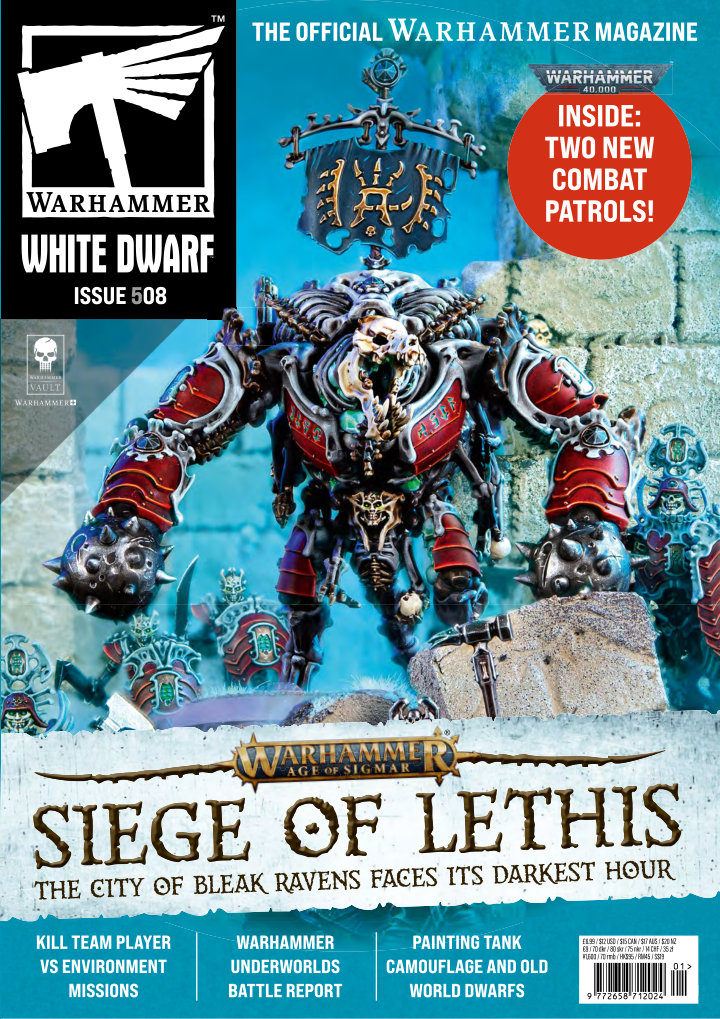
EditorialWD 508 · Inside cover
Lyle emphasises the people and emotions that make Warhammer part of everyday life, from painting evenings to friendships formed through games. His experience at Bugman’s Belter inspires a feature about newcomers attending a tournament. He invites readers to respond to this more personal approach and to the relationship between the hobby, enjoyment and belonging.
CommunityWD 508 · pp. 2–7
A Polish family describes sharing Age of Sigmar across two generations, while readers report successful painting experiments and identify heraldry from an older Deathwatch report. Matt Frieacre recreates Eidolon at Epic scale, and studio painters build scenes inside display cases. The section’s model showcase culminates in a Kasrkin deployment board with a suspended Valkyrie.
Age of SigmarWarhammer 40,000Nighthaunt
ModellingWD 508 · pp. 6–7
Tom Danvers uses the Kasrkin’s rappelling lines to support a Valkyrie above its squad. Experiments establish that six stiff one-millimetre wires can carry the aircraft, while carefully planned model positions tell the story of landing, covering fire and moving into a ruin. A magnetised arm keeps one trooper usable in games, and attaching the support wires before painting demands patient assembly of the finished display.
Warhammer 40,000Kill TeamAstra Militarum
Battle reportWD 508 · pp. 8–23
Nick’s Emberwatch face Louis’s Zikkit’s Tunnelpack using the new Embergard Rivals rules. An early exploding rat wounds the Stormcasts and inspires the Kill-wheel, forcing Nick to use repositioning tricks while Louis pursues treasure and Delving objectives. Every fighter eventually dies, including the Kill-wheel when its own machinery fails; that final destruction completes Nick’s Annihilation card and turns the game into a 20–19 Emberwatch win.
Warhammer UnderworldsStormcast Eternals
LoreWD 508 · pp. 24–31
The Grand Necromystic dredges ancient creatures from Lake Lethis and reshapes their bones into enormous siege constructs. While Marshal Yennard’s soldiers hold a breach at great cost, Anton Kreimnar’s Sombre Sons attack the Mortisans and fossil stores rather than reinforcing the wall. The diversion forces the Petrifex to abandon the siege, buying the city time while leaving much of the dangerous bone stockpile in enemy hands.
Age of SigmarOssiarch Bonereapers
RulesWD 508 · pp. 32–35
The campaign finale makes five fortifications the focus of a race against the Petrifex advance. Attackers can seize positions and bring destroyed units back through them, while defenders use secure outposts for magical gunfire and arriving reinforcements. Scoring balances held defences, destroyed constructs and an Ossiarch breakthrough to the city walls; faction-specific underdog twists keep both sides in contention.
Age of SigmarOssiarch Bonereapers
PaintingWD 508 · pp. 36–47
The feature encourages collectors to create a Khainite temple through its name, realm, loyalties, leader and colours. A Zainthar Kai example ties those choices to existing lore before a wide gallery demonstrates personal interpretations. Natural snakes, tropical birds, red-skinned cultists, armoured Melusai and iridescent scales show how conversions and colour schemes can express a sect’s character.
Age of SigmarDaughters of Khaine
PaintingWD 508 · pp. 38–39
Arran Folly builds around Morathi and the Melusai, combining his interest in their story with an effective gaming army. Coral snakes inform the Blood Sisters and green tree pythons the Stalkers, while non-metallic gold pushes his painting skills. Bright highlights across gold, green and white scales give the army a stylised, almost manga-like finish.
Age of SigmarDaughters of Khaine11 paint colours
PaintingWD 508 · pp. 38–39
Christine Coram’s Soulbound Hag Priestess provides the starting point for a collection shaped by her view of the Khainites as betrayed women. Darkling Coven components add variety to the models. Contrast basecoats and drybrushing make the green serpents practical to paint, while burgundy fabric receives stippled pale highlights for a distinct texture.
Age of SigmarDaughters of Khaine10 paint colours
PaintingWD 508 · pp. 40–41
Martin finds inspiration in Chris Peach’s red-skinned Warcry Bloodbrides and expands the idea into an army of ninety foot aelves, Khinerai, Melusai and Morathi. The range of model heights gives the collection an appealing silhouette. Red skin, blue-tinted metal, dark armour and glossy leather distinguish materials without compromising the force’s striking unified appearance.
Age of SigmarDaughters of Khaine12 paint colours
PaintingWD 508 · pp. 42–43
Jimbo develops an older fantasy collection into a vivid Age of Sigmar force. Purple and contrasting yellow receive strong highlights, while blue-grey flesh recalls the Space Wolves he painted as a child. The recipes show how unusual skin can sit alongside bright fabric, serpentine bodies and cool silver without losing a coherent army identity.
Age of SigmarDaughters of Khaine13 paint colours
PaintingWD 508 · p. 44
Shane’s Melusai come from Ghur’s oceans rather than a conventional temple. Raptoryx neck fins and sculpted face transitions suggest aquatic ancestry, while nets, spears and a trident borrow an Amazonian gladiatorial character from Drukhari and Warcry parts. Saturated green bodies and yellow bellies reinforce their unfamiliar habitat.
Age of SigmarDaughters of Khaine7 paint colours
PaintingWD 508 · p. 44
Ash begins with Kyrae’s green tree-viper tail, then chooses the other warband colours to complement it. Layered orange-red hair and warm leather contrast with bright green scales. Muted bases keep attention on the strongly coloured characters rather than competing with them.
Age of SigmarWarhammer UnderworldsDaughters of Khaine12 paint colours
PaintingWD 508 · p. 45
Will looks to rainforest birds and snakes for a Ghyran jungle sect. Bright blues and greens, offset by purple, give the models a lush character, while gold armour is imagined as ritual decoration for ambushers. Recipes show yellow-green scale edges and layered blue wing membranes with contrasting veins.
Age of SigmarDaughters of Khaine8 paint colours
PaintingWD 508 · p. 46
Mike matches his manifestations to a desert army using the patterns of Saharan vipers and sidewinders. Pale drybrushed bone, dark patterned snakeskin and layered blood effects ground the magical pieces in natural references. The result treats the summoned forms as part of the same environment as the army rather than unrelated display models.
Age of SigmarDaughters of Khaine9 paint colours
PaintingWD 508 · p. 46
Leeanne’s scales imitate snakes whose colours change with reflected and refracted light. An unnamed iridescent acrylic creates the shifting surface, supported by burnished gold and pale hair. The accompanying metallic recipe includes a purple glaze, tying the reflective armour to the model’s changing hues.
Age of SigmarDaughters of Khaine7 paint colours
ModellingWD 508 · p. 47
Duncan transforms the agile Melusai into a heavily armoured vanguard. Executioner torsos, Incubi klaives and additional blades give them more weight and bulk, while a Slaughter Queen gains extra arms for ritual violence. Pale lilac snake bodies provide a softer contrast to the crowded metalwork.
Age of SigmarDaughters of Khaine2 paint colours
PaintingWD 508 · p. 47
Nick paints Gryselle’s fighters during a challenge to complete twenty warbands in twenty weeks. A guide intended for Morgwaeth’s Blade-coven provides a transferable basis for red cloth, pale flesh and black leather. Bright edge highlights finish the quick transparent base colours, demonstrating how one warband palette can serve another related group.
Age of SigmarWarhammer UnderworldsDaughters of Khaine10 paint colours
TacticsWD 508 · pp. 48–51
Jimbo explains how matching weapons to the correct target turns their printed abilities into useful battlefield advantages. Anti-X rewards target selection, Charge favours protected cavalry attacks and critical mortal damage bypasses high armour saves. Examples also distinguish multiplying hits, automatic wounds and shooting in combat, ending with a Lumineth puzzle that asks readers to exploit their abilities while respecting Khorne’s counters.
Age of SigmarLumineth Realm-lords
PaintingWD 508 · pp. 52–55
Emily separates camouflage into a chosen pattern and the technique used to produce it. Hand-painting provides precise control, sponges make organic patches quickly, and tape or adhesive putty protects selected areas during repeated spraying. Four worked examples show how the same principles can suggest urban, woodland or alien surroundings, encouraging experimentation with both colours and shapes.
Warhammer 40,000Astra Militarum
PaintingWD 508 · p. 53
The first pattern is outlined and filled with black over pale grey, then crossed with darker grey shapes. The second uses successive green layers applied with a sponge, leaving earlier colours visible between patches. Moving back and forth between tones softens the woodland effect without requiring specialist equipment.
Warhammer 40,000Astra Militarum6 paint colours
PaintingWD 508 · p. 54
Triangular tape masks over a white vehicle produce hard-edged dazzle camouflage through successive grey sprays and changes to the mask layout. A second method rolls adhesive putty into an irregular pattern over pale flesh before applying dark grey. Removing either mask reveals protected base colours, with edges left soft or refined by hand as desired.
Warhammer 40,000Astra Militarum4 paint colours
PaintingWD 508 · p. 55
The studio answers a request for Ushoran’s worn bracelets with three separate metal recipes rather than one universal gold. Brown and near-black shades age coppery gold, green shading enriches a paler gold and burgundy darkens weathered brass. A very thin turquoise wash supplies small verdigris spots that connect the metals to their ancient wearer.
Age of SigmarFlesh-eater Courts13 paint colours
LoreWD 508 · pp. 56–63
Volkus’s mineral wealth and industry support the Massif Ballistus, a gun so vast that its barrels enter the stratosphere. The gazetteer maps the manufactorums, maglev routes, ritual assembly district and miserable undercity that sustain it, along with settlements devastated whenever it fires. Wider entries describe a moon shattered to stop an Ork invasion, a fortified astropathic relay, a penal quarry world and abandoned jungle training grounds, offering varied locations within the Kessandras System.
Warhammer 40,000Astra Militarum
RulesWD 508 · pp. 64–77
Two new patrols contrast elite human firepower with outcast Necron hunters. Strike Platoon Gorgonne VI brings a command squad, two Scion units and a Taurox Prime, balancing concentrated shooting with the need to preserve fragile troops. Mindflenser’s Murder Court uses a Psychomancer, Immortals, Flayed Ones and Ophydian Destroyers to provoke Battle-shock, threaten objectives and strike from unexpected positions.
Warhammer 40,000Astra Militarum
RulesWD 508 · pp. 66–71
Kreeth commands twenty Scions and a missile-armed Taurox Prime. Simplified orders improve aim, cover or objective duty, and the commander chooses between stealth and close-range shooting enhancements. The rules support sticky objectives, rapid infantry movement and return fire from casualties, while secondary choices reward an established territorial cordon or clearing enemies from objectives.
Warhammer 40,000Astra Militarum
RulesWD 508 · pp. 72–77
Mokhryst the Mindflenser leads five Immortals, two small Flayed One units and two Ophydian Destroyer units. Her abilities and stratagems disrupt enemy resolve, converting Battle-shock into better attacks and reduced objective control. Infiltration, Deep Strike and movement after an enemy falls back give the patrol tactical reach, while Reanimation Protocols and an optional resurrection enhancement help maintain its limited numbers.
Warhammer 40,000Necrons
CommunityWD 508 · pp. 78–83
Lyle attends the Blood Bowl event as a spare player but instead follows Amber, Steve and Ed through their first tournament experiences. Nervous beginnings give way to helpful opponents, first touchdowns, hard defeats and a memorable draw. Their accounts show how modest goals, painted teams and friendly conversation make an event rewarding across different experience levels, with new friendships surviving well beyond the final game.
Blood BowlDark Elves
PaintingWD 508 · pp. 84–87
Matt explains the Old World Dwarfs through the materials and beards that dominate their models. Different metals distinguish ornamental wealth from working equipment, while hair colours communicate age and personality. Glazed capes and unusually edged gemstones provide colour accents around the warm gold and cold silver, with detailed swatches documenting each surface.
Warhammer: The Old WorldDwarfen Mountain Holds
PaintingWD 508 · pp. 84–86
The Dwarf King serves as a study in contrasting metallic surfaces. Cool polished gromril, white-gold decoration, warm utilitarian gold and dark working axe heads remain visually separate through their shading and finish. Ungrim’s axe receives a greenish patina, and the guide recommends starting from the desired metallic mid-tone before shading down and highlighting upward.
Warhammer: The Old WorldDwarfen Mountain Holds14 paint colours
PaintingWD 508 · pp. 86–87
Beards identify individual Dwarf characters and their stage of life. A Thane’s dark hair begins greying at the roots, while the much older King has almost white hair; Slayer orange is treated as a separate statement. Six recipes cover Ungrim’s beard and crest, ginger, brown, white and black hair, using neutral tones that leave room for bright cloaks and gems.
Warhammer: The Old WorldDwarfen Mountain Holds16 paint colours
PaintingWD 508 · p. 87
The team studies how gems reflect light when set into metal, replacing the usual single bright corner with a lighter outer band and highlights at both top and bottom. Red and blue recipes give Dwarfen stones a distinct finish. Smoothly glazed red and blue capes contrast with hard metal and reinforce the characters’ wealth without overpowering their neutral beards.
Warhammer: The Old WorldDwarfen Mountain Holds13 paint colours
ShowcaseWD 508 · pp. 88–97
The three-month collecting challenge ends with all four generals exceeding or meeting their intended army scale. Dave upgrades his knights and adds a trebuchet, Jay finally fields Settra with mounted support, Connor expands beyond Norscan raiders into elite cavalry and monsters, and Dan completes a giant-led Orc host. The galleries show how early colour choices and later conversions have become substantial coherent armies.
Warhammer: The Old WorldKingdom of Bretonnia
ShowcaseWD 508 · pp. 90–91
Dave’s original knights complete their narrative pilgrimage into Grail Knights, with a new Questing unit preserving that role in the army. Knights Errant, Pegasus Knights and more peasants enlarge the collection beyond its planned two thousand points. The trebuchet becomes a favourite small diorama, its machinery and individual crew adding character alongside the noble heroes.
Warhammer: The Old WorldKingdom of Bretonnia
ShowcaseWD 508 · pp. 92–93
Jay reaches the collection’s intended destination with Settra atop the Chariot of the Gods. Additional Skeleton Chariots suit the monarch’s retinue and provide mobile shooting and impact, while horsemen protect the slow army’s flanks. The completed gallery presents the challenge as motivation to finish a playable force and finally take its eternal king onto the battlefield.
Warhammer: The Old WorldTomb Kings of Khemri
ShowcaseWD 508 · pp. 94–95
Connor broadens the Norscan collection into a Warriors of Chaos Grand Army. Knights and gold-armoured Chosen add elite units, while a Manticore lord and Giant Spawn enlarge its monster contingent. An icy blue Warpfire Dragon becomes the final favourite, combining the collection’s winter atmosphere with a dramatic magical centrepiece.
Warhammer: The Old WorldWarriors of Chaos
ShowcaseWD 508 · pp. 96–97
Dan adds more converted Wolf Riders and a mounted Goblin leader, then supplies magical support with an Orc Shaman. Stone Trolls repeat blue used on banners to connect a classic monster scheme to the wider host. A Giant and enormous Bone Grinder finish the force; the latter demands patience and confidence in basic painting techniques to become an army centrepiece.
Warhammer: The Old WorldOrc & Goblin Tribes1 paint colour
FictionWD 508 · pp. 98–107
A divining sniper, Rima Mashanna, guides cultists into a trap around the exhausted Tattershields. Yarin struggles against unreliable sensors and a ruined city while Linnd sends recovered supplies back and keeps the mission moving. Pinned in a broken bastion, Yarin risks a sentry tower and uses its floodlight to expose the sniper, allowing his comrades to kill her; the survivors then discover a possible communications station that may offer their next chance or another ambush.
Warhammer 40,000Astra Militarum
CommunityWD 508 · pp. 108–109
The Bunker explains its 2025 rearrangement: tactics and painting now sit with the relevant game coverage, and monthly large-game scenarios move to detachable cards. Challenges, skirmish rules and community galleries continue, with new events beginning at the Car Show. A rank tracker and submission calendar preserve the practical framework for following personal hobby progress.
ModellingWD 508 · pp. 110–111
The Bunker invites hobbyists to create souped-up Warhammer vehicles for a show and race theme. Hot rods, track cars and showroom pieces can express the maker’s own imagined automotive culture. Photographs and shared submissions form the community side of an event that also supplies a simple racing game over the following pages.
RulesWD 508 · pp. 112–113
A straight-track racing game lets each builder distribute five upgrade points among chassis, turbo and handling. Drivers repeatedly roll to increase speed, but matching a value already on the speedometer causes a redline failure. Turbo can preserve speed, handling can alter a roll and chassis absorbs damage, creating a push-your-luck race in which a car may cross the line just before breaking down.
RulesWD 508 · pp. 114–119
Three linked Kill Team missions send a solo or cooperative team to investigate, steal and evacuate a relic whose devotees grow increasingly hostile. Custom cultist datacards and marksman or brawler behaviours adapt Joint Ops, while the threat principle gives special weight to defending the relic. A referenced Relic ploy deck adds supernatural interference and is required for the intended campaign experience.
Kill Team
RulesWD 508 · p. 116
The team must reach the relic and spend two action points investigating it while safely clear of enemy operatives. Up to ninety wounds of cultist defenders occupy the surrounding shrine complex. Victory comes immediately from completing the action, making clearing enough space around the objective more important than exterminating every devotee.
Kill Team
RulesWD 508 · p. 117
One player operative begins carrying the relic and must escape over the enemy-side killzone edge. The artefact can be handed between operatives through normal marker actions, but its bearer cannot use long-distance removal and repositioning tricks. Fresh cultist reinforcements arrive after the first turning point, turning the mission into a pressured crossing rather than a static defence.
Kill Team
RulesWD 508 · p. 118
The extraction site is already occupied, and pursuing devotees enter from the team’s own edge. The relic must be placed on the highest vantage of Stronghold B from the fifth turning point onward. The team therefore has to survive long enough, clear the pickup point and protect a carrier while enemies converge from opposing directions.
Kill Team
CommunityWD 508 · pp. 120–123
Reader Glade Guard and Custodian Guard accompany studio units chosen as the foundations of their armies. Calum revisits a third-edition Tyranid scheme, Matt gives Jakhals the look of escaped workers and Sam describes white-armoured Marble Guard Vanquishers. Phil’s muted Chaos Legionnaires use lacquered armour and slight verdigris to convey a weather-beaten older style.
Warhammer 40,000Age of SigmarWood Elves22 paint colours
PaintingWD 508 · pp. 124–125
The team starts separate painting and gaming cards for 2025. Matt links two generations of Stormcast heroes through his Shyishan colour scheme, Dan adds bluish robes to Zikkit’s Tunnelpack and Lyle applies camouflage to a long-waiting Deathstrike. Their early progress and stated aims show how the new bingo structure can support several ongoing collections rather than a single annual army.
Age of SigmarWarhammer UnderworldsStormcast Eternals7 paint colours
TacticsWD 508 · p. 126
The recommended Lumineth response assigns each unit a target suited to its weapons while limiting enemy advantages. Dawnriders hit Bloodcrushers to prevent their own anti-infantry charge, Windchargers screen the toughest threats and remain useful if engaged, and Lyrior attacks daemonic Bloodletters. Avoiding the Skull Cannon and withdrawing Sentinels accepts that some enemy abilities cannot be completely neutralised.
Age of SigmarLumineth Realm-lords