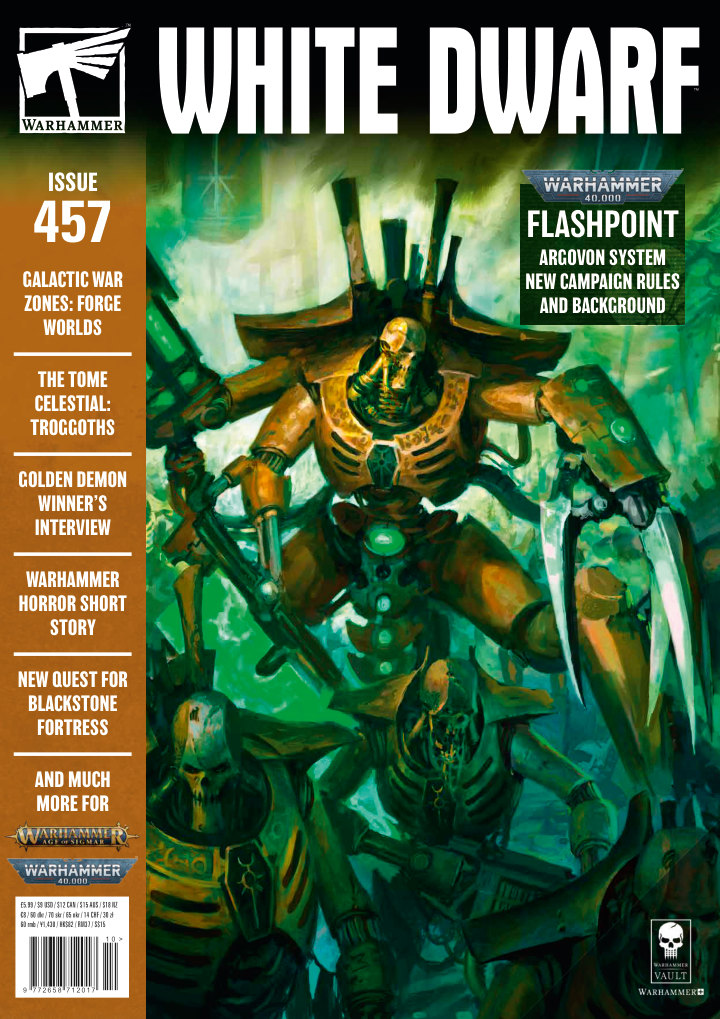
EditorialWD 457 · p. 1
The editor introduces connected background, fiction and rules articles that explore a particular conflict over several issues. Argovon launches the format with its own campaign, while a clear agreement to use one Flashpoint keeps its special rules together and prevents unrelated war zones from becoming an accidental rules mixture.
CommunityWD 457 · pp. 4–9
Readers share family terrain projects, lockdown learning and finished models, while the replies discuss custom rules and photographing miniatures. Detailed responses supply recipes for pale blue and white armour, copper details and Daniel Jackson’s Arkhan the Black, whose bone, spirits and blue armour receive separate treatment.
Warhammer 40,000Age of Sigmar23 paint colours
FictionWD 457 · pp. 10–17
Vazya and the indebted enforcer Bakhin investigate a legendary train that supposedly carries passengers to treasure. Its locked carriages and increasingly disturbing companions lead instead to an underground cult and a monstrous revelation; the final return to the city turns the tempting local legend into a means of drawing in further victims.
Warhammer 40,000
EditorialWD 457 · pp. 18–21
Jordan Green considers why grotesque comedy belongs in settings filled with catastrophe and cosmic horror. Orks, grots and troggoths follow their own coherent but absurd logic, yet looking at those same creatures through an ordinary soldier’s eyes restores their danger and prevents their comic appeal from reducing them to harmless relief.
Warhammer 40,000Age of Sigmar
LoreWD 457 · pp. 24–31
Troggoths emerge from the deep places in wandering herds whose violence and apparent stupidity frustrate more calculating opponents. Accounts of Glogg’s growing migration, the Stoical Gobblemaws and the Old Lady of the Bog explore regional differences and uncertain origins, while a historical sequence follows the destruction these creatures leave across the Mortal Realms.
Age of SigmarGloomspite Gitz
RulesWD 457 · pp. 32–33
The troggoth-focused allegiance improves regeneration, lets Dankholds share a general’s command influence and allows destroyed Rockgut or Fellwater units to return near a Loonshrine. The Stomping Megamob battalion adds retreat-and-charge or retreat-and-shoot flexibility, turning the background’s relentless migration into a distinct army option.
Age of SigmarGloomspite Gitz
ShowcaseWD 457 · pp. 34–39
Jes Bickham’s collection begins with an affection for the new troggoth models and grows into the inspiration for the accompanying Tome Celestial. Named Dankholds, ranks of Rockguts and Fellwaters, Mollog and the imposing Big Mudda give the army character, while the collector describes the appeal of a simple force of wonderfully dim monsters.
Age of SigmarGloomspite Gitz
PaintingWD 457 · p. 38
Jes explains the pale purple-pink skin that suggests creatures accustomed to darkness, contrasted with deep blue fungal growths. Compact recipes cover claws, leather, the green creature in Glogg’s hand and rocky bases, allowing the varied monsters to share a recognisable palette without becoming visually uniform.
Age of SigmarGloomspite Gitz15 paint colours
EditorialWD 457 · pp. 40–43
Jervis Johnson explains how a points calculator provides an initial estimate from a unit’s characteristics, abilities and allegiance context. Playtesting and recurring feedback then refine that estimate, with special attention to the assumptions of Pitched Battle play and the reason a unit’s value cannot be equally exact in every possible battlefield situation.
Age of Sigmar
InterviewWD 457 · pp. 44–49
Slayer Sword winner Maxime Penaud reviews his development as a painter and the work behind his 2019 Dankhold Troggboss. Strong countershading, directional light, carefully judged texture and extensive sculpting combine in the finished piece, while work-in-progress photographs and practical advice emphasise ambitious projects, repeated colour tests and patient critical assessment.
Age of SigmarGloomspite Gitz
LoreWD 457 · pp. 52–59
An Imperial account surveys the Argovon System’s threatened worlds and the hurried assembly of Task Force XI within the Pariah Nexus. Planetary hazards, ecclesiastical strongholds, military formations and an unreliable assessment of enemy forces establish a campaign setting shaped as much by bureaucratic confusion and prejudice as by the advancing Stilling.
Warhammer 40,000Astra Militarum
CampaignWD 457 · pp. 60–62
Three alliances compete over three campaign phases, earning war zone points through games and converting phase wins into strategic points. A Campaign Master coordinates the group, Crusade armies can participate, and the final phase carries extra weight so that a poor opening need not decide the entire campaign.
Warhammer 40,000
RulesWD 457 · pp. 63–64
Players place fracture tokens that define randomly opening fault lines as the battle progresses. Tectonic effects can damage or disorient formations caught above them, while advancing or charging across an existing fissure adds another hazard, encouraging commanders to think about the ground between objectives as well as enemy fire.
Warhammer 40,000
RulesWD 457 · pp. 64–66
Waterlogged terrain becomes alkaline, impassable or especially treacherous to vehicles, while changing rain and wind interfere with movement and shooting. Mysterious objectives add another layer of risk and opportunity through ancient technology, submerged cover or unnerving sigils, making the flooded battlefield central to mission decisions.
Warhammer 40,000
RulesWD 457 · pp. 66–67
Snow, fog and razor-edged blizzards alter movement, visibility or the risks faced by vehicles. Loud destructive weapons can also trigger avalanches in the busiest table quarter, creating a meaningful trade-off between concentrated firepower and the danger of burying friendly and enemy formations together.
Warhammer 40,000
RulesWD 457 · pp. 67–69
Campaign-specific Crusade Agendas reward scavenging, defending Imperial positions, preserving sacred ground and pursuing factional objectives. Additional options cover Mechanicus xenotech recovery, escaping Genestealer Cults and Deathwatch assassination, linking unit experience to the wider alliance struggle through bonus war zone points for a suitably involved warlord.
Warhammer 40,000Astra Militarum
FictionWD 457 · pp. 70–73
Tempestus Scions attack a newly appeared Necron artillery battery after its guns devastate an Imperial armoured column. Destroyer ambushes leave the survivors carrying their fallen comrades’ demolition charges, and Emmerik must make the final approach under pursuit by Scarabs, measuring success in the destruction of the weapons rather than his own survival.
Warhammer 40,000Militarum Tempestus
LoreWD 457 · pp. 74–75
Forge worlds sustain Imperial industry at the cost of poisoned landscapes and brutal living conditions. The article considers how protective equipment, rad-waste colours and industrial grime can identify both native armies and invaders, using the environment as a source of collecting, painting and conversion ideas.
Warhammer 40,000Adeptus Mechanicus
PaintingWD 457 · pp. 76–77
Dusty bases, stained uniforms and carefully chosen contrasts connect armies to industrial battlefields without losing the models against their surroundings. Nyle Ajina’s Rusted Claw cult demonstrates a quick Contrast-led process over layered spray undercoats, with distinct recipes for work suits, fatigues, guns, red details and skin.
Warhammer 40,000Genestealer Cults5 paint colours
ModellingWD 457 · pp. 78–80
Industrial settings support unusual scratch-built machines and heavily adapted servants of the Machine God. Calum McPherson’s towering Tech-Priest, Lewis Collins’s Armiger-based grot aircraft and Thomas Elliott’s hunter-killer robot show how recognisable parts can be recombined into new silhouettes, with painting notes reinforcing dirty metal and worn armour.
Warhammer 40,000Adeptus Mechanicus9 paint colours
PaintingWD 457 · p. 81
A Thermic Plasma Regulator receives a bright industrial yellow finish before successive weathering stages age its panels. Drybrushed highlights, sponge-applied chips, exposed metal and layered corrosion create the appearance of equipment neglected for centuries, with a light undercoat helping the yellow remain vivid beneath the grime.
Warhammer 40,0006 paint colours
EditorialWD 457 · pp. 82–85
Elliot Hamer encourages players to experiment with army composition and tactics rather than repeating a familiar list indefinitely. Reviewing games, introducing a new battlefield role and trying different mission contexts develop understanding through experience, while the unexpected situations created by experiments also generate better stories and more varied games.
Warhammer 40,000
TacticsWD 457 · pp. 86–89
John Bracken traces Arena Mortis from a popular studio variant to its boxed expansion and explains the appeal of one-fighter multiplayer combat. Upgrade selection, resurrection, chip damage and changing Mortis Lenses reward different choices from ordinary games, while killing opponents and scoring glory provide competing routes to success.
Warhammer Underworlds
FictionWD 457 · pp. 90–93
Morgwaeth’s Daughters of Khaine search Beastgrave for an elusive fragment of their god while Morgok’s orruks seek a worthwhile fight. An arena of repeatedly rising undead brings their paths together, turning frustrated exploration into a violent contest in which both warbands find the living mountain has more than enough foes to offer.
Warhammer UnderworldsMorgwaeth’s Blade-coven
TacticsWD 457 · pp. 94–99
Dave Sanders builds a plan around three durable orruks, their individual attack profiles and the Waaagh! counters that accelerate their strongest turns. Recommended upgrades, objectives, board choice and deployment balance direct aggression with activation timing, showing how a small warband can win without treating every fighter as interchangeable.
Warhammer UnderworldsMorgok’s Krushas
TacticsWD 457 · pp. 99–103
Morgwaeth and Kyrae provide dependable leaders for a fragile but dangerous five-fighter warband. The guide develops a flexible plan combining kills with objective play, using reach, Combo attacks, careful inspiration and selected damage or survival cards to keep the less resilient fighters relevant through the game.
Warhammer UnderworldsMorgwaeth’s Blade-coven
ModellingWD 457 · pp. 104–111
Gareth Etherington explains creating atmospheric miniature photographs with terrain, coloured light, flash, fog and carefully planned composition. Behind-the-scenes examples show practical setups, while finished scenes demonstrate visual paths, contrasting moods and the rule of thirds; a look back at his early photography and reader submissions connects spectacle to clear model presentation.
CampaignWD 457 · pp. 112–117
Daedalosus and UR-025 venture together into the Blackstone Fortress to investigate Spindle Drones, each concealing a different motive for the partnership. The five-stage standalone quest moves from capture and a delicate dissection challenge to Guardian Drone combat, escape and the discovery of a production chamber, with the pair’s mistrust shaping special rules.
Warhammer QuestAdeptus Mechanicus
TacticsWD 457 · pp. 118–121
Jay Clare analyses Azog’s exceptional combat rules alongside the command abilities and White Warg that make him more than a powerful duellist. Managing Might, choosing suitable enemy heroes and assembling supporting troops are as important as his raw damage, with sample force suggestions showing how to protect and exploit the army’s expensive centrepiece.
Middle-earth Strategy Battle GameAzog’s Legion
CampaignWD 457 · pp. 122–127
Arbitrator David Delgado describes a scattered group’s narrative Necromunda campaign, kept active between meetings through shared models and gang stories. Multiplayer sessions and player-led developments gradually replace strict campaign bookkeeping with agreed injuries, advances and opportunities, followed by practical advice for giving every participant a memorable role in the unfolding underhive drama.
Necromunda
ShowcaseWD 457 · p. 122
John Blanche chooses Cawdor for their filthy medieval fanaticism and adds Flagellant, Grey Knight and Blackstone Fortress details to the plastic gang. His campaign recollections emphasise enthusiastic roleplaying and indiscriminate fire, with allies and scenery proving scarcely safer than the cultists his fighters regard as their natural enemies.
NecromundaHouse Cawdor
ShowcaseWD 457 · p. 123
Nicolas Grillet’s Eolles combine an elderly matriarch, scavengers, abandoned voidfarers and a floating former assassin into an unusual underhive community. Their conversions provide a rich narrative identity even when games go badly, with failed charges and a fatal leap offset by the leader’s unexpectedly effective grenades.
Necromunda
ShowcaseWD 457 · p. 123
Kev White pursues a deliberately violent, potentially Chaos-tainted interpretation of Van Saar despite the house’s natural strength in shooting. His early leader becomes a dangerous close-combat fighter before a meltagun ends the experiment, leaving a more practical rad-cannon champion to continue the gang’s corrupt ambitions.
NecromundaHouse Van Saar
ShowcaseWD 457 · p. 124
Maxime Corbeil paints nearly identical Delaque gangers with a quick dark scheme and a cold glow beneath their collars. Converted hired guns expand the cast, while a reputation for repeatedly betraying allies becomes part of the gang’s identity rather than an obstacle to the campaign’s collaborative storytelling.
NecromundaHouse Delaque1 paint colour
ShowcaseWD 457 · p. 125
Alexandre Dumillard represents corrupted Ash Wastes miners with Genestealer Cult rules so that hybrids and aberrant bodies can express Tzeentchian mutation. A mixture of Chaos and cult components creates the fighters, whose apparently generous alliances repeatedly conceal plans that leave their supposed partners paying the price.
NecromundaChaos Cults
ShowcaseWD 457 · p. 126
James Glendinning builds the Goat Fellas around Gor Half-horn and memories of Imperial Beastmen, combining Beastman limbs with Cadian equipment. Goliath rules provide their battlefield identity, and the project expands into a sizeable cast including a Bullgor-based Stimmer and a Gore-grunta transformed into a Sumpkroc.
NecromundaHouse Goliath
ShowcaseWD 457 · p. 126
David Delgado modernises classic Confrontation figures with weapons and limbs from several contemporary Imperial kits. Used as Venators, these models serve the campaign as bodyguards, prison security and even arena patrons, letting a distinctive collection become a recurring supporting cast for other gangs’ adventures.
NecromundaVenators
FictionWD 457 · pp. 128–141
Miriya’s party discovers the Keep’s gruesome experiments as Vaun explains LaHayn’s ambitions and the hidden significance of Neva. His apparent cooperation collapses into an escape that exposes the Sisters to capture, leaving Miriya and Verity imprisoned while the lord deacon reveals a plan to take the Emperor’s place through stolen psychic power.
Warhammer 40,000Adepta Sororitas
CommunityWD 457 · pp. 142–143
Working from home during the pandemic, the team shares painted models and remote games rather than a conventional studio roundup. Mephiston, Titan weapons, Nick Horth’s ex-Guard Orlocks and a spectral Guardian of Souls illustrate the varied projects, with practical colour notes accompanying several of the finished miniatures.
Warhammer 40,000Age of Sigmar15 paint colours
ShowcaseWD 457 · p. 144
Darren Latham adds Bladeguard, a Chaplain and a Prognosticator to his long-running Silver Skulls collection. He explains how a tiny addition of old Black Ink once helped shade the matte silver armour and how a newer Contrast paint can achieve a similar result over the same metallic base.
Warhammer 40,000Silver Skulls4 paint colours