EditorialWD 402 · p. 1
Jes Bickham places the Eldar release within a busy year of new armies. The enormous Wraithknight and two aircraft provide the month’s most striking additions. Glenn incorporates them into his Ulthwé force for a battle against Necrons. Nick Bayton’s greenskins and a collection of converted tanks supply contrasting hobby projects.
Warhammer 40,000Warhammer Fantasy BattlesAeldari
ReviewWD 402 · pp. 6–9
The Wraithknight combines immense scale with the curved lines of smaller Eldar constructs. Its living pilot shares the machine with the spirit of a dead twin, giving the armour a tragic identity. Wraithcannons, a suncannon and a ghostglaive offer very different main armaments. Articulated joints and optional locating pins allow collectors to choose between straightforward assembly and more ambitious poses.
Warhammer 40,000Aeldari
ReviewWD 402 · pp. 10–11
A Spiritseer pilots the Hemlock while distortion weapons and a mindshock pod attack its victims in unsettling ways. The double-delta wings preserve a sleek silhouette despite the unusual armament. Dorsal fins and notched shapes connect the aircraft to seers and ghost warriors. Adam highlights those visual links as well as the craft’s role as a terror weapon.
Warhammer 40,000Aeldari
ReviewWD 402 · pp. 12–13
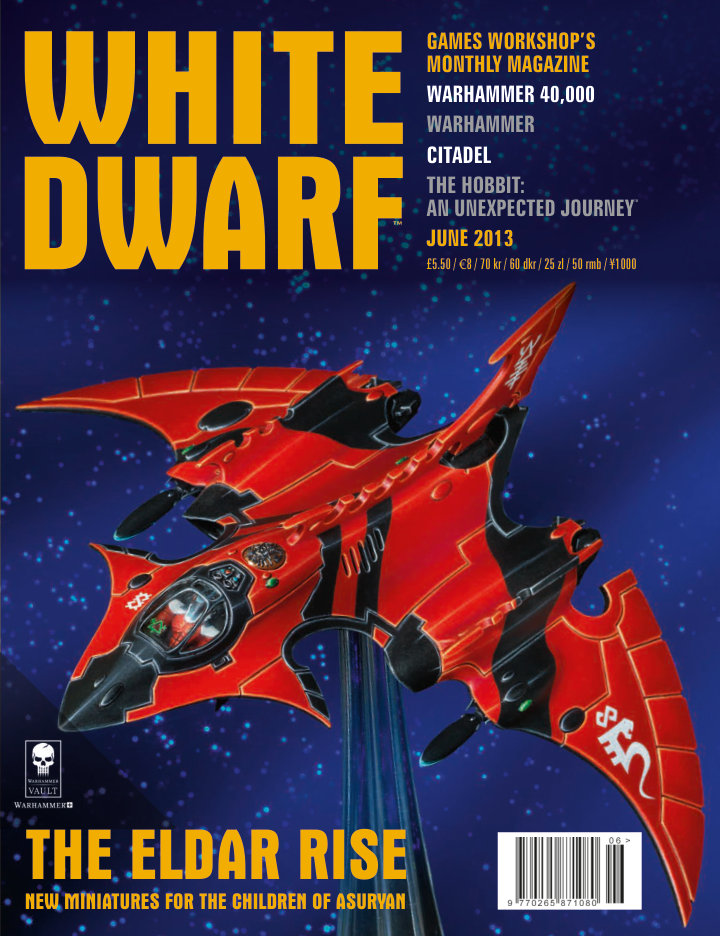
The Crimson Hunter treats aerial combat as an Aspect Warrior discipline. Its Nightshade Interceptor shares the Hemlock’s foundation but adds wings and a more predatory profile. Bright lances and a pulse laser establish its fighter role, with starcannons offered for an Exarch. A distinct pilot helmet carries the Aspect identity into the cockpit.
Warhammer 40,000Aeldari
ReviewWD 402 · pp. 14–15
Five plastic ghost warriors replace the older models with a much wider range of poses. Interchangeable legs, torsos, collars and arms permit variation without making the guns difficult to align. Both wraithcannons and D-scythes are included for the entire unit. The large weapons and statuesque forms connect these infantry to the broader family of Wraithlord and Wraithknight designs.
Warhammer 40,000Aeldari
ReviewWD 402 · pp. 16–17
The alternative Wraithguard build arms five constructs for close combat. Ghostswords or axes with forceshields give two distinct arrangements. Extra plates, elbow blades and helmet crests make the figures more heavily armoured than their gun-carrying counterparts. Oliver Norman’s design uses those changes to suggest spirits whose anger endures within the wraithbone.
Warhammer 40,000Aeldari
ReviewWD 402 · p. 18
Jes Goodwin’s plastic Farseer uses flowing cloth and an extended hand to create a sense of active spellcasting. Jewellery sits away from the body, adding depth despite the model’s compact size. Spirit stones and a singing spear establish the character’s psychic identity. A ruined Eldar base links the figure to the remains of an ancient civilisation.
Warhammer 40,000Aeldari
ReviewWD 402 · p. 19
Mike Fores gives the Spiritseer an eyeless helmet and plentiful spirit stones to connect him to the dead he guides. A witch staff and a raised soul stone make the figure’s role immediately visible. An elaborate warp vane carries the same family of shapes found on ghost constructs. The review introduces the Finecast model through those narrative design details.
Warhammer 40,000Aeldari
ReviewWD 402 · p. 20
The Alaitoc outcast crouches on a broken piece of Eldar architecture. A mask, ammunition and travelling equipment reinforce his stealthy identity. Voidbringer and the carefully focused face emphasise precision rather than overt movement. The review connects the miniature to Illic’s mastery of hidden webway routes and the Pathfinders who join him.
Warhammer 40,000Aeldari
ReviewWD 402 · p. 21
The Battleforce combines Dire Avengers, Guardians with a weapons platform, a Wave Serpent and a Vyper. It offers several different battlefield elements rather than a single type of infantry. Psychic cards cover the Runes of Battle and Runes of Fate. The notices describe the collection and reference tools without reproducing their complete game rules.
Warhammer 40,000Aeldari
ReviewWD 402 · pp. 22–25
Andrew Kenrick praises a codex whose artwork and page design reinforce the Eldar’s faded grandeur. Ancient myths, the Fall and modern craftworlds establish the background to their continuing struggle. New units sit alongside expanded Aspect Warrior and Phoenix Lord material. Heraldry and miniature photography make the book a collecting reference as well as an army rules source.
Warhammer 40,000Aeldari
ReviewWD 402 · p. 26
Five Dire Avengers include alternative Exarch equipment and varied shooting poses. Their command options range from a shimmershield to wrist-mounted guns. The Windriders provide a more mobile expression of the Eldar’s curved technological style. Both sets include a large new transfer sheet for adding craftworld and unit identity.
Warhammer 40,000Aeldari
ReviewWD 402 · p. 27
Yriel’s banners, bionic eye and long coat evoke a returning corsair as well as Iyanden’s commander. The Wraithlord provides a much larger companion with interchangeable heavy weapons and hands. Four feet and flexible joints support static or walking poses. The two notices revisit established models alongside the month’s new ghost warriors.
Warhammer 40,000Aeldari
ReviewWD 402 · pp. 28–29
A limited clothing release imagines the uniform of a watchman aboard the Imperial warship Divine Right. Ship silhouettes, naval badges and deliberately bureaucratic safety warnings carry the theme across the garment. A communications-canister package extends the fiction beyond the printed design. The feature records the 2013 release and its presentation as a historical product.
Warhammer 40,000Battlefleet GothicImperial Navy
CommunityWD 402 · pp. 30–31
The updated tour lists Memphis, Cologne, Birmingham and Modena. Golden Demon and Armies on Parade provide major reasons to bring completed hobby projects. Local Parade Day winners can progress to the larger Games Day display. A still-unrevealed exclusive miniature and opportunities to meet designers complete the preview.
ReviewWD 402 · p. 32
William King returns to Macharius through the eyes of bodyguard Leo Lemuel. A lost relic draws the crusade into conflict with the Dark Eldar lord Ashterioth. Adam finds the contrasting viewpoints effective in making a legendary commander and a cruel opponent believable. The review also praises the book’s connections to King’s other fiction and Raymond Swanland’s cover.
Warhammer 40,000Astra Militarum
ReviewWD 402 · p. 33
Daenyathos explores the life behind the Soul Drinkers’ foundational teachings. Dan recommends reading its revelations after the main series rather than following strict chronology. The second omnibus carries the Chapter through increasingly desperate conflicts, including battles with the Mechanicus and Necrons. Together the reviews emphasise concealed motives and the tragedy of a Chapter cut off from the Imperium.
Warhammer 40,000Soul Drinkers
ReviewWD 402 · p. 34
David Guymer presents Queek as a violent and unstable warlord amid the fighting for Karak Eight Peaks. A Grey Seer’s interference offers little restraint on his appetite for battle. The skulls on his trophy rack seem to supply their own advice. Dan praises a gruesome, energetic novel with more personality than a succession of killings.
Warhammer Fantasy BattlesSkaven
ReviewWD 402 · p. 34
An ominous astropathic warning draws the Dark Angels towards Stern’s Landing. Empty cities, bells and swarming flies establish the threat before the full Chaos plot emerges. C Z Dunn’s audio drama follows the events that bring Balthasar into his later command. Andrew highlights both the opening message sequence and the performers’ contribution to its atmosphere.
Warhammer 40,000Dark Angels
ReviewWD 402 · p. 35
The Eldar codex appears digitally alongside the printed release, adding interactive navigation and high-resolution galleries. Iyanden is announced as a separate supplement focused on the craftworld’s history, heraldry and battles. Scenarios and additional rules are promised with the showcase material. White Dwarf’s electronic edition is also described, with extras outside the supplied print scan.
Warhammer 40,000Aeldari
ReviewWD 402 · p. 36
The tracked Rapier carries a heavy weapon that crushes targets through intense gravity. A gun shield, optical lenses and unusual generators communicate its arcane technology. Two crew accompany the carriage, including one mounted aboard it. Adam presents the model as a distinctive alternative within the growing Rapier family.
The Horus HeresySpace Marine Legions
ReviewWD 402 · p. 37
Breacher Marines wear strongly protected Iron Armour and large shields for close assaults. Bolters, a graviton gun and a lascutter provide options for their five-model set. The Reconnaissance squad takes a different approach with cloaks, specialised armour and either shotguns or sniper rifles. The paired reviews contrast protected advance with hidden observation.
The Horus HeresySpace Marine Legions
ReviewWD 402 · p. 38
The Thallaxii introduce large cyborg troops from the Mechanicum’s Ordo Reductor. Hunched armour and heavy lightning guns make them look formidable despite their mobility. Small jet packs and additional exhausts suggest bounding advances. Adam highlights their value in representing a less familiar part of the Heresy’s forces.
The Horus HeresyMechanicum
ReviewWD 402 · p. 39
Cataclysm expands Warhammer: Invasion into multiplayer games with a substantial new card set. Faith and Steel adds further tricks, ambushes and characters including Balthasar Gelt. Black Crusade’s Tome of Excess turns to Slaanesh with social conflict and new equipment. The overview records the different ways Fantasy Flight extends its card and roleplaying games.
Warhammer: InvasionBlack CrusadeThe Empire
ShowcaseWD 402 · pp. 44–49
Battle for Skull Pass inspires Nick to begin with a production line of roughly two hundred Goblins. Quick, repeatable painting produces the army’s bulk, while characters and monsters receive more individual attention. Names grow out of battlefield successes and mishaps, from dependable archers to Skarsnik’s elite bodyguard. The expanding collection becomes a record of those games rather than a project with a fixed endpoint.
Warhammer Fantasy BattlesOrcs & Goblins1 paint colour
EditorialWD 402 · pp. 50–51
Jervis considers the personalities players attribute to particular units after repeated games. A veteran regiment can feel dependable while a newly painted monster acquires an unlucky reputation. He recognises tactical habits and selective memory behind those impressions. Even so, the emotional history of a personal collection makes it more satisfying to use than anonymous playtest pieces.
Battle reportWD 402 · pp. 52–69
Glenn More’s Ulthwé army attempts to halt Jes Bickham’s Necrons as Primordus IV awakens. The Wraithknight repeatedly destroys key units, while the Avatar and Wraithblades eventually overcome the C’tan. Jetbike fire downs a Night Scythe and the Hemlock unexpectedly destroys the Command Monolith. Jes’s force is annihilated by the seventh turn, leaving the Eldar with a 7–1 victory.
Warhammer 40,000Aeldari
RulesWD 402 · pp. 58–59
Three data nodes modify the Crusade mission with low-value objectives. A Command Monolith provides a larger prize: the Necrons score for activating it, while the Eldar can score by destroying it first. Its chance of awakening improves late in the game and activation brings additional guns into use. Vanguard Strike deployment and the tomb complex make the scenario’s story visible on the table.
Warhammer 40,000Aeldari
TacticsWD 402 · pp. 70–75
Dan divides his Tau army into a long-range firebase, a mobile strike force and units that tempt the enemy forward. Markerlights connect their shooting, while overlapping support and careful retreats help preserve lives. Shadowsun and guided arrivals let the suits attack a vulnerable part of the opposing army. A separate personal system marks survivors after each game and promotes them after five battles, linking tactical caution to modelling projects.
Warhammer 40,000T’au Empire
ShowcaseWD 402 · pp. 76–77
Mikko Luoma creates an Inquisitorial group for a narrative involving Kari Hernesniemi’s rival Inquisitor Cassar. Pherion uses a Necromancer body to suggest authority without physical strength. A Cairn Wraith and improvised servo-arm become the Red Priest. The models remain robust enough for play, keeping their visual stories connected to the developing campaign.
Warhammer 40,000Inquisition
InterviewWD 402 · pp. 78–79
Michael Anderson nominates the Screaming Bell, especially its dynamic Grey Seer. Seb Perbet’s component planning allows a pose that would be difficult with conventional body divisions. Colin Grayson develops the structural frame from a physical mock-up while Seb works on the creatures and smaller details. Moving the Seer above the Rat Ogre gives the final miniature a clearer hierarchy.
Warhammer Fantasy BattlesSkaven
InterviewWD 402 · pp. 80–86
Jes Goodwin and Phil Kelly describe Eldar culture as something developed through successive models, stories and symbols. Craftworld runes carry several meanings, connecting present military identity to myth and catastrophe. Iyanden’s losses lead naturally towards ghost warriors, while Ulthwé’s location helps explain its seers. Aspect Warriors show the same connection between disciplined identity, costume and a narrow battlefield role.
Warhammer 40,000Aeldari
BackgroundWD 402 · p. 87
Jes Goodwin explains how the new transfer sheet links plastic miniatures to their imagined culture. Craftworld marks sit alongside Aspect badges, ghost-warrior symbols and smaller functional labels. Size and pattern variations distinguish vehicles, warriors and individual units. The annotated sheet also identifies less prominent craftworlds and warns that symbols such as the Hemlock rune have a specific meaning.
Warhammer 40,000Aeldari
CommunityWD 402 · p. 88
Seven collectors begin a series following their preparations for Armies on Parade. A small display board must combine a coherent army with a convincing setting. Monthly progress reports will lead towards the Birmingham Games Day final. The introduction presents the challenge as a shared collecting and painting project with visitor voting at its conclusion.
CommunityWD 402 · p. 89
Eddie Eccles chooses Harlequins inspired by Andy Chambers’s Masque of Vyle. Working for Black Library gives the faction’s fictional guardians an additional personal connection. Masks, books and other collected props help him establish the mood of the project. The entry introduces his plan before showing a finished display.
Warhammer 40,000Harlequins
CommunityWD 402 · p. 89
Carl Dafforn plans a snowy Ogre army suitable for both a display and later Battle Brothers games. A month-by-month schedule begins with a Hunter and Yhetees before moving through Ogres, Maneaters and a Stonehorn. The manageable sequence suits his steady painting pace. Finding time for the accompanying display board remains part of the challenge.
Warhammer Fantasy BattlesOgre Kingdoms
CommunityWD 402 · p. 89
Jon Flindall starts a Nurgle Daemon collection while experimenting with the newer shades and glazes. An overrun Empire village will provide the display setting. Boarded windows, mud and a neglected windmill are intended to communicate decay. The plan ties the models and their surroundings to the same diseased narrative.
Warhammer Fantasy BattlesDaemons of Chaos
CommunityWD 402 · p. 90
Dan Harden returns to Armies on Parade with an Empire project inspired by Uniforms and Heraldry. Purple and white Ostermark colours establish the main force. The Death’s Heads and Knights of the Everlasting Light offer distinctive regiments and conversion opportunities. He uses their written histories to plan a collection with identities beyond its basic unit types.
Warhammer Fantasy BattlesThe Empire
CommunityWD 402 · p. 90
Chris Bilewicz begins a Sylvanian Vampire Counts display with a relatively small initial group. A large Zombie unit will mix Empire Militia components with the undead kit. Isabella von Carstein provides the first character model. The entry introduces a measured start and the conversions intended to give the horde more variety.
Warhammer Fantasy BattlesVampire Counts
CommunityWD 402 · p. 91
Dominic Murray plans a Tau reconnaissance force examining a crashed Imperial ship. A Realm of Battle tile and Aquila Lander wreck establish the display’s central scene early. Stealth and Crisis suits will secure the site around it. A new, brighter colour scheme offers a change from his previous Marine and Guard armies.
Warhammer 40,000T’au Empire
CommunityWD 402 · p. 91
Nick Bayton chooses the Blood Ravens from Dawn of War’s opening cinematic. Sketches and screen captures help him recreate recognisable figures and moments. The display will turn a familiar digital battle against Orks into a physical army scene. The initial entry explains that reference-led ambition before the models are completed.
Warhammer 40,000Blood Ravens
ShowcaseWD 402 · pp. 92–93
Carl Dafforn builds a dense Skeleton regiment with coffin-lid shields and several undead characters. Fallen masonry and unusual interactions reward looking beyond the front rank. A Necromancer restoring a skull connects the figures to the act of raising the dead. The unit becomes a small narrative scene while remaining the core of a gaming army.
Warhammer Fantasy BattlesVampire Counts
ShowcaseWD 402 · pp. 94–95
Chris Peach expands a command group converted by Dave Andrews into fifty Talabecland Spearmen. Strong red, yellow and black keep a mixture of old and new miniatures coherent. Multiple musicians, banners and small alterations give the ranks more movement. Freehand symbols and subtle head swaps make repeated poses less obvious.
Warhammer Fantasy BattlesThe Empire
ShowcaseWD 402 · pp. 96–97
Carl Dafforn imagines his Dwarfs holding a snowy mountain pass. Blue and gold complement the silver armour while a limited palette keeps the regiment cohesive. Thorgrim adds height and a strong central focus among the Ironbreakers. Several smaller characters and grey beards preserve a restrained, practical military appearance.
Warhammer Fantasy BattlesDwarves2 paint colours
ShowcaseWD 402 · pp. 98–99
Michael Wieske steadily builds a Beastman army through careful individual painting. A handler restraining a Warhound brings extra volume and activity to the Gor regiment. Swapped weapons personalise the Beastlord without requiring a complicated reconstruction. Malagor’s trophies and a Bray-shaman extend the unit’s character beyond its ordinary infantry.
Warhammer Fantasy BattlesBeastmen
ShowcaseWD 402 · pp. 100–101
Frank Wille fills Night Goblin ranks with mushrooms, crude instruments and an unfortunate captive Dwarf. Johan Märs presents bright Ostermark Halberdiers with added details. Daniel Fredriksson combines Hochland colours, converted command models and carefully painted banners across two regiments. The selections demonstrate how repeated infantry can still contain individual jokes and stories.
Warhammer Fantasy BattlesOrcs & Goblins
ModellingWD 402 · pp. 102–103
Eddie Eccles turns a Land Raider into a moving shrine for his Fallen army. Garden of Morr architecture and caged skeletons create an ominous reliquary above the hull. Razorback, Scimitar and Ravenwing parts replace the standard weapons. Dark Angels ornaments keep the elaborate conversion connected to the force’s origin.
Warhammer 40,000Fallen
ModellingWD 402 · pp. 104–105
Dan Harden uses a Leman Russ chassis for an Imperial recovery vehicle. Sentinel joints, Baneblade wheels and Ork chains help build a convincing lifting and winching system. Less obvious components, including Valkyrie parts and a Bretonnian head, complete the details. The project illustrates the usefulness of a well-organised bits collection and targeted trades.
Warhammer 40,000Astra Militarum
ModellingWD 402 · pp. 106–107
Eddie Eccles gives a Fire Prism a different silhouette using spare Raider and Ravager sails. Bright lances replace its main gun, while a spiked prow changes the front of the hull. A Daemonette instrument becomes a serpentine decoration that fits naturally into the upper sail. Painted star fields reinforce the vessel’s unfamiliar identity with relatively few major alterations.
Warhammer 40,000Aeldari
PaintingWD 402 · p. 108
A white undercoat supports a bright red finish for Saim-Hann ghost warriors. A crimson wash gives depth before red and orange layers restore the raised surfaces. A pale final highlight sharpens the edges. Keeping the differently coloured helmets separate prevents red from spreading onto their clean white finish.
Warhammer 40,000Aeldari6 paint colours
PaintingWD 402 · p. 109
Four guides cover white helmets, green gemstones, black guns and metallic ghostswords. Diluted grey washes preserve the pale helmets, while a gloss finish enhances the gems. Violet shading distinguishes the blades from the grey highlights on the weapons. A sidebar explains how the side of a small brush can produce controlled edge highlights.
Warhammer 40,000Aeldari15 paint colours
PaintingWD 402 · p. 110
Yellow armour and blue helmets create the craftworld’s strong contrast. A yellow wash over white supplies a fast infantry method, with pale edges restored afterwards. The heads are painted separately over black using a darker blue sequence. Dan follows the studio scheme developed by Duncan Rhodes and Chad Mierzwa for a repeatable lunchtime project.
Warhammer 40,000Aeldari8 paint colours
PaintingWD 402 · p. 111
Fire Dragons and Dire Avengers retain their own Aspect colours while yellow details connect them to Iyanden. Small tabards and helmet crests carry that craftworld identity without replacing the main schemes. Larger vehicles use sprayed yellow rather than relying on the infantry wash method. The article explains why a technique that works on a small figure needs adjustment for broad armour panels.
Warhammer 40,000Aeldari12 paint colours
PaintingWD 402 · p. 112
Dan adopts the Hobby Team’s scheme for his new fighter. A black upper undercoat and white underside make the contrasting finishes easier to establish. Pink highlights enrich the crimson before a final wash settles it. Bone and white stages give the lower hull a pale cream appearance.
Warhammer 40,000Aeldari10 paint colours
PaintingWD 402 · p. 113
Glenn demonstrates transfers using the new Eldar sheet. A clean, glossy surface makes the wet marking easier to position. Careful removal of excess water prevents it drifting before it dries. Medium and a final protective spray seal the result and reduce the contrast between the gloss preparation and the surrounding finish.
Warhammer 40,000Aeldari3 paint colours
PaintingWD 402 · pp. 114–115
Glenn divides the large model into legs, torso and two arms for painting. Masked connection points preserve clean plastic for final assembly. Blue edges define black armour, while several thin coats build bright yellow markings and pale wraithbone over the dark foundation. The same approach carries into the sharply masked chevrons on his Hemlock.
Warhammer 40,000Aeldari12 paint colours
PaintingWD 402 · p. 116
Nick uses repeated drybrushing to make a very large Goblin force practical. Grey and brown passes give the black robes texture and wear. The skin receives a separate sequence of greens for more definition. The method prioritises the effect of a complete ranked unit while leaving room to improve individual heroes.
Warhammer Fantasy BattlesOrcs & Goblins7 paint colours
PaintingWD 402 · p. 117
Red caps and bright Squigs break up the army’s large areas of black and green. Heroes receive additional flesh highlights and more carefully finished robes. A short sequence explains how dots and lines can establish neat triangular dags. Small trophies, ornaments and unusual details give individual Goblins a stronger character within the horde.
Warhammer Fantasy BattlesOrcs & Goblins22 paint colours
EditorialWD 402 · pp. 118–119
Jeremy asks why apparently strange collecting decisions make sense to their owners. A new league, a desired scenario or a painting experiment can explain a sudden change of army. Talking through those motives reveals useful ideas as well as eccentric habits. He encourages curiosity about other hobbyists’ projects, even when their enthusiasm leads to unusual materials or elaborate personal scenarios.
CommunityWD 402 · p. 121
A former Games Day display returns to prominence in the Citadel Miniatures Hall. Space Wolves defend against a Tyranid attack in a scene filled with small details. The notice identifies its origin in the studio’s 2009 event work. It presents the display as an opportunity to study a large narrative composition rather than a new set of game rules.
Warhammer 40,000Space Wolves
CommunityWD 402 · pp. 138–140
The team advances new and established armies alongside several lunchtime games. Jes finally wins a rematch against Dan’s Tau, while Beth and Adam finish their first encounter in a draw. Matt adds a Stormraven and Andrew expands his Death Guard. Completed projects and rivalries show how the shared hobby room feeds the next round of collecting.
Warhammer Fantasy BattlesWarhammer 40,000Lizardmen
CommunityWD 402 · p. 141
Adam returns from a Hobbit Throne of Skulls weekend with three wins from five games. His Goblins are joined by Trolls and Bolg, changing the force he originally planned. A painting nomination and victory in the quiz add to the experience. The report emphasises enjoyable opponents and new acquaintances rather than an overall tournament title.
Middle-earth Strategy Battle GameGoblin Town
Battle reportWD 402 · p. 141
Matt’s Black Templars meet Glenn’s expanded Eldar collection in a violent office game. Terminators excel in close combat while the Wraithknight destroys Crusaders and attacks a hovering Stormraven. Neither side secures a decisive result. The short report ends with plans for a larger rematch.
Warhammer 40,000Black Templars
InterviewWD 402 · pp. 142–143
Jes Goodwin and Oliver Norman approach the new ghost warriors through the Eldar’s desperate need to summon the dead. Implacable poses distinguish Wraithguard from living infantry. On the Wraithknight, small controls and runes establish scale beside its enormous armour plates. Hierograms on the spirit seals connect the sculpted surface to the soul within each construct.
Warhammer 40,000Aeldari
InterviewWD 402 · pp. 144–145
Jes Goodwin develops an Aspect Warrior aircraft distinct from the Guardian-piloted Nightwing. Delta wings, a raised neck and control vanes suggest extreme agility. A physical mock-up becomes a digital model with help from Ed Cottrell. The Hemlock adapts that foundation with different fins and visual connections to other Eldar craft.
Warhammer 40,000Aeldari
InterviewWD 402 · p. 146
Phil Kelly explains why raising ghost warriors is a terrible moral choice for the Eldar rather than ordinary military practice. Removing souls from the infinity circuit risks their safety but may be necessary for survival. The codex gives those constructs a larger place in army building. Battle Focus expresses another part of Eldar culture through careful movement and specialised units working together.
Warhammer 40,000Aeldari
ShowcaseWD 402 · p. 147
Tammy Nicholls adds fine details to distinctive Deathwing Terminators with architectural liner pens. Jon Flindall develops an Inquisitorial retinue for planned narrative games. Stefano Carlini moves from Flesh Tearers to Salamanders and new aircraft. The brief tour presents personal collecting alongside the designers’ professional work.
Warhammer 40,000Dark Angels
InterviewWD 402 · pp. 148–149
Keith Robertson’s Dread Maw requires painstakingly sculpted teeth and scales. Edgar Skomorowski works on a Legion Praetor and an event-exclusive Warrior Priest with elaborate character details. Keith’s own Death Guard and Iyanden collections reveal projects alongside the studio commissions. The visit combines previews with an account of the work behind the surfaces.
Warhammer Fantasy BattlesThe Horus HeresyThe Empire
InterviewWD 402 · pp. 150–151
William King explains his choice to show Macharius through ordinary bodyguards. Their vulnerability preserves uncertainty even when the broad history of the crusade is known. A decade between novels allows a darker and more successful commander to emerge without narrating every campaign. Ashterioth’s viewpoint and Imperial political opposition provide different kinds of enemies around the search for the Fist.
Warhammer 40,000Astra Militarum
All substantive articles, new-release reviews, interviews, galleries, painting recipes, the seven War Diary projects and staff reports in the supplied June 2013 issue are indexed. The Warpstone Green source label was visually checked and its contemporary product identified in paint notes. Routine price listings, advertisements, directories and the closing quotation are excluded. Substantive School League, terrain-display and campaign background features within the back matter are included where present; routine calendars and venue details remain excluded.