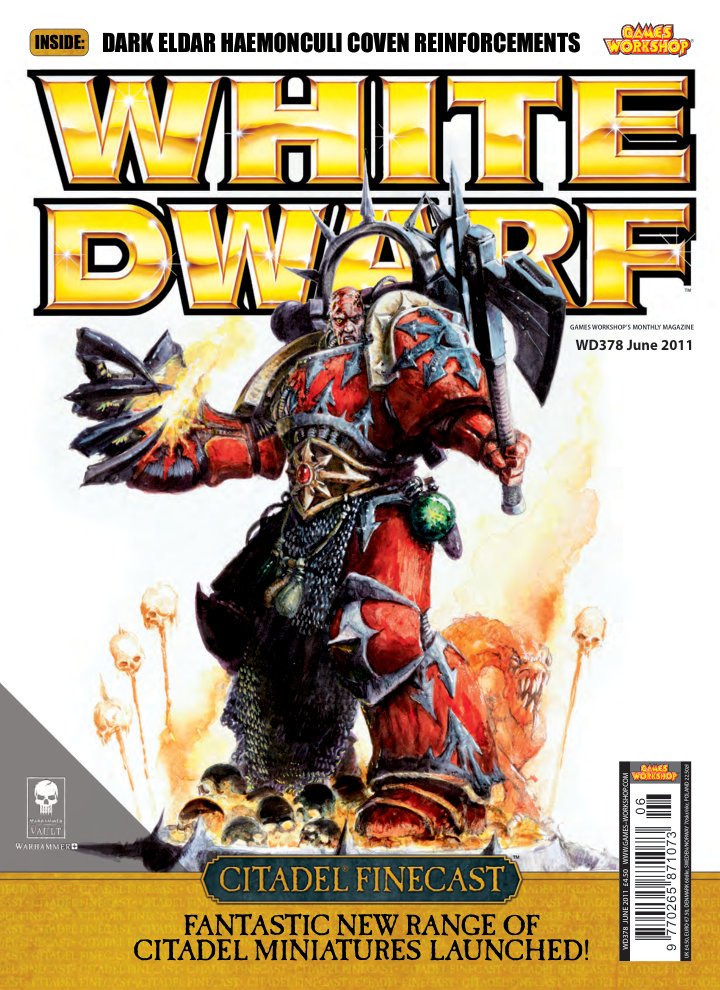
EditorialWD 378 · Inside cover
Andrew Kenrick hands the editorial to Alan Merrett, whose experience reaches from early metal casting to managing the Citadel design team. Merrett places the launch of resin Finecast alongside earlier developments in plastics and announces that future non-plastic releases will use the new range. His enthusiastic account records the expectations surrounding a major manufacturing change and the relaunch of many familiar models.
InterviewWD 378 · pp. 2–15
Andy Hall introduces the replacement of metal miniatures with a new resin range, describing the launch, revised clampack packaging and anticipated benefits for detailed models. Interviews with sculptors, assemblers and painters explain the contemporary expectations of sharper casting, lighter parts and easier conversion. Galleries of familiar characters demonstrate the scope of the change, while practical examples show how the material was being prepared and painted in the studio.
Warhammer Fantasy BattlesWarhammer 40,000
InterviewWD 378 · p. 7
Aly Morrison argues that matt resin makes sculpted details easier to read and brings a production casting closer to its original master. He compares an original Runelord sculpt with its Finecast version and anticipates lighter material permitting more adventurous poses. His comments capture the designers’ hopes for the new process, including reduced vulnerability to falls and fewer limits imposed by top-heavy metal components.
ModellingWD 378 · pp. 8–9
Chris Peach demonstrates removing Queek Headtaker from his resin frames, cleaning mould lines and dry-fitting parts before applying a small amount of super glue. He discusses brushing away flash, filling occasional bubbles and using gentle heat to reposition flexible parts. Gulavhar’s large wings illustrate the claimed assembly advantage of lighter components, with the existing locating pegs providing a sound join.
Warhammer Fantasy BattlesMiddle-earth Strategy Battle GameSkaven
PaintingWD 378 · pp. 12–15
Joe Tomaszewski explains why detailed castings provide a useful foundation for precise painting while stressing that the craft still depends on practice. Darren Latham’s Astorath contrasts glossy red armour with non-metallic gold, and Matt Kennedy differentiates a Blood Knight’s dark barding from its brighter rider. Further classic characters show varied treatments of crystal, skin, cloth and weapons across the newly recast range.
Warhammer Fantasy BattlesWarhammer 40,0002 paint colours
PaintingWD 378 · p. 13
Matt Kennedy paints the mounted Gandalf within a deliberately limited palette while keeping robe, beard and horse distinct. Dheneb Stone gives the clothing a warm white foundation, whereas Shadowfax develops from the cooler Space Wolves Grey. A neutral beard and dark muzzle separate the adjacent pale surfaces, preserving the miniature’s likeness and detail without adding strong colour.
Middle-earth Strategy Battle GameThe Fellowship2 paint colours
InterviewWD 378 · pp. 32–43
Simon Grant talks to Phil Kelly, Jes Goodwin and the sculptors about the Haemonculi’s influence over Commorragh and the visual logic behind their horrific servants. Wracks, Grotesques and Engines of Pain share masks, altered bodies and sinister equipment, with resilience arising from their background rather than an arbitrary army fix. Scourges express individual surgical vanity, while the Venom and Razorwing use recognisable engineering and shared Eldar ancestry to make extreme alien designs believable.
Warhammer 40,000Dark Eldar
FictionWD 378 · pp. 33–41
During celebrations marking Ivarra’s recovery from an Ork invasion, Kharvile’s coven secretly harvests people for a vast experiment. Scourges abduct selected soldiers so quickly that the Guard cannot identify its enemy, while disappearances grow across the hives. A later investigation finds liquefied flesh feeding an alien structure: a million human lives have been compressed into a jewel whose trapped cries please the Haemonculus.
Warhammer 40,000Dark Eldar
LoreWD 378 · p. 36
The Talos combines a still-living organism with machinery intended to inflict suffering, both in the coven’s chambers and against victims sheltered inside vehicles. The Cronos instead consumes life essence and distributes the stolen vitality to nearby Dark Eldar. The two engines therefore embody different aspects of Haemonculus cruelty: direct mutilation and a parasitic power that intensifies an entire force’s violence.
Warhammer 40,000Dark Eldar
TacticsWD 378 · p. 42
The 1,496-point force expands two Battleforces into a fast Wych army led by Lelith Hesperax. Raider and Venom squads converge on vulnerable sections of the enemy line while a more defensive Warrior unit holds an objective and targets transports. Reavers and a Razorwing supply anti-tank mobility, with the Talos offering a slower but dangerous threat to anything caught nearby.
Warhammer 40,000Dark Eldar
TacticsWD 378 · p. 43
This 1,500-point army pairs Kharvile and Wracks with a Succubus-led Wych strike, supported by two Razorwings, Scourges and Reavers. Almost everything moves quickly, while the slower Cronos serves a supporting role by distributing pain tokens. Multiple darklight and haywire weapons answer armour, but the central plan is to overwhelm infantry with missiles and fast elite assaults.
Warhammer 40,000Dark Eldar
InterviewWD 378 · pp. 46–50
Andy Hall returns to the Tomb Kings with Robin Cruddace and Mark Harrison to examine bow-armed Ushabti, Necrotects and Prince Apophas. New Ushabti heads retain the established style while giving the enormous archers distinct identities. Necrotects express the furious pride of artists returning to find their monuments ruined, and Apophas breaks the usual mummy image through a tragic revenant concept realised as a shifting swarm of scarabs.
Warhammer Fantasy BattlesTomb Kings
LoreWD 378 · pp. 48–49
A stolen death mask condemns Alcanblad a century after its mayor returns from the south with the trophy. Rultris and his Necrotect advance to reclaim it, their stone monsters resisting the defenders’ weapons as damaged onyx magically repairs itself. Ushabti cut through Flagellants and knights, while Apophas consumes a Light Wizard and his guardian, turning the town’s monument to its founder into the focus of its destruction.
Warhammer Fantasy BattlesTomb Kings
RulesWD 378 · p. 50
Apophas’ complete 130-point entry combines flight, regeneration and emergence from beneath the sands with a chosen soul-hunting target. His scarab body can project a breath attack and releases a final destructive swarm when destroyed, but he cannot join a unit or lead the army. The accompanying history reveals that his bargain with Usirian is impossible to fulfil: no stolen soul will ever balance his own on the god’s scales.
Warhammer Fantasy BattlesTomb Kings
TacticsWD 378 · pp. 52–59
Robin Cruddace builds a Tomb Kings plan around protecting the Hierophant, arranging overlapping leadership support and grinding enemies down with large, magically replenished regiments. He explains combinations among the Lore of Nehekhara’s spells and the different jobs of infantry, chariots and war statues. Entombed units attack vulnerable rear areas or plug holes, while paired sphinx types cover one another’s weaknesses; poison and reckless high-value casting remain particular dangers.
Warhammer Fantasy BattlesTomb Kings
TacticsWD 378 · pp. 58–59
Cruddace’s 2,997-point army gives its mounted King a broad command radius and protections suited to his flammable body. Two Priests support three skeleton hordes and Tomb Guard, with the Hierophant ready to fly away once combat threatens. Bow-armed Ushabti and archers advance behind the main line, while Stalkers, a Scorpion, Apophas and a reserve Necrosphinx exploit opportunities or rescue pressured sectors.
Warhammer Fantasy BattlesTomb Kings
TacticsWD 378 · pp. 60–65
Mat Ward argues that the small Grey Knights roster is highly customisable through squad powers, mixed Nemesis weapons and specialised equipment. He separates objective holders, assault units, resilient Paladins, fast elements and fire support, then considers how leaders modify the whole army. The recurring limit is cost: even effective upgrades must earn their place in a force that can easily spend too much on too few bodies.
Warhammer 40,000Grey Knights
TacticsWD 378 · p. 65
Grand Master Drak’s 1,499-point force relies on Grand Strategy to add scoring capability beyond its Terminator squads. Purifiers support assaults, Interceptors provide mobile close support and a large psycannon-equipped Purgation Squad can divide into combat squads when objectives require it. A versatile Dreadknight is the preferred beneficiary of the additional scoring role, making the leader’s army-wide rule central to the plan.
Warhammer 40,000Grey Knights
Battle reportWD 378 · pp. 66–83
Phil Kelly’s 1,995-point Haemonculus force faces Glenn More’s 1,998-point Saim-Hann army in Capture and Control with Spearhead deployment. Early Razorwing missiles and an Incubi assault wreck the Eldar defenders, but Glenn’s coordinated reserves threaten the opposite objective. Pain-token resilience keeps the Wracks and Scourges fighting until the Engines of Pain join the decisive combat; the Dark Eldar hold their objective while the Eldar one is contested, winning after five turns.
Warhammer 40,000Dark Eldar
EditorialWD 378 · pp. 84–85
Jervis Johnson completes his personal selection with Mephiston, Sam and Bill, the Baneblade and Witchfate Tor. Each recalls a lesson: collect characters that capture an army’s spirit, preserve the emotional truth of a story, dare to expand the scale of a game and make its world tangible through terrain. His luxury is time with his unpainted collection and painting equipment, while the Warhammer rulebook supplies inspiration; forced to keep one choice, he returns to the Tactical Squad.
Warhammer Fantasy BattlesWarhammer 40,000
CommunityWD 378 · pp. 86–91
The new event celebrates complete painted armies through local voting followed by Games Day displays, with staff also eligible to enter. A leader, two further units and a finished two-foot-square board form the entry requirements, without demanding a legal gaming force. Five studio collections illustrate how a deadline, favourite character, fresh model or discovered colour scheme can turn ordinary army building into a coherent display project.
ShowcaseWD 378 · p. 87
Simon Grant’s High Elves unite the south-eastern kingdoms through white clothing and distinct regional spot colours. Blue identifies Saphery, leather tones distinguish Eataine’s White Lions and green marks Faelar’s Yvressian command. Armies on Parade provides a deadline for expanding the force toward 3,000 points and growing its elite regiments, connecting decades of collecting with a new generation of models.
Warhammer Fantasy BattlesHigh Elves3 paint colours
ShowcaseWD 378 · p. 88
Tom Hutchings’ Tyranids grow from a favourite Hive Tyrant and enthusiasm for the Trygon into a varied display force. A pink-flesh and red-carapace scheme deliberately blends elements of Leviathan and Kraken. Preparing for Armies on Parade shifts his attention beyond an efficient gaming list, encouraging more species and a converted Tervigon to enrich the collection.
Warhammer 40,000Tyranids
ShowcaseWD 378 · p. 89
Mark Latham builds a grand Orc army to commemorate Bashum’s earlier battle-report triumph over a Slann. A large core of Boyz gives the Warboss an appropriately impressive following, with a Troll as unit filler and pet Goblin Giblit carrying the standard. Future spider additions may increase the Goblin role, while a choice remains between expanding the army and building scenery for its parade display.
Warhammer Fantasy BattlesOrcs & Goblins
PaintingWD 378 · p. 90
Matt Holland finally commits to a Tau army after the Cities of Death cover supplies a gritty white-armour reference. White undercoat, thin black recess lining and restored white panels establish the finish before metallic chips and dusty lower areas add wear. Red markings connect battlesuits to Fire Warrior cloth, and the collection includes an individual Broadside conversion and a distinctive commander.
Warhammer 40,000Tau Empire4 paint colours
ShowcaseWD 378 · p. 91
Kevin Chin’s enthusiasm for Dwarfs rapidly becomes a Host of Erebor battlehost that also works as a Strategy Battle Game force. Dáin leads Warriors, Khazâd Guard and four Vault Warden Teams, with Gandalf providing a different visual and gaming element. Yellow armour, imagined gold-thread tunics and deep blue accents suggest the wealth inherited from Smaug and make the shieldwall striking on display.
Middle-earth Strategy Battle GameWar of the RingDwarf Holds1 paint colour
ShowcaseWD 378 · pp. 92–93
Matt Weaver’s ongoing army centres on Logan Grimnar and a noisy, aggressive approach to battle. Eight pre-mixed armour stages are drybrushed from dark blue-grey toward lighter tones, with gold, orange hair and snow providing contrast. Naming every warrior after Nordic or Icelandic sagas gives the collection a heroic identity, and a biker’s captured Dark Angels banner adds a deliberately provocative trophy.
Warhammer 40,000Space Wolves4 paint colours
LoreWD 378 · pp. 94–95
The annotated spread presents the Phantom as the largest Eldar Titan, a graceful wraithbone war engine whose spirit core assists its Steersman. The pilot merges with the Titan’s awareness, allowing its movements and reactions to resemble an Aspect Warrior rather than an Imperial machine. Weapon and system callouts identify the pulsar, D-cannon, missile batteries, holo-fields and gravity vanes, while directing players to The Doom of Mymeara for rules.
Warhammer 40,000Eldar
Battle reportWD 378 · pp. 96–103
Simon Grant leads the Fellowship through a hypothetical Isengard ambush after choosing the Gap of Rohan instead of Moria. Saruman’s magic isolates heroes while Gríma drains their ability to act, gradually overwhelming the company despite its combat prowess. Frodo alone escapes, denying Adam Troke the highest victory level but leaving Evil with the win; swapping sides produces a second demonstration of how urgently the Fellowship must break the encirclement.
Middle-earth Strategy Battle GameThe Fellowship
RulesWD 378 · p. 97
The Fellowship deploys at the centre of a four-foot-square board surrounded by a 700-point Evil army. It has fifteen turns to move three members off the table, with Frodo’s survival determining the highest victory levels. The company ignores break-related Courage tests while the Ringbearer lives, and a supplied 698-point Isengard list uses Saruman, Gríma and numerous Orcs and Uruk-hai to contain the heroes.
Middle-earth Strategy Battle GameThe Fellowship
Battle reportWD 378 · p. 103
Adam takes the Fellowship and initially tries to kill Saruman while protecting the Hobbits around a ruined building. Simon sacrifices ordinary warriors and uses magic to keep the heroes contained; although Gandalf eventually kills Gríma with a displaced Orc, too much time and Might have already been lost. Gimli’s death opens the defence and the entire Fellowship is overwhelmed by turn ten, turning cautious positioning into a warning about the escape mission’s urgency.
Middle-earth Strategy Battle GameThe Fellowship
CommunityWD 378 · pp. 106–109
Rik Turner previews the forthcoming event through participation games, hobby areas, designer access and painting competition. The art contest adopts Storm of Magic, while Black Library announces early books including The Gildar Rift, The Keeler Image and William King’s Tyrion and Teclis trilogy. Forge World adds two event-only models, a Chaos Dwarf Hellsmith and Mark III Boarding Assault Captain, alongside displays of work in progress.
Warhammer Fantasy BattlesWarhammer 40,000