EditorialWD 505 · Inside cover
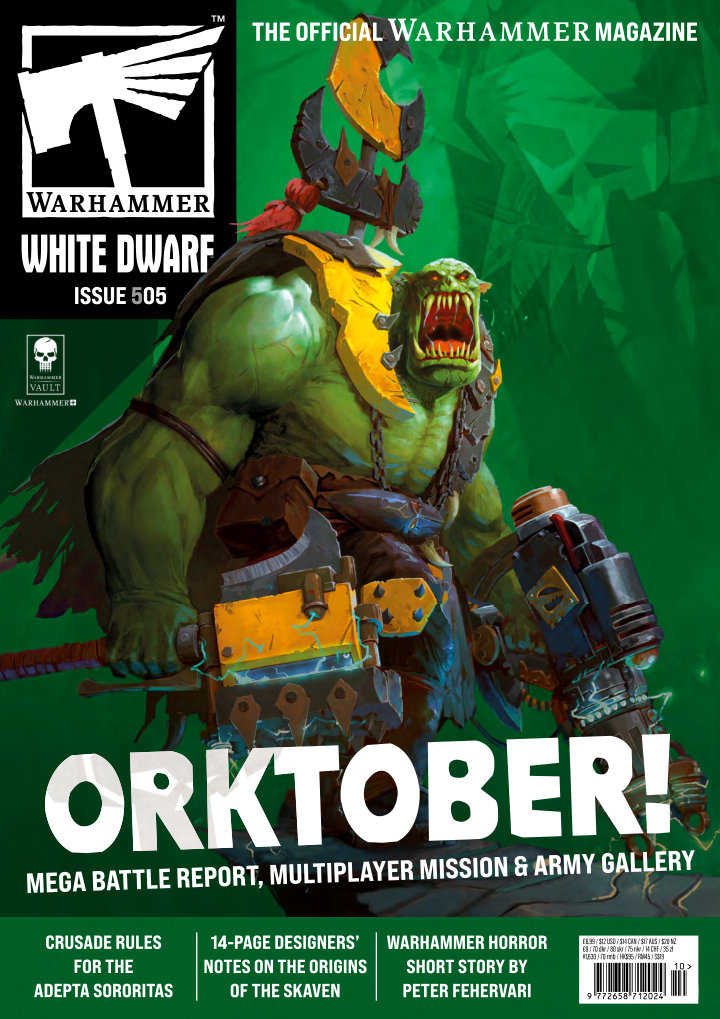
Lyle Lowery introduces Orktober through a battle report that grew from Duncan Waugh’s enthusiasm into a six-player studio project. Each participant builds around a different Ork detachment, while Lyle paints the squig objectives. The editorial connects those personal bursts of excitement with the creative energy behind both hobby projects and the magazine.
Warhammer 40,000Orks
CommunityWD 505 · pp. 2–7
Readers share affectionate mishaps, favourite army projects and enthusiasm for The Old World across generations. Oli Musil’s account of rescuing two magazines from bathwater accompanies a Dark Krakens miniature, while other letters discuss the Four Warlords finale and making scenic hills. Painted reader collections and photographs of the studio’s issue 500 celebration broaden the section’s view of hobby life.
Warhammer 40,000Warhammer Fantasy BattlesDark Krakens
ShowcaseWD 505 · p. 4
Matthew Shackleton makes a Warmaster the centrepiece of his Titan Legio with airbrushed gradient stripes and imposing banners. Heat-shaped clear plastic gives the banners their flowing form, and transfers complete their decoration. Classic Epic Space Marines populate the base, tying a modern Titan to the older small-scale collection.
Adeptus TitanicusEpic2 paint colours
CommunityWD 505 · pp. 8–9
The studio concludes its Spearhead league with a Parade Day and a secret ballot for best-painted army. Roberto Cuevas wins with a richly detailed Slaves to Darkness force. Lyle explains why a painting celebration matters to league members whose main motivation is completing an army, then introduces the next studio Crusade campaign.
Age of SigmarSlaves to Darkness
CommunityWD 505 · pp. 10–11
The monthly challenge system rewards played scenarios, event games, painted units and themed entries with cumulative points and ranks. A journal provides space to preserve achievements across the magazine collection, while the submission calendar explains when models should be photographed for future showcases. October’s theme centres on psykers, sorcerers and supernatural models.
CampaignWD 505 · pp. 12–13
The studio’s new Pariah Nexus campaign adds rules for fighting within an alliance and bringing smaller games into a shared war. Infighting still develops Crusade units but earns no alliance points; Combat Patrol and Kill Team contribute through separate rewards. An optional D66 aftermath table introduces reinforcements, raids, scars, relics and blackstone discoveries, making the wider conflict felt between battles.
Warhammer 40,000
RulesWD 505 · pp. 14–15
Commanders secretly choose three prime objectives each round, with the second player revealing one selection. Alpha and Omega markers have different values for attacker and defender, so the same position can represent different priorities. Final scoring rewards objectives chosen by both opponents, turning the last round into a contest over the ground both have identified as decisive.
Warhammer 40,000
RulesWD 505 · pp. 16–17
An updated version of the 2017 battleplan requires an army control score of at least twenty before a player can take an objective. Once seized, a marker remains controlled until the opponent reaches that threshold. The underdog can increase the control scores of selected units, creating chances to contest entrenched forces while ordinary objective and battle-tactic scoring continues.
Age of Sigmar
RulesWD 505 · pp. 18–19
Three Warcry battleplans place warbands in a ruined city where warpstone and emberstone offer the means to forge powerful weapons. Field Experiments makes a chosen fighter’s critical hits stronger but punishes missed attacks. Crafting Weapons of Power rewards keeping a weaponsmith safely at work across consecutive rounds, while Unearthing Realmstone combines objective control with aggressive engagement and an underdog’s chance to create a new deposit.
Warcry
TacticsWD 505 · pp. 20–23
Stephen Box revisits Dan’s Adeptus Mechanicus list and argues for understanding existing models before replacing them. Scouts, Lone Operative and Stealth change the roles of units Dan had misused, while choosing an appropriate Doctrina and detachment improves movement and protection. Worked examples connect leaders, Battleline support and Pteraxii to secondary scoring and efficient attacks; the closing puzzle asks how to earn eight points in the opening turn.
Warhammer 40,000Adeptus Mechanicus
PaintingWD 505 · pp. 24–27
Lyle Lowery explains how carefully controlled drybrushing can finish attractive terrain quickly and form the foundation of a convincing glow. He recommends starting with little paint, testing the brush and retaining just enough moisture to avoid a chalky result. The accompanying guides apply these principles to Spearhead scenery and rusty Ork buildings, while a reader question supplies the studio’s blue Saurus recipes.
PaintingWD 505 · p. 24
The studio supplies the missing Sons of Horus Green in a reader’s attempt to reproduce blue Saurus skin. Mixed colours distinguish the main hide, pale belly and dark scales, with separate edge highlights for the scales. A warm, darkened gold recipe complements the blue-green flesh rather than treating the metal as a separate colour problem.
Age of SigmarSeraphon17 paint colours
PaintingWD 505 · pp. 25–26
A black-primed ruin is progressively drybrushed with grey before its recessed symbol is painted opaque white. Metalwork is finished first so later white highlights and translucent green glazes can cast light onto the surrounding stone and fittings. The guide also shows how wet blending a turquoise wash over bronze produces a heavy patina with softened edges.
9 paint colours
PaintingWD 505 · p. 27
Ork scenery begins with black and silver sprays, followed by clan-coloured details. Very thin brown and orange washes collect in recesses to suggest rust without complicated individual weathering marks. A second method uses the fine grit in Typhus Corrosion beneath a light orange drybrush, adding the rough surface of heavily oxidised metal.
Warhammer 40,000Orks5 paint colours
CommunityWD 505 · pp. 28–31
Reader and studio models explore the supernatural through elegant aelven figures, corrupt psykers, ghosts and daemonic machinery. Studio contributors explain a coconut-crab carapace, a Raven Guard successor’s heavily converted Chief Librarian, moss-covered shaman conversions and a Flesh Tearers banner inspired by older codex artwork. Limited palettes and personal references make the individual pieces distinctive.
Warhammer 40,000Age of SigmarLumineth Realm-lords8 paint colours
LoreWD 505 · pp. 32–37
The Argent Shroud’s commitment to deeds over words sends its 5th Preceptory away from a sheltered mortuary world when an appeal reaches it from Astorgius. Warp storms scatter the Astorgian Crusade into separate wars. Magritte attacks a Genestealer Cult’s propaganda centre, Georgiana adapts a transportless commandery into airborne relief forces against the T’au, and Nialha prepares to board a Word Bearers warship despite warnings that these diversions compromise their original vow.
Warhammer 40,000Adepta Sororitas
RulesWD 505 · pp. 38–45
Adepta Sororitas commanders can lead their army in prayer, spending Miracle dice to intone a chosen hymn or a random pair for a battle round. The hymns improve mobility, protection, faith, firepower or melee strength. Linked agendas, requisitions and traits reward sacred ground, inspiring orators and specialist clergy; relics extend these abilities, while three campaign badges chart a force’s rise into an exemplar of faith.
Warhammer 40,000Adepta Sororitas
Battle reportWD 505 · pp. 46–65
Six players each field one of the Ork codex’s detachments in a three-against-three hunt for runaway squigs. Wade, Dave and Steve initially press forward, but Andy, Tom and Duncan retreat into a firing position and ambush the attackers. Swinging fortunes, overheated weapons and squigs that bite their would-be owners sustain a chaotic game; Andy’s team claims the feast after its walkers and mobile units reverse the early pressure.
Warhammer 40,000Orks
RulesWD 505 · pp. 48–49
Eight squigs act as moving objectives, scattering each round and damaging units they bounce through. Their colours alter speed, food yield, luck or biting behaviour. Controlling them earns Squig Meat and victory points, while killing enemy warlords supplies another route to success, allowing a large Ork scrap to remain a competition over dinner as well as casualties.
Warhammer 40,000Orks
ShowcaseWD 505 · pp. 66–77
Jack Masters presents the Goff horde he expanded into a 6,500-point collection after deciding to improve his painting in 2022. Strong green skin and black armour unify an army that serves both competitive gaming and personal relaxation. He describes winning painting awards, reaching the top UK Ork ITC ranking with Ghazghkull, enjoying games with opponents and building looted Knights from an eclectic stock of Ork, Imperial and squig parts.
Warhammer 40,000Orks
PaintingWD 505 · p. 71
Jack’s scheme concentrates its most elaborate work on the green skin and black armour, keeping most supporting materials to a few colours. Multiple pale green highlights define the skin, while blue-grey edges keep the black readable. The recipes cover white armour, cloth, metals, leather, red details, bone, teef, squighogs and orange earth, making the entire horde’s palette reproducible.
Warhammer 40,000Orks37 paint colours
RulesWD 505 · pp. 78–81
The campaign finale divides one battlefield into two consecutive battles. A small Stormcast infiltration force first tries to destroy Gnawholes under pressure from replenishing Clanrats; survivors remain when the full armies deploy. The second stage scores destruction, the central belltower and the fate of the portals, with underdog twists supporting both sides. The winner determines the campaign result, and the bell’s destruction leads into the accompanying story.
Age of SigmarStormcast Eternals
FictionWD 505 · pp. 82–89
Hamilcar’s raid draws a Skaven master out to defend the Warpshatter Bell, but the counterstroke confronts an immense burrowing creature and walls made of stitched flesh. Astral Templars split into hunting packs against Moulder monsters, while Hamilcar and Ibruda enter the beast to confront Guztik. Their victory removes the bell and briefly protects Phosphoria, yet the surviving Skaven rulers are already ordered to recover flesh samples for Vizzik Skour’s next scheme.
Age of SigmarAstral Templars
InterviewWD 505 · pp. 90–103
Jes Goodwin, Seb Perbet and Steve Buddle trace the Skaven’s character from small rat-like Beastmen into a complete civilisation of scavenging, diseased and cruel creatures. Posture, armour, tails and worn materials preserve a shared silhouette while each Great Clan develops a recognisable theme. A timeline connects the earliest ratmen with successive fantasy and specialist-game ranges, and Maxime Corbeil explains how Vizzik Skour combines that history into a heavy-robed, verminous prophet.
Age of SigmarWarhammer Fantasy BattlesSkaven
InterviewWD 505 · pp. 100–101
Steve Buddle describes Skryre technology as destructive ingenuity unconcerned with its operator’s safety. Hammered brass, stitched and strapped pipes, warpstone, accumulators and mismatched wooden structures unite otherwise varied weapons. The visual catalogue ranges from long guns and globes to ratling machinery and the Doomwheel, whose absurdity changes character when its green lightning is aimed at the observer.
Age of SigmarSkaven
InterviewWD 505 · pp. 102–103
Maxime Corbeil gives Vizzik the mass and costume of a priest to embody the Horned Rat’s hunger for worship. Gnarled horns, layered metal, damaged cloth, warpstone and rotten wood connect him to decades of Skaven designs. Details such as offerings pinned within a Clanrat’s reach, spies whispering into his ear and the knot-tailed rat king turn the large silhouette into a narrative about authority and surveillance.
Age of SigmarSkaven
LoreWD 505 · pp. 104–107
The battle for Beta-Garmon contracts from planetary war into Nyrcon City’s devastated districts. A Raven Guard rescue formation, the Shadowed Talon, survives its aircraft’s destruction and wages a stealth campaign against vastly greater forces. Sons of Horus discipline eventually traps the survivors, but an Imperial Fists assault rescues them; the original extraction targets’ fate remains uncertain amid the larger siege.
The Horus HeresyRaven Guard
RulesWD 505 · pp. 108–111
Incursion adapts Zone Mortalis to open-roofed streets and dense buildings. It defines building capacity, armour, battlements and levels, then adds fortified walls, burning barricades, plunging fire and emplaced shooting positions. Template weapons can force occupants outside and precision fire can pick targets within a building. Designer notes stress agreeing how physical terrain and optional larger militia units will work before play.
The Horus Heresy
RulesWD 505 · pp. 112–113
An attacking force seeks a rooftop target within enemy-held streets. Strategic Advantage determines attacker and defender, the key location and first-turn initiative. Reinforcement points let both sides introduce units from different edges, while entrenched defenders can appear on unoccupied battlements. The target’s endgame value and standard secondary objectives combine territorial pressure with the attrition of street fighting.
The Horus Heresy
RulesWD 505 · pp. 114–115
A downed aircraft’s administrative envoy becomes the focus of a rescue operation. Infantry near the envoy can move them, and scoring units earn different values according to distance and allegiance. Reinforcement costs vary by entry edge, with defenders able to occupy battlements, so bringing support into the right district matters as much as reaching the survivor first.
The Horus Heresy
FictionWD 505 · pp. 116–125
A traveller awakens blinded, tongueless and restrained, guided through his stolen memories by the aristocratic witch Urzelka Esseker. Scenes of Oblazt’s cruelty expose the hatred she has cultivated in him, while her account of her sister’s art reveals a passage toward an impossible ocean of dreams. The traveller accepts a deeper form of sight and approaches the living painting, becoming another participant in an artistic revelation that has already consumed its creator and many followers.
Warhammer 40,000
TacticsWD 505 · p. 126
The answer combines a pre-game Scout move with the Swift Action mission rule to begin scoring immediately. Aggressor Imperative guarantees the Vanguard’s advance and also accelerates nearby Ruststalkers. Careful placement lets the Rangers cleanse while crossing into another quarter, yielding all eight available secondary points and demonstrating why movement abilities deserve attention during army analysis.
Warhammer 40,000Adeptus Mechanicus