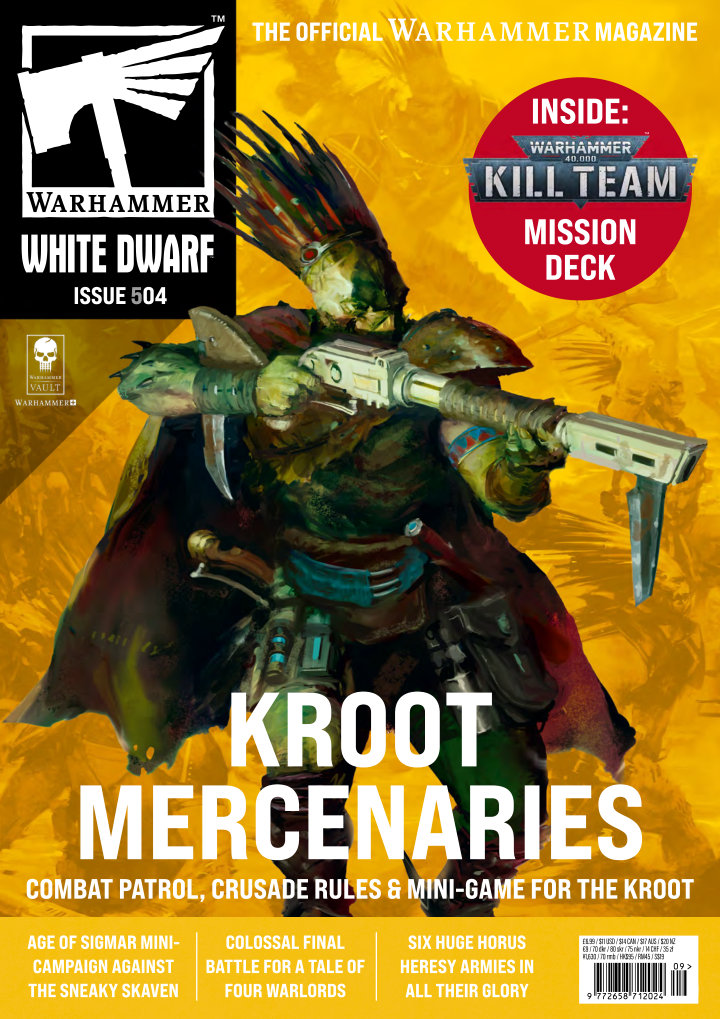
EditorialWD 504 · Inside cover
Lyle Lowery celebrates the inventive Kroot collecting community and introduces an issue built around its favourite species. The new miniature range supplies an opportunity for fresh fiction, a dedicated Combat Patrol, mercenary Crusade rules and a hunting mini-game. He singles out Predators and Prey as an example of inspiration producing a distinctive tabletop experience.
Warhammer 40,000Kroot
CommunityWD 504 · pp. 2–7
The expanded reader section combines affection for older issues with reports of current hobby activity. A long-time collector describes rebuilding a magazine collection, readers welcome Spearhead and Legions Imperialis, and photographed models range from a vivid Lumineth character to a complete blue-and-yellow Mechanicus patrol. A digital diorama contest and a tightly fought studio Underworlds final show other forms of creative competition.
Warhammer 40,000Age of SigmarLumineth Realm-lords
ShowcaseWD 504 · p. 4
Martin Orlando combines new Lumineth imagery with a classic High Elf silhouette through Dragon Prince components. Older fantasy art informs the skin and eyes, while Elrond’s film armour inspires the red-and-silver palette. Saturated colours and carefully blended purple shading give the model its reflective finish, showing how references from several sources can become one coherent personal scheme.
Age of SigmarLumineth Realm-lords3 paint colours
ShowcaseWD 504 · p. 5
The magazine presents the winning scenes made with Realms of Ruin’s digital scene editor. Graeme W Harris’s symmetrical battle composition takes first place, with a low viewpoint among Stormcasts and an expansive fortified-city scene completing the top three. Judges explain how depth, readable opposing forces, camera position and small environmental details support narrative and composition.
Age of Sigmar
CommunityWD 504 · p. 6
After 110 games in a month, Steve Barrett’s Cyreni’s Razors and Art Thorne’s Magore’s Fiends meet for the studio trophy. The final power step appears to offer Steve a killing blow, but an extra wound on Magore overturns that expectation. Art wins 14–12, and the small report captures how precise knowledge of a fighter’s remaining resilience can decide an otherwise tense finish.
Warhammer UnderworldsIdoneth Deepkin
LoreWD 504 · pp. 8–13
Jordan Green encourages collectors to treat the large Warhammer settings as room for their own stories rather than obligations to follow every major narrative event. Choosing a historical conflict or a particular realm can supply a unifying theme. He develops that idea through Shyish-inspired armies: haunted Kharadron salvage crews, cursed gargants, identity-preserving Stormcasts and morbid Lumineth are among the examples linking setting, conversions and heraldry.
Age of SigmarWarhammer 40,000Kharadron Overlords
CommunityWD 504 · pp. 14–15
The Bunker introduction explains how monthly scenarios can anchor regular club nights or supply an interesting pick-up game. It previews warp-rift shooting, dangerous warpstone objectives and Kill Team’s changing Tempest Orders, alongside the last month of the Spearhead league. Photographs show practice games helping studio players learn the format and choose their armies.
CommunityWD 504 · pp. 16–17
The monthly tracker turns club games and painting into cumulative achievement points, with space to carry forward a score and record a new rank. September’s Elite Units challenge connects the calendar to the photographed collections later in the section. The pages also invite hobbyists to preserve a written record of what they completed rather than only tallying points.
CommunityWD 504 · pp. 18–21
Extra points in the final month let late activity reshape the studio standings. Jon Simmons wins four games near the deadline and takes the champion title, while a one-title-per-player policy distributes other awards more widely. Leila Appleton describes the appeal of a contained painting project, varied opponents and a comeback system that kept her Stormcast games uncertain until their final moves.
Age of SigmarSoulblight Gravelords
PaintingWD 504 · pp. 20–21
Lyle’s third playable Spearhead is a spring-themed Sylvaneth force inspired by London cherry blossom. Dark bark provides a subdued foundation for pink leaves and ethereal blue, while green new growth suggests the season. He explains wicking wet magenta paint away from white leaves to create soft transitions, alongside drybrushed bark and transparent blue details.
Age of SigmarSylvaneth10 paint colours
RulesWD 504 · pp. 22–23
Randomly connected objectives become warp rifts through which models can draw new firing lines. Visibility is checked from the far end and distance combines both parts of the shot, making ordinary cover relationships less dependable. Regular objective control remains important, and an unpredictable hidden fuel cache adds an endgame bonus to a battlefield already shaped by changing rift connections.
Warhammer 40,000
RulesWD 504 · pp. 24–25
Three dangerous deposits become the focus of this reworked objective battle. Each round’s underdog can trigger a warpstone effect, from explosions and uncertain healing to sharper weapons or a risky increase in attacks. Holding clusters scores throughout the game and becomes more valuable in the last round, inviting players to balance proximity to corrupting power against its tactical benefits.
Age of Sigmar
RulesWD 504 · pp. 26–27
A shared deck of orders replaces the usual mission and Tac Op scoring with objectives that change as the battle develops. Active cards can be scored by either side, unsuccessful orders expire, and a Command Point ploy allows players to discard an unwanted task. Three deployment maps accompany a format designed to reward adaptation rather than a plan fixed before the first turning point.
Kill Team
TacticsWD 504 · pp. 28–31
Sam Pearson gives memorable names to tactical patterns discovered during studio Spearhead leagues. Defensive deployment protects shooting units, terrain can close off an objective, and reinforcement units can be spent aggressively rather than hidden. Reserving fast Squig Hoppers, deliberately remaining the underdog and gambling on a double turn offer stronger rewards with greater risks; a final puzzle asks readers to apply movement and scoring priorities together.
Age of SigmarCities of Sigmar
PaintingWD 504 · p. 32
A reader asks how to recreate Amaranthine and the Obsidian Knight. Updated recipes bring the older Freeblade schemes into the current paint range, using a magenta glaze to enrich Amaranthine’s crimson and separate treatments for warm gold, bone, black armour and silver. The contrasting palettes illustrate how individual heraldic identities can coexist within a Freeblade Lance.
Warhammer 40,000Imperial Knights18 paint colours
PaintingWD 504 · p. 33
Lyle uses an airbrush to make spectral Nighthaunt bodies fade into their robes, avoiding the impression that ordinary sunlight defines their edges. Rusty weapons and stony bases ground the ghosts. His Dark Angels use a different approach: white zenithal light beneath thin green coats, carefully drybrushed highlights and red weapon casings create readable armour without losing the Chapter’s characteristic dark finish.
Age of SigmarWarhammer 40,000Nighthaunt20 paint colours
PaintingWD 504 · p. 34
Ben’s Hive Fleet Vega takes its dark teal and pastel-purple palette from an armoured corn cricket, adding neon mottling as warning marks. The Progeny of the Star Mind cult carries related skin colours beneath turquoise fatigues and black armour, masquerading as a private industrial security force. Bright pink graffiti marks its uprising; recipes distinguish flesh, carapace, clothing, equipment and cult markings.
Warhammer 40,000Tyranids18 paint colours
PaintingWD 504 · p. 35
Adam’s Settler’s Gain models reflect Hysh and the Lumineth through bright white, blue and opulent gold. Dark horses and leather keep the luminous colours readable rather than overwhelming every surface. The short recipes document warm cream fabric, shaded metal, blue shields and subdued natural materials over a white undercoat.
Age of SigmarCities of Sigmar17 paint colours
ModellingWD 504 · p. 35
Thomas Lojewski turns inexpensive pencils into angular base crystals by sharpening, carving extra facets and cutting pieces to length. The example is primed pale, tinted icy blue, highlighted and glossed to suggest translucent ice. A nearby note broadens the search for basing materials to textured plastic, cork-like board fragments, filter beads and dried birch seeds.
4 paint colours
CommunityWD 504 · pp. 36–41
The Grand Strategium explains its No Army Required initiative, shared collections, introductory workshops and compact league games. Reader elite units lead into studio work ranging from black-armoured Terminators and Contrast-painted grots to pale Stormcasts and pink Wraithguard. Contributors describe personal heraldry, a shared green recipe and how an apparently random palette unexpectedly echoed a Rogue Trader mercenary force.
Warhammer 40,000Age of SigmarBlack Templars15 paint colours
CommunityWD 504 · pp. 42–43
The team’s anniversary Grombrindal projects include Sophie’s first attempt at non-metallic metal and Lyle’s Blood Bowl version, destined to watch over an Undead team it cannot join. Matt expands his small-scale Imperial Fists with Spartans and a Kratos, adapting his usual Legion palette through drybrushing. The update also tracks growing cult collections and the team’s Spearhead activity.
Blood BowlThe Horus HeresyImperial Fists
LoreWD 504 · pp. 44–49
Kroot forces shape the fractured Chalnath war through scouting, terror attacks and detecting Genestealer infiltration. Their pragmatic beliefs contrast with the faith-driven combatants around them, while Flesh Shapers guard against tainted prey. Detailed accounts of Ohrak’s Longhunt Packs, Kra’eht’s Preyfinders and Shakat’s Blades show independent guerrilla campaigns, careful counter-infiltration and targeted attacks on enemy religious leaders supporting the wider T’au advance.
Warhammer 40,000Kroot
FictionWD 504 · pp. 50–53
Shakat observes Battle Sisters attacking a cult-held generator complex, then recognises that their supporting militia are infected traitors preparing a crossfire. Rather than intervene immediately, he uses the Sisters’ attack to occupy one enemy while his Kroot encircle the other. Krech’lok’s charge completes the ambush, allowing the hunting pack to destroy its chosen prey and leave before the larger battle is resolved.
Warhammer 40,000Kroot
RulesWD 504 · pp. 54–61
This all-Kroot patrol combines a Lone-spear, two Carnivore units, a Krootox Rider and two Rampager packs. Na’pok guides attacks against marked prey while infantry screen the fragile but powerful assault beasts. Dedicated Enhancements, alternative scoring objectives and Stratagems support encirclement, precision fire and redeployment from battlefield edges, with bespoke datasheets and practical roster commentary completing the force.
Warhammer 40,000Kroot
CampaignWD 504 · pp. 62–71
Mercenary pacts drive this Kroot-centred Crusade system. The reliability of an employer, chosen task and difficulty determine both setbacks and eventual rewards, forcing players to judge whether a dangerous bargain remains worthwhile. Completed contracts can add specialised biological strains to new units; Kroot Agendas, Requisitions, Battle Traits, relics and badges build on scouting, hunting and successful service while allowing supporting T’au units.
Warhammer 40,000Kroot
RulesWD 504 · pp. 72–75
Rival hunting packs compete for wildlife whose models act independently of either army. Nests spawn skittish scavengers, pursuing predators or hulking beasts, each with different movement and aggression triggers. Melee kills produce Bloody Harvest points, while shooting wastes the prize; killing an opposing carrier can steal its accumulated meat. Lures, reactive movement and fragile carriers make the hunt more than a conventional firefight.
Warhammer 40,000Kroot
RulesWD 504 · pp. 76–77
Three possible maps arrange nests and lures for the hunting mini-game. The number of new creatures depends on how many remain, keeping prey appearing without simply flooding the table. After five rounds, only Bloody Harvest points carried by surviving units count, so protecting successful hunters and deciding when to attack a rival are as important as finding the next beast.
Warhammer 40,000Kroot
Battle reportWD 504 · pp. 78–101
Four collectors finish their Age of Sigmar series in a battle across the Necro-Dame realmgate between Ghur and Shyish. Jake’s Chaos, Chris’s Gloomspite Gitz, Laura’s Soulblight and Sebastien’s Cities-and-Ironjawz force fight independently, choosing turn order with playing cards. Awlrach’s wandering boat damages and relocates units crossing the water, producing both tactical openings and spectacular confusion.
Age of SigmarSlaves to Darkness
CampaignWD 504 · p. 102
The Moulderhunt campaign links a sequence of battles between Astral Templars and Skaven around the land bridge south of Moulderport. Each result grants a choice of bonuses for the next encounter. Players can finish after three battles or continue into the following issue’s finale, and the article explains how the same structure can be adapted to other armies and locations.
Age of SigmarAstral Templars
RulesWD 504 · p. 103
Battle for the Pass opens the campaign under corrupting warp-gales. Terrain and objectives can become dangerous sites that damage nearby units but also strengthen casting at a price. The winner chooses the next battle’s advantage: Stormcasts can prepare an ambush or defend their territory, while Skaven improve gnawhole protection or the replenishment of Clanrats.
Age of SigmarAstral Templars
RulesWD 504 · p. 104
The second campaign battle uses Limited Resources and places the rival generals in a personal contest. Duel points can reroll attacks or saves while the leaders fight one another, encouraging each player to weigh a dangerous confrontation against the wider mission. Victory can improve Stormcast charges and priestly preparation or bring a potent but unpredictable mutation to a Skaven monster.
Age of SigmarAstral Templars
RulesWD 504 · p. 105
The Better Part of Valour becomes a confrontation beneath a Warpshatter Bell. As rounds pass, its eventual toll becomes more likely and can temporarily strengthen Skaven attacks. The result either determines the campaign winner or supplies a finale bonus: the Astral Templars gain defensive resolve, while the Skaven can empty their pits and return destroyed monsters through gnawholes.
Age of SigmarAstral Templars
LoreWD 504 · pp. 106–109
Moulderport grows from the Vermindoom’s wreckage into a flesh-harvesting stronghold where rival Master Moulders cooperate just enough to maintain their power. Phosphoria becomes a source of bodies until Astral Templars interrupt the harvest. Hamilcar proposes striking a great bell tower to provoke a ruler into the open and destabilise the alliance, but a closing Skaven council reveals that the enemy has already learned of the plan.
Age of SigmarSkaven
CampaignWD 504 · pp. 110–119
A new campaign setting moves Warcry from the Gnarlwood to Aqshy’s battered archipelago between the Great Parch and the Gnaw. Coastal exploration can reveal wrecks, dangerous pools, faction-suited refuges and treasure. Aggressive leader traits, encampment bonuses and nautical artefacts support the new setting, while corrupted items offer extra power with lasting risks; a treasure-hunting quest rewards objectives, captured loot, battlefield presence and slain leaders.
Warcry
ShowcaseWD 504 · pp. 120–121
The Ollanz-Mu collecting challenge reaches its final instalment with six three-thousand-point armies assembled by seven hobbyists. The introduction returns to the cluster’s role near Beta-Garmon, then contrasts the Traitor Legions with the Loyalist forces raised to oppose them. The completed collections provide a record of how initial themes expanded through specialist infantry, armour, aircraft and individual conversions.
The Horus HeresyEmperor’s Children
ShowcaseWD 504 · p. 122
Rob’s completed Emperor’s Children use late-Heresy armour and diverted wargear to establish the 42nd Millennial’s origins. Converted MkVI Palatine Blades fit the new-plastic aesthetic, while Land Raiders deliver elite troops and support tanks suppress enemy armour. Mechanised Tactical Squads then claim ground, giving the imposing armoured display a defined tactical structure as well as a coherent narrative.
The Horus HeresyEmperor’s Children
ShowcaseWD 504 · p. 123
Rich completes his Alpha Legion with a Falchion and Storm Eagle, combining overwhelming firepower with rapid delivery of Terminators. The army’s expeditionary history opens the door to Solar Auxilia allies, while further MkVI conversions promise Headhunters, an Effrit cadre and ambiguous command figures. The metallic scheme and unified armour silhouettes remain the visual foundation even as the planned collection grows beyond the challenge.
The Horus HeresyAlpha Legion
ShowcaseWD 504 · p. 124
Stuart’s last additions are Thallaxii with an inverted colour scheme that distinguishes Mechanicum assets from Iron Hands Legionaries. The Destroyers’ improvised disintegrator weapons express a desperate force turning ancient tools into armaments. With this version of the army finished, he considers continuing its story through Blackshields and the increasingly extreme implications of the Legion’s rejection of flesh.
The Horus HeresyIron Hands
ShowcaseWD 504 · p. 125
Owen reflects on a World Eaters collection defined by individual melee fighters rather than one centrepiece. Components from both Heresy and later Khorne kits connect the warriors’ current weapons with their Legion’s future. Having completed the mass of infantry and vehicles, he considers Angron as a focused painting project before choosing whether to expand again or begin another Legion.
The Horus HeresyWorld Eaters
ShowcaseWD 504 · p. 126
Sophie caps her Blood Angels with a Glaive, choosing a black turret and luminous green volkite weapon for a commanding contrast. Her games reveal a difference between imagined and actual deployment: unreliable Termite arrivals contrast with effective Dawnbreakers and a useful Xiphon. The account links the finished display to practical lessons about mobility, reserves and support fire.
The Horus HeresyBlood Angels3 paint colours
ShowcaseWD 504 · p. 127
Quinn finishes his converted Salamanders with Dreadnoughts rather than tanks to preserve a void-assault theme, adding long-range support to the flame-heavy infantry. Adam’s smaller White Scars contribution reaches a playable foundation with a tank, transport and Tactical Squad. Their future plans continue the same identities through Drop Pods, bikes, Assault Squads and compact armoured support.
The Horus HeresySalamanders
TacticsWD 504 · p. 128
The Spearhead puzzle’s suggested solution ties up enemy cavalry with Troggoths while freeing Stabbas to claim the Ignax objective and score Take Without Warning. Alternative plans rely on Squig Hopper movement or risk losing position to make a charge. The commentary explains why apparently small choices about retreating, screening and where to end a move determine whether all required tactics can be scored.
Age of Sigmar