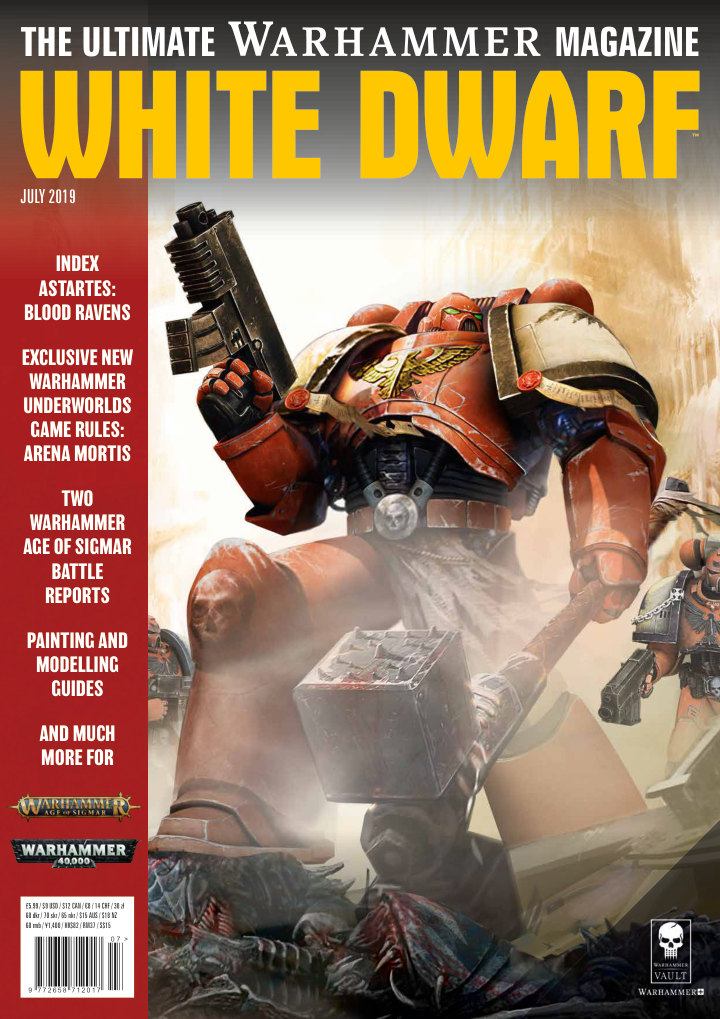
EditorialWD 444 · p. 1
Lyle celebrates smaller games that let new collections reach the table quickly and fit into short hobby sessions. Meeting Engagements and the new single-fighter Arena Mortis both retain dramatic decisions despite their limited forces, making a few models the beginning of a satisfying game rather than merely an unfinished army.
CommunityWD 444 · pp. 4–7
Readers describe the hobby as a source of community and welcome the accessible newer games. Painting advice explains an orange-diamond Harlequin scheme, while a question about Black Templars Librarians and a showcase of Daniel Jackson’s Magnus provide contrasting lore and modelling interests.
Warhammer 40,000Age of Sigmar8 paint colours
LoreWD 444 · pp. 8–11
Phil follows deities whose origins lie in the world before the Mortal Realms, tracing their histories, worshippers and connections to particular realms. Their rivalries, mistakes and continuing ambitions make the pantheon an active source of alliances and conflict rather than a distant religious backdrop.
Age of Sigmar
EditorialWD 444 · pp. 14–17
Robin describes an iterative cycle of rules, games and revisions before external testers share their own experiences. Competitive organisers and narrative players bring different priorities, but all stress sustained work, careful feedback and the value of knowing how an army should feel as well as how efficiently it wins.
Warhammer 40,000
FictionWD 444 · pp. 18–23
Captain Atanaxis receives Custodians bearing the means to create Primaris Blood Ravens, a gift whose implications are as unsettling as its promise is welcome. Compliance becomes unavoidable, but he and his Librarian resolve to learn what the accompanying Martian servants know and withhold their findings even from Angelos until they understand more.
Warhammer 40,000Blood Ravens
LoreWD 444 · pp. 24–31
The Blood Ravens’ uncertain origins and powerful Librarians make their pursuit of knowledge both a source of strength and a cause for suspicion. Recruitment worlds, forgotten disasters and the Third Aurelian Crusade explain their present troubles, while Primaris technology offers new survival prospects and another secret to investigate.
Warhammer 40,000Blood Ravens
RulesWD 444 · pp. 32–33
A Chapter Tactic and dedicated options express the Blood Ravens’ resilience and psychic expertise. A Chief Librarian upgrade and relic support their leaders, while Gabriel Angelos’s datasheet supplies the Chapter Master’s distinctive weapon and battlefield abilities for an eighth-edition army.
Warhammer 40,000Blood Ravens
ShowcaseWD 444 · pp. 34–37
Rik Turner adds Dark Imperium’s Primaris forces to his already enormous Blood Ravens collection. Efficient red armour and bone details keep the additions consistent with the older army, while a substantially rebuilt Gabriel Angelos provides a centrepiece suited to the Chapter’s new generation.
Warhammer 40,000Blood Ravens
PaintingWD 444 · p. 36
Rik develops a quick method for painting a whole boxed force with red spray, a shared dark wash and successive warm drybrushes. Bone panels and selected details are rebuilt afterwards, balancing a fast army workflow with the colour separation needed to keep the Blood Ravens recognisable.
Warhammer 40,000Blood Ravens13 paint colours
ModellingWD 444 · p. 37
Rik cuts important details from the Forge World character and grafts them onto an Aggressor body to create a Mk X-armoured Angelos. A mesh-supported putty cape requires extensive shaping, demonstrating how a familiar named hero can be rebuilt around modern armour while retaining his identity.
Warhammer 40,000Blood Ravens
PaintingWD 444 · pp. 38–39
Matt paints a dark red Intercessor through thin layers and controlled edge highlights before completing bone shoulder plates and smaller details. Working in batches allows one stage to dry while another model is painted, and a simple dusty base provides contrast without competing with the Chapter colours.
Warhammer 40,000Blood Ravens25 paint colours
LoreWD 444 · pp. 40–45
Guilliman gathers the Imperium’s resources into vast fleets while repression and difficult strategic compromises protect the muster. An immense logistical organisation coordinates self-sufficient battlegroups, yet cultural blending, losses and the demands of war force them to evolve, while Torchbearers carry Primaris aid to isolated Chapters ahead of the wider crusade.
Warhammer 40,000Imperium
ModellingWD 444 · pp. 46–48
Dangerous forests provide the first setting for a new army-theming series. Camouflage, borrowed vegetation and local colours can express a jungle campaign, but alien pride or unfamiliar biology may instead justify bright schemes, giving collectors more options than repeating conventional green fatigues.
Warhammer 40,000
PaintingWD 444 · p. 49
Jamie Robson adapts jungle camouflage to Ultramarines while retaining a blue shoulder for Chapter recognition. Bold twig-like patches work at miniature scale, and the same palette becomes digital camouflage on a Devilfish by replacing organic marks with rectangular shapes.
Warhammer 40,000Ultramarines6 paint colours
ModellingWD 444 · p. 50
A half-sunken piece of architecture replaces the Assassin’s original base and locates the stalking figure within an overgrown jungle. The change shows how environmental modelling can alter a character’s story while leaving the miniature itself recognisable.
Warhammer 40,000Officio Assassinorum
ModellingWD 444 · p. 50
Mark loads the scout vehicle with field equipment and hides its outline beneath camouflage netting and foliage. Mud made from paint, powders and grass covers the tyres, while gloss and rust suggest a machine struggling through a wet, corrosive environment.
Warhammer 40,000Genestealer Cults2 paint colours
ModellingWD 444 · p. 51
Barbed Bracken is trimmed into a ghillie suit around an Eliminator. The sculpted plant fragments make the sniper appear integrated with the jungle rather than merely painted in its colours, using scenery components as personal camouflage.
Warhammer 40,000Dark Angels
ModellingWD 444 · p. 51
Emma shows the gardener-daemon leaving liquefied, corrupted vegetation behind him. Glossy rot pools and Barbed Bracken turn the base into evidence of the character’s work, giving an AoS figure a place within the jungle-themed discussion.
Age of SigmarMaggotkin of Nurgle1 paint colour
ModellingWD 444 · p. 51
Thomas replaces the Hive Tyrant’s head with a Zoanthrope’s to give it an especially sinister silhouette. Cool purple skin contrasts with warm green vegetation, while red and yellow accents suggest a creature beginning to mimic its jungle surroundings.
Warhammer 40,000Tyranids
ModellingWD 444 · p. 51
A tree stump replaces industrial scenery beneath the assassin, and branches transform the familiar’s perch into a sapling. A second knife and reclaiming vegetation make the model look prepared for close work in a living forest.
Warhammer 40,000Genestealer Cults
ModellingWD 444 · p. 52
Maxime’s shrine-world warband uses washed-out figures against intensely green bases to suggest light filtered through tainted jungle. A varied group of converted servants and a psyker leader draws from Chaos, Mechanicus and other kits, while contrasting textures unify the limited palette into a strange local culture.
Warhammer 40,000
PaintingWD 444 · p. 53
Pink trunks and yellow foliage keep this forest alien even after several muted drybrushes. Cool shaded rocks and differently treated details make the whole copse readable, illustrating how a deliberately unusual foundation can survive weathering and highlights without becoming ordinary woodland.
Warhammer 40,00013 paint colours
EditorialWD 444 · pp. 56–59
Jervis follows the six-stage development of a warscroll from miniature and background to profiles, abilities, review and testing. The Soulrender provides a concrete example of rules serving the model’s intended story, while technical editing and consistent wording remain essential before publication and translation.
Age of Sigmar
CommunityWD 444 · pp. 60–61
The four collections grow large enough for their first games, with Stormcast defeating Nurgle and squigs overrunning Skaven despite dangerous return fire. The introduction records changes in the hobbyists’ circumstances and shifts the challenge from initial assembly towards learning how their new armies actually behave.
Age of Sigmar
ShowcaseWD 444 · pp. 62–63
Matt rapidly expands the Umbral Spectres with infantry, Evocators and endless spells after a slow first month. His first battle highlights the power of the magical warriors, and he challenges the other collectors to stop waiting for a finished army and play with what they already have.
Age of SigmarStormcast Eternals
ShowcaseWD 444 · pp. 64–65
Alex completes her starter models and learns through practice games while experimenting with new Contrast colours on Nurglings. Her Fly recipes create shiny green wings without complex blending, and dates beneath the bases provide a personal record of painting progress.
Age of SigmarMaggotkin of Nurgle16 paint colours
PaintingWD 444 · p. 65
Alex creates iridescent-looking wings by drybrushing metal over green highlights and applying glossy gemstone paint. A separate purple-grey skin recipe distinguishes flesh from carapace, giving the Plague Drone several clearly different surfaces without demanding advanced blending.
Age of SigmarMaggotkin of Nurgle12 paint colours
ShowcaseWD 444 · pp. 66–67
Steve adds eel riders, Reavers and a Tidecaster to an intended Sylvaneth alliance while preparing for a painting competition. Warm patterned eels and shell-like equipment provide contrast, and the scenic basing links the sea warriors to the already painted woodland army.
Age of SigmarIdoneth Deepkin9 paint colours
ShowcaseWD 444 · pp. 68–69
Ben’s mounted squig army expands rapidly through sprayed colour transitions and repeated efficient recipes. Converting a second Loonboss makes the leaders distinguishable, while colourful plants and a moon-shaped objective bring the entire force into a shared unnatural landscape.
Age of SigmarGloomspite Gitz8 paint colours
PaintingWD 444 · p. 69
Ben’s purple ground supports red, green and yellow bracken that echoes the fantastic character of the squigs above it. Each plant recipe remains simple enough to batch-paint on the sprue, avoiding accidental drybrush marks on finished miniatures.
Age of Sigmar14 paint colours
CommunityWD 444 · pp. 70–71
Two games explore the General’s Handbook’s approaches to small battles. Randomly generated Open War reinforcements create an evolving contest, while a matched-play Meeting Engagement divides a thousand-point army into timed contingents, testing both spontaneous tactics and deliberate planning.
Age of Sigmar
Battle reportWD 444 · pp. 72–81
Jervis’s Stormcasts face Sam’s Khorne warriors as new units are generated during the game. A fierce central fight destroys major units on both sides, but mobile Stormcast elements ultimately hold three objectives to Khorne’s one, showing why fast support matters even when a huge monster dominates attention.
Age of SigmarHammers of Sigmar
Battle reportWD 444 · pp. 82–91
Ben’s Hedonites establish an early scoring lead while Louis’s Sylvaneth struggle against the Contorted Epitome and timed arrivals. Even killing the central daemon does not recover the lost ground, as speed and positioning let Slaanesh reclaim the important objectives and finish the Meeting Engagement 18–2 ahead.
Age of SigmarHedonites of Slaanesh
TacticsWD 444 · pp. 92–93
The four players reflect on the different demands of their small battles. Jervis and Sam emphasise unpredictable arrivals and close late turns, while Ben and Louis identify speed, spell selection and arriving at the right location as decisive in the more deliberately structured game.
Age of Sigmar
TacticsWD 444 · pp. 94–97
Dave recommends choosing objectives that reward a coherent plan and can often be scored through the same actions. Examples distinguish aggressive, flexible, control and positional approaches, while warnings about mutually awkward requirements help prevent attractive cards from pulling a deck in incompatible directions.
Warhammer Underworlds
RulesWD 444 · pp. 98–105
Three to six players each bring a single fighter to a chaotic arena where death leads to return and further upgrades. Changing initiative, the central Mortis Hex and repeated scoring keep the battle active, while its custom card restrictions and printable initiative cards support a distinct multiplayer experience within Underworlds.
Warhammer Underworlds
RulesWD 444 · pp. 106–109
Players create a Titan Legion by combining a limited selection of traits, Stratagems and wargear rather than adopting an existing named force. Restrictions preserve the balance against opponents without Legion benefits, while the available tools connect custom backgrounds to different tactical identities.
Adeptus Titanicus
RulesWD 444 · pp. 110–111
Anuj Malhotra builds a custom Legion around the hazards of protecting densely packed industrial structures. Its chosen movement and attack options support sudden, controlled engagements, illustrating how a home world’s practical problems can guide both a force’s culture and its rules selection.
Adeptus TitanicusLegio Naessias
InterviewWD 444 · pp. 112–115
Rogue Factor explains adapting Necromunda into a tactical video game with highly customisable gangers and enormous vertical environments. Tabletop scenery experiments inform modular level design, while action choices and lasting injuries preserve the sense that equipment, position and a fighter’s developing history all matter.
Necromunda: Underhive Wars
CampaignWD 444 · pp. 116–117
The campaign’s final stages take Evil companies beyond Fangorn towards the northern mountains and their supposed prize. The introduction connects the three linked scenarios to the earlier journey, retaining opportunities for advancement as the warband approaches an encounter much greater than an ordinary skirmish.
Middle-earth Strategy Battle Game
RulesWD 444 · pp. 118–119
Elven hunters catch the company as it follows the river north. Escape through the far edge or defeating the pursuers can secure victory, and the reward table includes useful spoils and a possible mount to help the leader continue the difficult journey.
Middle-earth Strategy Battle Game
RulesWD 444 · pp. 120–121
The company decides that attacking Woodsmen is safer than travelling through Mirkwood, but must finish quickly before Beorn arrives. A turn limit turns the skirmish into an urgent raid, with surviving defenders threatening to bring overwhelming retribution.
Middle-earth Strategy Battle Game
RulesWD 444 · pp. 122–123
The expedition finally enters a dragon’s mountain lair, where defeating the creature is the only route to success. Exceptional rewards reflect the scale of the danger, offering new powers and unique equipment to a company that has survived the entire journey.
Middle-earth Strategy Battle Game
CampaignWD 444 · pp. 124–125
The explorers must keep their stolen Ambull alive long enough to breach the sealed chamber, then survive the consequences of their own scheme. The quest setup leads into a sequence where the same creature changes from valuable tool to furious obstacle before the final escape with the Grayl Intulia.
Warhammer Quest
RulesWD 444 · pp. 126–127
The explorers defend both themselves and the egg-seeking Ambull while it tears into the chamber. Waves of hostiles and an altered behaviour table complicate the waiting game, making killing the most obvious monster a direct route to mission failure.
Warhammer Quest
RulesWD 444 · p. 128
Once the beast has opened the chamber, its purpose changes from protected investment to enemy that must be defeated. Enraged behaviour and event effects make the confrontation dangerous, rewarding careful preparation after the effort spent preserving the creature.
Warhammer Quest
RulesWD 444 · p. 129
The party collects the coveted relic and other valuables but still needs to break through gathering Chaos forces. A fixed final fight replaces an easy withdrawal, with success yielding both recovered resources and the employer’s promised trading reward.
Warhammer Quest
InterviewWD 444 · pp. 130–132
Andy Clark describes the relationship between broad studio background and the intimate character work of a novel. His Knights, Celestine and Gloomspite stories demand different tones, while recurring characters and narrative hooks let each project deepen a setting without closing off later possibilities.
Warhammer 40,000Age of Sigmar
RulesWD 444 · p. 133
A Commander profile brings Eisenhorn into Kill Team with psychic powers, specialist equipment and several experience levels. His faction permissions let him lead appropriate Imperial forces, translating a literary investigator into a flexible but clearly defined battlefield character.
Kill TeamInquisition
RulesWD 444 · pp. 134–138
Chaos Daemons become a complete Kill Team faction through tactics, specialist choices and profiles for the four gods’ core servants. Icons and instruments support their different roles, while splitting Horrors and other unusual abilities require their own rules within the skirmish structure.
Kill TeamChaos Daemons
LoreWD 444 · p. 139
Mission motives, warband identities and a large syllable-based generator give daemonic kill teams a personal purpose and name. Suggested tasks range from assassination to weakening reality, allowing a mixed group to share a patron’s plan without needing to follow an ordinary military chain of command.
Kill TeamChaos Daemons
CommunityWD 444 · p. 140
The studio shares a Munchkin card inspired by White Dwarf and recently converted heroes for Nurgle collections. Spare Blightking and Plague Marine parts give familiar daemon and caster models different faces and equipment, demonstrating how small swaps can personalise figures used across several games.
Warhammer 40,000Age of Sigmar
PaintingWD 444 · p. 141
Matt links the new warband to his Gnarlroot army through warm layered wood and muted green skin. The separate recipes keep bark and living flesh distinct while making the small collection compatible with his much larger Sylvaneth host.
Warhammer UnderworldsYlthari’s Guardians8 paint colours
PaintingWD 444 · p. 141
A silver spray, gloss shade and metallic drybrush create the Profiteers’ machinery quickly. Brass details and red Contrast over silver add different metal colours without sacrificing the bright reflective foundation.
Warhammer UnderworldsThundrik’s Profiteers5 paint colours
PaintingWD 444 · p. 141
Lyle follows a staged yellow-armour recipe, using successive bright layers and a final drybrush to define the plates. Dark green skin is separately shaded and highlighted, giving the orruks a strong conventional contrast with their vivid equipment.
Warhammer UnderworldsIronskull’s Boyz10 paint colours
Battle reportWD 444 · pp. 142–143
Five studio players test their finished Arena Mortis rules with a collection of very different heroes. Lethal hexes, destroyed upgrades and increasingly powerful returning fighters create repeated reversals, illustrating the fast decisions and good-natured grudges the new mode encourages.
Warhammer Underworlds