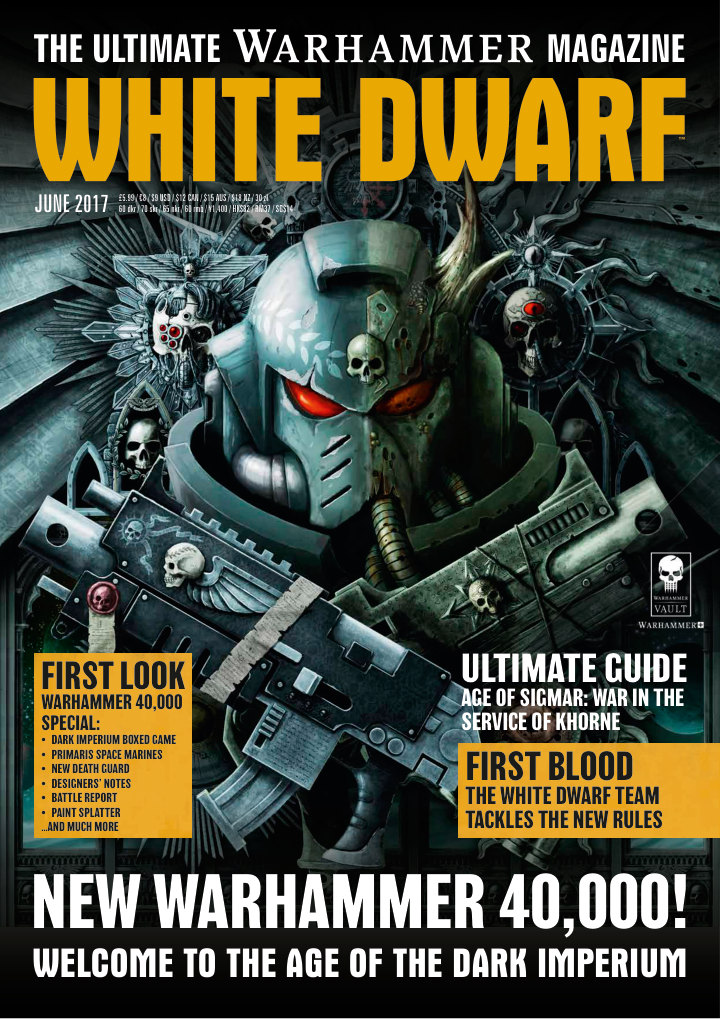
EditorialWD 419 · p. 1
The editorial welcomes the new edition after the staff’s first games, finding familiar battles beneath the streamlined rules. It highlights stratagems, tactical choices and narrative possibilities before directing readers to the issue’s detailed rules, background and miniature coverage.
Warhammer 40,000
ShowcaseWD 419 · pp. 4–5
The new edition is introduced through Dark Imperium, the Primaris Space Marines and their corrupted Death Guard opponents. The preview explains the simultaneous release of five Index books for existing collections and connects the renewed rules to the Great Rift’s division of the Imperium.
Warhammer 40,000
ShowcaseWD 419 · pp. 6–7
A component tour explains the boxed game’s twenty-two Primaris Marines, thirty-one Death Guard and followers, full hardback rulebook and two army booklets. The packaging separates sprues, books and gaming accessories, while simple assemblies make the new forces accessible despite their detailed sculpting.
Warhammer 40,000Space Marines
ShowcaseWD 419 · pp. 8–9
The new breed of Astartes reinforces existing Chapters and establishes new ones in Mark X armour. A model-by-model introduction distinguishes the supporting officers and Ancient from Intercessor battleline troops, plasma-armed Hellblasters and orbital-assault Inceptors, explaining the battlefield identities behind the miniatures.
Warhammer 40,000Space Marines
ShowcaseWD 419 · pp. 10–11
The new range combines corrupted veterans, plague-stricken civilians and a Daemon imprisoned inside a flying war machine. Profiles of the Lord of Contagion, Plaguecaster and Blightbringer explain how brutality, sorcery and the Tocsin of Misery drive a slowly advancing host of Plague Marines and Poxwalkers.
Warhammer 40,000Death Guard
ShowcaseWD 419 · pp. 12–13
The new hardback combines a large background section with core rules and tools for open, narrative and matched games. Terrain, multiplayer battles and expansions broaden the available formats, while a limited edition packages art, maps, gaming markers and a compact rules volume alongside the main book.
Warhammer 40,000
ShowcaseWD 419 · pp. 14–15
Five launch volumes supply datasheets, power ratings and detailed points for the existing miniature range. The overview separates two Imperial books, two xenos books and Chaos, and explains how shared faction keywords allow a collection to combine related forces within the new detachment system.
Warhammer 40,000
ShowcaseWD 419 · pp. 16–17
A combat gauge, command dice, wound trackers and Tactical Objective cards support the new game’s measurement and bookkeeping. Seven sculpted objective markers give missions more visual character, while Death Guard Green arrives as both brush paint and spray for the newly expanded Legion.
Warhammer 40,0001 paint colour
ShowcaseWD 419 · p. 18
The Goblin team box supplies twelve players and a ready roster, with unusual balls, counters and coins. The preview contrasts the Snivellers’ uncommon adherence to normal play with other Goblin teams’ reliance on Trolls and cheating, and notes a smaller pack for teams needing only a few Goblins.
Blood BowlGoblin teams
RulesWD 419 · p. 19
Goblin coaches can introduce three different illegal balls while risking the referee dismissing the kicker. The Explodin’ Ball has a ticking fuse, the Shady Special hinders passes and a Snotling in a ball disguise can move unpredictably around the pitch; replacement balls and escaped carriers are covered alongside the effects.
Blood BowlGoblin teams
ShowcaseWD 419 · pp. 20–21
The small-warband expansion adapts Age of Sigmar for adventures in ruined Shadespire, adding individual warriors, artefacts, spells and linked battleplans. A short history explains shadeglass and Nagash’s punishment, while four warband boxes and a scenery-based gaming mat provide starting points for all Grand Alliances.
Age of Sigmar
ShowcaseWD 419 · p. 22
The Achillus and Galatus translate familiar Custodian arms into weapons for their interred veterans. One carries an immense spear with a las-pulser, while the other combines a protective shield with the Galatus warblade, extending the Emperor’s guardians’ duty beyond mortal injury.
The Horus HeresyAdeptus Custodes
ShowcaseWD 419 · p. 22
Moritats are isolated Legion killers whose near-suicidal methods set them apart from their brothers. Pistols, rare volkite weapons and jump packs support their role as ruthless assassins and shock troops operating without an ordinary squad’s protection.
The Horus HeresySpace Marines
ShowcaseWD 419 · p. 23
Psychically directed Castellax-Achea combine familiar battle-automata with forbidden crystal technology and aether-flame weapons, provoking Mechanicum objections. The Custodes’ Sagittarum instead carry closely guarded Imperial technology, combining bolt fire with disintegrator beams in their Adrastus calivers.
The Horus HeresyThousand Sons
ShowcaseWD 419 · p. 24
The computer-game preview follows Sanctioned Operatives hunting gangcults along an alternate America’s lawless highways. Adjustable time flow lets players line up attacks and avoid danger within fast vehicular battles, while familiar Interceptor designs connect the adaptation to the original game.
Dark Future
ShowcaseWD 419 · p. 25
Nick Kyme and Jack Jadson’s comic follows injured former star Dreng Sturmblud’s return to the game with the struggling Hochland Harbingers. Tactical experience and a demanding coach may turn the team around, with the first issue offered under a selection of collectible covers.
Blood Bowl
ShowcaseWD 419 · p. 25
A new comic explores Gregor Eisenhorn’s activities before the events of the video-game adaptation. The notice identifies Ryan O’Sullivan and its art team and presents it as another route into the story associated with Dan Abnett’s Inquisitor.
Warhammer 40,000Inquisition
ShowcaseWD 419 · p. 26
Guy Haley follows Guilliman from his defeat by Fulgrim to the burden of leading the Imperium after the Great Rift. The preview emphasises the contrast between the Emperor’s original dream and the crumbling realm his returned son must now defend.
Warhammer 40,000Ultramarines
ShowcaseWD 419 · p. 26
Graham McNeill returns to the Thousand Sons after Prospero’s devastation, as Magnus tries to restore lost knowledge on the Planet of the Sorcerers. The preview stresses the broken Legion’s predicament and the danger that the Primarch’s attempted recovery may deepen his damnation.
The Horus HeresyThousand Sons
ShowcaseWD 419 · p. 27
Josh Reynolds sends the Steel Souls chamber into Nurgle’s domain in search of a lost companion. The notice presents the campaign as a confrontation between Stormcast heroes and the Plague God’s servants, with Tornus the Redeemed among its important characters.
Age of SigmarStormcast Eternals
ShowcaseWD 419 · p. 27
Chris Dows’s audio drama recounts a disastrous Drop Troop assault before moving to a Commissar’s questioning of a survivor. That structure promises both combat and scrutiny of what went wrong, giving the distinctive Elysian regiment more attention than a simple action scene.
Warhammer 40,000Astra Militarum
ShowcaseWD 419 · p. 27
The audio collection brings together stories of Stronos, Lucius and Lukas the Trickster by three writers. Its mixture of Iron Hands, Emperor’s Children and Space Wolves offers contrasting characters and approaches to the far future in one listening selection.
Warhammer 40,000Iron Hands
InterviewWD 419 · p. 27
Guymer explains his attraction to the poorly treated Iron Hands and the challenge of portraying characters without ordinary emotional gestures. He contrasts the familiar Old World with the freedom of the Mortal Realms, recalls completing Gotrek and Felix’s story and expresses a desire to explore Skaven society further.
CommunityWD 419 · pp. 30–31
Readers request more tactics, list-building explanations, introductory boxed-game battles and new uses for Genestealer Hybrids. Other letters trace the magazine’s role in a long Games Workshop career, ask about Age of Sigmar Blanchitsu and describe a beginner’s unexpected route from Ultramarines to Crimson Fists.
LoreWD 419 · p. 31
Grombrindal answers a question about the geographic extent of a T’au sept. He describes colonisation beginning on a habitable planet before spreading through the rest of its star system, making the system the sept rather than merely its principal world.
Warhammer 40,000T’au Empire
EditorialWD 419 · pp. 32–35
The opening guide maps the issue’s coverage of the new edition: redesigned rules and army selection, a galaxy split by the Great Rift, and two contrasting new miniature forces. It explains how detachments, power ratings and stratagems sit alongside the return of Guilliman, Primaris reinforcements and the Death Guard’s renewed assault.
Warhammer 40,000
LoreWD 419 · pp. 34–35
The foldout sets a vast battle within a galaxy consumed by endless conflict. Its accompanying reflection identifies the most terrible enemies as manifestations of humanity’s own inner darkness, tying the spectacle to the moral horror of the setting.
Warhammer 40,000
InterviewWD 419 · pp. 36–38
Jes Bickham and Robin Cruddace explain the redesign from an intimidating accumulation of general rules to compact core mechanics and unit datasheets. Template removal, common profiles for vehicles and monsters, character auras, alternating combats and a single morale phase illustrate the approach, while open, narrative and matched play preserve different gaming styles.
Warhammer 40,000
RulesWD 419 · p. 39
An annotated Space Marine Dreadnought entry explains how to read the new datasheets. Battlefield role, power rating, profile, weapon statistics, options, abilities and keywords are identified, showing how the same page supports both fighting with a unit and organising it within an army.
Warhammer 40,000Space Marines
LoreWD 419 · pp. 40–41
Cadia’s destruction and the opening of the Cicatrix Maledictum extinguish the Astronomican and isolate worlds across the galaxy. Guilliman’s return and Indomitus Crusade offer a response, but hazardous passages through the Rift and the unknown fate of Imperium Nihilus define a profoundly divided human realm.
Warhammer 40,000
LoreWD 419 · pp. 42–43
Guilliman’s ancient commission gives Belisarius Cawl ten millennia to develop a new generation of Space Marines using the Emperor’s surviving research. Their eventual release both rebuilds depleted Chapters and creates the Ultima Founding, with battlefield success and Primarch authority overcoming objections to the innovations.
Warhammer 40,000Space Marines
LoreWD 419 · pp. 44–45
Detailed annotations distinguish modular Tacticus and Gravis armour, Inceptor descent equipment and the additional systems of officers and standard bearers. New rifles, plasma weapons and boltstorm gauntlets extend familiar Imperial designs, while cabling, power plants and armour layering explain how the miniature’s equipment is meant to function.
Warhammer 40,000Space Marines
LoreWD 419 · pp. 46–47
The new Death Guard models are examined as the result of ten millennia of mutation, field repairs and unholy manufacture. Ancient armour, living weapons, bells and Nurglings link the Legion’s equipment to Nurgle, while the Bloat-drone and Poxwalkers blur the boundaries between imprisoned Daemons, corrupted machines and still-conscious victims.
Warhammer 40,000Death Guard
ShowcaseWD 419 · p. 48
Aidan Daly applies the Dark Angels’ hidden heraldic language to the new Intercessors, including company knees, squad arrows and freehand checks. Very fine highlights preserve the dark green foundation rather than turning the armour into a lighter overall colour.
Warhammer 40,000Dark Angels1 paint colour
ShowcaseWD 419 · p. 49
Max Faleij individualises his Space Wolves with knotwork, personal weapon names and Fenrisian inscriptions on purity seals. Worn brown leather pouches and carefully placed weathering connect the clean new armour to the Chapter’s death-world origins and independent traditions.
Warhammer 40,000Space Wolves
ShowcaseWD 419 · p. 49
David Perryman builds a smooth red foundation in thin layers and keeps orange highlights from taking over by adding white to the final ochre. Company markings and individual battle honours integrate the squad with the Blood Angels’ organisation and give the newly introduced warriors a sense of personal history.
Warhammer 40,000Blood Angels4 paint colours
ShowcaseWD 419 · p. 50
Chris Innes retains the Ultramarines’ blue tone by mixing the highlight from Macragge and Calgar rather than switching hue. Freehand symbols, a checked sergeant’s knee and a designated second-in-command show how even a Codex-adherent squad can present distinct individual members.
Warhammer 40,000Ultramarines2 paint colours
ShowcaseWD 419 · p. 50
Paul Norton’s Blood Ravens Lieutenant and Maxime Corbeil’s Black Templar demonstrate that chapter identity can come entirely from paint and transfers. Paul outlines a restrained red recipe and three levels of highlight, while Maxime’s warmer pale pads contrast with sharply highlighted cold black.
Warhammer 40,000Blood Ravens5 paint colours
ShowcaseWD 419 · p. 51
Steve Bowerman, the Army Painters and Duncan Rhodes show further First Founding schemes on Primaris squads. Accurate striped helmets, crisp black edges and assembled squad-number transfers demonstrate familiar heraldry on the new armour, with Duncan deliberately keeping his Salamanders free of extra flame ornament.
Warhammer 40,000Imperial Fists1 paint colour
Battle reportWD 419 · pp. 54–59
Robin Cruddace and Jes Bickham guide the staff through Dark Imperium’s forces in an objective game. The unfolding fight illustrates movement and advancing, character auras, new weapon profiles, mortal wounds and alternating combats; forgotten support rules and an exceptionally tough Lord of Contagion provide practical lessons before the Primaris Marines destroy the Death Guard and secure victory.
Warhammer 40,000Ultramarines
TacticsWD 419 · pp. 60–61
Matt Hutson translates a narrative Thousand Sons collection into an eighty-six-power Patrol Detachment. He explains using the detachment chart as a collecting checklist, with another troop unit and commander opening a Battalion and Magnus suggesting a later Supreme Command formation.
Warhammer 40,000Thousand Sons
TacticsWD 419 · pp. 62–63
Dan Harden compares a ninety-four-power T’au Battalion with its detailed 1,759-point total, finding power ratings convenient for his relaxed gaming group. His larger collection can form specialised detachments or a Brigade, showing how one army can support multiple styles without changing its central identity.
Warhammer 40,000T’au Empire
TacticsWD 419 · pp. 64–65
Steve Bowerman welcomes quick power-based selection and narrative tools that support unequal forces. A broad Blood Angels collection fits several detachments, while shared Imperial keywords let him add other Chapters or Skitarii; he chooses models for appearance and develops battlefield roles through play.
Warhammer 40,000Blood Angels
TacticsWD 419 · pp. 66–67
Jes Bickham builds a 1,982-point Tyranid Battalion with Synapse leaders and a broad selection of large organisms. He explains accounting for models and weapons separately, then discusses reworked profiles and armaments that give monsters such as the Haruspex and Tyrannofex more distinct capabilities.
Warhammer 40,000Tyranids
Battle reportWD 419 · pp. 70–83
Robin Cruddace’s 185-power Ultramarines defend an industrial route against Dan Harden’s 188-power coalition of Death Guard, Black Legion, Nurgle Daemons and a Renegade Knight. The narrative Meat Grinder mission gives Chaos returning units while concealed deployment helps the defenders establish strong fire bases; characters, command rerolls, falling back and outflanking stratagems become central lessons in the new rules.
Warhammer 40,000Ultramarines
ShowcaseWD 419 · pp. 84–85
Neil Hollis paints every component separately to reach the Primarch’s details, then coordinates reflection points across the assembled non-metallic armour. Copper-orange gold separates the trim from yellow hazard stripes, while cool silver and a green-and-cream wrecked Knight balance the piece; he also discusses concentration, frustration and the value of taking breaks.
The Horus HeresyIron Warriors
ShowcaseWD 419 · p. 86
Robin McLeod distinguishes pale armour, skin and robes through differently coloured shading rather than abandoning Mortarion’s sombre palette. Restrained verdigris, freehand wood grain and carefully placed grime preserve the delicate blending while keeping the weathering within a narrow set of colours.
The Horus HeresyDeath Guard
ShowcaseWD 419 · p. 87
Danny Nuttall converts Narik Dreygur with a banner arm and flowing Deathwatch cape to represent Maloghurst. Matching the direction of every component creates movement, and the judges regard those modest changes and the strong colour execution as decisive.
The Horus HeresySons of Horus
ShowcaseWD 419 · p. 88
Ellis Kaye combines rich purple, non-metallic gold and cyan details with bright green gemstones. The commentary highlights his steady improvement, carefully worked face and attention to small details that support the model’s overall quality.
The Horus HeresyEmperor’s Children
ShowcaseWD 419 · p. 88
Nathaniel Phillips uses smoothly controlled light-to-dark yellow armour to establish a consistent source of illumination. Sigismund’s stern face, bright sword reflections and small freehand inscription preserve the individual character within the elaborate armour.
The Horus HeresyImperial Fists
ShowcaseWD 419 · p. 89
Lawrence Widdicombe contrasts glossy red armour with dark, aged gold ornaments and an expertly placed cloak transfer. Blue light around Ahriman’s raised hand reflects onto nearby surfaces, giving the suggestion of an imminent psychic power.
The Horus HeresyThousand Sons
ShowcaseWD 419 · p. 89
John Sambells frames a dark, menacing Horus with turquoise cloth and jade gems. A warmer, pale face becomes the focal point, enhanced by a red glow inside the collar that recalls Adrian Smith’s classic confrontation between Horus and the Emperor.
The Horus HeresySons of Horus
ShowcaseWD 419 · p. 90
The third painting month calls for a fast-moving unit with optional additional troops. The introduction previews Vypers, a Stormhawk, Sentinels and Raptors, introduces two reader-reproducible paint guides and follows Dan’s decision to begin a shared Sector Imperialis battlefield.
Warhammer 40,000
ShowcaseWD 419 · p. 91
Chris Bilewicz adds three differently armed Vypers for flexibility and a Dire Avenger shrine honouring Morai-Heg with red left arms. Separate undercoats simplify the bone lower hull and turquoise body, while black-and-white plumes tie the new infantry back to his existing jetbikes.
Warhammer 40,000Aeldari2 paint colours
ShowcaseWD 419 · p. 92
Maxime Corbeil tests his Black Templars scheme on a larger aircraft, giving the cockpit an ace’s yellow stripe and numerous kill markings. Painted weapon alternatives and carefully chosen transfer panels make the fighter flexible in games while preserving a clear visual focus.
Warhammer 40,000Black Templars
PaintingWD 419 · p. 93
Maxime explains cold blue-black armour, warm pale shoulder pads, yellow lenses and red checked knees in staged recipes. Separately undercoated pads keep the white clean, homemade medium-based glazes unify the colour and consistent tiny light spots suggest a polished reflective finish.
Warhammer 40,000Black Templars17 paint colours
ShowcaseWD 419 · p. 94
James Ashbey expands his mechanised Cadians with a melta-heavy Devil Dog and two armoured Sentinels, giving the walkers different weapons. Sponge chips followed by pale dust continue his weathering experiments, while enclosed cabs fit the regiment’s imagined urban deployments.
Warhammer 40,000Astra Militarum2 paint colours
PaintingWD 419 · p. 95
The red-and-grey infantry scheme is broken into fatigues, armour, green weapon cases and flesh, working from large areas to details. Sand-coloured bases prevent the grey models blending into their surroundings, and an accompanying tank note stresses applying markings before chips and dust so the wear tells a coherent story.
Warhammer 40,000Astra Militarum19 paint colours
ShowcaseWD 419 · p. 96
Dan Harden chooses Raptors instead of a Heldrake to preserve the infantry-focused identity of his Iron Warriors. A second Marine squad uses small head and arm changes and a Chosen champion to distinguish the models without losing the force’s consistent purple accents and metallic appearance.
Warhammer 40,000Iron Warriors
ShowcaseWD 419 · p. 97
The warlords consider the new edition’s detachments, vehicle rules and Primaris models before a free-choice painting month. Dan begins the shared city board and adds Khârn using gold trim painted before red armour, while Maxime returns to a favourite Emperor’s Champion sculpt for his Black Templars.
Warhammer 40,000Iron Warriors5 paint colours
ShowcaseWD 419 · pp. 98–99
Joey Logan returns to his collecting roots with a Skink-and-Kroxigor Seraphon force in bright yellow and deep purple. Airbrushing, medium-thinned washes and a purple staining method develop new skills, while a luminous green Troglodon provides a deliberately contrasting centrepiece.
Age of SigmarSeraphon10 paint colours
ShowcaseWD 419 · pp. 100–101
Dan Hyams builds a Destruction army around a painstakingly highlighted pale Maw-krusha, bringing the skin to life with coloured glazes. Black chipped armour, bright green flesh and a mixture of modern and classic greenskins connect old painting styles to unusual units such as the Colossal Squig and Spider Riders.
Age of SigmarIronjawz9 paint colours
ShowcaseWD 419 · pp. 102–103
Gareth Cosby develops a School League demonstration force into a narrative Bloodbound army built around a champion and his followers. Subdued washes, glazes and plentiful gore replace his slower individual-model approach, while scenic bases and units in multiples of eight reinforce Khorne’s identity.
Age of SigmarBlades of Khorne1 paint colour
ShowcaseWD 419 · pp. 104–105
Joe Naber paints an entire Fyreslayer force together to overcome his habit of moving between projects. A dark undercoat and two directional airbrushed skin colours speed the shared infantry palette, while a separately painted rider and drybrushed Magmadroth provide the centrepiece for a playable first Age of Sigmar army.
Age of SigmarFyreslayers3 paint colours
LoreWD 419 · pp. 108–115
The guide follows mortal warriors from the temptations of Chaos through Khorne’s trials into Bloodbound hierarchies, champions and supporting priests, smiths and standard bearers. It then explains how slaughter draws daemonic armies into reality and distinguishes Bloodletters, Juggernauts, engines, Heralds and Bloodthirsters, stressing that the host’s apparent frenzy can conceal experienced battlefield command.
Age of SigmarBlades of Khorne
InterviewWD 419 · pp. 116–123
The studio art team describes a shared visual vocabulary built from miniatures, writing and decades of earlier illustrations. Individual artists retain their styles while developing environments and interactions beyond what static models can show, from the Fortress of Hera to newly imagined Mortal Realms.
InterviewWD 419 · pp. 124–131
Artists discuss favourite works ranging from the decaying Emperor and Ecclesiarchal triptych to Khorne’s malicious Daemons and Nagash’s life-draining advance. Fantastical maps, a battle containing smaller individual stories and Tzeentchian figures inspired by anatomical diagrams and portrait lockets show how imagery can convey ideas as well as depict miniatures.
Warhammer 40,000Age of Sigmar
InterviewWD 419 · pp. 132–135
Harvey Snape turns a Solitaire painting project into a complete Masque of the Midnight Sorrow, drawn by the Harlequins’ ritual identities and the challenge of widespread freehand diamonds. A staged grid-and-diagonal method explains the patterns on suits and vehicles, while darker red-blue colours and separately painted riders keep the ambitious project coherent before he considers related Aeldari allies.
Warhammer 40,000Harlequins5 paint colours
PaintingWD 419 · pp. 136–137
Tom Moore’s staged Ultramarines guide covers blue armour, gold, silver, red cloth, pale lining and bright optics. A final extra armour highlight distinguishes the Captain from ordinary troops, while carefully thinned blue-white paint around sword nodes produces a localised power glow; a temporary small base provides access beneath the cloak.
Warhammer 40,000Ultramarines25 paint colours
PaintingWD 419 · pp. 138–140
James Gallagher breaks the elaborate Nurgle champion into manageable surfaces, recommending a sensible order and shorter painting sessions. Detailed recipes cover sickly green armour, brass, blades, contrasting cloth, organs, Nurglings, pipes, horns and cool smoke; highlights draw attention to the axe, trophy rack and head, and thinned shades give tusks a natural darkening gradient.
Warhammer 40,000Death Guard37 paint colours
PaintingWD 419 · p. 141
Multiple washes create unhealthy flesh rapidly, allowing some irregularity to suit Nurgle’s victims. The guide pairs skin with an orange jumpsuit, battered brass and dirty cord, and suggests yellow or orange washes as alternate disease tones; clothing choices can imply a victim’s former Imperial occupation.
Warhammer 40,000Death Guard16 paint colours
ShowcaseWD 419 · pp. 144–145
The retrospective revisits the Vyper’s release with rules, tactics and Jes Goodwin’s design discussion, alongside a huge vertical gaming board and an Epic redesign. Wayne England’s Great Unclean One concepts, Mike McVey’s Lustria diorama and an Orc collecting guide recall the variety of the 1997 magazine.
Warhammer 40,000Epic
CommunityWD 419 · pp. 146–151
The gallery showcases Knights, Death Spectres squads, varied Chaos and Stormcast characters, Sylvaneth and Ork war engines. Each photograph credits its painter, with a separate feature explaining the pair of House Hawkshroud Knights selected as models of the month.
PaintingWD 419 · p. 150
Aurélie Schick adapts Auric Arachnus’s spider heraldry to two yellow House Hawkshroud Knights. Masking establishes the body shape for airbrushing, then thin parallel brush lines define the legs before filling them in, minimising corrections over difficult yellow paint.
Warhammer 40,000Imperial Knights
CommunityWD 419 · p. 152
The new rules fill lunch breaks with games and inspire plans for Primaris reinforcements across several staff Chapters. Kharadron ships, Seraphon heroes and Nurgle Daemons continue alongside them, showing how the team’s collecting interests span the settings.
ShowcaseWD 419 · p. 152
Matt Hutson paints an Intercessor as the starting point for adding Primaris to his long-established Black Templars. Armageddon Crusade insignia ties the new model into the existing army while giving him a practical reference for painting further reinforcements.
Warhammer 40,000Black Templars
PaintingWD 419 · p. 152
Jonathan adds Endrinriggers to his Kharadron fleet, mixing an entire Sanguinius tint with black to produce an almost-black red. Khorne Red brightens the cloth within the same palette, while his experience of the unit’s strength in games informs its place in the collection.
Age of SigmarKharadron Overlords3 paint colours
CommunityWD 419 · p. 153
Three staff games test new army rules: Matt Holland’s T’au struggle to stop Dan’s Gorkanaut, Ben’s Marines overcome Skitarii, and Martyn’s Necrons outgun Ben. Lessons include reading flyer abilities on datasheets and beginning with smaller games, while a separate note introduces a randomly allocated Silver Tower painting challenge.
Warhammer 40,000T’au Empire
CommunityWD 419 · p. 154
Completed staff projects include Mel’s difficult Eternity Warden, Michael’s Aether-Khemist and a preview of Dan’s metallic-looking Plague Marines. The captions celebrate finished work while noting the urge to keep refining details and the next collecting challenge already underway.
Age of SigmarWarhammer 40,000Seraphon1 paint colour
CommunityWD 419 · p. 154
Martyn and Jonathan discuss planned Dark Angels and Blood Angels and the appeal of the new consolidated rulebook. Its photography, background, rules and expansions make it an attractive reference as well as a source of ideas for their next armies.
Warhammer 40,000
CommunityWD 419 · p. 155
Stu finishes a Nurgle Daemon Start Collecting! force after a friendly rivalry with Harvey motivates him to work late. The short account values actually completing the models even when another painter may eventually achieve a more polished finish.
Age of SigmarWarhammer 40,000Daemons of Nurgle
CommunityWD 419 · p. 155
Martyn uses a simple Scout squad to practise a limited Dark Angels palette before painting more armour. Nearby workbenches hold Jonathan’s Ironclad, Michael’s Blood Drinkers test Lieutenant and Matt’s Gunhauler, illustrating the next steps growing out of current projects.
Warhammer 40,000Age of SigmarDark Angels1 paint colour
ShowcaseWD 419 · p. 156
Ben adds a Hunter anti-aircraft tank to complement his Stalker while developing the Raven’s Watch’s unusual doctrine. The army’s next infantry will be Primaris in a rebuilt Sixth Company, replacing the company lost to Hive Fleet Eumenides and giving the new models a specific role in his background.
Warhammer 40,000Space Marines