EditorialWD 403 · p. 1
Jes Bickham introduces Apocalypse as an opportunity to use whole collections in spectacular battles. Giant new models and substantial scenery give that ambition a physical form. The team expands its armies before fighting a large siege. The issue’s painting and design material follows those preparations from individual models to an entire fortified battlefield.
Warhammer 40,000
ReviewWD 403 · pp. 6–9
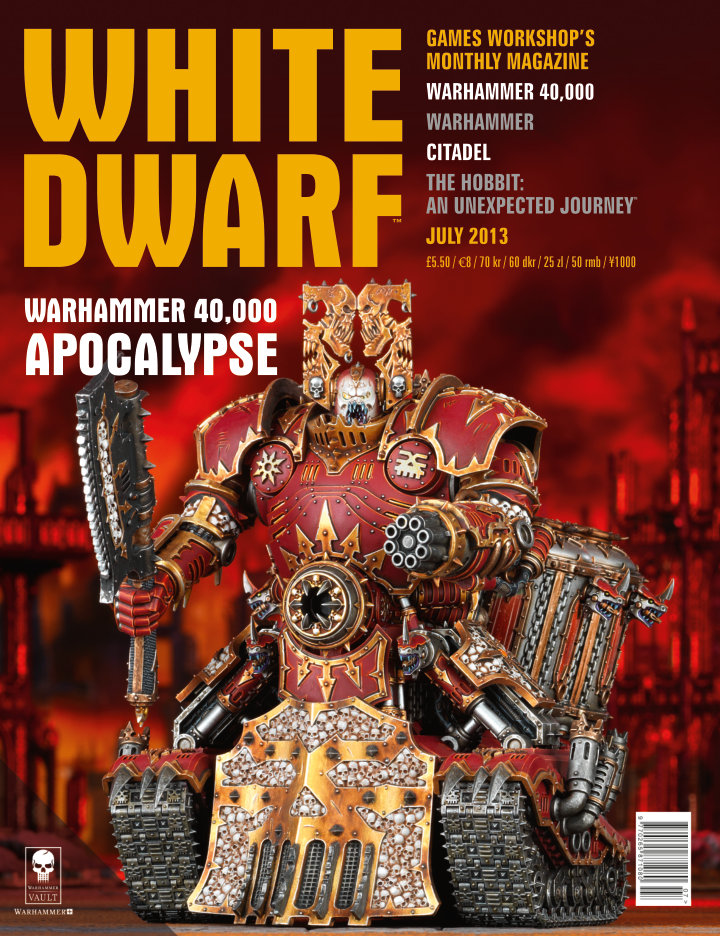
Andrew Kenrick finds the tracked Daemon Engine both enormous and straightforward to assemble. Khorne symbols, layered armour and countless skulls tie it to the existing Chaos range. Several head and gun options allow different arrangements of the same menacing silhouette. The fold-out introduces the machinery and weapons behind its single-minded battlefield purpose.
Warhammer 40,000Chaos Space Marines
ReviewWD 403 · pp. 10–12
A star god struggles at the centre of a vast, partly disassembled metal prison. Canoptek creatures continually repair the damage it causes, making the kit’s structure part of its story. Forty loose Scarabs allow collectors to add activity around the exterior. Jes sees the Vault as a dramatic centrepiece that remains surprisingly simple to construct.
Warhammer 40,000Necrons
ReviewWD 403 · p. 13
The captive C’tan can be assembled separately if the larger kit is built as an Obelisk. Energy ribbons and restraints make it a striking companion to the established star-god shards. Its release is described as a desperate and dangerous Necron decision. A light undercoat and washes are suggested as a quick approach, without naming individual paints here.
Warhammer 40,000Necrons
ReviewWD 403 · pp. 14–15
The alternate Tesseract Vault assembly creates a floating fortress built to oppose aircraft. Tesla spheres occupy its corners and a gravity pulse supplies its defining weapon. Shared damaged panels suggest debris falling away as the machine rises rather than being drawn inwards. The build also leaves the C’tan available as a separate model.
Warhammer 40,000Necrons
ReviewWD 403 · p. 16
The captain studies a long scroll supported by a cyber-cherub. Communications equipment and a stave of office express responsibility for the Chapter’s deployments. His cloak and ribbons of parchment create an almost dioramic composition. Adam draws attention to the way those details distinguish a strategic commander from a conventional fighting pose.
Warhammer 40,000Space Marines
ReviewWD 403 · p. 17
A double-headed axe and purposeful stride give the Assault Company commander a direct, threatening presence. His jump pack carries elaborate scrollwork and winged skulls. Bionics and a grim expression suggest an experienced killer rather than a showy duellist. The review explains how pose and equipment establish the character’s military office.
Warhammer 40,000Space Marines
ReviewWD 403 · p. 18
The Devastator commander wears Heresy-pattern armour and carries an imposing combi-plasma weapon. A large targeting array follows his gaze, linking the pose to his fire-control role. Servo-skull, grenades and purity seals add technological and ceremonial detail. The model presents a custodian of dangerous equipment as well as a captain of long-range troops.
Warhammer 40,000Space Marines
ReviewWD 403 · p. 19
A raised sceptre and a fist against the chest give this captain an emphatic orator’s pose. Scars and elaborate armour connect ceremony with experience in battle. A large vox-equipped servo-skull is anchored near his feet with censers. Adam presents the figure as a keeper of Chapter traditions whose voice carries them onto the battlefield.
Warhammer 40,000Space Marines
ReviewWD 403 · pp. 20–23
Dan introduces a book designed for whole collections and immense shared battles. Datasheets range from single super-heavy machines to large coordinated formations. Missions, Strategic Assets, heroic moments and environmental disasters add decisions beyond ordinary shooting and movement. An Armageddon warzone connects the spectacle to a major historical campaign in the setting.
Warhammer 40,000
ReviewWD 403 · pp. 24–25
The Strongpoint combines a two-level bunker with a huge turret shaped around an Imperial eagle. Lifting its macro-cannon reveals a vortex missile battery underneath. Gothic alcoves and armoured doors make the structure fit the wider fortification range. Connections to the Wall of Martyrs let it become part of a continuous defensive complex.
Warhammer 40,000Imperium
ReviewWD 403 · pp. 26–27
Two quad-linked anti-aircraft weapons dominate a sizeable bunker. Spiked parapets, banners and an Imperial Aquila establish its place in the setting. Optional steps and doors support connections to existing defence lines. The review highlights how the kit combines a clear battlefield function with modular scenery construction.
Warhammer 40,000Imperium
ReviewWD 403 · pp. 28–29
Two autonomous gun emplacements can carry either battle cannons or punisher weapons. Their armoured bases include gothic decoration and a small maintenance hatch. Simple assembly and movable turrets make them convenient additions to a battlefield. Adam connects their accessible construction to the later drybrushing guide.
Warhammer 40,000Imperium
ReviewWD 403 · pp. 30–31
The special edition presents the rules as contents of Torquemada Coteaz’s campaign chest. Separate volumes, cards, datasheets and a reference screen receive fictional Imperial covers and labels. An Exterminatus document serves as the numbered certificate. The set also introduces Warzone: Pandorax ahead of its wider release.
Warhammer 40,000Inquisition
ReviewWD 403 · pp. 32–33
A large double-sided figure case accompanies the Gamer’s Edition rulebook. Its exterior imitates a vortex-grenade stasis container, while removable foam accommodates large models. A separate card set contains the supplement’s Strategic Assets in a clear case. The notices describe the practical storage and play aids alongside their elaborate fictional presentation.
Warhammer 40,000
ReviewWD 403 · pp. 34–35
Clear multipart templates accommodate the enlarged blast and barrage effects of Apocalypse weapons. Their clip-together design makes them easier to transport. A decorated metal dome represents a vortex grenade, while a Mechanicus-themed cube stores a large quantity of matching dice. The accessories translate the supplement’s scale into tangible gaming tools.
Warhammer 40,000
ReviewWD 403 · pp. 36–37
The new datasheets group familiar troops and vehicles into recognisable military formations. Examples range from a Space Marine company to an Ork Green Tide and a Kroot hunting force. One-click collections package the relevant models together in the contemporary web store. Adam explains the collecting idea without reproducing the formations’ complete rules.
Warhammer 40,000Space Marines
ReviewWD 403 · p. 38
Azog appears both on foot and riding the White Warg. Deep scars, a damaged ear and a flayed-skin apron give the figure a brutal character. His severed hand is replaced by a long iron claw. The enormous mount mirrors its rider’s battered appearance and establishes a much stronger presence than an ordinary Warg.
Middle-earth Strategy Battle GameAzog’s Hunters
ReviewWD 403 · p. 39
Three figures depict the Dwarves during the fighting outside Moria. Thorin rallies his companions with the branch that gives him his later name, before acquiring Orcrist. Balin advances in layered protection, while Dwalin carries paired axes beneath a distinctive younger hairstyle. The models connect the company’s later personalities to an earlier battle.
Middle-earth Strategy Battle GameErebor
CommunityWD 403 · pp. 40–41
The tour continues to advertise Memphis, Cologne, Birmingham and Modena. Golden Demon and Armies on Parade offer different ways to display completed models. Meeting sculptors, writers and designers complements those competitions. The exclusive Games Day miniature remains unrevealed in this update.
ReviewWD 403 · p. 42
John French begins with a defeated sorcerer hiding behind another identity. A meeting with the vengeful Torbek forces Ahriman back towards his powers and the consequences of the Rubric. Andrew praises the contrast between that broken figure and the confident villain familiar from the codex. Psychic duels and an airborne fight with Warp Talons provide memorable action around the character’s return.
Warhammer 40,000Thousand Sons
ReviewWD 403 · p. 43
The anthology gathers a wide range of stories from the fiction magazine’s final run. Adam particularly praises Gav Thorpe’s linked Lion stories and Andy Smillie’s account of a captive Space Wolf. Other tales cover figures as different as Valkia and Sigmar. Alex Helm’s winning short story closes the collection with a tank crew trapped as Tyranids attack.
Warhammer Fantasy BattlesWarhammer 40,000Dark Angels
ReviewWD 403 · p. 44
C L Werner follows the Black Plague under Emperor Boris Goldgather. Skaven engineering and human desperation connect a broad cast across the catastrophe. Puskab Foulfur and Frederik Van Hal provide opposing perspectives on the disaster. Jes finds the novel compelling because it does not soften the hardship at the centre of this period of Imperial history.
Warhammer Fantasy BattlesThe Empire
ReviewWD 403 · p. 44
Guy Haley shows Goblins from a much more frightening perspective than the usual tabletop joke. Playwright Jeremiah von Bickenstadt becomes an unwilling witness to their world. Skarsnik’s awareness and ambition emerge alongside the violence. Dan especially values the novel’s exploration of Goblin culture and the danger of encountering a horde at ground level.
Warhammer Fantasy BattlesOrcs & Goblins
ReviewWD 403 · p. 45
Vulkan joins Ferrus Manus and Mortarion in reclaiming a world dominated by Eldar. The immediate campaign alternates with memories of his youth on Nocturne. Adam finds the scenes with Vulkan’s adoptive father particularly revealing. Compassion remains central even while the Primarch leads an overwhelmingly powerful war effort.
The Horus HeresySalamanders
ReviewWD 403 · p. 45
Gav Thorpe’s audio drama sends Artemis and a Deathwatch team aboard a suspicious Rogue Trader vessel. The warriors must overcome their differences while investigating a potentially deadly cargo. Adam praises the distinct voices, action and final revelation. A shorter accompanying notice follows Grey Knight Hyperion towards the conflict with Angron at Armageddon.
Warhammer 40,000Deathwatch
ReviewWD 403 · p. 46
The Tesseract Ark combines a familiar vehicle rear with a broad front shield and singularity weapon. Its power is described as stolen from a dying star. Tesla cannons flank the protected pilot position. Adam presents the resin vehicle as a rare and technologically distinctive addition to a Necron collection.
Warhammer 40,000Necrons
ReviewWD 403 · p. 47
A weapon set supplies rotor cannons, feeds and ammunition for five Legion Marines. Their purpose is sustained fire against lightly armoured opponents. The Destroyer squad instead carries equipment descended from the Unification Wars, including radiation weapons and paired pistols. Reinforced armour and specialised ammunition give the latter a more ominous identity.
The Horus HeresySpace Marine Legions
ReviewWD 403 · p. 48
Apocalypse arrives as separate digital rules, datasheets and an Armageddon warzone volume. Interactive references support use during a large battle. A Farsight supplement promises history, heraldry and rules for the breakaway enclave. The notice also records the electronic rulebook and magazine formats available at the time.
Warhammer 40,000T’au Empire
InterviewWD 403 · p. 49
Designer Carl Jackson describes preserving Talisman’s memorable social moments in a digital version. Players can share one device or meet opponents online. Turning another character into a toad remains part of the appeal. The short interview introduces the release across mobile devices and PC without becoming a rules guide.
Talisman
ShowcaseWD 403 · pp. 54–59
Chaos Knights inspire Jamie’s collection, but the opportunity for conversions soon expands it far beyond one regiment. Large infantry blocks receive distinctive champions and command groups. Rival leaders Scylla and Loic give the force an internal narrative, while blue details unite followers of different gods. Recent monsters continue a cycle in which painting creates an urge to game and gaming inspires more models.
Warhammer Fantasy BattlesWarriors of Chaos
CommunityWD 403 · p. 60
Carl Dafforn begins his snowy Ogre display with Yhetees. Several experimental schemes lead to a result different from his first expectation. An hour’s painting each weekday also completes the Hunter and Sabretusks. The update demonstrates how a steady routine keeps a larger display project on schedule.
Warhammer Fantasy BattlesOgre Kingdoms
CommunityWD 403 · p. 61
Eddie Eccles devotes substantial time to his Harlequin display. A converted Wraithlord uses Dark Eldar spares to distinguish it from standard craftworld models. Work also advances on the accompanying troupe. The update emphasises how enthusiasm for a current project can sustain both conversion work and painting.
Warhammer 40,000Harlequins
CommunityWD 403 · p. 61
Jon Flindall paints before the working day begins to advance his Nurgle horde. Fifteen Plaguebearers and three Nurglings bases establish its first troops. With those smaller figures completed, he intends to move to a Plague Hulk. The report links a consistent daily session to clear progress on the larger display.
Warhammer Fantasy BattlesDaemons of Chaos
CommunityWD 403 · p. 62
Dan adds Death’s Head Halberdiers and a Great Cannon to his Empire entry. The regiment’s history in Uniforms and Heraldry supplies the theme. Red and black distinguish it from the rest of his Ostermark force. Planned roads and a hilltop redoubt will give the models a coherent display setting.
Warhammer Fantasy BattlesThe Empire
CommunityWD 403 · p. 62
Chris spends much of the month turning Empire Militia into Zombies for his Sylvanian display. Liquid Green Stuff assists the alterations. Spirit Hosts and Isabella provide a painting reward after the longer modelling task. The update balances labour on the army’s bulk with more immediately satisfying character pieces.
Warhammer Fantasy BattlesVampire Counts1 paint colour
CommunityWD 403 · p. 63
Dominic chooses a colour scheme and completes a small Fire Warrior reconnaissance group. He also sets up a private progress group for the seven participants. Shared updates, encouragement and teasing help maintain their momentum. The entry shows the social side of preparing separate armies for one event.
Warhammer 40,000T’au Empire
CommunityWD 403 · p. 63
Nick has not completed his Blood Ravens yet, although the display’s models are assembled. Test figures and written stage notes establish a repeatable scheme. His friends expect a familiar last-minute burst of painting. The update distinguishes useful preparation from the visible completed models still needed for the deadline.
Warhammer 40,000Blood Ravens
EditorialWD 403 · pp. 64–65
Jervis recalls using the first Apocalypse to encourage games beyond equal-sized two-player battles. The new edition keeps that freedom while adding missions, disasters and heroic choices. Working with Phil Kelly makes him reconsider his own preference for minimal rules after seeing players enjoy the extra decisions. He draws a parallel between collaborative design and sharing the work of organising a large game.
Warhammer 40,000
CollectingWD 403 · pp. 66–67
The team identifies three ways to prepare a collection for larger games. A collector can add a super-heavy centrepiece, complete an existing formation or simply expand favourite units. Each offers a different scale of commitment and a reason to revisit an army. The introduction frames Apocalypse as a source of hobby projects rather than only a change of rules.
Warhammer 40,000
ShowcaseWD 403 · pp. 68–69
Andrew expands his Death Guard into a Legionnaire Warband with additional Plague Marines, Chosen and Possessed. A new Lord of Skulls then prompts a pact with World Eaters in the army’s story. Berzerkers and Khârn prevent the red engine from standing alone among pale armour. The project demonstrates how one addition can lead naturally into a wider allied collection.
Warhammer 40,000Death Guard
ShowcaseWD 403 · pp. 70–71
Adam adds three richly decorated Predators to a mostly infantry-based Dark Angels army. Spare Chapter pieces and Forge World crew help the squadron look experienced. Five more Librarians and a Drop Pod create another formation with an entirely different purpose. Azrael and Deathwing Knights round out the burst of painting before the large battle.
Warhammer 40,000Dark Angels
ShowcaseWD 403 · pp. 72–73
Matt returns to a long-running Black Templars collection through the Armageddon warzone. One additional Crusader completes a tank formation. A new Baneblade strengthens an existing Steel Legion contingent beside his Shadowsword. The shared campaign theme makes those separate forces feel like parts of one larger collection.
Warhammer 40,000Black Templars
ShowcaseWD 403 · p. 74
Erik adds a Stompa even though his Ork army is still relatively small. Joining friends’ forces will let him participate in a much bigger battle. The imposing walker supplies a clear role among their other super-heavy machines. His enthusiasm already extends to further vehicle formations, illustrating how the centrepiece can become the start of wider expansion.
Warhammer 40,000Orks
ShowcaseWD 403 · p. 75
Jes paints a Tesseract Vault to crown the Xonthar Dynasty. Imagining the Overlords agreeing to unleash such a dangerous prisoner expands the army’s background. The captive star god receives its own name and place in that story. Small Canoptek details also inspire plans for more constructs elsewhere in the collection.
Warhammer 40,000Necrons
ShowcaseWD 403 · p. 76
Know No Fear inspires Glenn to collect Guard from the ruined world of Calth. Rebreathers and substantial armoured support define the intended theme. He begins with a Baneblade, Chimeras and Leman Russ tanks rather than the usual infantry core. Apocalypse lets those vehicles fight alongside his Ultramarines while the rest of the army develops.
Warhammer 40,000Astra Militarum
ShowcaseWD 403 · p. 77
Dan’s regular Apocalypse group expects something new at each gathering. Adding two Riptides completes a wing around the one he already owns. Existing suits also bring other formations within reach. The update shows how a recurring game can set manageable milestones for an army that is already substantial.
Warhammer 40,000T’au Empire
CollectingWD 403 · pp. 78–79
Large scenery pieces and specialist Forge World models offer further ways to expand Apocalypse games. Defensive networks can become formations in their own right. Titans and Tyranid bio-constructs provide alternatives to the new plastic centrepieces. The closing spread illustrates those possibilities through an Eldar Revenant, a Scythed Hierodule and Imperial fortifications.
Warhammer 40,000Aeldari
Battle reportWD 403 · pp. 80–105
Dark Angels and Blood Angels defend Nymidae against Chaos Marines and the Xonthar Dynasty. Lords of Skulls smash fortifications before overwhelming Imperial fire destroys the engines in return. Khârn briefly becomes a Daemon Prince, while a psychic disaster removes an entire battlefield tile. The defenders win after four turns with devastating casualties; Dan commands the Necrons after Jes falls ill.
Warhammer 40,000Dark Angels
RulesWD 403 · p. 92
The organiser awards victory points for controlling major fortifications and for destroying buildings or super-heavy vehicles. Imperial reserves can arrive from the short edges to represent relief forces. Defenders deploy first inside the network, while the attackers receive the first turn. The fold-out also explains the timing and positions of the forces held in reserve.
Warhammer 40,000Dark Angels
ShowcaseWD 403 · pp. 106–107
Michael Wieske advances his Blood Angels slowly with careful gems, freehand markings and subtle kit combinations. Death Company pieces personalise the Assault squad. Alaitoc Rangers provide a side project with muted camouflage contrasting against bright armour colours. The gallery rewards patient attention to small details rather than rapid collection growth.
Warhammer 40,000Blood Angels
ShowcaseWD 403 · p. 108
Dan’s Guardian collection grows from an earlier Doubles event army. A Warlock combines Dire Avenger, High Elf and Fire Dragon components. Spiral freehand breaks up large weapon shields and vehicle panels. Matching bases allow the force to join his Tau in larger games, while a green Phoenix banner supplies a striking focal point.
Warhammer 40,000Aeldari
ShowcaseWD 403 · p. 109
Glenn’s Grey Knights and Ultramarines belong to separate armies but share a common basing style. Battlefield debris and matching rims let them form a coherent Imperial force. Red details provide another connection across otherwise different armour schemes. The gallery presents that shared visual language alongside carefully finished individual models.
Warhammer 40,000Grey Knights1 paint colour
ShowcaseWD 403 · pp. 110–111
Entries from Spain and the Lowlands painting competition demonstrate contrasting squad styles. Weathered Mantis Warriors and muted Death Riders suggest prolonged service. Bright Blood Angels instead use crisp colours and familiar ceremonial imagery. A Ravenwing squad combines subtle conversions with freehand decoration and even painted wood grain on weapons.
Warhammer 40,000Mantis Warriors
InterviewWD 403 · pp. 112–113
Michael Perry praises Brian Nelson’s Necromancer as an example of the depth possible in a small plastic character kit. Strong silhouette and controlled detail preserve a sense of menace. Brian explains the vulture imagery behind its drooping posture, collar and sleeves. A disturbed grave base reinforces the figure’s dependence on the dead.
Warhammer Fantasy BattlesVampire Counts
PaintingWD 403 · p. 114
Andrew follows Steve Bowerman’s scheme for his giant Daemon Engine. Building tracks and upper body separately preserves access to the interior surfaces. A bronze foundation supports drybrushed brass before shading and a sharper metallic finish. Working on the trim first lets later colours cover any untidy drybrushing.
Warhammer 40,000Chaos Space Marines6 paint colours
PaintingWD 403 · p. 115
Red panels gain richness from a glaze and wash over a metallic foundation. Separate sequences cover stained steel, pale skulls and glossy blood tanks. Bright orange and yellow establish a daemonic internal glow. Repainting each area after the brass stage keeps the different surfaces distinct, with small chips suggesting wear.
Warhammer 40,000Chaos Space Marines17 paint colours
PaintingWD 403 · pp. 116–117
Jes matches the new Vault to his existing silver-and-blue vehicles. Drybrushed metal makes the large structure relatively quick, while the Leeches receive more careful edge highlights. Green power nodes add a sickly contrast. Three warm washes over white turn the C’tan into a fiery centrepiece, with a final pale highlight defining the body.
Warhammer 40,000Necrons15 paint colours
PaintingWD 403 · pp. 118–119
Dave Andrews and the hobby team complete a large fortress in two days by dividing the work between components. Sprayed green structures and drybrushed metal are assembled after painting. A muted green keeps the scenery from competing with the Dark Angels using it. Additional small recipes distinguish gold emblems, deck plates and the eagle’s red eye.
Warhammer 40,000Imperium13 paint colours
PaintingWD 403 · p. 120
Five examples make different forces feel at home on recognisable battlefields. Matt’s ash wastes, Dan’s snow and Andrew’s urban debris sit alongside a plague base and Jes’s Tyranid ground. Texture paint, scenic fragments and drybrushing establish the main surfaces. Shared basing can also unite otherwise separate armies for Apocalypse.
Warhammer 40,00017 paint colours
PaintingWD 403 · p. 121
Cold silver armour and blue accents establish the army’s main identity. Flesh and red armour receive warmer treatments for contrast. The blue expands from weapons into banners and clothing as the collection develops. A consistent spot colour allows even Khorne’s red followers to remain visibly part of the same force.
Warhammer Fantasy BattlesWarriors of Chaos13 paint colours
EditorialWD 403 · pp. 122–123
Jeremy recalls the effort and occasional disasters involved in running enormous battles. Size alone cannot replace the planning that makes a smaller game enjoyable. Shared painting and terrain projects provide benefits before the dice are rolled. Despite exhaustion and logistical mishaps, the memories and friendships made at such events eventually tempt him back into organising another.
CommunityWD 403 · pp. 142–143
The team continues individual projects despite the Apocalypse deadline. Andrew’s Lord of Skulls inspires more World Eaters, while Dan develops the Empire display and Glenn paints Guard tanks. Office games include another decisive Eldar victory and a Tyranid win over Guy Haley’s visiting Orks. The update shows large battle preparations generating further collecting rather than stopping normal hobby activity.
Warhammer 40,000Warhammer Fantasy BattlesDrukhari
InterviewWD 403 · pp. 144–145
Dave Thomas and Nick Ho describe the Vault as a prison in continual danger of being torn apart. Scarabs and Leeches explain how it survives that destruction. Star charts and circuit patterns inspire the dense interior, while Alex Hedström’s C’tan draws on plasma-globe energy. Face and chest restraints preserve the sense that even this immense machine is barely controlling its occupant.
Warhammer 40,000Necrons
InterviewWD 403 · pp. 146–147
Dale Stringer reinterprets the old Epic Lord of Battle through the modern Chaos range. Armour bands, exhausts and Khorne symbols link the new engine to existing kits. Broken chains suggest its violent release, while a front grille provides an imagined way to harvest the blood powering it. The design deliberately keeps the older model’s broad silhouette without copying every dated feature.
Warhammer 40,000Chaos Space Marines
InterviewWD 403 · pp. 148–149
Dave Andrews begins fortifications with a convincing battlefield purpose before adding gothic ornament. Modular connections let the Wall of Martyrs expand into different layouts. Servitor-operated guns and giant eagle forms make familiar military structures specific to the Imperium. He hopes the scenery will inspire raids, sieges and other scenarios beyond standard battles.
Warhammer 40,000
InterviewWD 403 · p. 150
Phil Kelly likens Apocalypse to the climactic action of a vast war film. Strategic Assets provide reversals, while Divine Intervention and disasters make the battlefield feel unstable. A gamesmaster can fit those effects into a story and keep a large group moving. The emphasis remains on a memorable shared spectacle alongside the destruction of models.
Warhammer 40,000
ShowcaseWD 403 · p. 151
Preparations for Apocalypse extend beyond writing and sculpting. UK stores jointly paint an entire Ultramarines Chapter with its vehicles. Dave Andrews’s group completes the large fortress used in the battle report within two days. A playtest photograph connects those major modelling efforts to the development of the rules.
Warhammer 40,000Ultramarines
InterviewWD 403 · p. 152
Israel Gonzalez’s Minotaurs Contemptor receives lavish armour decoration appropriate to a Chapter with privileged equipment. A maze-and-Minotaur shield and fine parchment details make the hero recognisable. The sculpt extends motifs used on existing Minotaurs characters. The preview presents a nearly finished model ahead of its associated Imperial Armour appearance.
Warhammer 40,000Minotaurs
ShowcaseWD 403 · p. 153
Steve Whitehead builds Flesh Eaters inspired by their early Rogue Trader appearance. Blood Angels parts help establish the successor Chapter’s identity. Blake Spence continues an Emperor’s Children force begun for a Games Day display. The paired showcase finds growing personal armies behind the studio’s larger modelling work.
Warhammer 40,000The Horus HeresyFlesh Eaters
InterviewWD 403 · p. 154
John French begins Ahriman’s story in the gap between a sympathetic Heresy portrayal and the later codex villain. Noble motives coexist with extraordinary arrogance and destructive certainty. Breaking that confidence lets the sorcerer hide from both his powers and identity before fate catches him. French uses the planned series to ask whether attempts to escape a known destiny may help fulfil it.
Warhammer 40,000Thousand Sons
ShowcaseWD 403 · p. 155
Eddie Eccles and Michael Knight continue their opposing Dark Angels projects. Sammael and Ravenwing give the loyal army a mobile core. Fallen mix veteran bodies with standard Marine parts and older armour helmets. The update shows their preparations moving towards the planned confrontation introduced in earlier issues.
Warhammer 40,000Dark Angels
All substantive release reviews, features, seven War Diary updates, expanded staff armies, battle material, painting recipes and interviews in the supplied July 2013 issue are indexed. The battle actually begins on printed80 despite cross-references to78. Routine prices, directories, advertisements, event calendars and the closing quotation are excluded.