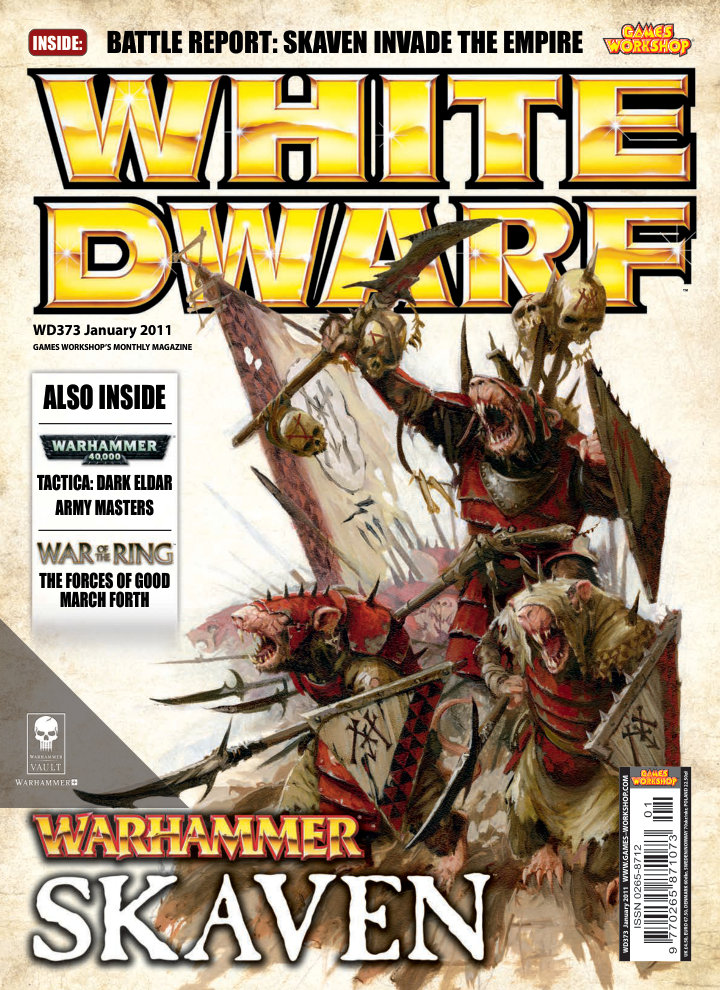
EditorialWD 373 · Inside cover
Andrew Kenrick welcomes the Skaven’s new monsters and war machines as expressions of their particularly wicked blend of science and mutation. The issue’s heraldry feature has already tempted him toward Clan Septik, while the Dark Eldar return with a Wych Cult showcase and tactics. Middle-earth’s Free Peoples and expanded building rules provide other ways into the month’s hobby projects.
Warhammer Fantasy BattlesWarhammer 40,000
CommunityWD 373 · pp. 12–15
The studio begins preparing a Third War for Armageddon Planetary Empires campaign, restricting armies to forces present in the original conflict and considering specialised city and jungle battles. Dave Thomas’s bearded Skaven Warlord is revealed as the year’s Games Day model, while other news introduces Blood Bowl’s expanded computer edition and flexible Warhammer Fantasy Roleplay guides. The website preview points toward Skaven collecting, magic, painting and community submissions.
Warhammer 40,000Warhammer Fantasy Battles
InterviewWD 373 · pp. 16–27
Adam Troke asks Jeremy Vetock and Seb Perbet how the Skaven’s malicious humour, expendable hordes and extraordinary weapons shaped the army’s development. Jeremy explains the relationship between cheap troops and unreliable specialist threats, while Seb traces his sculpting from the original range’s imagery to Stormvermin, the Screaming Bell and flowing character silhouettes. Their discussions culminate in the Hell Pit Abomination’s tortured, regenerating body and the larger dual-purpose war-machine kit, showing how rules, horror references and collaboration brought the new releases together.
Warhammer Fantasy BattlesSkaven
LoreWD 373 · pp. 26–27
Warlord Sleekfur volunteers for raids that other clan leaders shun, intending to turn the Council’s diversion into personal wealth and slaves. His troops burn settlements and use the Warp Lightning Cannon to break a defending lord, but Grey Seer Greysore and the appearance of Deathmaster Snikch prevent an early retreat with the spoils. The arrival of Bretonnian knights forces another battle, and the accompanying 2,996-point army gives the story’s named regiments and machines a tabletop form.
Warhammer Fantasy BattlesSkaven
TacticsWD 373 · pp. 30–35
Phil Kelly recommends using Dark Eldar speed to choose favourable fights and deny retaliation, rather than simply racing straight into the opposing army. Raiders, deliberate vehicle screens and webway portals deliver specialised units where they belong; pain tokens then reward finishing weakened targets and can protect a unit before a counterattack lands. He explains why ending combat in the enemy turn is often safer than an immediate wipeout, and distinguishes the movement, equipment and escape tactics that make Reavers and Hellions effective.
Warhammer 40,000Dark Eldar
RulesWD 373 · pp. 38–43
Jervis Johnson and Mat Ward explain how large structures can be divided into adjacent sections, each garrisoned and assaulted as its own building. Optional movement and attacks between sections prevent the awkward need to leave a building simply to reach its next room, while careful agreement about line of sight and adjacency keeps complicated layouts manageable. Fortified-manor and tower examples add distinct magical properties, demonstrating how architecture can become a layered objective rather than a single generic box.
Warhammer Fantasy Battles
RulesWD 373 · p. 42
The manor is divided into Great Hall, Tower, Courtyard and Outhouse, with specific connections controlling movement and assaults. Suggested properties give each area a role, from a defensive courtyard to a wizard’s tower or a lone character’s last refuge. An alternate Vampire Counts version replaces those effects with blood-slick halls, ghostly walls, unsettling corpses and riddling spirits, showing how the same model can support a radically different setting.
Warhammer Fantasy BattlesThe Empire
RulesWD 373 · p. 43
Each of Witchfate Tor’s four floors becomes an adjacent building section whose magical effect applies only to its occupants. Suggested themes distinguish a shrine, former barracks, dungeon and magic-embossed ground floor, while an optional random table reveals an unpredictable property when troops enter. The resulting structure encourages movement between levels and gives a captured tower more internal character than a single shared terrain rule.
Warhammer Fantasy Battles
Battle reportWD 373 · pp. 46–69
Andy Hall’s 2,997-point Skaven horde attacks Christian Byrne’s 2,249-point Empire defenders in Raze and Ruin, with Ikit Claw secretly seeking the town’s meteoric-iron bell. Both Imperial artillery pieces explode immediately and the Skaven’s shooting and monsters inflict devastating losses, but the defenders kill both Abominations and nearly rout Ikit before an improbable morale result saves him. A Warlock’s teleporting attack removes the Death Wizard, and surviving rats and hordes eventually seize every building for a 5–0 victory. Extensive character backgrounds and the closing story make the result another stage in Clan Skryre’s conspiracy.
Warhammer Fantasy BattlesSkaven
LoreWD 373 · pp. 48–53
Morskittar sends Ikit Claw to recover Blüdhof’s rare meteoric bell for a weapon intended to shift power away from the Grey Seers. Kritislik’s informer Skrish tries to arrange Ikit’s death, inadvertently warning the town before the attack; a passing force of Talabheim troops then comes to its aid. Portraits of both armies give the battle its cast of rival gunners, fearful wizards, scarred soldiers, mercenaries and mutually suspicious Skaven, with small bespoke rules reflecting several of their personalities.
Warhammer Fantasy BattlesSkaven
EditorialWD 373 · pp. 70–71
A visit to the Citadel Miniatures Hall prompts Jervis Johnson to trace painting’s development from block-coloured enamels to water-thinned acrylics, layered highlights and scenic bases. He credits the ’Eavy Metal team and published guides with spreading techniques, then considers how Foundation paints and washes improved ordinary army painting. Aly Morrison’s continued experiments illustrate the practical lesson: keep learning and choose methods that serve the desired effect rather than treating one approach as final.
1 paint colour
TacticsWD 373 · pp. 72–77
Andrew Kenrick gathers enthusiastic studio collectors to introduce War of the Ring’s Good armies and the different pleasures of building them. Rohan’s cavalry, versatile Gondor, elite Elves and resilient Dwarf kinbands offer contrasting approaches, while Forgotten Kingdoms allies add iconic heroes and capabilities a main army may lack. Each contribution connects the setting’s appeal to a practical starting collection and a few important battlefield strengths and limitations.
War of the RingRohan
TacticsWD 373 · p. 73
Andrew Kenrick recommends beginning with several Riders of Rohan sets and favourite heroes, then adding infantry and elite cavalry as the army’s needs become clear. On the battlefield the Rohirrim harry and weaken the enemy before delivering a decisive charge, while infantry support and seize objectives behind them. Théoden’s inspirational role and Éomer’s combat ability make the great heroes part of both the army’s narrative appeal and its tactics.
War of the RingRohan
TacticsWD 373 · p. 74
Chris Peach presents Gondor and Arnor as a versatile force of well-equipped infantry, cavalry and powerful heroes that nevertheless often fights outnumbered. Rangers reduce enemy formations while mounted units protect the flanks, and leaders improve resilience or supply decisive combat power. His starting collection builds a substantial Minas Tirith core, then adds Rangers, a chosen cavalry type and the economical support of Faramir.
War of the RingGondor
TacticsWD 373 · p. 75
Adam Troke introduces allies whose importance exceeds their lack of a conventional kingdom or standing army: Wizards, Ents, Eagles, Hobbits and celebrated groups of companions. They can fill practical gaps, such as giving monsters to Men’s armies or magical support to Dwarves, while the Fellowship or Three Hunters can reshape a force’s narrative identity. Collectors are encouraged to add favourite figures because these choices can join any Good force.
War of the RingForgotten Kingdoms
TacticsWD 373 · p. 76
Simon Grant balances the Elves’ exceptional skill, speed, courage and Terror against the small numbers their points costs permit. Their mobility favours overwhelming isolated parts of an army rather than prolonged attrition, with armour influencing which formations can endure a harder fight. Galadhrim infantry, knights and a leader such as Haldir or Galadriel provide one starting route, while Glorfindel offers a particularly potent hunter of enemy champions.
War of the RingElven Kingdoms
TacticsWD 373 · p. 77
Adam Troke describes Dwarves as a slow but exceptionally tough infantry army that wins through skilled, enduring close combat. Several Warrior boxes create the core kinbands, with banners and captains turning them into a functional force before Rangers, artillery or armoured elites broaden its options. Balin is highlighted as a strong first leader, while the lack of cavalry and flying monsters makes careful development of the resilient battleline central to the army.
War of the RingDwarf Holds
ShowcaseWD 373 · pp. 78–83
Chris Peach’s Cult of the Red Grief fills a gap left while ’Eavy Metal concentrated on the new Kabalite range. Muted dried-blood red armour, black suits, bright blue hair and pale skin create a striking identity that carries onto the army’s airborne craft. Wych parts convert vehicle crews, Reavers and Hellions into one cult-affiliated force, while repeated but individually varied sigils distinguish transports and smaller groups. An aethersail banner and alternate Helliarchs combine visual centrepieces with useful collection choices.
Warhammer 40,000Dark Eldar4 paint colours
InterviewWD 373 · pp. 84–85
Martin Footitt nominates Brian Nelson’s Ghazghkull for its aggressive forward motion, imposing bulk and mechanically convincing mega armour. Fine rivets, wires and trophies coexist with open areas that invite checkerboards, rust and other painted detail. Brian explains his intention to create a counterpart to Yarrick without copying the earlier Ghazghkull pose, and the accompanying Ork gallery traces the progression of scale from Boy to Warboss to this exceptional warlord.
Warhammer 40,000Orks
PaintingWD 373 · pp. 86–93
Duncan Rhodes and Chad Mierzwa use Uniforms & Heraldry of the Skaven to give plastic regiments specific clan identities. Colour schemes, banners, shield runes and small physical changes translate the illustrated background into armies, from volcanic Volkn and naval clans to Albino Guard, electrical enthusiasts and plague-fanatics. The examples show why names and stories can guide practical paint choices and conversions instead of leaving a collection as an anonymous mass of rats.
Warhammer Fantasy BattlesSkaven
PaintingWD 373 · p. 87
Duncan Rhodes represents Clan Volkn’s dyed red fur with a red foundation and repeats volcanic imagery in the shields and banner. Their obsidian weapons receive a gloss finish rather than ordinary metallic paint, linking the unit’s equipment to the stone mined beneath its home. The compact example shows how a clan’s origin can guide both colour and surface texture.
Warhammer Fantasy BattlesSkaven2 paint colours
PaintingWD 373 · p. 87
The heraldry book expands Pestilens beyond its familiar dirty green robes, prompting Chad to try faded purple clothing on Plague Monks. A purple Foundation basecoat and brown wash produce the sombre, worn effect while the surrounding illustrations suggest alternative banners and regimental details. The example retains the clan’s diseased identity through treatment and imagery while varying its main colour.
Warhammer Fantasy BattlesSkaven2 paint colours
PaintingWD 373 · p. 88
Chad gives the naval rivals of Clan Skurvy dirty green robes reminiscent of rotten seaweed. Several green foundations, a brown wash and selected highlights provide a quick army-painting method, while ochre runes repeat the same identifying device on shields and the regimental banner. Their watery background therefore informs the palette as well as their heraldry.
Warhammer Fantasy BattlesSkaven5 paint colours
PaintingWD 373 · p. 89
The Council of Thirteen’s feared white-furred guards are set apart by vivid red armour. Chad builds it from a Foundation red and brighter highlight, then places a mixed black-and-brown wash in the recesses to keep its definition. Their unusual fur and elite status make them a visual sign that the Council has a particular interest in a battle’s outcome.
Warhammer Fantasy BattlesSkaven4 paint colours
ModellingWD 373 · p. 89
Duncan adapts the tunnel-fighters of Clan Gangrous by replacing their right hands with sharpened spear tips, reflecting the clan’s practice of forcing blades into amputated wrists. Repeated clan runes on shields and the banner make those bodily alterations part of a shared regimental identity. The example demonstrates how a small, systematic conversion can communicate a notably vicious piece of background.
Warhammer Fantasy BattlesSkaven
PaintingWD 373 · p. 90
Clan Ektrik’s fascination with electrical weapons appears in lightning-bolt banners and conductive bronze armour. Duncan layers dark metal through bronze to bright silver to give the armour a distinctive finish, linking its appearance to the clan’s dependence on Skryre’s Doomwheels and cannons. The accompanying background jokes that frequent static discharge keeps the warriors’ fur permanently raised.
Warhammer Fantasy BattlesSkaven3 paint colours
ModellingWD 373 · p. 90
Chad chooses raggedly clothed Clanrats for the visible front rank to convey Gristlecrack’s poorly equipped, slave-like armies. Snipped tails represent the clan’s mutilating signs of allegiance, and small robe markings reinforce their branded identity. The repeated three-clawed shield and banner device ties these deliberately humble figures into a coherent unit.
Warhammer Fantasy BattlesSkaven
ShowcaseWD 373 · p. 91
Chris Peach’s naval Skaven use small conversions to establish a collection full of mutinous maritime character. Whips keep the rats in line, lookout rats occupy banner poles and elite Stormvermin carry bright yellow cloth and scavenged firearms. These details make the clan’s fleet-based identity visible even when its army fights on land outside Marienburg.
Warhammer Fantasy BattlesSkaven
PaintingWD 373 · p. 92
Duncan gives the fanatical allies of Pestilens off-white robes specifically chosen to display their grime. A pale Foundation and white highlights receive a generous brown wash, while the Plaguevermin’s neglected armour gains brown and orange corrosion. Bright silver scratches restore the sense of recently exposed metal, contrasting filthy surroundings with blades that mysteriously never lose their edge.
Warhammer Fantasy BattlesSkaven6 paint colours
PaintingWD 373 · p. 93
The wealth of a captured Dwarf mine lets Ferrick’s warriors maintain better equipment than many rivals. Duncan expresses that distinction through bright final metallic highlights and comparatively clean armour, while both sculpted and freehand clan marks stand out on shields. The metal-sheet banner remains chipped and tarnished around its conspicuously clear runes, adding wear without losing the clan’s prosperous identity.
Warhammer Fantasy BattlesSkaven2 paint colours
ShowcaseWD 373 · pp. 96–101
A tour of the Skaven arsenal presents the visual character, battlefield purpose and modelling possibilities of its engines and weapon teams. The Screaming Bell and Plague Furnace provide towering centrepieces, the new catapult and cannon share a versatile triangular frame, and the Doomwheel turns a cage of rats into an unstable killing machine. The final weapon-team gallery ranges from subterranean drills and spinning blades to poisoned gas, volatile flame and gambling on ever more Ratling shots.
Warhammer Fantasy BattlesSkaven
ModellingWD 373 · p. 98
The Plagueclaw’s diseased payload provides the background for a machine developed between Skryre and Pestilens. The focus then turns to Colin Grayson and Seb Perbet’s kit: its triangular frame can be assembled in three orientations, changing the weapon’s height, and the masked crew can be repositioned around it. Studio and low-profile examples show how several catapults can look distinct within one army.
Warhammer Fantasy BattlesSkaven
ModellingWD 373 · p. 99
The cannon shares the Plagueclaw kit’s adjustable frame, allowing a low, menacing studio build or Chad Mierzwa’s much taller arrangement. The article points out how barrel height changes the visible profile and potential lines of fire, while close-up photographs reveal the telescope, enchanted barrel and specialised crew. It connects the construction choices to the weapon’s identity as a dangerous but erratic warpstone engine.
Warhammer Fantasy BattlesSkaven
InterviewWD 373 · pp. 102–103
Graham McNeill and Dan Abnett discuss writing histories whose legendary outcomes are already familiar but whose lived details remain uncertain. McNeill’s Sigmar story grows from one planned book into a trilogy shaped around stages of life, while Abnett describes reverse-engineering the Imperium for Prospero Burns and discovering institutions too young to possess their later traditions. Both find creative freedom in the gaps, balanced by the need for new stories to fit the world readers know.
Warhammer Fantasy BattlesThe Horus HeresyThe Empire