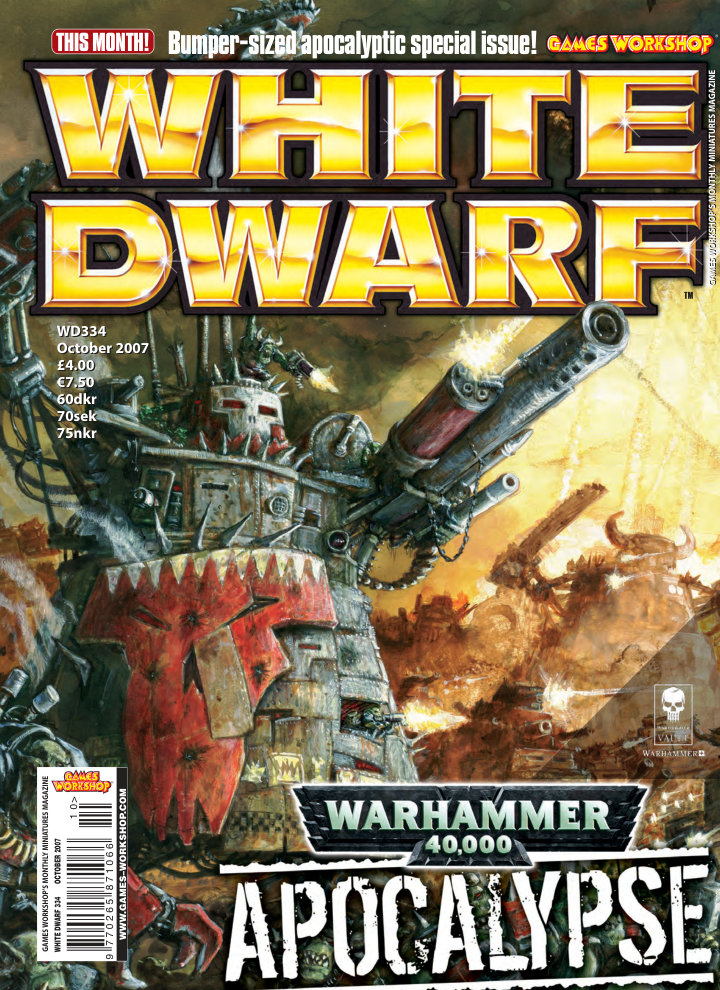
EditorialWD 334 · p. 2
Grombrindal welcomes Apocalypse as a way to place whole collections on the battlefield without ordinary army limits. A foldout photograph introduces the scale of the spectacle, while the issue’s enormous Studio battle shows what happens when friends combine their armies. The Baneblade, formation design and practical modelling coverage connect that grand ambition with projects collectors can attempt themselves, alongside painting and cavalry tactics for the other games.
Warhammer 40,000
CommunityWD 334 · p. 35
Rick Priestley outlines a planned reorganisation of mail order around complete miniatures, identifiable individual models and a new range of conversion components. Clearing older stock and temporarily removing the existing component service will make room for that restructuring, while popular classics and useful parts may return in new forms. The account records a significant change for collectors who rely on discontinued figures and individual bits, including the distinction between those changes and the largely continuing Specialist Games ranges.
CommunityWD 334 · p. 36
The returning board game sends two to six adventurers through increasingly dangerous regions in search of the Crown of Command. Characters must build strength, craft and endurance before entering the inner region, with a Talisman needed to cross the Valley of Fire. The preview explains how accumulating advantages through encounters prepares a character for the final struggle, placing the familiar quest structure at the centre of the game’s revival.
Talisman
InterviewWD 334 · pp. 40–63
Jervis Johnson explains how removing conventional army limits makes room for entire collections, super-heavy machines and unusually ambitious multiplayer battles. Timed deployment, strategic assets and formation datasheets address the practical demands of that scale without replacing the core game. Interviews, vehicle examples and two expanded armies show the design extending beyond rules into collecting and scenery. Its central aim is to give players permission and tools to stage the vast conflicts described in the setting.
Warhammer 40,000Space Marines
RulesWD 334 · p. 44
The Chapter’s senior commanders bring different strategic resources to a shared command formation. A Chapter Master, four Company Masters and a supporting squad unlock once-per-game assets corresponding to reconnaissance, precision fire, orbital support and raiding. Descriptions of the commanders’ equipment connect each battlefield role to his wider responsibilities, from training neophytes to guarding the fortress or directing the fleet.
Warhammer 40,000Space Marines
RulesWD 334 · p. 45
Three or more Vindicators can combine their fire into one exceptionally large demolisher barrage rather than firing separately. The attack can destroy the terrain beneath its impact, harming occupants and potentially pinning survivors, with additional tanks improving the chance of demolishing the feature. The rule gives a familiar siege vehicle a formation role suited to Apocalypse’s massive battlefields, where removing an entire defended position can reshape the fight.
Warhammer 40,000Space Marines
ModellingWD 334 · pp. 45–47
An annotated vehicle and component keys explain the Vindicator’s siege cannon, protective dozer blade, loading crane and supporting systems. A short history traces the design to converted Rhinos used by the Ultramarines during the Horus Heresy, before the demolisher-armed version became widespread. The detailed plastic breakdown helps modellers identify the new tank’s characteristic parts and understand why its compact chassis is built around clearing fortified urban positions.
Warhammer 40,000Space Marines
InterviewWD 334 · pp. 48–51
The feature examines the Baneblade as both a ten-crew battlefield behemoth and a major advance in plastic miniature production. Tim Adcock explains the balance between functional tank design and restrained Gothic details, plus the technology that made the enormous kit possible. Annotated photographs identify weapons, crew positions and optional fittings, while background distinguishes carefully recorded original STC vehicles from inferior copies. Regimental colours and kill markings give each example a particular service identity.
Warhammer 40,000Imperial Guard
RulesWD 334 · p. 48
Two weapon references distinguish the Baneblade’s long-ranged blast from the Hellhammer’s shorter-ranged, more powerful attack that denies cover. A co-axial autocannon can help either primary weapon correct its aim when its preliminary fire hits the target. The comparison makes the choice between wide battlefield reach and close support in dense terrain explicit, rather than treating the alternative turrets as purely cosmetic options.
Warhammer 40,000Imperial Guard
ModellingWD 334 · pp. 52–53
The Baneblade chassis becomes a Hellhammer, Yarrick’s Fortress of Arrogance, a Plaguereaper and an Ork Skullhamma through different conversion approaches. Plasticard and city components build Yarrick’s pulpit, masking tape and putty swell the pus cannon, and container lids form the plague vats. The Skullhamma uses tubes, wire and heavy riveted plates to replace Imperial restraint with Ork excess. Each example develops the vehicle’s identity through its silhouette and most recognisable details.
Warhammer 40,000Imperial Guard1 paint colour
InterviewWD 334 · pp. 54–57
Graham Davey describes coordinating a project whose rules, background, painting, scenery and photography came from many different Studio teams. Datasheets explain how armies operate on a much larger scale, while new presentation ideas communicate events such as a growing Waaagh! or an awakening tomb world. He also discusses Destroyer weapons, flying machines and manageable three-thousand-point games, showing how the book’s largest spectacles can inspire smaller groups of collectors.
Warhammer 40,000
RulesWD 334 · p. 55
The complete three-hundred-point datasheet turns a Land Raider into a dedicated anti-armour gun platform by replacing passenger capacity with a large battery of lascannons. Heavy protection and the machine spirit support its role against enormous targets, but a sufficiently poor volley can trigger a power surge that penetrates the tank itself. The background presents that dangerous concentration of weaponry as an exceptional response to enemy Titans and other massive war engines.
Warhammer 40,000Space Marines
TacticsWD 334 · pp. 58–61
Andy Hoare starts with conventional two-thousand-point forces and adds formations that change their scale and battlefield options. Ultramarines gain long-range suppression and a Land Raider spearhead, while a Saim-Hann army expands its existing mobility into a vast Wind Rider Host. The examples show that an Apocalypse collection can grow from familiar troops and vehicles, with formation benefits giving those additions a purpose beyond simply increasing the points total.
Warhammer 40,000Ultramarines
TacticsWD 334 · pp. 58–59
A balanced core contains infantry, scouts, assault troops, Dreadnoughts and several kinds of supporting firepower. Apocalypse additions bring a Suppression Force and an Armoured Spearhead, combining Whirlwinds and a spotting Land Speeder with heavily protected Land Raiders. The resulting 3,510-point army retains the versatility of its original force while adding the bombardment and breakthrough capability needed to influence a much larger battlefield.
Warhammer 40,000Ultramarines
TacticsWD 334 · pp. 60–61
The Eldar example begins with a varied army whose jetbikes, Shining Spears and transports can choose favourable engagements. An enormous Wind Rider Host then increases that mobility with further jetbike and Vyper squadrons under an Autarch. The commentary emphasises isolating unsupported enemies rather than meeting the whole opposing line, showing how a larger collection can intensify the established character of a craftworld force.
Warhammer 40,000Eldar
ModellingWD 334 · pp. 62–63
Large battles require room for armies, players and the equipment surrounding a game, but the battlefield need not be a simple rectangle. Joined tables, unusual shapes and even floor space can accommodate different venues, with tall scenery offering both visual height and cover for large models. Scratch-built objective markers and an armoured train demonstrate how themed pieces can define the setting, while agreed counts-as rules bring unusual creations into play.
Warhammer 40,000Imperium
EditorialWD 334 · pp. 66–68
Jervis argues that Apocalypse depends on a shared intention to make an enjoyable event, since its collecting freedom could otherwise be exploited into unpleasant armies. Players should discuss the theme, scenery and expectations, then judge decisions partly through the experience they offer their opponents. A reckless but memorable charge by Tigurius illustrates the point: dramatic moments and generous play can matter longer than the result, especially when many people have invested time in one large game.
Warhammer 40,000
Battle reportWD 334 · pp. 70–95
Eleven Studio commanders fight an approximately forty-two-thousand-point battle across a city, warp crater and desert approach. Chaos fills the rift with hundreds of daemons, while armoured companies trade devastating fire and an Ultramarines Battle Company arrives behind the enemy. Titan duels, aircraft and catastrophic tank explosions transform the battlefield. The Imperial Guard narrowly holds its foothold and Calgar’s warriors claim the crater, giving the Imperium a four-objective-to-two victory despite Chaos retaining the bridge and wall breach.
Warhammer 40,000Imperial Guard
RulesWD 334 · pp. 76–77
The organisers divide an L-shaped battlefield into three sectors with different missions: defending the Imperial city foothold, closing a warp rift and taking the desert bridge and wall breach. Each sector receives themed forces and reserves, while tunnels connect two areas. Narrative deployment replaces the usual bidding procedure, and the rift counts as two of the six objectives, making the central struggle disproportionately important to the result.
Warhammer 40,000Imperium
PaintingWD 334 · pp. 96–101
Kirsten Williams and Fil Dunn paint two mounted leaders through carefully mapped basecoats, shading washes and successive highlights. Suladan combines a pale horse, purple clothing, ornate gold and bright stones, while Boromir’s darker mount and restrained equipment reinforce Gondor’s identity. Separate banners and subassemblies preserve access to the details. The paired guides show how a consistent staged method can produce distinct characters through material choices, final accents and freehand insignia.
Middle-earth Strategy Battle GameHarad35 paint colours
PaintingWD 334 · pp. 97–99
Kirsten establishes each material with a neat base before using washes to create the first depth. Pale highlights build the horse’s white coat, while purple trousers, red sleeves, turquoise stones and warm gold give the Serpent Lord a rich palette. Fine details are reserved for the final stage, including eyes and the elaborate red-and-black banner. The guide stresses thin repeated coats and patient brush control rather than attempting the finished effect in one application.
Middle-earth Strategy Battle GameHarad30 paint colours
PaintingWD 334 · pp. 100–101
Fil completes the potentially messy metallic stages before refining the surrounding cloth and leather. A brown horse, blue-grey reins and dark red shield sit beneath bright armour and a carefully highlighted face. Pale colours define the Horn of Gondor and banner, while silver scratches add wear to the shield. The alternative arm is painted separately and can be pinned for swapping, preserving both a clean finish and a useful choice of battlefield presentation.
Middle-earth Strategy Battle GameGondor21 paint colours
ModellingWD 334 · p. 103
The kit’s fine and coarse slate, resin details and etched brass offer different scales of battlefield debris. Brass signs, mesh and tread plates can be curled around a cylindrical handle or clipped into damaged shapes, turning flat components into convincing bent metal. The completed example combines these materials into a war-torn base, demonstrating that careful shaping matters as much as simply adding more decorative pieces.
Warhammer 40,000
ModellingWD 334 · pp. 104–107
The component key and mounting examples turn ordinary vehicles into recognisable formation commanders. Chaos gains an arcane sensor or combi-melta assembly, Eldar grav-tanks receive an advanced sensor array and Space Marine hulls carry a communication and targeting device. Tau scanner parts can be used separately or combined, while the Guard vox-caster fits several tank designs. The guide identifies suitable attachment points so the upgrades communicate command status without compromising the vehicle’s silhouette.
Warhammer 40,000Chaos Space Marines
TacticsWD 334 · pp. 110–115
Mat Ward explains how free reforms, mobile shooting and feigned flight make light horsemen valuable despite poor protection and no rank bonus. Diagrams show them trapping fleeing enemies, attacking exposed flanks, firing from outside charge arcs and drawing powerful units into unfavourable positions. The countermeasures exploit their fragility with missiles, magic or fast attackers. Contributions on Mounted Yeomen, Gyrocopters and Dire Wolves extend the principles beyond the most obvious cavalry choices.
Warhammer Fantasy BattlesBretonnia
CommunityWD 334 · p. 119
The national final brings one hundred and forty-four young players to Warhammer World after a year of club preparation and regional qualifying. Three rounds determine champions in each system, while accompanying adults join painting and scenery activities. Redcar Community College, Southend High School for Boys and John Hampden Grammar take the respective game trophies. The report links those results to the wider support stores and teachers provide for school clubs throughout the season.
Warhammer Fantasy BattlesWarhammer 40,000