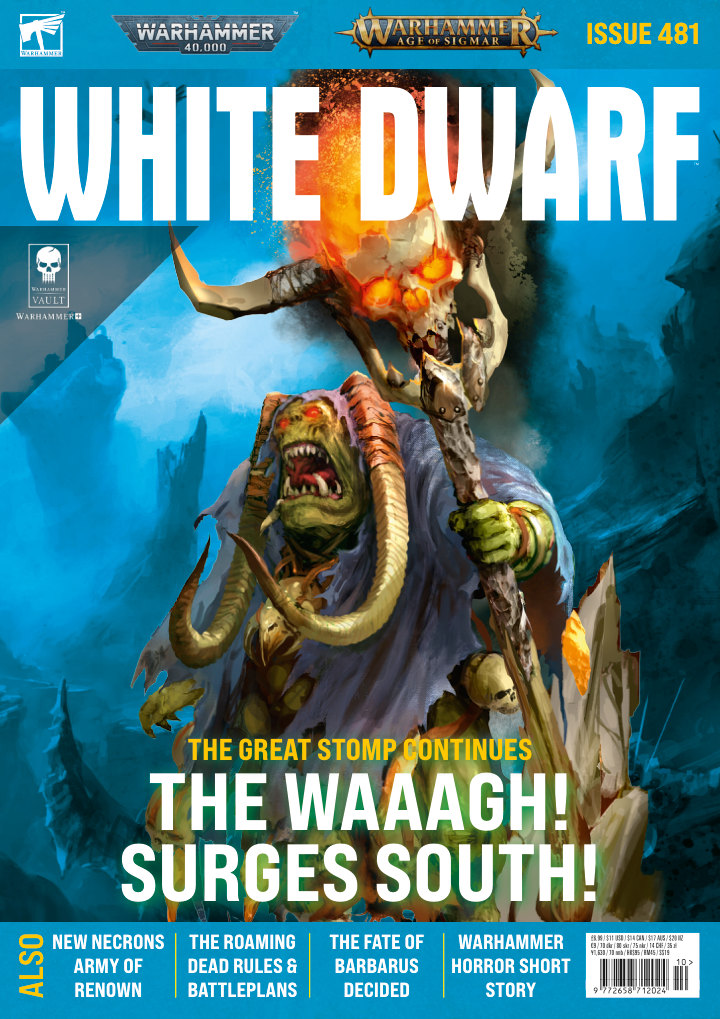
EditorialWD 481 · p. 1
Lyle Lowery introduces an October issue built around several flavours of horror, from a branching tale and automated zombie battles to Necron killing machines. The team’s Gallowdark expedition supplies another kind of darkness, while ongoing Rondhol and Barbarus features maintain the magazine’s longer campaign narratives.
CommunityWD 481 · pp. 4–9
The team supplies detailed Delaque recipes and answers a question about how the Cities of Sigmar police incompetent leaders. Reader projects include Eunice Tan’s Lileath conversion, Natalia Rodak’s characterful Mega-Gargants and a squig cake, while a letter about clearer battle reporting prompts discussion of how to balance diagrams with cinematic narrative.
Warhammer 40,000Age of Sigmar26 paint colours
LoreWD 481 · pp. 10–13
Imperial planetary classifications provide a framework for imagining varied armies and battlefields without implying that every world in a category looks alike. Agri, death, hive, shrine and feudal examples reveal enormous differences beneath bureaucratic labels, including environments that remain settled only because valuable resources or military recruitment justify their human cost.
Warhammer 40,000
LoreWD 481 · pp. 16–23
Ka-rokk’s river-borne army gathers momentum through recruitment, intimidation and cunningly planted rumours. Daggboy veterans draw gargants, subterranean grots and other monsters towards the same targets, while alliances with piratical ogors remain provisional; Brinnock and its hidden secrets become a natural focus for forces whose motives only partly coincide.
Age of SigmarIronjawz
CampaignWD 481 · pp. 24–27
The campaign recaps achievements, territory acquisition and the difference between controlling land and pillaging it before adding choke points. These strategically important sites demand victory in a specific battleplan as well as enough achievement points, preventing their special benefits from being bought without first fighting for the location.
Age of Sigmar
RulesWD 481 · p. 28
An attacker splits into vanguard and flanking contingents to breach the huge chamber beneath Brinnock while defenders hold its protected approaches. Restricted areas and controlled reinforcement entry shape the engagement, with victory depending on how many attacking units force their way deep into the defended territory by the end.
Age of Sigmar
RulesWD 481 · p. 29
A foggy, overgrown approach to Lake Retch is haunted by a roaming monster that the defender can place before deployment. Units compete for points while dealing with this additional threat, with killing the denizen offering a reward and the final margin distinguishing a hard-fought minor victory from decisive control.
Age of Sigmar
RulesWD 481 · pp. 30–35
Automated Deadwalker Zombies provide opposition for solo or cooperative games without a separate undead player. A distance-based behaviour table governs their shambling movement and sudden attacks, while replacement rules, fearless behaviour and a dedicated profile make the horde a renewable environmental threat rather than a conventional army with an independent commander.
Age of SigmarSoulblight Gravelords
RulesWD 481 · pp. 36–37
Four heroes enter Ulfenkarn to retrieve three relics from scattered mausoleums and escape through the city streets. Slain zombies return in new waves and can be drawn towards nearby trouble, forcing players to judge when to hold a route, search a building or run before the horde overwhelms the small party.
Age of SigmarDeadwalker Zombies
RulesWD 481 · pp. 38–39
A settlement’s defenders face four approaching zombie groups whose size scales with the available models and defending armies. Endless reinforcements and broken friendly units create a prolonged survival problem, with heroes able to rally their followers and the final score measuring how successfully the settlement holds out rather than merely counting enemy casualties.
Age of SigmarDeadwalker Zombies
ModellingWD 481 · pp. 40–41
Warcry’s small warbands offer extensive freedom to combine modelling ideas, colours and stories from across the Mortal Realms. The guide suggests a structured brief covering realm, quest, identity and palette, using the Hammers of Mithraxes to show how background can explain the appearance of individual fighters and tie the group together.
Warcry
ShowcaseWD 481 · p. 42
Chris imagines a mixed tribal force fighting for Sigmar against Chaos, converting a supposed unarmoured Stormcast leader and adapting aelves with Escher parts. Red clothes, brilliant green hair and brown lining identify the warband, demonstrating how an established collection’s narrative can be expressed through unexpected combinations of models.
WarcryCities of Sigmar8 paint colours
ShowcaseWD 481 · p. 42
Chris gives the Daughters of Khaine an unusually light appearance through white clothing, pale skin, blonde hair and teal robes. Swapped aelven heads and weapons add individuality, while diluted Contrast colours establish a fast cohesive method that deliberately departs from the faction’s more familiar dark schemes.
WarcryDaughters of Khaine9 paint colours
ShowcaseWD 481 · p. 43
Chris treats the Carngrad pit fighters as individuals with mismatched armour and weapons, retaining signs of their different origins. Burgundy leather, repeated red sigils and common bases then unify the varied equipment, with a pale skin recipe keeping the fighters legible beneath their contrasting metals.
WarcrySpire Tyrants5 paint colours
ShowcaseWD 481 · p. 44
Steve’s Bloodplates cover their armour in the blood of defeated enemies. Contrast paints over pale skin and metallic armour make the scheme quick to repeat, while verdigris provides a cool counterpoint to the red and extends the unsettling visual story beyond the warband’s name.
WarcryIron Golems5 paint colours
ShowcaseWD 481 · p. 44
Steve pairs rich green robes with warm gold and weapons painted as reflective green-black obsidian. Smooth transitions across blade surfaces suggest directed light, while a controlled common palette gives the elegant fighters a unified appearance despite the different proportions of armour, cloth and skin on each sculpt.
WarcryCypher Lords7 paint colours
ShowcaseWD 481 · p. 45
Maxime uses Cursed City models to start a larger undead collection through manageable campaign painting. Dirty cloth and black armour emerge from pale undercoats, Contrast washes and drybrushing, with artists’ inks adding shading and weathering to create a deliberately worn force rather than pristine rank-and-file figures.
WarcrySoulblight Gravelords6 paint colours
ShowcaseWD 481 · p. 46
Ashley imagines an enclave beneath an ice-covered sea, painting white outer robes and deep blue interiors to echo the surface and hidden water. Pale skin and a glossy beach-sand base reinforce the cold aquatic setting, showing how a simple environmental idea can control the appearance of an entire warband.
WarcryIdoneth Deepkin9 paint colours
ShowcaseWD 481 · p. 47
John chooses a cool near-monochrome scheme based on an early Iron Golem test palette. Pale grey skin and black armour receive a deliberately warm brass accent, with Contrast shading over metal and a bright final highlight preserving the equipment’s sheen without breaking the overall restrained appearance.
WarcryIron Golems9 paint colours
ShowcaseWD 481 · p. 47
Carlos begins the project before Skaven have their own Warcry rules and represents the ratmen as the Unmade instead. Stormvermin and Clanrat bodies combine with the human warband’s limbs and equipment, while vivid blue and yellow clothing ties together the different ranks of converted fighters.
WarcrySkaven5 paint colours
ShowcaseWD 481 · p. 48
Ben uses dirty dark colours to express the Scions’ malice, with green cloth recalling the drakes they hunt and consume. A shared brown shade unifies materials and a separate brass recipe defines the armour, keeping the force cohesive while leaving the flame cult’s personal interpretation visible.
WarcryScions of the Flame7 paint colours
ShowcaseWD 481 · p. 48
Steve expands the Bloodplates’ world with a band of Furies and Raptoryx that appear to have been broken and tamed by the warband. Contrast paints establish flesh, wings and crests quickly, while additional green, purple and blue tints enrich darker areas without losing their sinister animal character.
WarcryChaotic Beasts8 paint colours
ShowcaseWD 481 · p. 49
Jes’s favourite warband uses the crow motif as a creepy, coherent expression of Chaos. Single Contrast coats over a pale undercoat receive selective highlights on skin, cloth and feathers, and a Mindstealer Sphiranx adds both a centrepiece and the suggestion that the fighters’ companion may eventually become their predator.
WarcryCorvus Cabal6 paint colours
ShowcaseWD 481 · p. 50
Steve heavily converts the warband from several Seraphon and other kits, reshaping Blood Bowl saurus and adding new scales where clothing once sat. Bow-armed skinks, a repositioned Terradon and feathered Cold Ones expand the group’s variety, while different skin recipes keep the creatures distinct within the same collection.
WarcrySeraphon14 paint colours
ShowcaseWD 481 · p. 50
Ashley pictures trees surviving in Chamon’s bleached alchemical wastelands, using white bark, black heartwood and a powerful copper-sulphate blue accent. The unusual appearance grows from a specific setting idea, while concise recipes show how to retain clear pale and dark wood surfaces beneath the fantastic coloration.
WarcrySylvaneth8 paint colours
ShowcaseWD 481 · p. 50
Phil paints his Scions and their Fomoroid ally mainly with Contrast colours and a few metallics. Warm red and yellow clothing and armour meet grey cloaks suggesting ash or cooled lava, while yellow-green alchemical flames become an intentionally unnatural focal accent across the warband.
WarcryScions of the Flame8 paint colours
ModellingWD 481 · pp. 52–53
Mark Bedford builds a modular hot desert battlefield with cork strata, foam rocks and Ghurish terrain. Rearrangeable halves give eight configurations, green acrylic-gel pools provide colour and depth, and adapted walkways, hanging cages and numerous skulls make the smaller scenery tell stories around the fleshy red trees.
Warcry1 paint colour
PaintingWD 481 · pp. 54–55
Nyle Ajina uses purple trees, green stone and warm sepia details to make eye-catching scenery achievable with sprays, washes and drybrushing. Subassemblies improve access, shared colours reduce work and ordering the drybrushing helps hide mistakes, while separate recipes cover bone, earth, marshwood and the unnatural gnarloaks.
Warcry14 paint colours
PaintingWD 481 · p. 55
A six-stage alternative paints a tree with drybrushed texture before a deep red Contrast coat and glossy finish make it appear wet and fleshy. Bone, earth, ropes and metal receive simple supporting colours, creating a disturbing focal piece from an efficient process suited to repeating across a battlefield.
Warcry11 paint colours
LoreWD 481 · pp. 56–57
Be’lakor’s followers recruit, indoctrinate and send black-hearted cohorts into the Gnarlwood in pursuit of Seraphon secrets. The background distinguishes this shadowy movement from a unified Chaos army, explaining the Centaurion Marshals and the Dark Master’s ambitions before the new quests develop his servants’ specific goals.
WarcryChaos Legionnaires
CampaignWD 481 · p. 58
A Chaos Legionnaires cohort searches for celestial treasures that can win Be’lakor’s favour. Progress towards a chosen artefact comes through the quest framework, and the Perfidious Treasures table supplies rewards whose deceitful or disruptive effects make the prize part of the warband’s particular service to the Dark Master.
WarcryChaos Legionnaires
CampaignWD 481 · p. 59
A Decuriarch wins distinction by impressing other warriors and drawing recruits towards Be’lakor. Completing the quest grants a heroic trait from a specialised table, with options ranging from greater martial lethality to a supernatural brand that improves the leader’s chances during the dangerous aftermath sequence.
WarcryChaos Legionnaires
CampaignWD 481 · p. 60
A Centaurion Marshal offers aid only after the cohort proves itself through a sufficiently impressive tally of victims. The quest leads into a dedicated confrontation whose head-count scoring tests the warband’s offensive commitment, turning a potential ally into a reward earned through the violence demanded by the Dark Creed.
WarcryChaos Legionnaires
RulesWD 481 · pp. 61–63
A new encampment lets a successful cohort attract a Centaurion Marshal and improve the renown prospects of its heroes. Name, origin and leader-background tables then give the warriors identities beyond their profiles, including coerced converts, secret agents and champions whose loyalty to Be’lakor conceals additional ambitions.
WarcryChaos Legionnaires
InterviewWD 481 · pp. 64–67
Maxime Pastourel explains a warband shaped by its swamp environment, with soaked clothing, scavenged wood and stilts determining the models’ forms. Fish skeletons, potion racks and Nurgle’s gifts combine noble hints with rot, while individual fighter commentary shows how practical survival and religious corruption meet in the sculpted details.
WarcryRotmire Creed
InterviewWD 481 · pp. 68–69
Aly Morrison gives Hashut’s human servants an industrial, militaristic identity built from protective forge clothing, repeated patterns and blunt crushing tools. Bull imagery, heavy chains and the flamehurler connect the destroyers to their patron, while the poorly equipped Shatterers show the coercive hierarchy beneath the armoured leaders.
WarcryHorns of Hashut
InterviewWD 481 · pp. 70–73
Ray Dranfield explains designing terrain that looks partly plant and partly predatory animal while remaining durable and playable. Elbow-shaped branches, finger-like roots and trapped bones make the trees unsettling, while marshwood platforms, a huge skull watchtower and fragments of Talaxis provide distinct routes, scales and narrative focal points.
Warcry
LoreWD 481 · pp. 76–85
Imperial forces build an aggressive defensive network to protect a desperate psychic message from Cherrist. Imperial Fists fortify gains while Black Templars strike outward, but Necron pressure repeatedly defeats local successes; the final communiqué reaches Guilliman and prompts him to turn towards the Nephilim Sub-sector, giving the costly ritual its wider significance.
Warhammer 40,000Imperial Fists
RulesWD 481 · pp. 86–91
A Necron Army of Renown concentrates on Destroyers and Flayed Ones, exchanging ordinary dynastic flexibility for specialised extermination benefits. Its roster restrictions, attack bonuses, warlord trait, relics and secretly ordered annihilation protocols reward the destruction of weakened enemies, while new stratagems extend the killing machines’ speed, resilience and battlefield control.
Warhammer 40,000Necrons
CampaignWD 481 · pp. 92–93
The five staff teams leave their planetary killzones for a mapped expedition inside the Gallowdark. Existing operatives and histories carry forward into new resource gathering and close-quarter missions, with early games already causing losses and demonstrating that narrow rooms and doors alter tactics even for experienced campaign fighters.
Kill Team
CampaignWD 481 · pp. 94–95
Lyle’s Kommandos adapt quickly to the Gallowdark and narrowly beat Matt’s Warpcoven 12–11 through a late scoring opportunity. His scenery method uses grey sprays, drybrushing and stencilled hazard stripes to prepare many walls efficiently, while the expedition ledger records the team’s first salvage gains and supporting assets.
Kill TeamOrk Kommandos1 paint colour
CampaignWD 481 · pp. 96–97
Sophie’s Harlequins lose their familiar flying movement and vantage points but gain new opportunities through the Guard action. Doors and tight corridors complicate a game against Lyle, with improved scoring and surviving operatives providing encouragement even as her troupe learns a different style of spatial control.
Kill TeamHarlequins
CampaignWD 481 · pp. 98–99
Matt completes his final planet-side Spec Op before taking the Warpcoven into space. Sorcerers and a warpflamer exploit the cramped interior, while extra Tzaangors give him more melee options; the updated roster shows how narrative advancement and new models reinforce one another during the move to a fresh campaign format.
Kill TeamThousand Sons
CampaignWD 481 · pp. 100–101
Ben enjoys close-quarter missions despite losing his sniper’s favoured perches and adds two tougher combat specialists. Kitbashed Ace and Spades express their complementary characters, while an unsuccessful dramatic entrance against the T’au illustrates how Guard attacks can punish a charging officer before his intended duel begins.
Kill TeamAstra Militarum
CampaignWD 481 · pp. 102–103
Dan’s Pathfinders reach the hulk with their Spec Op unfinished and quickly suffer their first permanent casualty. A Blooded operative turns the initial fight against Ben after early setbacks, while newly painted Kroot offer an alternative for close combat and additional pale walls expand the team’s developing space-hulk setting.
Kill TeamT’au Empire
Battle reportWD 481 · pp. 104–117
The concluding turns bring chemical detonations, brutal attrition and concentrated Traitor fire against the two Loyalist Primarchs. Russ survives on a single wound and joins the Lion in clearing the bastion’s approach; despite pockets of Iron Warriors resistance, the Loyalists win 20–6, with the players’ reflections highlighting reactions, target priorities and the psychological impact of Primarchs.
The Horus HeresyDark Angels
LoreWD 481 · pp. 118–121
A historical account turns the tabletop battle into a record of the Lion’s campaign of vengeance. Fighting around the crash site, bastion and void shield echoes the report’s decisive incidents, then broadens into planetary destruction as surviving defenders and attackers withdraw, leaving the shattered Death Guard home world behind the departing Loyalist fleets.
The Horus HeresyDark Angels
TacticsWD 481 · p. 122
Battle Doctrines missions isolate the tactical uses of a particular unit instead of relying on ordinary force organisation. The introduction makes the Land Raider Proteus Carrier the focus of three challenges, encouraging repeated games and swapped roles so players can explore its strengths and vulnerabilities under deliberately different battlefield conditions.
The Horus Heresy
RulesWD 481 · p. 123
A transport-led attack must cross exposed ground and deliver troops into the defender’s position. Restricted army choices and scoring for embarked assault units focus attention on the Proteus Carrier’s primary role, while the defender gains substantially from immobilising or destroying the tanks before their passengers can make decisive charges.
The Horus Heresy
RulesWD 481 · pp. 124–125
Attackers use Land Raider protection to carry infantry through a defended corridor towards safety. Dangerous ground constrains the dismounted alternative, and the final position of surviving infantry matters to scoring, testing whether the commander can exploit transport durability without mistaking the vehicle’s own survival for the whole mission.
The Horus Heresy
RulesWD 481 · pp. 126–127
An ambushed Land Raider column fights through tight terrain where close assaults can defeat even heavy armour. Infantry screens and movement around restricted approaches matter as much as guns, with a short time limit and survival-focused scoring challenging both the convoy defender and the attackers trying to destroy every carrier.
The Horus Heresy
TacticsWD 481 · pp. 128–131
Elrond’s combat skill, foresight and magic make him a versatile leader whose best use depends on supporting choices. Advice covers mounted fighting, Wrath of Bruinen, priority control, Rivendell Knights and the Vanquishers of the Necromancer, with nearby heroes and a banner helping preserve resources or improve the reliability of key actions.
Middle-earth Strategy Battle GameRivendell
FictionWD 481 · pp. 132–141
An avalanche traps Pythius among mountain ghouls, forcing him to choose between flight and an increasingly convincing disguise. Branching routes lead through corrupted villages, betrayal and the loss of his own identity, with the reader deciding how he seeks escape while every apparent solution carries the hunger and madness of the mordants closer.
Age of SigmarFlesh-eater Courts
CommunityWD 481 · pp. 142–143
The Season of Skirmish challenge encourages staff to build both a kill team and Warcry warband before joining paired campaigns. Hobby Bingo updates follow new characters, Matt’s completed Horns of Hashut, Josh’s Isengard and Ben’s named Dark Angel, with short painting and conversion notes accompanying the progress reports.
Warhammer 40,000Age of Sigmar3 paint colours
ShowcaseWD 481 · p. 144
Matt builds the Spartan around a separately painted interior and keeps the tracks off for spraying before final assembly. Sponge-applied highlights and weathering give the yellow tank a heavily used appearance, illustrating how construction planning and fast surface techniques make a large Heresy vehicle easier to finish.
The Horus HeresyImperial Fists
ShowcaseWD 481 · p. 144
Sophie recreates the Luna Wolves’ grey armour through a pale sprayed base, a light layer and a controlled white Contrast wash. Bright final highlights, a few black panels and transferred wolf emblems keep the large vehicle readable and connect it to the Legion’s identity before its later Sons of Horus colours.
The Horus HeresyLuna Wolves4 paint colours