EditorialWD 423 · p. 3
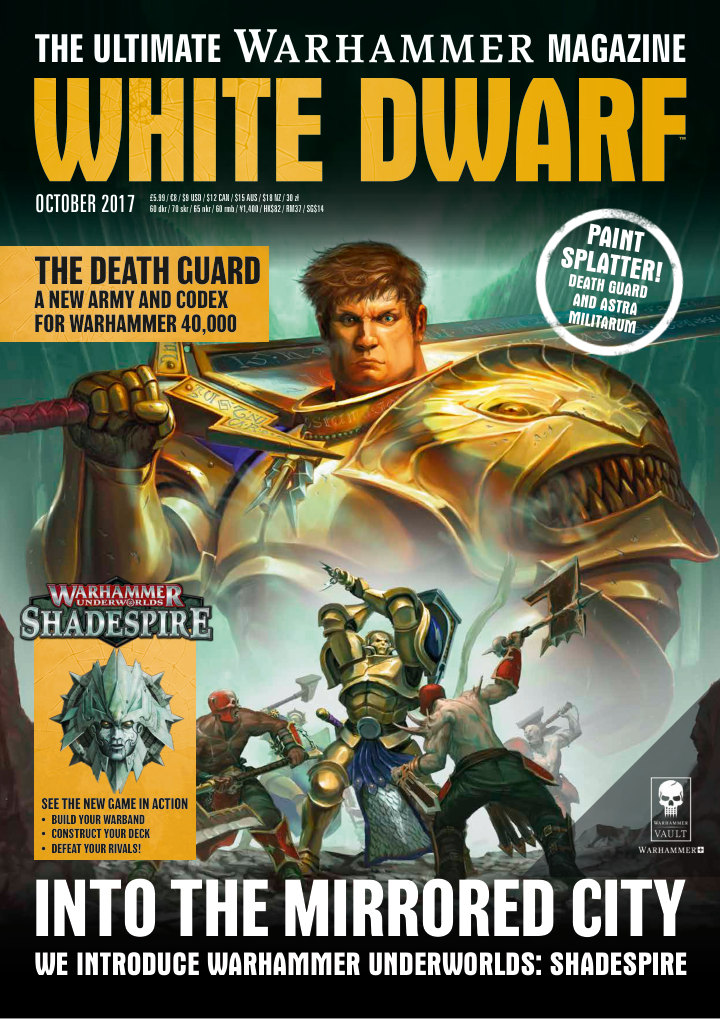
The editorial introduces Shadespire’s arena battles alongside an expanding Death Guard range. It points to design work that turns decades of plague imagery into a complete army, while the painting guides explore new characters and alternative Imperial Guard uniforms.
ShowcaseWD 423 · pp. 6–9
Nagash’s curse traps the Katophrane city between light and shadow, leaving treasure seekers caught in recurring deaths. The boxed game sets three Stormcast against five Reavers on double-sided boards, with objectives, ploys and upgrades adding hidden plans and deck construction to the contest.
Warhammer UnderworldsStormcast Eternals
ShowcaseWD 423 · p. 10
Mortarion’s executioners accompany favoured champions as both protection and a warning that their conduct is being watched. Hooded armour, manreapers, chemical weapons and plague bells combine the Legion’s ancient appearance with its corruption.
Warhammer 40,000Death Guard
ShowcaseWD 423 · p. 11
Distorted Cataphractii armour protects exceptionally resilient shock troops. Individual mutations and different axes, flails, launchers and heavy guns give the multipart unit variety while retaining a shared identity as veterans of the Long War.
Warhammer 40,000Death Guard
ShowcaseWD 423 · p. 12
Multipart infantry combine grotesque growths with the equipment and discipline of experienced soldiers. Repaired weapons, ancient armour and different infections make each warrior individual without losing the impression of a coherent military formation.
Warhammer 40,000Death Guard
ShowcaseWD 423 · p. 13
The Champion’s power fist recalls an older Death Guard miniature, while alternative parts and attendant Nurglings extend his personality. The Icon Bearer carries a distorted Legion standard that spreads despair among enemies, with makeshift repairs connecting his equipment to the army’s long service.
Warhammer 40,000Death Guard
ShowcaseWD 423 · p. 14
Mortarion’s artillery vehicle binds a Daemon into a machine that follows commands without a mortal crew’s disloyalty. Its high-arching plague mortar is supported by interchangeable hull and side weapons, suggesting several battlefield jobs within the same brutal design.
Warhammer 40,000Death Guard
ShowcaseWD 423 · p. 15
The multipart drone offers armoured, insectile and daemonic faceplates for the malign entity imprisoned inside. Plaguespitters, a heavy blight launcher and a fleshmower give the hovering chassis distinct ways to spread infection.
Warhammer 40,000Death Guard
ShowcaseWD 423 · p. 16
An incubatum tank, mechanical churn and pressure-fed sprayer make the Blightspawn a mobile producer of disease. The preview follows the apparatus and the specialist carrying it, including a Nurgling preparing a grenade.
Warhammer 40,000Death Guard
ShowcaseWD 423 · p. 17
A gaunt silhouette distinguishes the Surgeon from the swollen warriors nearby. His corrupted medical equipment nurtures diseases and harvests gene-seed from loyalist and traitor bodies, continuing the Legion’s medical traditions in a terrible form.
Warhammer 40,000Death Guard
ShowcaseWD 423 · p. 18
A rack of flasks gives the Putrifier the outline of a mechanical fly. He refines plague grenades, gathers specimens and carries an injector pistol, while the unstable collection on his back makes his own death hazardous.
Warhammer 40,000Death Guard
ShowcaseWD 423 · p. 19
Casualty lists, ammunition and the repeated number seven become religious calculations. An abacus, bone pen and assisting Nurgling express a character who finds order in pestilence and promises renewed vigour through its interpretation.
Warhammer 40,000Death Guard
ShowcaseWD 423 · p. 20
The new Typhus preserves recognisable details of the classic model with a commanding pose and optional Destroyer Hive flies. His strained relationship with Mortarion places the familiar manreaper and corrupted armour within a continuing rivalry.
Warhammer 40,000Death Guard
LoreWD 423 · p. 20
Hammerhal’s connection between realms, Alarielle’s Living City and the Changeling’s manipulation of settlements show how geography, divine patronage and Chaos plots shape life after the reconquest. The short report stresses the dangers beneath the cities’ apparent prosperity.
Age of SigmarCities of Sigmar
ShowcaseWD 423 · p. 21
The codex combines regimental doctrines, orders, psychic powers, heirlooms and stratagems with a broad set of datasheets. Super-heavy tanks join the main book, and accompanying cards gather the numerous reference rules used by Imperial commanders.
Warhammer 40,000Astra Militarum
ShowcaseWD 423 · pp. 22–23
Up to four players campaign across the Flamescar Plateau using territories, cards and new battleplans. Anvilgard, Hammerhal and Tempest’s Eye collections mix aelves, duardin, humans and Stormcast in city-specific formations, showing the variety within the reclaimed settlements.
Age of SigmarCities of Sigmar
ShowcaseWD 423 · pp. 24–25
Four double-sided folding tiles and push-fit ruins form a portable battlefield. A three-mission campaign accompanies scenery whose brown plastic matches a named Citadel colour, helping collectors expand or repaint the set.
Warhammer 40,0001 paint colour
ShowcaseWD 423 · p. 26
The Sisters of Silence gain a covert grav-transport designed to capture psykers. Distortion technology, holding cells, alternative nose assemblies and an opening iris give it a purpose beyond carrying troops, while magnet recesses simplify assembly.
The Horus HeresySisters of Silence
ShowcaseWD 423 · p. 27
The returning game descends beneath Hive Primus to gangs struggling away from the manufactorums above. Goliath and Escher models contrast chemical muscle enhancement with a female-dominated pharmaceutical culture, introducing the range through different societies.
NecromundaHouse Goliath
ShowcaseWD 423 · p. 28
Sanguinius, Guilliman and the Lion leave Imperium Secundus to cross the Ruinstorm and reach Terra. Their doubts and past mistakes complicate the supernatural barrier separating them from the wider war.
The Horus HeresyBlood Angels
ShowcaseWD 423 · p. 28
Lorgar’s early life places faith and visions within Colchis’s decaying society. Kor Phaeron’s influence and the ambitions surrounding the prophet give the Primarch’s devotion a troubled background.
The Horus HeresyWord Bearers
ShowcaseWD 423 · p. 29
Yvraine and Iyanna investigate craftworld Ziasuthra’s reappearance. Hopes of finding a missing cronesword are complicated by suspicions about its return, testing the emerging Ynnari movement.
Warhammer 40,000Ynnari
ShowcaseWD 423 · p. 29
Ultramarines, Mechanicus and Inquisition enter the space hulk Fury together. Their uneasy cooperation becomes a liability when the vessel and an unidentified enemy turn exploration into a struggle to survive.
Warhammer 40,000Ultramarines
ShowcaseWD 423 · p. 29
Yvraine and the Visarch seek an artefact on the Plague Planet, but first need the Black Library guardians’ cooperation. The audio adventure connects their new mission to the older mysteries of the webway.
Warhammer 40,000Ynnari
InterviewWD 423 · p. 29
Roberts explains how covers develop from concepts and compositions that leave room for titles into finished illustrations. He recalls The Seventh Serpent’s difficult viewpoint, The Master of Mankind’s gold, and mixed excitement and regret at approaching the Siege of Terra.
The Horus Heresy
ShowcaseWD 423 · p. 30
A free update adds a mode centred on base construction and destruction, with defensive doctrines. Elite skins and the Mortis Vale map expand its visual choices while keeping the update connected to enormous centrepiece war machines.
Warhammer 40,000
ShowcaseWD 423 · p. 31
The mobile game adds Skaven as a downloadable warband. The preview stresses the value of each fighter in the campaign and anticipates further warbands rather than treating battles as disposable encounters.
MordheimSkaven
CommunityWD 423 · pp. 34–35
Readers discuss family projects, scenery, memorable covers and access to older material. Replies celebrate a young painter’s Carnosaur, explain the focus on making new articles, and share a striking Titan from Legio Osedax.
InterviewWD 423 · p. 35
Grombrindal turns Duncan’s reputation into advice about practice, patience and thinning paint. The joke supports a practical point: time learning and applying techniques matters more than assuming better tools alone will improve a model.
InterviewWD 423 · pp. 36–39
Al Bickham and Andy Hall explain how five ritual stages give the campaign a narrative rhythm while preserving its sandbox freedom. Rival rituals invite interference and Chaos attacks, building towards an endgame instead of allowing a successful empire to coast indefinitely.
Warhammer Fantasy BattlesLizardmen
Battle reportWD 423 · pp. 40–47
Jonathan’s Stormcast face Stu’s Reavers in a worked Shadespire battle. Commentary explains board placement, objectives, activations, attacks, support, inspiration, ploys and upgrades as the players discover the value of positioning and timing.
Warhammer UnderworldsStormcast Eternals
InterviewWD 423 · pp. 50–55
Maxime Pastourel explains how the range draws on Jes Goodwin’s Plague Marines, Mark Gibbons’s illustrations and later Nurgle miniatures. Heavy armour, protective equipment and repairs preserve the Legion’s military identity beneath fungus, flies and industrial mutation.
Warhammer 40,000Death Guard
InterviewWD 423 · p. 54
Darren Latham explains the working logic behind his Foul Blightspawn. A crank drives the pistons that churn infections in the tank before they reach the sprayer, while a questing tentacle pulling a grenade pin adds a second small story to the character.
Warhammer 40,000Death Guard
InterviewWD 423 · p. 55
Gaku Matsubayashi keeps details from Jes Goodwin’s classic Typhus, including the manreaper, fly emblem, Nurgling and missing rivets. Calas Typhon’s armour supplies another link to the character’s past, while a new command pose and optional fly cloak allow different presentations.
Warhammer 40,000Death Guard
InterviewWD 423 · pp. 56–57
Andy Clark, Robin Cruddace and James Gallagher discuss the first independent Death Guard codex. Seven plague companies supply history, while resilience, mid-range fighting, bodyguards and Mortarion’s supporting abilities distinguish the army mechanically from other Chaos Marines.
Warhammer 40,000Death Guard
InterviewWD 423 · pp. 58–61
Judges and painters reflect on Golden Demon as a place for storytelling, composition and inventive treatment of Citadel worlds. Darren Latham explains how technical control supports an emotional effect, alongside memories of the competition’s early organisers.
ShowcaseWD 423 · pp. 62–63
Michał Pisarski’s Slayer Sword diorama places a kneeling vampire before a proud, apparently bored Nagash. Sculpted clothing, textured stone and controlled black, green and red colours make the hall a readable tribute to the World-that-Was.
Warhammer Fantasy BattlesDeath
ShowcaseWD 423 · p. 64
Filip Haking spends five and a half years developing a trench whose soldiers express fear, exhaustion and hope. Individual conversions, sculpted faces and scratch-built supplies give the surrounding Guardsmen as much narrative importance as the central Lamenter.
Warhammer 40,000Astra Militarum
ShowcaseWD 423 · p. 65
Kev Lawrence arranges tightly ranked Dwarfs, leaping Elves and attacking Orcs around a mountain. Treasure below the action and contrasts between ice, earth, marble, skin and fur reward close viewing while preserving the relationships between the main groups.
Middle-earth Strategy Battle GameDwarves
Battle reportWD 423 · pp. 66–75
James Ashbey’s Cadians and Maxime Corbeil’s Black Templars defend a cathedral against Chris Bilewicz’s Aeldari and Dan Harden’s Chaos forces. Limited initiative cards make the sequence of turns another resource to manage on their eight-foot battlefield.
Warhammer 40,000Astra Militarum
Battle reportWD 423 · pp. 76–89
Dan Harden’s Skaven invade Matt Hutson’s Sylvaneth woodland using their personal collections and Knife to the Heart. Weapon teams devastate early Hunters, but resurrection, forest paths and regenerating monsters repeatedly disrupt their plans.
Age of SigmarSkaven
InterviewWD 423 · pp. 90–95
Maxime Pastourel accepts a challenge to use supposedly unpromising fighters by creating a Gretchin rebellion. Gorkamorka inspires orange machinery, blue skin, elaborate conversions and Gretchingrad’s junk settlement, with generous bases and weathering unifying unrelated components.
Warhammer 40,000Gretchin
PaintingWD 423 · p. 92
A white foundation makes the machines’ orange bright before diluted red deepens the colour. Yellow and historical white pick out raised detail, providing a simple recipe behind a much more complicated collection of conversions.
Warhammer 40,000Gretchin5 paint colours
ModellingWD 423 · p. 92
An old Rhino hull, a Shadowsword cannon and Forge World ammunition become a Gretchin artillery wagon. Crew and improvised additions make the reused Imperial vehicle seem operated by small, ambitious mechanics rather than its original owners.
Warhammer 40,000Gretchin
ModellingWD 423 · p. 93
An Ork Trukk receives a Burna-bommer turret, cramped Grot cab and folding boarding planks. Extra weapons and improvised transport arrangements carry the collection’s ramshackle engineering onto a smaller vehicle.
Warhammer 40,000Gretchin
ModellingWD 423 · p. 93
Maxime revisits the first kit he designed by building five Mek Gunz for his army. One routes a shokk attack gun hose beneath its frame, reinforcing the impression of dangerous machinery barely controlled by its crew.
Warhammer 40,000Gretchin
ModellingWD 423 · p. 94
Sponged chips, scratched edges and worn rocks suggest careless Grot driving and maintenance. Weathering supports the collection’s comedy, while glowing green screens give orange machines contrasting focal points.
Warhammer 40,000Gretchin
ModellingWD 423 · p. 94
The leader combines the Red Gobbo’s revolutionary image with a false hair-squig moustache. A motorised lectern, tank-track wheels and a defeated Runtherd’s banner turn the tiny tyrant into an imposing political figure.
Warhammer 40,000Gretchin
ModellingWD 423 · p. 94
A Cairn Wraith body and concealed Grot head create an eccentric psyker with a staff assembled from junk. Killa Kan and Nob components transform the ghostly original into another odd product of the revolution.
Warhammer 40,000Gretchin
ModellingWD 423 · p. 95
A Gorkanaut becomes a pirate vessel with a sculpted hat, eye patch, cutlass and scratch-built balconies. Grot crew replace its pilot, extending the fantasy of small creatures taking over their masters’ machinery.
Warhammer 40,000Gretchin
ShowcaseWD 423 · pp. 96–103
Artists explain compositions that make Order’s armies recognisable under pressure. Bright Stormcast wedges cut through darker foes, Kharadron machinery confronts monsters, and Sylvaneth break through ice, with commentary connecting silhouettes, colour and motion to each story.
Age of SigmarStormcast Eternals
ShowcaseWD 423 · pp. 106–109
Mortuary workers, an Inquisitor’s scribal retinue and an ascetic church expand the Pilgrym’s strange Imperial society. Body horror, relics and archaic machinery support three incompatible forms of devotion, each expressed through conversions and personal histories.
Inquisitor
ModellingWD 423 · pp. 106–107
Toni Sokura’s mortuary household makes wealth from disposing of pilgrims and harvesting organs while remaining politically marginal. A mechanised patriarch, his daughter and medical servants use Scyllax parts and fantasy bodies to form a coherent procession.
Inquisitor
ModellingWD 423 · p. 108
Peter Hudson follows Inquisitor Klain Inson back into the underhive after the Daylight Wall Incident. A converted Fleetmaster, augmented interrogator and unsettling astropath surround ordinary-looking scribes whose appearance strengthens the bureaucratic character.
Inquisitor
ModellingWD 423 · p. 109
Adam, Eric and Greg Wier imagine zealots who believe torment and mutilation can release the Emperor from material existence. A tracked cardinal and sensor-equipped infiltrator combine early Citadel relics with modern parts to express their disturbing theology.
Inquisitor
ModellingWD 423 · pp. 110–115
Dan Hyams and Mick Cudworth suspend Kharadron ships and Flesh-eater Courts around an isolated tower. Reused terrain, hidden supports and a load-bearing ladder make the airborne action convincing; cold scenery and cotton clouds leave the miniatures as the main colour accents.
Age of SigmarKharadron Overlords5 paint colours
ModellingWD 423 · pp. 116–119
Phil Kelly and the miniature team connect names, origins, symbols and duties to distinctive Space Marine Chapters. Checking colours on different models, choosing practical insignia and developing a clear central idea help turn a sketch into an army that can actually be collected.
Warhammer 40,000Space Marines
ShowcaseWD 423 · p. 117
Maxime Pastourel’s sons of Dorn combine pale armour with purple, gold and religious imagery. Chaplains and pilgrim crusades supply their identity, while Roman company markings and existing components make the concept reproducible.
Warhammer 40,000Sons of the Phoenix
ShowcaseWD 423 · p. 118
Max Faleij’s Guilliman-descended Chapter guards the Nachmund Gauntlet against daemonic machines and renegade Knights. Pale green armour, black packs and white faces distinguish the collection while retaining conventional markings.
Warhammer 40,000Castellans of the Rift
ShowcaseWD 423 · p. 118
Aidan Daly develops a fleet-oriented Chapter from Talassar. Boarding warfare and planetary assaults connect its background to dark blue, copper and white armour, red markings and the naval title used by its commander.
Warhammer 40,000Void Tridents
ShowcaseWD 423 · p. 119
Darren Latham’s descendants of Corax specialise in urban warfare. Blue-grey armour and white upper surfaces form a clear silhouette, with yellow company trim and carefully placed symbols showing the scheme on a finished Marine.
Warhammer 40,000Necropolis Hawks
PaintingWD 423 · pp. 120–121
Natalie Slinn starts with green undercoat and treats armour, metals, cloth, flesh and flies as different surfaces. Layered greens and pale cloth frame the corroded body, while selective washes and highlights carry the method through horns, exposed flesh and the dark weapon.
Warhammer 40,000Death Guard32 paint colours
PaintingWD 423 · pp. 122–123
Natalie Slinn pairs pale bone armour with muted green and separate rusty mail and pitted brass. Gloss shades distinguish the metals; thin rust streaks add damage, and recipes for the Nurgling, fumes, blade and face finish the model without making every surface equally dirty.
Warhammer 40,000Death Guard36 paint colours
PaintingWD 423 · p. 122
Aidan Daly explains dots built in progressively smaller areas, with glazes available to soften transitions. Fine dots suggest material texture, while broader dry stippling gives large feathers a faster, rougher pattern.
1 paint colour
PaintingWD 423 · pp. 124–125
Paul Norton paints blue fatigues and pale armour to show how Cadian equipment supports another regiment’s identity. Recess shading keeps light panels clean, metallic icons distinguish the details, and small interruptions to markings suggest worn paint.
Warhammer 40,000Astra Militarum20 paint colours
PaintingWD 423 · pp. 126–127
Paul Norton converts a Cadian with a Genestealer Cult head, removing its alien forehead ridge. Cream outer clothing, brown fatigues and blue-green armour receive controlled recess washes, with tattoos and a bright lens reinforcing the chemically enhanced regiment’s identity.
Warhammer 40,000Astra Militarum25 paint colours
PaintingWD 423 · pp. 128–129
Paul Norton combines Cadian, Scion, Catachan and Freeguild parts into a richly dressed soldier inspired by Chris Peach’s army. Pink cloth, white finery and gold ornament contrast with lacquered black armour, while scratched leather keeps the uniform credible as field equipment.
Warhammer 40,000Astra Militarum21 paint colours
PaintingWD 423 · p. 128
Brown and bone drybrushes colour sand before a neat rim and tufts finish the bases. A texture-paint alternative offers a faster dusty result, helping three different uniforms belong to the same kind of battlefield.
Warhammer 40,000Astra Militarum6 paint colours
PaintingWD 423 · p. 128
Aidan Daly mixes black into flesh colour for facial patterns, adding more skin colour as the pattern crosses raised features. Following the underlying lighting makes decoration belong on the face instead of appearing as a flat symbol.
1 paint colour
ShowcaseWD 423 · pp. 132–133
January 1994 brings the first Space Wolves codex, Bjorn’s early model and Adeptus Arbites. The retrospective also recalls bunker rules and card scenery, Arkhan’s chariot, a naval battle and Mike McVey’s Eldar painting, connecting familiar ideas to earlier forms.
Warhammer 40,000Man O’ War
CommunityWD 423 · pp. 134–137
The gallery spans Imperial Knights, Skaven Blood Bowl players, alien characters, Custodian troops and fantasy monsters. Photography advice explains how plain backgrounds, lighting and focus help miniature painting survive reproduction.
Warhammer 40,000Age of Sigmar
ShowcaseWD 423 · p. 137
David Harper gives an Iron Lords transport grime, chipped panels and the appearance of hard use. Weathering reinforces the Chapter’s practical character while preserving the recognisable shapes and contrast of the Land Speeder Storm.
Warhammer 40,000Iron Lords
CommunityWD 423 · pp. 138–139
Allan He introduces a Chinese store painting contest. Li Wei’s Ogre wins overall, while luminous spacecraft, the Yncarne, a Necromancer and non-metallic gold on an Imperial Fist demonstrate the different approaches emerging from the local community.
CommunityWD 423 · pp. 140–144
The staff learn Shadespire, discuss Dawn of War III, remember Warhammer Fest and finish miniatures. Projects sit beside the office league’s last games, showing how borrowed models and friendly competition can launch new collections.
Warhammer 40,000Warhammer Underworlds
ShowcaseWD 423 · p. 140
A new Lieutenant gives Matt an opportunity to begin the Imperial Fists’ Fifth Company beside his existing Third Company collection. The character adds a different company identity without requiring a completely separate Chapter scheme.
Warhammer 40,000Imperial Fists
CommunityWD 423 · p. 140
Michael, Stuart, Shaun and Martyn try Shadespire while colleagues watch their first tactical experiments. Martyn’s offset board arrangement helps his Stormcast win, with the column also admitting that studying the rules beforehand contributed to the apparent beginner’s triumph.
Warhammer UnderworldsStormcast Eternals
InterviewWD 423 · p. 141
Martyn and Shaun discuss easy initial learning followed by deeper anticipation and deck construction. Their four-player games alter objectives and alliances, with weak positions sometimes benefiting when opponents focus on one another.
Warhammer Underworlds
CommunityWD 423 · p. 141
The team recalls taking new releases and hobby projects to Warhammer Fest. Public attention to preview miniatures and Golden Demon photography brings the magazine’s studio work into direct contact with the wider hobby community.
PaintingWD 423 · p. 141
Max Faleij gives a Crimson Fist two red hands to identify a veteran, adding red checks to balance the scheme. The new model demonstrates how restrained heraldic changes can make a familiar Chapter colour scheme more individual.
Warhammer 40,000Crimson Fists
Battle reportWD 423 · pp. 142–143
Final games feature withdrawing Tau battlesuits, punishing Dark Reaper shooting and failed charges. Matt finishes undefeated on twelve league points ahead of Martyn, while Jonathan, Ben and Dan reflect on close results and decisive units.
Warhammer 40,000
PaintingWD 423 · p. 144
Borrowing Tau for the office league inspires Jonathan’s own collection. Grey spray is adjusted with black and white for contrasting panels, a shared pale highlight connects them, and a yellow wash over bone makes the warmer accent colour.
Warhammer 40,000T’au Empire7 paint colours