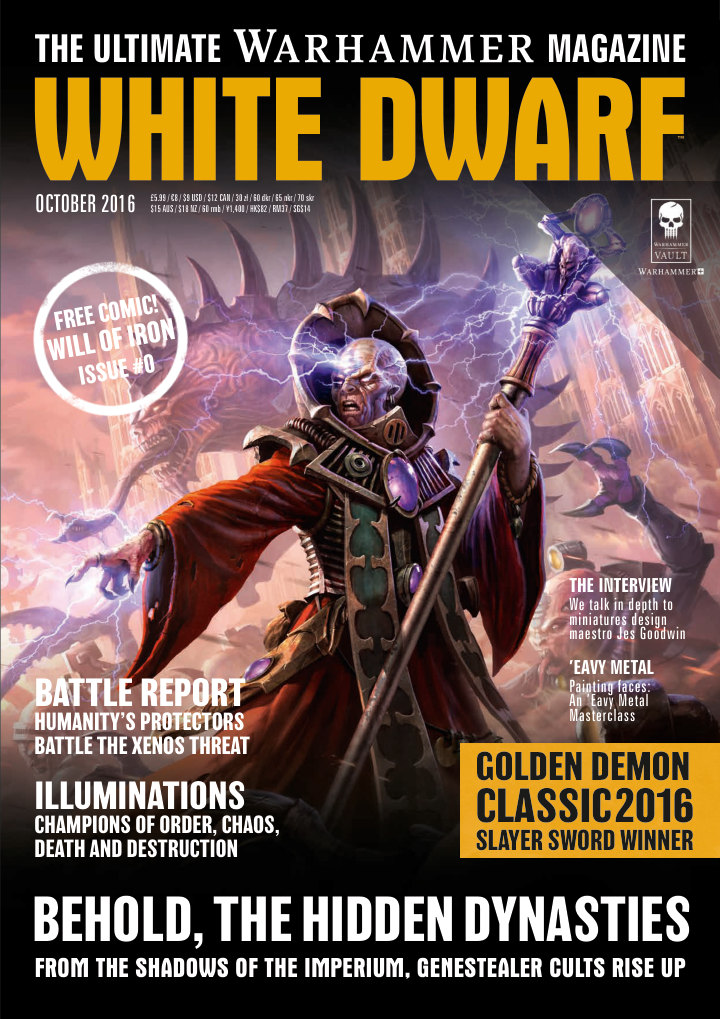
EditorialWD 411 · p. 1
The editorial marks Jes Bickham’s move from White Dwarf to the Design Studio after overseeing the monthly relaunch. His successor introduces the continuing team and highlights two much-requested additions: an interview with Jes Goodwin and the return of the ’Eavy Metal Masterclass.
ShowcaseWD 411 · pp. 4–5
Genestealer Cults return as a complete army after their appearance in Deathwatch Overkill. The introduction stresses how corrupted workers, industry and stolen weapons turn an apparently productive Imperial world into an uprising directed by an alien intelligence.
Warhammer 40,000Genestealer Cults
ShowcaseWD 411 · p. 6
The release preview introduces the Patriarch, Magus and Primus as the cult’s psychic, political and military leaders. The plastic set combines all three with familiars, while the accompanying background explains how their authority emerges as the infected population grows through successive generations.
Warhammer 40,000Genestealer Cults
ShowcaseWD 411 · p. 7
The Goliath is described as an ordinary Imperial industrial vehicle pressed into cult service. The kit can build a troop-carrying truck or a lower, heavier Rockgrinder, whose drilldozer and repurposed mining weapons make a civilian workhorse dangerous to infantry and armoured opponents.
Warhammer 40,000Genestealer Cults
ShowcaseWD 411 · pp. 8–9
Two multipart infantry sets represent the cult’s visibly monstrous early generations and its more human-looking infiltrators. Annotated models explain mining tools, scavenged weapons and environmental suits, while the Acolyte kit’s Metamorph options make its connection to Tyranid biomorphs especially apparent.
Warhammer 40,000Genestealer Cults
ShowcaseWD 411 · pp. 10–11
The Iconward carries the cult’s sacred banner into open revolt, while converted Cadian infantry show how later-generation hybrids infiltrate defence forces. Armoured Claw and Leman Russ releases add stolen transports and tanks, using the upgrade frame to mark conventional Imperial equipment as cult property.
Warhammer 40,000Genestealer Cults
ShowcaseWD 411 · p. 12
The new codex combines the brood cycle and histories of major cults with army entries, eight formations and the Broodmind psychic discipline. A companion painting book introduces the techniques needed to build a cult collection, from undercoating through final detail work.
Warhammer 40,000Genestealer Cults
ShowcaseWD 411 · p. 13
The first unhelmeted Stormcast model represents a warrior driven by vengeance or a mysterious vision rather than a directly assigned quest. The background follows the candidate’s seclusion and awakening with special armour and a rune-etched sword, introducing a Warhammer World exclusive character.
Age of SigmarStormcast Eternals
ShowcaseWD 411 · p. 14
The resin release provides Dain both on foot and riding his war boar, recalling his appearance during the Battle of the Five Armies. The notice identifies this as the first new Middle-earth miniature sculpted by the Forge World team and emphasises his hammer-wielding battlefield character.
Middle-earth Strategy Battle GameIron Hills
PaintingWD 411 · p. 14
A reformulated basing range replaces the previous grit with plastic microbeads for a more consistent texture. Larger pots and paired thick and thin formulations allow either restrained ground cover or built-up surfaces, with more detailed coverage promised for the following issue.
LoreWD 411 · p. 14
The Windlance is recalled as the weapon with which Girion loosened a scale on Smaug’s underside. The short background now places Bard at the ancient launcher in Lake-town, watching for the dragon and establishing its importance to the wider Smaug coverage.
Middle-earth Strategy Battle GameLake-town
ShowcaseWD 411 · p. 15
Titan’s ongoing comic begins with the supplied issue-zero preview and follows competing expeditions into the newly reopened Calaphrax Cluster. The introduction names Dark Angels, Inquisitor Sabbathiel and House Malorus among the major participants and introduces the writer and artists behind the series.
Warhammer 40,000Dark Angels
ShowcaseWD 411 · p. 16
David Annandale’s opening Primarchs volume reaches general hardback release, sending Guilliman and the XIII Legion against the Orks of Thoas during the Great Crusade. The notice presents the campaign as a way to explore the character behind Macragge’s battle king before the Heresy.
The Horus HeresyUltramarines
ShowcaseWD 411 · p. 17
Chris Wraight’s Primarchs novel revisits the battle of Durath, where Russ fights beside Lion El’Jonson. The preview identifies the story as an account of the rivalry’s origins rather than the fully developed hostility between their Chapters ten thousand years later.
The Horus HeresySpace Wolves
ShowcaseWD 411 · p. 17
Guy Haley’s linked tank novels follow Bannick from the war for Kalidar IV into a new rebellion in the Geratomro warzone. A Baneblade crew supports Shadowsword Titan hunters in the sequel, where unexpected allies challenge assumptions about the Imperium as well as threatening their lives.
Warhammer 40,000Astra Militarum
InterviewWD 411 · p. 17
Chris Wraight discusses writing the Lion and the Wolf before centuries of inherited enmity. He describes revisiting early sources, reconciling them with the Horus Heresy novels and contrasting the Primarchs’ philosophies, then briefly points towards a future novel about the contemporary Imperium.
The Horus HeresySpace Wolves
ShowcaseWD 411 · pp. 18–19
Repackaged Blood Angels sets add upgrade frames to common Space Marine kits, making Chapter-specific forces easier to assemble. Larger formation bundles bring Terminators, Dreadnoughts and Death Company together, and the article lists the heads, pads and symbols supplied by the upgrade sprue.
Warhammer 40,000Blood Angels
ShowcaseWD 411 · p. 19
Five spellcasting and support characters become a boxed set for Silver Tower, ranging from a Chaos Sorcerer to a Skink Starpriest. A separate physical deck gathers forty-three hero profiles previously available through the app, including these models and earlier character releases.
Warhammer Quest
CommunityWD 411 · pp. 22–23
Amy Snuggs describes overcoming doubts to enter Golden Demon, gaining finalist pins and useful feedback while trying unfamiliar techniques. Other letters request gaming content and battle reports, and a painting reply suggests a blue sequence for the Sons of the Cyclops and borrowing recipes from related models.
4 paint colours
InterviewWD 411 · pp. 24–27
George Mann explains how Will of Iron balances huge Warhammer spectacles with the limited knowledge of a Dark Angels battle-brother and the contrasting perspectives of an Inquisitor and Interrogator-Chaplain. Tazio Bettin and Enrica Angiolini describe the reference work, collaboration and visual choices that translate a script into sequential art.
Warhammer 40,000Dark Angels
InterviewWD 411 · pp. 30–33
Steve Buddle explains the collaborative sculpting and difficult mould design behind the huge Smaug model, including its treasure-covered base and the small Bilbo that establishes scale. Aidan Daly describes using film references, airbrushed foundations and extensive brush blending to reproduce the dragon’s skin, patterns and distinctive eyes.
Middle-earth Strategy Battle Game
InterviewWD 411 · pp. 34–45
Simon Grant’s Space Wolves combine named heroes, old favourites and extensive conversions into a growing saga. Regular games with a friendly rival encourage more painted units, while a muted blue-grey, bone and metal recipe and varied Great Company markings unite the collection without suppressing the individuality of its warriors.
Warhammer 40,000Space Wolves13 paint colours
LoreWD 411 · p. 41
The profile describes the Wolves’ death-world traditions, warrior bands and refusal to follow the Codex Astartes in the manner of other Chapters. Their loyalty to humanity coexists with hostility towards Imperial authorities, illustrated by the Fang, the Great Companies and the memory of the Months of Shame.
Warhammer 40,000Space Wolves
InterviewWD 411 · pp. 46–53
Jes Goodwin reflects on his early sculpting, collaboration with John Blanche and Rick Priestley, and the development of Games Workshop’s visual identities. Shared design vocabularies link Eldar, Marines, Tyranids and Mechanicus models while still allowing distinct units and exceptional characters; the discussion shows how background, colour and practical construction all influence a range.
Warhammer 40,000Age of SigmarAeldari
ShowcaseWD 411 · pp. 56–57
The retrospective revisits February 2002 through War of the Beard material, Imrik’s second miniature, Chaplain background and Dogs of War rules. It also recalls Phil Kelly’s earlier Genestealer investigation and the magazine’s unusual layout around the new Fellowship of the Ring game.
Warhammer 40,000Warhammer Fantasy Battles
ShowcaseWD 411 · pp. 58–59
Dan Harden’s orange-armoured Skryre force turns an unusual colour suggestion into a complete parade collection. Dark, glossy warpstone contrasts with the warm armour, while converted engineers, Stormfiends and a ruined citadel board reinforce his interest in the Skaven’s apocalyptic machinery.
Age of SigmarSkaven10 paint colours
ShowcaseWD 411 · pp. 60–61
Owen Patten’s apparently Khorne-aligned warriors are being manipulated by a Gaunt Summoner, giving the collection room for both gods’ followers. A floating, flame-wreathed tower anchors the display, and blue-tinted steel with carefully differentiated spot colours keeps the mixed force visually coherent.
Age of SigmarSlaves to Darkness9 paint colours
ShowcaseWD 411 · pp. 62–63
Emma Durrant imagines pale Wraith constructs defending an autumnal Maiden World. Blue blades and blank helmets become focal points against cream armour, while red accents link the army to her Harlequins; separate recipes describe simple wraithbone and the earth, rocks and trees of its display.
Warhammer 40,000Aeldari15 paint colours
ShowcaseWD 411 · pp. 64–65
Chris Bilewicz combines Ryza orange and Metalica cream in a Mechanicus army with converted Cadian allies. Shared parts make the infantry look like an indentured militia, faded blue structures contrast with the models and layered mud with cracked earth gives the whole display a dry, industrial setting.
Warhammer 40,000Adeptus Mechanicus5 paint colours
LoreWD 411 · pp. 68–73
The guide follows a cult from the first Genestealer infection through successive generations, infiltration and eventual revolt. Annotated hybrids and hazard suits show how civilian work conceals the threat, while the role of leaders, cult symbols and Tyranid attraction explain why apparent prosperity can prepare a world for destruction.
Warhammer 40,000Genestealer Cults
LoreWD 411 · p. 71
A satirical Imperial briefing classifies Purestrains, early hybrids, later infiltrators and the Patriarch through reassuring slogans and alarming instructions. Its advice to report suspicious bald personnel or infections to a Commissar exposes the gulf between official certainty and the reality of the alien threat.
Warhammer 40,000Astra Militarum
InterviewWD 411 · pp. 74–77
The miniature designers explain a civilian visual language for the cult, using functional hazard suits, old firearms and industrial tools in place of specialised military equipment. Metamorph details preserve links to Tyranids, while the anonymous wheeled Goliath and its adjustable suspension extend the idea of an ordinary Imperial vehicle subverted for rebellion.
Warhammer 40,000Genestealer Cults
ModellingWD 411 · p. 76
Chris Peach describes the mining world board built for the cult codex, where a political building has become a platform for the Magus’s speeches. Pipework in a dried riverbed and added cranes and cargo imply that the uprising is changing the city’s use as well as its rulers.
Warhammer 40,000Genestealer Cults
InterviewWD 411 · pp. 78–79
Phil Kelly and Simon Grant describe rules intended to make a fragile civilian militia win through preparation and dirty fighting. Cult Ambush and Return to the Shadows let units disappear and redeploy, while formations, leaders and stolen Imperial weapons support several different interpretations of a carefully planned uprising.
Warhammer 40,000Genestealer Cults
RulesWD 411 · pp. 80–81
This exclusive mission traps a ground convoy in a Genestealer ambush, rewarding escape as well as changing tactical objectives. Road movement, height advantage, concealed positions and an initial return-fire opportunity shape the fight, with restrictions on infiltration and flying transports preserving the intended breakout challenge.
Warhammer 40,000Genestealer Cults
Battle reportWD 411 · pp. 82–93
Dan Harden’s Deathwatch attempt to escape Erik Niemz’s Rusted Claw ambush on Cagalian IX. The Watch Master kills the Patriarch before dying to its brood, repeated cult reinforcements block the convoy and a final escape reward tips a tightly contested battle to the Deathwatch by thirteen points to twelve.
Warhammer 40,000Deathwatch
ShowcaseWD 411 · pp. 94–99
The artists behind major Age of Sigmar character images explain how colour, framing and scale establish each champion. Examples include an apocalyptic Archaon, verdant Alarielle, a soulpod-rescuing Branchwych, contrasting Ghoul King and Treelord, Gordrakk’s emerging horde and the Glottkin’s carefully simplified backdrop.
Age of SigmarSlaves to Darkness
ShowcaseWD 411 · pp. 100–105
David Soper’s Slayer Sword-winning Gutrot Spume uses octopus references, stippled armour and sea effects to create a convincing nautical Nurgle scene. Other winners demonstrate a converted Fire Sorceress, reflective Slaughterpriest, Darkoath dungeon vignette, individually textured Deathwatch and a limited-palette Megaboss.
Age of SigmarWarhammer 40,000Maggotkin of Nurgle11 paint colours
ShowcaseWD 411 · pp. 107–115
The second month requires an infantry or cavalry unit, and the collectors respond with Revenants, Blightkings, Crypt Horrors and Brutes. Their progress includes palette choices, small conversions and the first inter-warlord game, where Matt’s Sylvaneth narrowly defeat Andrew’s resilient Nurgle force before the challenge moves on to monsters.
Age of SigmarSylvaneth
PaintingWD 411 · pp. 108–109
Matt Hutson gives Tree-Revenants spring-like pale green forms and Spite-Revenants an autumnal identity while retaining the same woody bodies. A staged drybrush recipe builds warm bark, and reclaimed Wood Elf trees with diseased basing become a Wyldwood for the growing Gnarlroot collection.
Age of SigmarSylvaneth5 paint colours
PaintingWD 411 · pp. 110–111
Andrew King adds mortal Blightkings whose blue armour echoes the skin of his Daemons but whose pale human flesh keeps them distinct. A separate staged Plaguebearer recipe uses controlled grey-blue, purple and crimson washes over white, ending with a pale highlight.
Age of SigmarMaggotkin of Nurgle12 paint colours
PaintingWD 411 · pp. 112–113
James Karch turns one of six Crypt Horror models into a Courtier and experiments with glossy flesh to distinguish these monsters from his usual armoured projects. The recipe layers pale flesh over grey and a gloss wash, then adds crimson warmth, with striking bases kept subordinate to the miniature.
Age of SigmarFlesh-eater Courts5 paint colours
PaintingWD 411 · pp. 114–115
Phil Cowey uses chips, sponged blood and pale warpaint to break up blue armour and green skin on his Brutes. Brown chips with lighter lower edges suggest damaged paint, while a separate sponge sequence adds metal wear and gore with more control than flicking paint at the figure.
Age of SigmarIronjawz5 paint colours
ModellingWD 411 · pp. 116–117
The guide demonstrates how heads, icons and small accessories turn Cadians or Catachans into later-generation cult hybrids. Practical notes cover cutting fragile parts from frames first, removing mouldlines and applying glue to a recessed joint before showing an infantryman and a converted heavy-weapon team.
Warhammer 40,000Genestealer Cults
ModellingWD 411 · p. 118
A Cadian Command Squad is converted into cult infiltrators by carefully removing eagles, exchanging hands and adding Neophyte equipment. A hidden blade, altered banner and tiny icon on the commander’s cane show how comparatively small changes can tell a clear story of divided loyalty.
Warhammer 40,000Genestealer Cults
ModellingWD 411 · p. 119
Darren Latham fills a Goliath with a whole Neophyte squad poised to disembark. Kneeling heavy-weapon legs fit benches and a spotting position, reposed arms direct fire or hurl charges, and a familiar adds character to the resulting mobile vignette.
Warhammer 40,000Genestealer Cults
PaintingWD 411 · pp. 120–121
The tutorial separates an all-over layer from raised highlights and fine edge lines, then uses a Deathwatch model to demonstrate progressively brighter accents on black. Paul Norton advises broad intermediate highlights and thin flowing paint, with the brightest spots reserved for corners that suggest polished surfaces catching light.
4 paint colours
PaintingWD 411 · pp. 122–123
A complete Blood Angels recipe uses controlled red recess shading and warm highlights, with different approaches to black cloth, weapons and reflective armour. Further stages cover gold, blood-drop gems, lenses, seals and squad markings, ending with a sand base and advice on keeping yellow details consistent with the armour’s highlights.
Warhammer 40,000Blood Angels30 paint colours
PaintingWD 411 · pp. 124–125
Acolyte and later-generation hybrid recipes reproduce the Rusted Claw’s filthy orange cloth, off-white armour and alien-tainted skin. Painting shared base colours before washing saves time, while purple facial shading, red eyes and tattoos link nearly human infiltrators to their Genestealer masters; separate equipment and industrial bases complete the scheme.
Warhammer 40,000Genestealer Cults30 paint colours
PaintingWD 411 · pp. 126–129
Aidan Daly paints a Space Marine head from smooth light foundation through selective deep shading, progressively refined highlights and warm glazes. Stubble, eyes, teeth and hair add texture and expression; he explains why the finished head must be judged against the surrounding model and adjusted to retain its role as the focal point.
12 paint colours
ModellingWD 411 · pp. 130–133
Mikael Silvanto completes his trilogy of Inquisitorial retinues with the gold-lit followers of Lord Pelagius. Bespoke machines emphasise the Inquisitor’s isolation, while Orthodox icon painting and Paul Dainton’s rulebook cover inspire a metallic foundation and directional light; earlier grey and gore-red warbands reveal how the project evolved.
Warhammer 40,000Inquisition
ShowcaseWD 411 · pp. 134–138
Les Martin’s Celestial Vindicators combine precise turquoise edge highlights, pastel reds and gold with tournament-minded collecting. He explains adapting wash blending from Warhammer TV, presents a coherent family of heroes and monsters and discusses how the Stardrake, Celestant-Prime and Skyborne Slayers work together in his games.
Age of SigmarStormcast Eternals11 paint colours
CommunityWD 411 · pp. 140–143
The reader gallery includes Thorin’s company, Grey Knights, Chaos, Eldar and Stormcast alongside Imperial vehicles and an ornate Knight-Lancer. The accompanying photography advice focuses on backgrounds, lighting, angle and focus so that the images show the work invested in the models.
Warhammer 40,000Age of Sigmar
ShowcaseWD 411 · p. 143
David Taylor’s Vulkan uses deep green armour and brass details but treats many decorative elements as tanned leather, tying them to the Firedrake hide. Restricted red accents on gems, hammer and eyes concentrate attention within an otherwise natural-looking scheme.
The Horus HeresySalamanders
EditorialWD 411 · pp. 146–147
An introductory directory explains the hobby’s collecting, building, painting and gaming strands and the roles of Citadel, Forge World and Black Library. It points readers towards stores, Golden Demon, painting guides, Warhammer TV and digital publications as sources for learning more.
CommunityWD 411 · p. 148
A staff challenge asks each participant to paint a new Silver Tower hero on a Shattered Dominion base. The results range from a metallic-red Fyreslayer and a skull-headed Sorcerer to a Necromancer and Skink Starpriest, with individual conversions and colour choices carried into their next shared quest.
Warhammer Quest2 paint colours