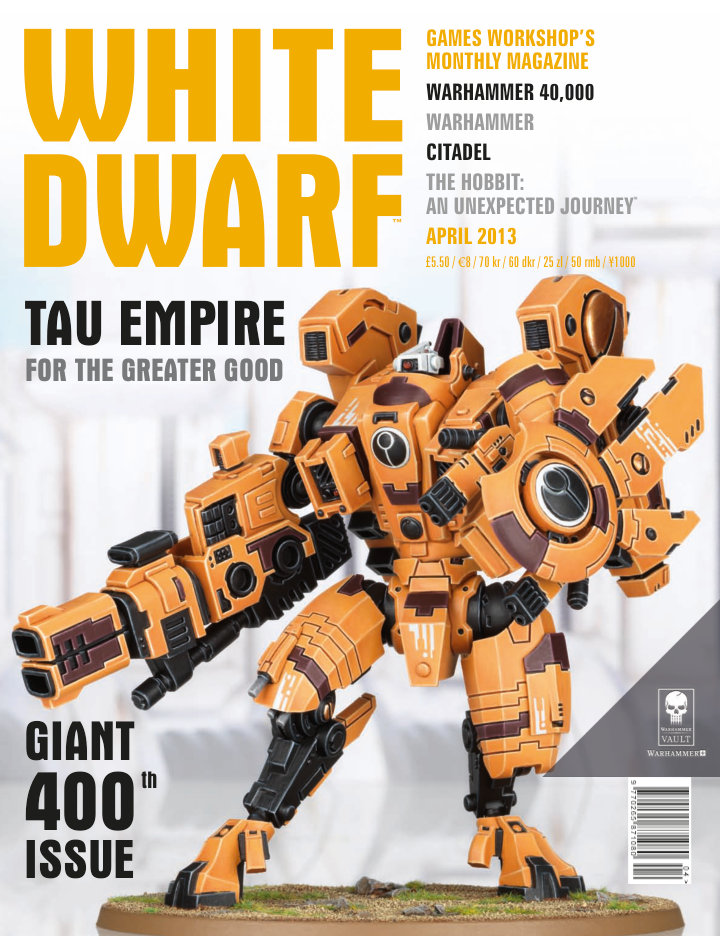
EditorialWD 400 · p. 1
Jes Bickham celebrates four hundred issues with a larger magazine and a substantial Tau release. A retrospective investigates their battlesuits, while the team builds an industrial battlefield for their first battle report. Dave Andrews, Mark Bedford and Phil Stutcinskas help complete the project within two days. Former editors’ reflections connect those current hobby projects to the magazine’s longer history.
Warhammer 40,000T’au Empire
ReviewWD 400 · pp. 6–7
The new Tau aircraft kit offers a bomber and a flexible strike fighter with a shared sleek silhouette. The Sun Shark generates pulse charges beneath its hull and can detach Interceptor Drones to defend it. The Razorshark instead uses a rotating quad ion turret and concealed wing missiles. Extended fold-out descriptions explain how these mechanisms distinguish Tau aircraft from the more conventional weapons of other armies.
Warhammer 40,000T’au Empire
ReviewWD 400 · pp. 8–11
The Riptide introduces a much larger suit without abandoning the established battlesuit family. A nova reactor, large shield and interchangeable main weapons give it a clear experimental identity. Numerous articulated joints allow varied poses, with locating pins simplifying a standard assembly. Dan recommends keeping the arms and jet pack separate during painting, and identifies compatible support systems and the accompanying Shielded Missile Drones.
Warhammer 40,000T’au Empire
ReviewWD 400 · pp. 12–13
The new Broadside adopts a heavily braced stance around a hand-held rail weapon. Hydraulic supports and substantial armour reinforce its sustained-fire role. Alternative missile fists and secondary systems allow very different weapon arrangements from the same kit. Two configurable Drones and additional support options broaden the possibilities beyond the main gun choice.
Warhammer 40,000T’au Empire
ReviewWD 400 · pp. 14–15
The Commander lands in a backward-leaning pose that suggests a sudden arrival in battle. Enforcer armour gives him a larger and more protected silhouette than a standard Crisis pilot. Weapon fittings remain compatible with the established plastic suits, allowing experimental and conventional equipment to be exchanged. Small details such as exposed hands and the bonding knife add a personal narrative to the Finecast figure.
Warhammer 40,000T’au Empire
ReviewWD 400 · pp. 16–17
Farsight’s customised battlesuit visibly separates the renegade commander from his peers. Segmented armour, a distinctive head and personal heraldry suggest equipment developed outside the normal military structure. His shield, plasma rifle and Dawn Blade create a forward-driving pose. Flowing streamers enhance that movement and provide surfaces for freehand Tau script.
Warhammer 40,000T’au Empire
ReviewWD 400 · pp. 18–19
The plastic Pathfinders combine running, kneeling and aiming poses suitable for reconnaissance troops. Compatible bodies and arms allow many combinations within the ten-model unit. Spare heads, equipment and several Drone types extend both modelling and battlefield roles. Rail and ion rifles, markerlights and a Recon Drone fitting a Devilfish cupola connect the squad to the wider Tau force.
Warhammer 40,000T’au Empire
ReviewWD 400 · pp. 20–22
Three leaders express different forms of Tau experience. The Fireblade’s armour and ritual details establish a veteran infantry commander, while Darkstrider’s analyser and reconnaissance equipment suit the Pathfinders. Longstrike instead occupies a Hammerhead turret in compact pilot armour. Each review connects pose and equipment to the character’s place in a combined-arms force.
Warhammer 40,000T’au Empire
ReviewWD 400 · p. 23
The shared gunship kit provides either a heavy battle tank or a missile-defence vehicle. A railgun or ion cannon defines the Hammerhead, while the Sky Ray carries a conspicuous seeker-missile rack and markerlights. Both retain the smooth, imposing profile associated with Tau vehicles. The notice identifies their major alternative builds without supplying a complete tactical guide.
Warhammer 40,000T’au Empire
ReviewWD 400 · pp. 24–27
Dan Harden reviews a codex whose clean page design reinforces the Tau’s unfamiliar technological culture. Jeremy Vetock expands their history through the Third Sphere and their reactions to the Imperium, Orks and Tyranids. The gallery explains camouflage, sept colours and ranks rather than presenting only one studio scheme. Extensive equipment choices and Supporting Fire link that visual variety to the army’s new tactical identity.
Warhammer 40,000T’au Empire
ReviewWD 400 · pp. 28–29
The Crisis team packages three suits with Drones and a selection of interchangeable weapons. Its multipart construction supports both standing and airborne poses. The accompanying Battleforce notice presents Fire Warriors, Stealth suits and a Piranha alongside the Crisis team as a broader foundation for the collection. Together the sets complement the new specialist releases with established elements of the army.
Warhammer 40,000T’au Empire
ReviewWD 400 · p. 30
The Finecast pair captures two travellers prepared to fight during their journey. Bilbo leaps over a broken stump with Sting drawn and provisions strapped behind him. Gandalf crouches beneath his hat with Glamdring partly unsheathed. The review suggests how those alert poses could serve both woodland scenarios and narrative dioramas.
Middle-earth Strategy Battle GameThorin’s Company
ReviewWD 400 · p. 31
Gollum sits in a fragile coracle enjoying a freshly caught fish. The sculpt contrasts his thin anatomy with an unusually delighted expression. Close views highlight the creature, boat and carefully detailed catch. The small scene presents a quieter moment from his life beneath the mountains, suitable for display as well as collecting.
Middle-earth Strategy Battle GameGollum
ReviewWD 400 · pp. 32–34
The Erebor Captain shouts orders with two axes raised, matching the equipment of his warriors. Dale’s Captain gains a heroic stance, ornamental clothing and a distinctive shield. Thrain advances under heavy armour with a large hammer, his damaged eye suggesting long experience. The three releases use facial expression and carefully matched kit to make command figures recognisable within their respective armies.
Middle-earth Strategy Battle GameErebor
ReviewWD 400 · p. 35
The hardback manual collects the expanded Hobbit game in a substantial illustrated volume. It includes film characters and the wider Lord of the Rings range, together with scenarios and hobby material. Painted models and guides support readers beginning their collections. This short overview describes the contemporary complete rules resource rather than printing additional rules of its own.
Middle-earth Strategy Battle Game
CommunityWD 400 · pp. 36–37
The anniversary merchandise feature turns Talabheim’s fictional inn into a wearable souvenir. Its emblem and menu decorate opposite sides of a shirt, with a matching printed bag. The accompanying text connects the design to the tavern’s reputation as a home for tough patrons and stories. Contemporary ordering details document a limited release tied to the four-hundredth issue.
Warhammer Fantasy Battles
ReviewWD 400 · p. 38
Andrew Kenrick examines Chris Wraight’s story of a Space Wolf returning from the Deathwatch. Ingvar’s altered perspective exposes tensions within Járnhamar pack and the uncertainty of renewed brotherhood. A Sister of Battle provides another relationship through which the Wolves’ assumptions can be tested. The review balances those character conflicts with the grotesque Nurgle enemies threatening the shrine world.
Warhammer 40,000Space Wolves
ReviewWD 400 · p. 39
Peter Fehervari’s novel follows the Arkan 19th into a jungle war entangled with treachery and competing loyalties. Adam Troke praises the uncertainty and brutality surrounding the unconventional regiment. Dan Harden reviews Braden Campbell’s Shadowsun novella for its alien perspective and close attention to Tau behaviour and equipment. Short notices alongside the reviews identify further fiction and audio releases.
Warhammer 40,000Astra Militarum
ReviewWD 400 · p. 40
The Maynarkh awakening drives a destructive campaign against the Orpheus Sector. Death Korps and Minotaurs meet the Necrons with an equally grim military response. The book combines that narrative with campaign material, unit rules and new army-list options. Colour plates and illustrated accounts give collectors reference material for the forces on both sides.
Warhammer 40,000Necrons
ReviewWD 400 · pp. 41–43
Forge World extends the Necron range with aircraft, terrain and a defensive weapon. The Night Shroud enlarges an existing flyer into an antimatter bomber. A rising tomb complex forms a board tile compatible with existing models and weapons. The Sentry Pylon’s movable mount and alternative guns offer different ways to represent ground and air defence.
Warhammer 40,000Necrons
ReviewWD 400 · p. 44
The Tau codex reaches iPad with the printed book’s contents and additional interactive galleries. White Dwarf’s digital edition likewise includes rotating release views and enlarged photography. A video battle debrief adds another contemporary extra. The notice records those formats without treating digital-only material as part of the supplied scan.
Warhammer 40,000
ReviewWD 400 · p. 45
Fantasy Flight’s supplement expands regiment creation, equipment and advanced character roles. Famous Imperial Guard formations provide additional background and ready-made identities. Sharpshooters and Breachers exemplify the more specialised careers available to players. The overview describes a resource for both the group and its gamesmaster rather than a complete adventure.
Only WarAstra Militarum
ShowcaseWD 400 · pp. 50–55
Richard Sherlock gives himself a year to build a Beastman horde after earlier Empire collecting. Moonclaw’s background provides the theme, and converted monsters supply the strongest individual projects. A Jabberslythe combines unexpectedly different kits, while boar riders serve a chariot’s role in play. Repeated banner designs, scenic bases and complementary colours keep the varied creatures recognisably part of one army.
Warhammer Fantasy BattlesBeastmen
EditorialWD 400 · pp. 56–57
An old Warhammer introduction prompts Jervis to revisit games run by an impartial third participant. A gamesmaster can create a story, choose the terrain and agree suitable house rules. Clear adjudication and friendly encouragement keep the battle moving without becoming authoritarian. This first instalment introduces the benefits, with further techniques promised for the following issue.
Battle reportWD 400 · pp. 58–75
Dan Harden’s Tau try to recover technology while Jes Bickham’s Tyranids invade the new refinery battlefield. Andrew Kenrick runs a disruptive Deathwatch force as gamesmaster, adding a third set of motives. Markerlights and coordinated shooting repeatedly kill large Tyranids, though recycling troops keep the pressure on and Shadowsun falls. Neither side secures the main recovery objective; the Tau win 3–1 through secondary achievements, with Longstrike and the Pathfinders earning particular praise.
Warhammer 40,000T’au Empire
RulesWD 400 · pp. 60–61
The Tau must recover technology from a crashed Devilfish while the Tyranids seek their complete destruction. Three lesser locations and familiar secondary objectives offer other ways to score. Destroyed Tyranid troops can return, offsetting the demanding annihilation objective. A gamesmaster-controlled Deathwatch contingent begins with the prize and can complicate both sides’ plans without claiming an ordinary victory of its own.
Warhammer 40,000T’au Empire
ShowcaseWD 400 · pp. 76–79
John Blanche develops a gang of labourers and pit slaves from combinations of Cultist, Ork and other components. They excavate archeotech beneath industrial structures, with drills, saws and small boats suggesting their working world. Mendicantus provides a preacher-like leader whose imagined role shapes the group’s identity. Names and short histories turn the converted bodies into characters rather than a set of interchangeable fighters.
Warhammer 40,000Imperium
InterviewWD 400 · pp. 80–83
Adam Troke asks Jes Goodwin how the Tau’s culture informed their original battlesuits. Ranged hunting and mobility require a different military image from existing armies. Digitigrade anatomy carries through into the suits’ stance and the imagined position of the pilot. Early sketches and the explanation of designation codes show how those practical ideas became a coherent technological family.
Warhammer 40,000T’au Empire
InterviewWD 400 · pp. 84–85
Matt Holland, Jes Goodwin and Daren Parrwood compare the roles represented by different suits. Crisis mobility, Stealth endurance and Hazard experimentation share visual relationships while serving distinct purposes. Farsight’s equipment suggests independent customisation, and Longstrike’s compact suit interfaces with a vehicle. The Broadside’s held weapon and ground-bracing supports connect its increased weight to a believable firing stance.
Warhammer 40,000T’au Empire
InterviewWD 400 · pp. 86–87
Matt Holland begins the Riptide project by asking why the Tau need a larger suit rather than simply a larger gun. Cardboard mock-ups test scale before the new concept settles into the existing battlesuit family. The pilot becomes an elite protector who can quickly reinforce a weak point and shield comrades. Risking an experimental reactor supports that narrative of service to the Greater Good as well as explaining the model’s equipment.
Warhammer 40,000T’au Empire
InterviewWD 400 · pp. 88–89
Tom Walton chooses Jes Goodwin’s mounted Lord for its powerful composition and implied violence. A triangular silhouette leads the eye towards the helmet while the immobile rider contrasts with his straining mount. Goodwin relates the model to a planned family of mounted Chaos champions. Deliberate metal textures and restrained armour detail help capture the moment just before action.
Warhammer Fantasy BattlesWarriors of Chaos
ShowcaseWD 400 · pp. 90–105
French and Italian competition winners extend the issue’s anniversary galleries. Bruno Lavallée’s Theodore Bruckner and Luciano Rosetto’s enormous Ork represent the two Slayer Sword pieces, with close views explaining fine surfaces and scenic details. A final UK diorama by Maz Wiernikowski sets a Warhound above a desperate Imperial Guard battle. The selection records artists and awards across many categories without claiming to provide paint recipes.
Warhammer Fantasy BattlesWarhammer 40,000The Empire
ModellingWD 400 · pp. 106–107
Mark Jones builds an especially extravagant walker to lead his other Ork machines. A Big Mek emerges from its top while a scratch-built shokk attack gun draws on spare Killa Kan weapons. A vacuum beneath the arms suggests the unfortunate creatures used as ammunition. Bad Moon colours support the idea that only a particularly wealthy Ork could commission the contraption.
Warhammer 40,000Orks
ModellingWD 400 · p. 108
Kornel Kozak combines Ogre, Marauder and Orc parts around a vulture-bearing Hunter. Spare Thundertusk components provide the bird and its arm as a ready-made focal point. A masked head and repositioned cavalry weapon give the figure a distinct profile. Two different banner components illustrate how straightforward combinations can create a convincing new accessory.
Warhammer Fantasy BattlesOgre Kingdoms
ModellingWD 400 · p. 109
Mark Bedford converts Librarian Turmiel into a bike-mounted psyker during a lunch break. Carefully separated head and torso sections join robed Ravenwing legs while retaining the character’s book. Small salvaged details preserve his office and chapter allegiance. A Beastman skull becomes a suitably horned Librarian emblem on the bike itself.
Warhammer 40,000Dark Angels
ModellingWD 400 · p. 110
Carl Dafforn places a spare Ghoul King above a Garden of Morr building as if leaping towards a gravedigger. Optional Vargheist wings extend the figure’s dramatic descent. Zombies occupy the interior, with removable sections preserving access for painting. The completed scene serves as both a collection display and a potential gaming objective.
Warhammer Fantasy BattlesVampire Counts
ModellingWD 400 · p. 111
Chris Innes imagines a wandering champion surviving a long devotional quest. Weapons, two shields and a heavy poncho make the figure look self-sufficient and well travelled. Parts from the mounted Lord and Skullcrushers retain a clear Khornate identity. The anniversary deadline supplies the motivation to finish a conversion planned for some time.
Warhammer Fantasy BattlesWarriors of Chaos
PaintingWD 400 · p. 112
Keith Robertson deliberately keeps the monster’s skin pale so its warpstone becomes the main focal point. Bright green stones are followed by diluted applications of similar colours on nearby flesh. That relationship suggests emitted light rather than merely contrasting decoration. The short discussion identifies the glazing medium and explains the effect’s purpose without naming the green paints.
Warhammer Fantasy BattlesSkaven1 paint colour
PaintingWD 400 · p. 113
Mark Bedford uses neutral colours to match an established Ogre collection. White warpaint and embedded gems provide the few bright points. Sponged highlights make the horns resemble hard flint or granite rather than ordinary bone. Rocks and snow complete a model initially painted for a hobby masterclass.
Warhammer Fantasy BattlesOgre Kingdoms
PaintingWD 400 · p. 114
Duncan Rhodes paints a giant spider despite his own unease around the subject. Red eyes use gem-style highlights to give the face a striking focus. A pale underside contrasts with the darker chitin. He recommends completing those hidden details before attaching the creature to its base.
Warhammer Fantasy BattlesOrcs & Goblins
PaintingWD 400 · p. 115
Dom Murray gives Otto von Stroheim a blue Griffon to match his Middenland army. The creature’s magical nature permits a colour choice beyond natural animals. A basecoat, wash and drybrush bring out the feather texture. Extra attention goes to the rider’s face, and separate painting preserves access before final assembly.
Warhammer Fantasy BattlesThe Empire
PaintingWD 400 · p. 116
Nick Bayton chooses the four-armed monster to accompany his Beastman army. Dark brown skin builds towards warmer highlights before two glazes settle the finish. The muzzle, hands and feet remain darker, and worn armour contrasts with the flesh. Existing kit details, including the statue and numerous trophies, provide enough character without extensive conversion.
Warhammer Fantasy BattlesBeastmen6 paint colours
ShowcaseWD 400 · p. 117
The new reader gallery presents two large creatures from recent painting competitions. Simon Elsen’s Hell Pit Abomination features particularly convincing gore around its mouths. Michael De Vries contributes an Arachnarok painted for an Amsterdam event. The pair demonstrates how readers’ display pieces can join the magazine’s established themed showcase.
Warhammer Fantasy BattlesSkaven
ModellingWD 400 · pp. 118–125
The White Dwarf team builds and paints an eight-section battlefield within two days. Dave Andrews, Mark Bedford and Phil Stutcinskas help turn available scenery kits into a layered industrial complex. Tall buildings, chimneys, bridges and collapsed structures create varied sightlines and room for large models. A deliberately wrecked Devilfish supplies the narrative objective, while a dirty yellow scheme makes the refinery feel like working machinery caught in a war.
Warhammer 40,000
PaintingWD 400 · pp. 126–127
Four septs demonstrate the difference between permanent identification markings and adaptable armour colours. T’au, Bork’an, N’dras and Sa’cea retain recognisable insignia across suits and infantry. Snow, urban and jungle palettes show how a force can change appearance for a battlefield without changing its home identity. Colour-reference tables provide base, highlight and undersuit choices rather than full staged recipes.
Warhammer 40,000T’au Empire27 paint colours
PaintingWD 400 · p. 128
The guide distinguishes Fire Warrior, squad-leader, battlesuit-leader and commander markings. Helmet colour, aerials and shoulder panels change according to rank while remaining tied to sept colours. Examples from several septs and the Farsight Enclave illustrate the same principles. Geometric unit marks and Tau lettering provide additional ways to identify squads.
Warhammer 40,000T’au Empire2 paint colours
PaintingWD 400 · p. 129
Dan Harden explains the purple armour and sharp blue edges of his battle-report Tau. He paints one squad at a time, working through armour, undersuit, base and equipment before finishing lenses. Pale final highlights make the scheme striking but time-consuming. Gloss-coated lenses and snowy bases complete the appearance of the cadre.
Warhammer 40,000T’au Empire13 paint colours
PaintingWD 400 · pp. 130–133
The terrain team shares the coordinated methods used across the refinery. Dark undercoating and distant white spraying establish variation before industrial yellow is applied more heavily to upper surfaces. Separate sequences cover earth, roads, statues, craters, the wrecked Devilfish, mantlets, stonework and metal floors. Thin dirty washes and sponged wear tie the materials together, with medium controlling the staining and large brushes keeping the extensive project manageable.
Warhammer 40,00018 paint colours
EditorialWD 400 · pp. 134–135
Jeremy gives deliberately unscientific answers to familiar gaming superstitions. Newly painted models, spoken dice predictions and unexpectedly heroic cheap troops all receive humorous explanations. The supposed codex curse and particular designers’ luck extend the joke to the studio. The column plays with shared habits and anecdotes rather than offering actual claims about probability.
CommunityWD 400 · pp. 154–157
The team reveals progress on its month-long painting challenge alongside the demands of the anniversary issue. Beth develops Dark Eldar, Andrew works on Beastmen and Matt adds Thousand Sons, while other members build vehicles, Ogres and Middle-earth figures. Erik narrowly wins a Kroot painting race and receives a rare Anghkor Prok model. The next ambition is to play with the new forces, including a planned survival-horror game in the refinery.
Warhammer Fantasy BattlesWarhammer 40,000Drukhari1 paint colour
InterviewWD 400 · pp. 158–159
Ian Livingstone recalls replacing Owl and Weasel with a more professional magazine and choosing a name that could suggest both science fiction and fantasy. Mark Latham remembers plastic-kit development and the camaraderie of deadlines. Guy Haley reflects on working at the heart of a lifelong interest. Robin Dews emphasises international growth and establishing battle reports as a regular feature, connecting the anniversary to several different editorial eras.
InterviewWD 400 · pp. 160–161
Jeremy Vetock describes developing the Tau codex alongside Matt Holland’s new miniatures. Shadowsun and Aun’va take centre stage, while Farsight retains deliberately unsettling unanswered questions. Expanded encounters and the Third Sphere give the young empire a larger place in the setting. Technology families and Kevin Chin’s unusual messenger-drone imagery reinforce a culture that is optimistic yet still alien.
Warhammer 40,000T’au Empire
InterviewWD 400 · p. 162
Matt Holland and Colin Grayson explain how manta-ray imagery and existing Tau vehicles shape the new aircraft. Smooth upper surfaces contrast with much of the mechanical detail underneath. Detachable Drones offer a distinctive defensive idea, and recessed missiles introduce a difficult but effective construction feature. A closed sensor-filled cockpit further separates the craft from familiar human aircraft.
Warhammer 40,000T’au Empire
ShowcaseWD 400 · p. 163
Andy Clark expands his Ogre army through lunchtime painting, adding a Firebelly and Thundertusk. Matt Holland revisits Crisis Battlesuits in his own Tau collection. Chris Peach returns to Empire cavalry with a unit of Pistoliers. The brief tour records ongoing personal work alongside the team’s new-release projects.
Warhammer Fantasy BattlesWarhammer 40,000Ogre Kingdoms
InterviewWD 400 · pp. 164–165
Trish Carden begins a textured Merwyrm after joining Forge World, while Daren Parrwood develops the Necron Tesseract Ark. A Bull Centaur leader and quad-heavy-bolter Rapier show further work in progress. Keith Robertson’s Squig Gobber turns smaller squigs into improbable ammunition. Matt Murphy-Kane’s converted Avatar provides a personal display piece among the professional previews.
Warhammer Fantasy BattlesWarhammer 40,000Necrons
InterviewWD 400 · p. 166
Chris Wraight explains the appeal of the Space Wolves’ loyalty, individuality and distance from other Imperial institutions. Blood of Asaheim lets him explore how constant fighting strains a small pack. Ingvar’s self-doubt and the Sisters of Battle provide perspectives beyond uncomplicated heroism. Wraight also discusses plans for further pack stories and his current return to Warhammer fantasy fiction.
Warhammer 40,000Space Wolves
ShowcaseWD 400 · p. 167
Gav Thorpe’s Ravenwing novel inspires Michael Knight and Eddie Eccles to build opposing collections. Michael develops loyal Dark Angels while Eddie converts Fallen, with a Contemptor carrying clues to its Calibanite origins. A glowing-eyed Librarian gives the loyal force a psychic focal point. The pair intend to turn those models into a future custom scenario, linking reading and collecting to a planned game.
Warhammer 40,000Dark Angels
All substantive articles, new-release reviews, interviews, painting guides, showcases and the anniversary reflections in the supplied April 2013 issue are indexed. Release-price listings, routine store and event notices, directories, subscriptions and the closing quotation are excluded. Advertised digital extras are not included in the print scan.