EditorialWD 393 · p. 2
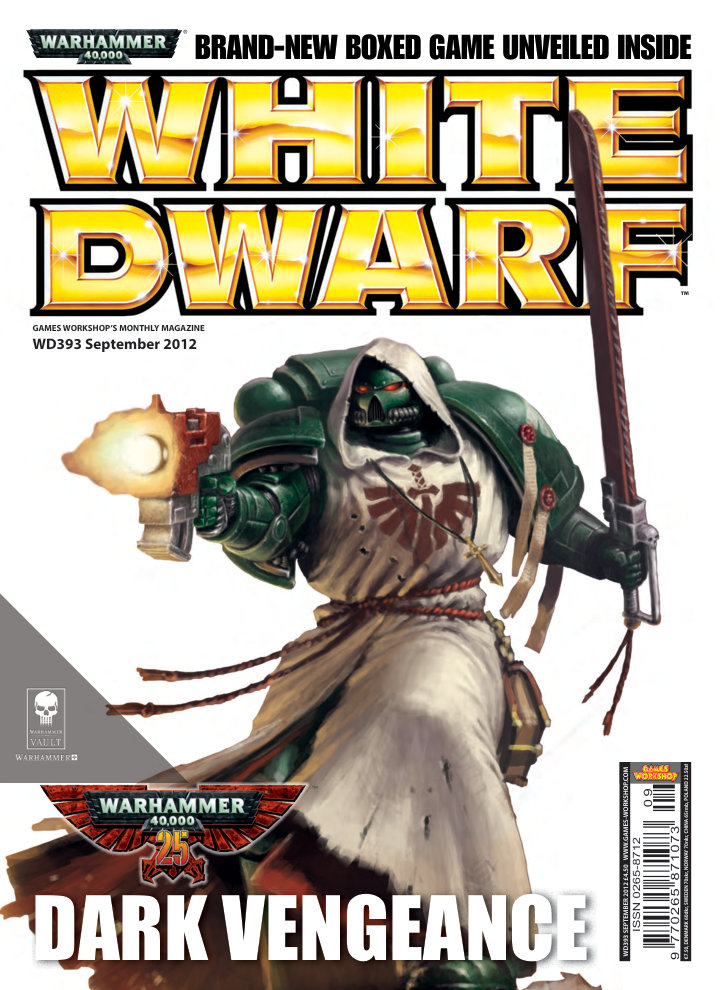
Andrew Kenrick introduces Dark Vengeance through the mutual hatred of its Dark Angels and Chaos Space Marines. His enthusiasm for the new push-fit Chosen and Helbrute leads into the issue’s designer interviews, campaign battles and hobby projects, with a Space Wolves parade army and rival Vampire Counts and Bretonnian collections broadening the coverage.
Warhammer 40,000Dark Angels
InterviewWD 393 · pp. 22–27
Simon Grant talks to Jervis Johnson, Jes Goodwin and Phil Kelly about a starter set whose named characters and opposing forces were designed around a connected story. Goodwin explains how a small elite Dark Angels force contrasts with numerous Cultists and warped, ancient Chaos Marines, while unusually intricate push-fit models retain dynamic poses with few components. Johnson describes the teaching booklet’s progression from basic lessons and solo missions to battles using the whole box; Kelly presents Cultists as the expendable mass that releases Chaos elites to attack.
Warhammer 40,000Dark Angels
LoreWD 393 · pp. 30–35
The background to Bane’s Landing connects Master Balthasar’s pursuit of the Crimson Slaughter with the death of his predecessor, Zadakiel. Their quarry seeks a Khornate altar capable of opening a powerful daemonic gateway when fed Space Marine blood, so a personal vendetta also threatens a much greater catastrophe. The feature introduces the opposing leaders and squads as participants in that struggle, grounding the starter campaign in the Dark Angels’ oaths and the Crimson Slaughter’s curse.
Warhammer 40,000Dark Angels
FictionWD 393 · p. 31
C. Z. Dunn’s first-person extract follows Sergeant Constantin Raphael as a fight with apparently insignificant Cultists turns costly. Autogun fire kills Regulus and knives find the gaps in Selaphiel’s armour, forcing Raphael to confront losses that dwarf his squad’s previous decades of service. His heightened perception of the fighting becomes grief and anger, revealing how easily the Dark Angels’ pride and desire for vengeance can shape a battlefield decision.
Warhammer 40,000Dark Angels
LoreWD 393 · pp. 32–33
The Crimson Slaughter began as the loyal Crimson Sabres, whose purge of Umidia brought Khorne’s curse upon them: the voices of their victims could only be quieted by more killing. Sevastus Kranon led them into the Eye of Terror before their search for the Hellfire Stone drew them back to Imperial worlds. Character accounts explain Draznicht’s third eye, the histories of Cultist leaders Anarkus and Tetchvar, and how Kranon’s resisting brother Sevarion became the imprisoned, maddened pilot of Mortis Metalikus.
Warhammer 40,000Crimson Slaughter
LoreWD 393 · pp. 34–35
Profiles give the Dark Angels strike force histories beyond their equipment. Balthasar’s Deathwing experience and new command are shadowed by his oath to avenge Zadakiel, while Librarian Turmiel’s precognition and reserve make him difficult to know. Raphael’s veteran Tactical Marines, Arion’s Ravenwing survivors and Barachiel’s Deathwing squad embody different traditions of the Chapter, united here by loyalty to the fallen master.
Warhammer 40,000Dark Angels
ShowcaseWD 393 · pp. 36–39
The studio painters present the Dark Vengeance characters and squads with details that reinforce their identities. Kornel Kozak uses Seraphicus’s pale tabard to draw attention against black armour, and Dave Holmes adds Fifth Company markings to the Dark Angels. Dave Heathfield’s red Crimson Slaughter contrasts with a black Black Legion interpretation, while fleshy Helbrute details, rich Chosen trim and Joe Tomaszewski’s pale blue weapon effects distinguish the corrupted warriors. The photographs show alternative finished schemes rather than named paint recipes.
Warhammer 40,000Dark Angels
Battle reportWD 393 · pp. 40–63
Andrew Kenrick commands the Chaos Space Marines and Matt Hutson the Dark Angels through all six missions in the Dark Vengeance teaching campaign, then they exchange armies and replay them. The escalating games show how the same models create very different problems, from controlling a rogue Helbrute to escaping with an objective. Their conclusions contrast the Dark Angels’ reliable ranged fire and resilient Deathwing with the numerical advantage, powerful Chosen and dangerous but erratic Helbrute of Chaos.
Warhammer 40,000Dark Angels
Battle reportWD 393 · pp. 42–43
Andrew plays a solo mission in which Mortis Metalikus attacks the nearest target and must be reduced to one Hull Point before Kranon can deactivate it in assault. He sacrifices Cultists as bait, exposing the Helbrute’s rear armour to the Chosen and using the scenario’s protection against accidental destruction when firing Kranon’s plasma pistol. Both Cultist units are lost, but Kranon reaches the machine and successfully shuts it down before becoming its next victim.
Warhammer 40,000Crimson Slaughter
Battle reportWD 393 · pp. 44–45
Matt’s three Ravenwing bikers must survive successive engagements with increasing numbers of Cultists and leave the opposite board edge each time. He tests whether to silence autoguns first or quickly engage the pistol-armed group, finding that stubborn survivors can delay the bikes even when little damage gets through their armour. One biker dies in the last patrol, but Arion wins his challenge against Tetchvar and the remaining squad escapes to complete all three engagements.
Warhammer 40,000Dark Angels
Battle reportWD 393 · pp. 46–47
A five-man Dark Angels combat squad ambushes two Cultist units that can only fire Snap Shots and cannot charge in the opening turn. Matt uses cover and a plasma cannon to devastate the advancing Cultists, switches targets to finish their autogun support and defeats the last attackers in melee. The rematch illustrates the cost of a closer deployment: Andrew’s rapid-fire opening destroys one unit, but the other reaches combat and inflicts heavy losses before the Marines prevail.
Warhammer 40,000Dark Angels
Battle reportWD 393 · pp. 48–51
Librarian Turmiel begins alone against Cultists, with Chosen arriving before his Deathwing reinforcements. His short-ranged Smite encourages a risky advance; failed powers and charges leave him exposed, and an autopistol kills him even after the Terminators arrive. The Deathwing then grind through the remaining opposition to win for Matt. Replaying the scenario reverses the result when Perils of the Warp weakens Turmiel and the Chaos attackers overwhelm the surviving Terminators.
Warhammer 40,000Dark Angels
Battle reportWD 393 · pp. 52–57
Both complete starter armies fight for victory points awarded for destroyed units and slain characters, making concentrated fire essential. Matt’s longer-ranged weapons force Andrew out of the Shrine of the Aquila, destroy the Cultists and Chosen, and let Ravenwing circle behind the Helbrute to wreck it with bolter glances. Balthasar and Kranon remain locked in a challenge when the Dark Angels secure victory. In the rematch, adding Seraphicus strengthens the Deathwing, but the Helbrute and Kranon finally demonstrate the destructive potential Chaos lacked in the first game.
Warhammer 40,000Dark Angels
Battle reportWD 393 · pp. 58–63
The campaign ends with an objective in the battlefield centre that can be picked up and carried away. Matt uses the Deathwing as a screen while Ravenwing prepare to seize it, but plasma overheating and a brutal Chaos countercharge cost him both leading characters and the Terminators. Arion nevertheless escapes with the stone and survives the Helbrute’s last shot through a jink save. In the replay Andrew instead shelters Turmiel until the Librarian can retrieve the objective, showing how the mission rewards a planned extraction rather than simply winning the central melee.
Warhammer 40,000Dark Angels
ShowcaseWD 393 · pp. 66–69
Ruined Imperial architecture supplies a setting for the remote and sparsely populated world of Bane’s Landing. The Fortress of Redemption provides a thematic Dark Angels centrepiece, while the Shrine of the Aquila and Sanctum Imperialis offer large walls, elevated positions and shelter for approaching troops. Smaller debris breaks up open ground: ammunition dumps can improve shooting, and the wrecked Battlescape suggests mutually agreed dangerous terrain. The selection connects atmosphere and battlefield function without prescribing a construction or paint recipe.
Warhammer 40,000Dark Angels
ShowcaseWD 393 · pp. 72–75
Studio hobbyists adapt the starter models to their existing collections or use them to begin new armies. Chris Peach and Duncan Rhodes paint nearly two sets as a Cultist-heavy Alpha Legion force, with green-edged blue armour and contrasting Helbrute flesh. Other examples include Steve Bowerman’s Night Lords, Matt Hutson’s accompanying Night Lords contingent, Andrew Kenrick’s white-robed Death Guard Cultist, Dan Harden’s Deathwing and Christian Byrne’s Word Bearer lord, demonstrating how the sculpted details support different allegiances without supplying named paint recipes.
Warhammer 40,000Alpha Legion
ModellingWD 393 · pp. 78–81
A survey of staff armies explains how interchangeable Marine parts and Chapter upgrade kits create individual identities. Robin Cruddace aims for subtle conversions across his Howling Griffons, Rik Turner adds Deathwatch weapons and Templar tabards to Blood Ravens, and Duncan Rhodes uses running legs even on Flesh Tearers heavy-weapon troops. Dom Murray combines several ranges for independent-looking Space Wolves, while Dave Andrews brings architectural components and John Blanche’s Gothic imagery into Ultramarines. Numerous smaller examples show heraldry, bionics, gestures and equipment swaps as practical ways to vary a force.
Warhammer 40,000Space Marines
ShowcaseWD 393 · pp. 84–87
Joseph Oliver’s Sutton Coldfield Parade Day winner combines a playable Space Wolves army with a Forge World Imperial Strongpoint display that also belongs to his home battlefield. Norse mythology motivates the force, and hair colours distinguish older Long Fangs and Wolf Guard from younger packs. Snow ties the figures to the blue-grey armour, while converted priests, a Contemptor and a prized Caestus Assault Ram add personality to Erik Morkai’s Great Company. Joseph describes the collection as a growing army intended eventually for Apocalypse rather than a display with no gaming role.
Warhammer 40,000Space Wolves
InterviewWD 393 · pp. 88–89
Matt Holland nominates Juan Diaz’s Slann Mage-Priest because its meditative pose, hovering throne and attentive Skink communicate authority and intelligence immediately. He praises the anatomical weight and reptilian texture that make the creature convincing without simply looking obese. Diaz explains that the living Slann and Lord Kroak began with the same throne and body, then diverged through thriving wildlife on one and the mummified attendants and dead surroundings of the other.
Warhammer Fantasy BattlesLizardmen
ShowcaseWD 393 · pp. 90–91
A small cross-system Golden Demon gallery brings together prize-winning Daemons from the 2011 competitions. Angelo Di Chello’s single 40K miniature sits alongside monster-category work by Georg Damm, Michael Cho and Julien Casses. Their different treatments of large daemonic forms and finely detailed character models illustrate the range of the competition rather than teaching a particular paint method.
Warhammer 40,000Warhammer Fantasy BattlesChaos Daemons
EditorialWD 393 · pp. 92–93
A reader’s review of six years of columns prompts Jervis Johnson to explain how Standard Bearer evolved from reporting studio decisions into personal reflections on the hobby. He describes choosing one clear subject, drafting it, returning later to edit and seeking something readers can apply to their own interests. His favourite discussion of archetypes grew from conversations with Alan Merrett, and his central argument is that writing, conversation and careful reflection help people understand what attracts them to the hobby.
PaintingWD 393 · pp. 94–95
Phil Stutcinskas discusses a Red Scorpions collection that grew through experimental command-squad conversions and his interest in weathering. He airbrushes earthy paint and medium over vehicle hulls, adds varnish to control drying around details, then builds dust with lightly stippled Dark Sand and Light Earth powders before picking out worn metal edges. A separate detail explains Commander Culln’s intricate golden freehand, mixing gold with an ochre paint for easier control and relying on a fine brush and patience.
Warhammer 40,000Red Scorpions8 paint colours
ShowcaseWD 393 · pp. 96–101
Chris Peach and Duncan Rhodes use a Blood in the Badlands-inspired campaign as the impetus for two rapidly expanding armies. Their gaming group has built a large modular Mighty Empires map, and the paired displays contrast Chris’s newly raised Vampire Counts with Duncan’s long-running Bretonnians. The armies are presented as works in progress driven by an ongoing rivalry, with full-force photographs showing how their collections have grown beyond their original starting points.
Warhammer Fantasy BattlesVampire Counts
ShowcaseWD 393 · pp. 98–99
Chris Peach completes this Undead force in two intense months after the year’s Vampire Counts releases renew his interest. His army is explicitly built to defeat Duncan’s Bretonnians, bringing together ranked skeletons, spectral riders, hulking horrors and flying monsters beneath repeated purple accents. The photographs show the finished campaign collection from several angles; no construction steps, army list or named paint recipe accompanies them.
Warhammer Fantasy BattlesVampire Counts
ShowcaseWD 393 · pp. 100–101
Duncan Rhodes traces his Bretonnians to a thousand-point force prepared for a doubles event and explains that the growing army still represents only part of his plans. The display pairs individually heralded knights with large bodies of men-at-arms and bowmen, mounted support and a striking red winged monster. Repeated banners and heraldic devices unite the varied subjects, but the article remains a photographic showcase rather than a painting guide or rules list.
Warhammer Fantasy BattlesBretonnia
CommunityWD 393 · p. 104
The news page presents BioWare’s Wrath of Heroes as a free, three-team player-versus-player game in which changing heroes can alter a battle. It also announces The Lathe Worlds for Dark Heresy, expanding the Adeptus Mechanicus in the Calixis Sector with new histories, careers and equipment. A school-year hobby note points to Dark Vengeance as a shared starting point for clubs learning the game together.
Warhammer Online: Wrath of HeroesDark HeresyAdeptus Mechanicus
CommunityWD 393 · pp. 106–107
The club guide begins with finding a supportive teacher and a regular space, then choosing a meeting long enough for meaningful painting or games. It recommends student recruitment through posters, shared responsibility for setup, a club name and accessible single-miniature competitions. Regular painting tables and specially written scenarios complement the School League’s short games, while local stores and the School Toolkit provide practical support for teachers and organisers.
CommunityWD 393 · pp. 108–109
Warhammer World staff describe how they will bring feature tables, exhibition highlights and opportunities for organised visits to Games Day. Adam Snook outlines gaming and mission-card activities, Lise Ward discusses miniature and art displays, and Ray Dranfield introduces the timed conversion contest. The preview also explains the A4 art competition, a twenty-minute quick-draw challenge and large participation battles, giving a picture of the event’s practical activities beyond its retail stalls.
CommunityWD 393 · p. 114
The Maidenhead profile centres on a community organised around the Jr. Reapers beginner group, the Reapers and the local GCN Maidenhead Reapers club. Regular painting competitions attract Golden Demon and Young Bloods entrants who share their techniques with other hobbyists. The store’s combination of organised games, building sessions and experienced painters is presented as its defining strength.
CommunityWD 393 · p. 116
Brighton’s hobby community is helping create a window battle scene based on a ruined, post-apocalyptic Brighton Pier. Three in-store clubs support the project alongside beginner, established-player and School League activities, while the Brighton Warlords offer further opponents through the local GCN network. The profile links the shared display with opportunities to practise for school and doubles events.