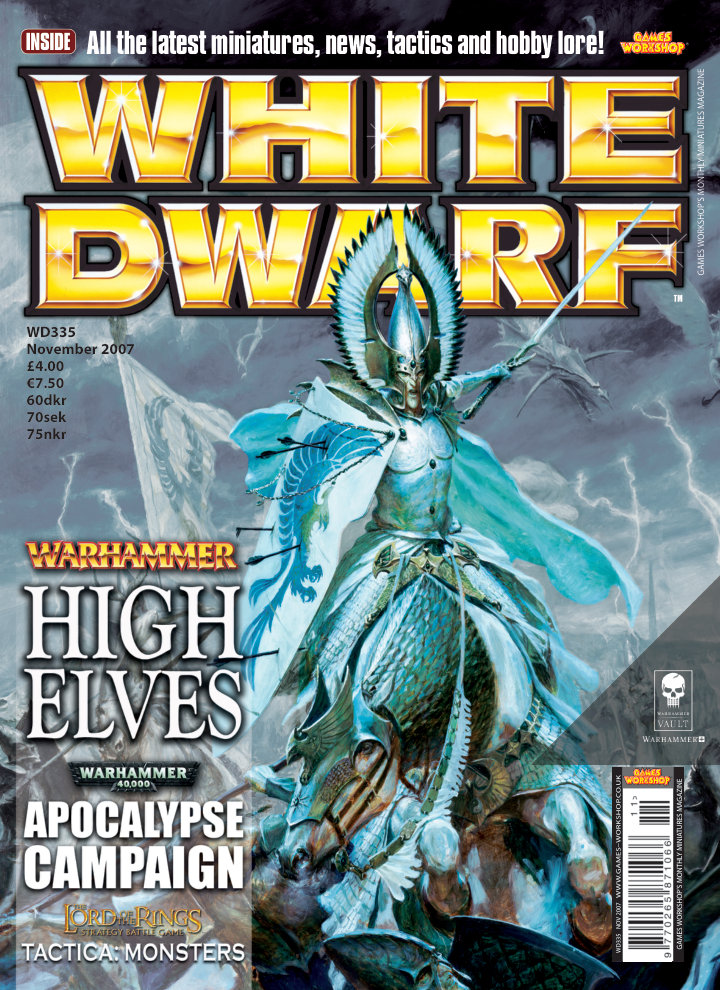
EditorialWD 335 · Inside cover
Grombrindal grudgingly admires the High Elves’ shining ranks while recording their author as another Elf-friend in his book of grudges. The new army book, chariot, heroes and dragon lead the issue, with a city campaign and Baneblade workshop extending Apocalypse coverage. Middle-earth monsters provide a final threat, making the editorial’s tour of the contents a characterful exchange between Dwarven pride and the appeal of impressive new armies.
Warhammer Fantasy BattlesWarhammer 40,000High Elves
LoreWD 335 · pp. 22–23
The forthcoming Ork codex promises a broad account of the species’ origins, tribal culture and relentless wars, alongside the leaders and ramshackle machines that drive a Waaagh! New bikes, Trukks and Tankbustas accompany the range, while the returning Shokk Attack Gun particularly excites veteran players. The preview presents those eccentric weapons and stubbornly aggressive warriors as expressions of a civilisation that lives for conflict.
Warhammer 40,000Orks
CommunityWD 335 · p. 24
The handheld strategy preview follows Ultramarines fighting Chaos through fifteen linked missions on Nintendo DS and PSP. Turn-based combat uses destructible three-dimensional battlefields and recognisable weapons from bolters to power fists. Multiplayer maps support opposing or cooperative groups, with selectable loyalist Chapters and Chaos Legions. The feature translates the setting’s small-unit warfare into a portable game with local and networked play.
Warhammer 40,000Ultramarines
InterviewWD 335 · pp. 27–43
Adam Troke rebuilds the High Elves around the identity found in their accumulated background: an ancient, dwindling people whose soldiers are exceptionally skilled. Always Strike First and a more generous selection of elite units make that identity visible in play, while three dragon ages and a Dragon Mage restore their old allies to prominence. Expanded history, character illustrations, themed armies and practical painting advice connect the revised rules with the visual and narrative character of Ulthuan.
Warhammer Fantasy BattlesHigh Elves
ModellingWD 335 · pp. 34–35
The annotated plastic frames identify the pieces that turn one character set into a mounted Prince and a foot Noble, and another into an Archmage and Mage. Alternative heads, weapons and decorative fittings allow each figure to express a particular role and provincial identity. Studying the component keys makes it easier to plan a pair of complementary leaders and select their equipment before assembly.
Warhammer Fantasy BattlesHigh Elves
LoreWD 335 · pp. 36–37
Dragons are intelligent partners of the High Elves rather than domesticated mounts, with the bond between rider and beast developing over centuries. The account follows their retreat into the mountains of Caledor and the difficult rituals needed to awaken them. Impetuous Sun Dragons, veteran Moon Dragons and immensely old Star Dragons differ in temperament and power, while Dark Elf attempts to steal eggs threaten the survival of an already dwindling alliance.
Warhammer Fantasy BattlesHigh Elves
TacticsWD 335 · pp. 38–39
Two Dragons and a strong unit of Dragon Princes define a fast, aggressive army drawn from Caledor. A Star Dragon carries a heavily equipped Prince, while a Dragon Mage brings fire magic and another mobile threat. Coordinated attacks place the monsters on the enemy’s flanks and cavalry to the front, with citizen infantry and bolt throwers supporting from behind. The commentary also warns that losing one of these expensive centrepieces early can be difficult to recover from.
Warhammer Fantasy BattlesHigh Elves
TacticsWD 335 · pp. 40–41
The 1,996-point Chracian force draws an approaching enemy into missiles and magic before unleashing three Lion Chariots. Korhil, White Lions and a spear block form a resilient infantry line, using woodland movement and suitable banners to choose defensible positions. An Archmage supplies magical support, including protection for the vulnerable chariots. The example shows how a provincial theme can produce a coherent defensive plan through the ordinary army list.
Warhammer Fantasy BattlesHigh Elves
PaintingWD 335 · pp. 42–43
Pete Foley provides four repeatable recipes for materials common throughout a High Elf army. Silver armour receives a cool blue-black wash before a bright metallic highlight, while gemstones are built from dark red to orange with a small reflected-light point. White cloth preserves grey shading beneath thin white coats, and a blue sash develops from deep recesses to pale edges. The paired pages offer a practical foundation for the army’s clean, bright appearance.
Warhammer Fantasy BattlesHigh Elves12 paint colours
Battle reportWD 335 · pp. 46–65
Adam Troke’s High Elves confront Andy Hoare’s three-thousand-point greenskin invasion on the shores of Yvresse. Fanatics, a Giant and stubborn Orc formations initially threaten the Elven line, but a Dragon and Lion Chariot destroy the Black Orc command and open the battle. The Elves lose both mages and several units, yet their elite infantry and coordinated charges eventually overwhelm the horde. Poorly timed Animosity and ineffective artillery compound the invaders’ problems, producing a decisive High Elf massacre.
Warhammer Fantasy BattlesHigh Elves
EditorialWD 335 · pp. 66–68
Jervis explains why an army’s identity should guide its design from the outset instead of being reconstructed around isolated fixes to underused units. High Elf infantry, elite warriors and dragons become the central themes of the new list, just as the Dark Angels revision restores the Deathwing’s established organisation. Rules and miniature design then reinforce those choices together. The aim is a flexible army that rewards collecting and playing the force described in its background.
Warhammer Fantasy BattlesWarhammer 40,000High Elves
ModellingWD 335 · pp. 69–73
Dave Cross describes developing tools specifically for assembling miniatures rather than adapting equipment made for other jobs. Detailed comparisons explain why slim flat-backed cutters, controlled knife grips, fine files and a small drill improve preparation, while a thin saw and suction-mounted vice help preserve valuable components during conversions. Practical examples cover pinning, drilling barrels, shaping putty and cutting large scenery pieces, linking each design choice to a modelling task.
CampaignWD 335 · pp. 74–79
Chaos invades Malin’s Reach, where Inquisitor Ilthaman takes command and orders the defenders to bleed the attackers as they advance through Cor Hydrae. The campaign combines Cities of Death and Apocalypse across three linked battles, with early victories granting assets for later encounters and the final battle deciding the result. The first instalment introduces Ilthaman’s ruthless plan, his rival Ptar’s daemonic ambitions and the heavily fortified defensive line where their forces first clash.
Warhammer 40,000Imperial Guard
RulesWD 335 · pp. 78–79
A five-thousand-point Imperial defence faces seven thousand points of Chaos across a broad street on a six-by-eight-foot city battlefield. Fortified ruins and prepared Imperial stratagems offset the attackers’ greater numbers, while all six objectives stand on the defended side. Both armies deploy within fixed time limits, Chaos attacks first and neither keeps reserves. Winning this opening struggle grants either Ambush or Flank March in the next battle, making the cost of holding the line matter beyond this game.
Warhammer 40,000Imperial Guard
TacticsWD 335 · pp. 80–85
Mat Ward organises monster play around reaching combat, crushing suitable warriors and managing unreliable Courage. Trolls, Dragons, Demons, giant spiders and Mûmakil each offer a different balance of force, speed and resilience, while Ents provide a powerful option for Good armies. The guide repeatedly relates the large creature to its supporting troops and heroes, warning that impressive profiles can still be undermined by missile fire, spells, poor positioning or the wrong duel.
Middle-earth Strategy Battle GameMordor
TacticsWD 335 · p. 81
Trolls bring crushing attacks to an Evil army but must survive the approach, with the different breeds’ armour affecting how well they endure arrows. Their threatening presence can draw fire away from ordinary troops, although taking several reduces the army’s model count and break point. Thrown stones offer another way to threaten crucial targets or dangerous heroes. Buhrdûr adds Might, better Courage and greater accuracy to the familiar Cave Troll role.
Middle-earth Strategy Battle GameMordor
TacticsWD 335 · p. 82
The Dragon’s strong basic profile can be tailored through flight, tougher skin, spellcasting or fire breath. Flight helps it reach useful fights quickly, while fire offers a particularly dangerous answer to tightly grouped enemies and powerful multi-wound models. Its Survival Instinct makes every wound a potential rout, so conserved Will remains valuable. A Ringwraith on Fell Beast offers a related combination of mobile fighting and magic through a different army option.
Middle-earth Strategy Battle GameMoria
TacticsWD 335 · p. 83
The Balrog’s resilience allows a straightforward advance into combat, but supporting captains are needed to prevent opponents feeding it one disposable warrior each turn. Gûlavhar instead depends on speed, Might and the ability to recover wounds by killing enemies, since his combat effectiveness falls as he is injured. The comparison separates a durable centrepiece from a more delicate roaming predator, with Aragorn’s blade singled out as a serious threat even to the Balrog.
Middle-earth Strategy Battle GameMoria
TacticsWD 335 · p. 84
Shelob combines rapid movement, terrain freedom and a venomous attack, but wounds can trigger a retreat through her self-preservation rule. Spider Queens trade some durability for Might and expendable Broodlings, which can move after being generated to reach unexpected combats. Ordinary Giant Spiders also have a useful niche clearing archers from difficult terrain. The guide makes movement and threat placement central to using these creatures, rather than relying on their alarming appearance alone.
Middle-earth Strategy Battle GameMordor
TacticsWD 335 · p. 85
A Mûmak’s trample can devastate a line of warriors or threaten even great heroes, but choosing the attack path is crucial when friendly models obstruct it. Haradrim archers help remove targets sheltered in terrain and weaken enemies the beast cannot readily reach. A Mahûd Chieftain improves control through Courage and Might, allowing more dependable heroic movement. The advice balances the creature’s tremendous destructive potential against its vulnerable Fight value and risk of losing control.
Middle-earth Strategy Battle GameHarad
ModellingWD 335 · pp. 86–93
Mark Jones assembles the large tank through an orderly sequence of subassemblies, allowing joins to dry and remain accessible for cleaning. The guide explains how to preserve moving weapon mounts, start the tracks at the correct locating point and keep the hull square. Alternative sponson positions and turret fittings customise the vehicle, while selected parts remain detachable for painting. The same principles support a Hellhammer build, with weapon choices settled before construction begins.
Warhammer 40,000Imperial Guard
PaintingWD 335 · pp. 94–99
Neil Green develops a mounted Prince through five clearly mapped stages, keeping the rider and steed separate until the painting is complete. Blue-shadowed whites, polished silver and bright gold establish the characteristic High Elf finish, while the dark horse and red gems provide contrast. Thin translucent layers produce the highlights before fine edges, eyes and reflected-light points finish the details. A separately illustrated stone base gives the character a suitably elaborate setting.
Warhammer Fantasy BattlesHigh Elves33 paint colours
PaintingWD 335 · p. 99
A warm brown base and dark ink establish the ruined pillar’s depth before broad ochre-brown overbrushing reveals its carved surfaces. Pale drybrushing catches the stone’s edges, and turquoise details supply small decorative accents. The five-step sequence finishes an elaborate base efficiently through texture, while its restrained tones let the brightly painted Prince remain the main focal point.
Warhammer Fantasy BattlesHigh Elves5 paint colours
CommunityWD 335 · p. 103
Andy Joyce describes revisions informed by feedback from the previous event, with Pete Foley helping align the scoring more closely with the other Grand Tournaments. Eight games across four scenarios provide a demanding weekend and reduce reliance on incidental bonuses. A new Doubles Tournament for 2008 extends the approach through bespoke missions and a shared force limited to one list and one ally, encouraging partners to build and play a coherent army together.
Middle-earth Strategy Battle Game