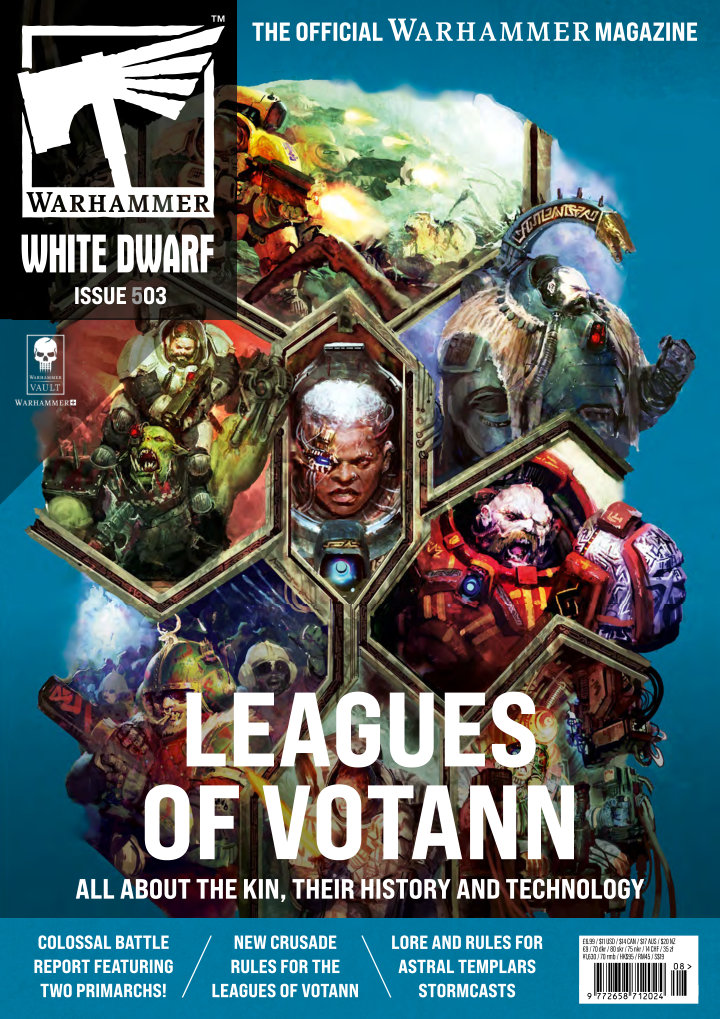
EditorialWD 503 · Inside cover
Lyle Lowery introduces the problem of viewing Imperial history from outside the fiction. A conversation with Andy Thomas-Clark about the enormous gulf between the Horus Heresy and the 41st Millennium leads to this issue’s exploration of forgotten technology, censorship and superstition, comparing that distance with the far shorter span of humanity’s recorded real-world history.
CommunityWD 503 · pp. 2–5
Readers describe finding an entry into Warhammer through the magazine and maintaining a family hobby after moving from Wisconsin to Prague. The gallery includes a Bretonnian-inspired Mangler Squig conversion with colourful heraldry and a marshy base, while the featured Tome Keepers collection turns a personal painting challenge into an expanding Space Marine force.
Warhammer 40,000Age of SigmarTome Keepers5 paint colours
PaintingWD 503 · p. 3
Fabio Girelli explains how White Dwarf’s Task Force Bhakir inspired a boarding patrol in aged ivory armour. A Wraithbone undercoat supports brown-shaded bone plates, black trim and red details, with a separate gunmetal recipe. Although the collection began for Boarding Actions, its first reported success came in a regular battle against Blood Angels, and the plan now extends towards a larger company-sized force.
Warhammer 40,000Space Marines12 paint colours
LoreWD 503 · pp. 6–13
Andy Thomas-Clark explains why the Imperium’s inhabitants know far less about their history than readers of Warhammer fiction. Ten millennia of constant war, unreliable records, enormous distances and deliberate destruction have erased context even within powerful institutions. The Scouring’s attempt to suppress betrayal becomes one of the foundations of the ignorance it was meant to prevent.
Warhammer 40,000Imperium
CommunityWD 503 · pp. 14–15
Lyle discusses bonus points as a tool for keeping a gaming league lively. Rewards can encourage painted armies, varied opponents or challenges to leading players, but changing the scoring must suit the group’s preference for predictability or surprise. The studio Spearhead league provides the example, with the organiser’s aim of increasing enjoyment taking precedence over any particular catch-up mechanism.
CommunityWD 503 · pp. 16–17
The Bunker challenge pages explain how to carry a score forward, record completed activities and progress through ranks from Trooper to Castellan. Games, club painting and the monthly themed challenge contribute to a personal hobby record. The accompanying calendar invites Leaders and Heroes entries and gives submission windows for later challenges.
CommunityWD 503 · pp. 18–21
The second month of the studio league adds a bonus for every game played, increasing opportunities to catch the early leaders. The report tracks faction participation, games in Aqshy and Ghyran, additional awards and a changed leaderboard. Dan Harden describes how his new Skaven exploit mobile characters and retreat abilities, illustrating how a growing painted army and practical experience develop together.
Age of SigmarSkaven
PaintingWD 503 · pp. 20–21
Matt Seymour uses hot orange-red flame colours against cooler teal and blue to make his Tzeentch models look unnaturally vivid. Pale, pastel bases separate the figures from their surroundings, while non-metallic yellow-gold trim connects the warm and cold areas. Short recipes document flames, teal details, gold trim and the delicately coloured bases.
Age of SigmarDisciples of Tzeentch12 paint colours
RulesWD 503 · pp. 22–23
Objective markers phase out of reality in rotating pairs, then return empowered, making the most valuable ground shift throughout the battle. Units near empowered markers gain movement-related benefits, while an endgame breakthrough rewards reaching the enemy deployment zone. The mission combines regular objective scoring with a changing spatial problem, discouraging players from treating their initial positions as permanently secure.
Warhammer 40,000
RulesWD 503 · pp. 24–25
This updated battleplan makes heroes decisive objective holders: other units have no control score, and a hero who kills a rival at an objective adds the victim’s Control to its own. An underdog twist improves attacks against enemy heroes. Standard turn-by-turn objective and battle-tactic scoring therefore sits alongside a contest to preserve, position and empower the army’s key characters.
Age of Sigmar
RulesWD 503 · pp. 26–27
Vie for Glory replaces private objective decks with a shared, face-up Community Objective Deck. Both warbands race to achieve the same goals, and scoring reveals a replacement so the puzzle continually changes. Additional shared objectives appear in the second and third rounds, widening the opportunities for a comeback; the article supplies the revised setup, redraw and tiebreak procedures.
Warhammer Underworlds
TacticsWD 503 · pp. 28–31
Stephen Box introduces a practical rating system for Primary scoring, Secondary scoring and damage, then applies it to Dan Harden’s thousand-point Adeptus Mechanicus collection. The exercise uncovers overlooked abilities, a gap against heavy infantry and the tension between standing still for accurate shooting and moving to complete missions. It treats honest assessment of an existing collection as useful even for a casual player.
Warhammer 40,000Adeptus Mechanicus
PaintingWD 503 · p. 32
A reader’s question about the Boarding Actions box photography leads to an industrial terrain recipe. Zandri Dust walls receive brown recess shading and grime towards the bottom, with separate bronze, silver and differently coloured pipe treatments. Drybrushing picks out the structure’s many raised details, while diluted washes create a coherent, worn ship interior.
18 paint colours
PaintingWD 503 · p. 33
Dan contrasts the stippled red plates and drybrushed brass of his Stygies VIII Skitarii with the industrial orange of Clan Ferrus. A universal brown starting colour helps unify the Skaven’s fur, equipment and armour, while the uneven orange finish becomes part of their grimy character. Separate recipes cover metallics, red armour, orange weapon glow, skin and turquoise warpstone.
Warhammer 40,000Age of SigmarAdeptus Mechanicus18 paint colours
PaintingWD 503 · p. 34
Matt applies the same mustard-yellow palette to Imperial Fists at different scales, changing from crisp edge highlights to stippled battle wear for his Horus Heresy models. His Gnarlroot Sylvaneth instead use drybrushed autumnal bark and bright greens for living and magical areas. The guide documents armour, trim, weapon casings, wood, pale hair and luminous details as distinct but repeatable recipes.
Warhammer 40,000The Horus HeresyImperial Fists26 paint colours
PaintingWD 503 · p. 35
Sophie’s Warp Guardians use black armour, warm gold details and a bold blue shared by armour panels, plumes and cloth. The final pale-blue highlight is reserved for hard armour edges so fabric and plates remain distinct. Washing the metallic areas together makes the process faster, and the three illustrated recipes give the collection a consistent finish.
Warhammer 40,000Adeptus Custodes10 paint colours
PaintingWD 503 · p. 35
Side-by-side heads demonstrate how the undercoat changes a transparent Contrast colour. White Scar supplies a neutral bright foundation, Grey Seer creates cooler results and Wraithbone adds warmth. Examples across pale, dark and fantastical skin tones make the choice visible, helping painters select a primer for the intended colour temperature rather than treating all light sprays as interchangeable.
13 paint colours
CommunityWD 503 · pp. 36–41
Warhammer Eugene describes a club programme combining work-in-progress sessions, an escalating Tyrannic War Crusade and rotating skirmish games. Reader character photographs lead into a studio gallery whose contributors explain quick ivory armour, silverbirch bark, a converted Beast Snagga boss and a personalised Freeguild General. The individual notes connect paint methods and kit changes to each model’s story.
Warhammer 40,000Age of SigmarTome Keepers17 paint colours
CommunityWD 503 · pp. 42–43
Matt completes his bingo sheet with Belthanos, whose giant insect receives a vivid pink shell built through drybrushing and a final magenta glaze. Sophie finishes a Strike Cruiser interior for her Moon Eaters using the same greys as the army, enriched with grime and coloured details. The update places these finished projects alongside the team’s continuing painting and games.
Age of SigmarWarhammer 40,000Sylvaneth9 paint colours
Battle reportWD 503 · pp. 44–67
The series ends with ten thousand points fighting over blackstone on Nova-Raukus. James and Rhuairidh combine World Eaters and Death Guard against Joe’s Space Marines and Kin and Andy’s Astra Militarum. The scenario rewards extracted crates, the central deposit and destroyed enemies, while accumulated series points supply one-use Warlord Tactics that create reversals and stolen opportunities.
Warhammer 40,000World Eaters
InterviewWD 503 · pp. 68–71
Duncan Waugh describes the design of the new Boarding Actions supplement, from tighter sightlines and friendly-model movement to fifty-five focused Detachments. Narrower rosters and concise rule sets allow more thematic tricks without overwhelming players, including hatchway ambushes and unusual ways for elite armies to secure objectives. Reworked Arks of Omen missions retain narrative interaction within a balanced small-game format.
Warhammer 40,000
LoreWD 503 · pp. 72–81
This background survey describes Kin society through its kindreds, holds, guilds and leagues, explaining the equal standing of Ironkin and the practical culture of survival and resource gathering. Cloneskeins, ageing Ancestor Cores and fragmentary origin traditions establish a different relationship with technology and history from the Imperium’s. Mining guilds, Brokhyr and military kinhosts then lead into the conflicts created by the Great Rift and the search for new claims.
Warhammer 40,000Leagues of Votann
CampaignWD 503 · pp. 82–95
The Kin’s Crusade system links battlefield achievements to a growing stock of minerals, biomatter, energy and intelligence. Resources buy and upgrade Kindred Assets, while rare finds open further opportunities and defeats can interrupt an asset’s operation. Grudges add both targeting advantages and compulsions, and faction Agendas, Requisitions, Battle Traits, relics and badges turn acquisition, efficient warfare and settled debts into long-term goals.
Warhammer 40,000Leagues of Votann
ModellingWD 503 · pp. 96–105
Paul Claridge and Ashley Hamstead-Reid show how a tilted section of crashed voidship can tell a salvage story inside a display cabinet. Boarding Actions rooms, bent resin floors, layered plastic-card hulls and stripped wires create convincing impact damage, with an old hairdryer even contributing wreckage. Bright Trans-Hyperian Kin explore the gloomy interior, while mirrored rear views and small narrative details reward looking beyond the main scene.
Warhammer 40,000Leagues of Votann9 paint colours
PaintingWD 503 · p. 99
The exhibition team’s Kin recipes use orange armour to stand out from the pale, filthy ship surrounding them. Cream panels, blue-grey fatigues, dark equipment and restrained steel support the orange without competing with it. Base colours, recess shading and successive highlights document a repeatable scheme for both infantry and the vehicles in The Envoy.
Warhammer 40,000Leagues of Votann16 paint colours
RulesWD 503 · pp. 106–108
The first Moulderhunt instalment introduces an Astral Templars Army of Renown for containing monstrous Skaven outbreaks around the Gnaw. Vanguard units anchor the roster, and aggressive battle traits reward attacks, pursuit and independent hunters operating in enemy territory. Hero upgrades, spells, prayers and an Everblaze Comet manifestation complete an alternative faction package; the article explicitly presents it as Legends content.
Age of SigmarStormcast Eternals
RulesWD 503 · p. 109
Hamilcar’s Legends warscroll translates his swagger and implausible fortune into charmed-fate points spent on crucial rerolls. His damage potential grows dramatically when he takes on a monster without friendly units sharing the fight. The accompanying note encourages readers to create a suitable conversion, connecting the rules to a character best known through Black Library stories.
Age of SigmarStormcast Eternals
LoreWD 503 · pp. 110–113
The Astral Templars are portrayed as tribal beast hunters whose maroon armour, pelts and deed-names set them apart from formal military Stormhosts. Their Andtorian origins, autonomous Vanguard bands and charismatic chieftains explain a style based on pursuit, attrition and a decisive kill. Celebrations, kinship and reverence for ancient godbeasts culminate in Templia Beasthall and the hospitality traditions surrounding the white bear Ursricht.
Age of SigmarStormcast Eternals
FictionWD 503 · pp. 114–115
Seeking revenge for her ruined home, the Freeguild soldier Landi approaches a cavern containing a stitched rat-bear monstrosity. Hamilcar joins her with a confidence she initially mistakes for divine presence, then appears to be swallowed by the creature. Landi’s defiance helps distract it long enough for the Bear-Eater’s improbable escape, turning terror into a victory and a new trophy while exposing the Skaven’s experiments.
Age of SigmarCities of Sigmar
TacticsWD 503 · pp. 116–119
Jimbo Warth compares the six generic manifestation lores by damage, resilience and utility. Examples explain why positioning and army needs matter: Forbidden Power offers mobility and denial, Aetherwrought Machineries combines disruption with damage, and Primal Energy favours straightforward attacks and healing. Twilit Sorceries, Morbid Conjuration and the Krondspine add further choices, with warnings about fragile spells, friendly casualties and finding space for a large summon.
Age of Sigmar
ShowcaseWD 503 · pp. 120–121
Seven studio collectors expand Legion forces for a campaign in the Ollanz Cluster, a staging area near the crucial route through Beta-Garmon. The introduction recaps the strategic setting and the first instalment’s small collections before presenting the newly enlarged armies. Contrasting plans for armour, infantry, rapid assault and elite intervention show how a shared campaign can support different collecting identities.
The Horus HeresyEmperor’s Children
ShowcaseWD 503 · p. 122
Rob Crouchley expands the Emperor’s Children around an Armoured Spearhead, applying black-to-purple airbrushed gradients across Predators and a Sicaran. A Proteus carries Palatine Blades in suitably ornate style, while a Kratos supplies a heavy brawler. The planned addition of Tactical Squads in Rhinos acknowledges the need to claim objectives within an otherwise enthusiastic commitment to tanks.
The Horus HeresyEmperor’s Children
ShowcaseWD 503 · p. 123
Rich Dansie uses the Alpha Legion’s stolen-war materiel theme to justify a Blood Angels Contemptor-Incaendius as a Rewards of Treachery unit. A Deredeo covers another threat range, while Lernaean Terminators, support infantry, reconnaissance troops and jetbikes broaden the army’s tools. The collection retains a narrative of raiding Loyalist supply fleets rather than becoming an assortment of unrelated favourite kits.
The Horus HeresyAlpha Legion
ShowcaseWD 503 · p. 124
Owen Patten reinforces his World Eaters’ close-assault identity with large jump-pack squads, eight Red Butchers in a Spartan and supporting Apothecaries. Melee Dreadnoughts extend the same theme, while future tanks are intended to support the infantry rather than replace them. Blood-spattered blue-and-white models show a Legion already descending into brutality despite retaining its earlier colours.
The Horus HeresyWorld Eaters1 paint colour
ShowcaseWD 503 · p. 125
Stuart Edney grows an infantry-heavy Iron Hands force around survivors worn down since Isstvan. Large Medusan Immortal units represent veteran warriors, while Tactical Squads use Inductii distinctions to set new recruits apart. Mortalis Destroyers and an Iron Father reinforce the theme, with possible Mechanicum allies framed as whatever resources the battered force can still obtain.
The Horus HeresyIron Hands
ShowcaseWD 503 · p. 126
Quinn Leeves’s Salamanders add durable Pyroclasts, close-range infantry and converted Adherents carrying custom combi-flamers. Adam Cooper’s White Scars supply the fast wing through a jetbike Praetor, Sky Hunters and a larger Assault Squad. Their paired account explains how flame-armed objective holders and swift attackers can retain separate Legion identities within one combined force.
The Horus HeresySalamanders
ShowcaseWD 503 · p. 127
Sophie Wilkinson designs her Blood Angels as an elite force arriving from multiple directions. Termite drills deliver Crimson Paladins, an aircraft supplies strafing support and a Contemptor supports the infantry. Weathered drills and a subtly battle-worn Xiphon distinguish their roles visually, while plans for a super-heavy promise a different kind of firepower for the next expansion.
The Horus HeresyBlood Angels
TacticsWD 503 · p. 128
A photocopiable chart supports Stephen Box’s army-analysis exercise. Blank rows allow readers to record units, assess their contribution to Primary Missions, Secondary Missions and damage, and add explanatory notes. Its purpose is to expose gaps and overlapping roles in a collection before deciding whether the answer lies in different tactics or different units.
Warhammer 40,000