EditorialWD 482 · p. 1
Lyle Lowery introduces a seasonal collection of twelve Warhammer PC games supplied through a promotional code, alongside further discounts. The editorial frames the bundle as a way to enjoy the setting during colder months, linking the magazine’s hobby interests to several different styles of digital gaming.
CommunityWD 482 · pp. 4–9
Readers share the benefits of family gaming, rediscovered collecting and painting during demanding periods of life. Recipes cover Adam Gladziński’s chipped blue-grey Ragnar and Andrew’s vividly painted Kruleboy Murknob, while the lore reply discusses the Relictors’ fall from Imperial approval and the gallery adds finished models from several systems.
Warhammer 40,000Age of Sigmar26 paint colours
CommunityWD 482 · pp. 10–13
A branching questionnaire turns collecting preferences into faction suggestions, beginning with the sort of commander the reader would like to be. Aggression, resilience, manoeuvre, allegiance and favourite imagery lead through varied options, while the introduction encourages background reading and personal enthusiasm when choosing a sub-faction and colour scheme.
Warhammer 40,000
LoreWD 482 · pp. 16–17
The release of Darktide inspires a tabletop modelling project based on its playable character types. An introduction to Atoma Prime and Tertium explains the hive’s industrial importance and susceptibility to Chaos, before the feature invites readers to translate the game’s Inquisitorial operatives into individual miniatures and scenes.
Warhammer 40,000
ModellingWD 482 · p. 18
Luke adapts Agathae Dolan to capture the trailer’s fervent Ecclesiarchal warrior, concentrating the conversion on recognisable character details. A rich red robe scheme and worn metal establish the operatives’ severe Imperial appearance, showing how an existing religious miniature can become a convincing Darktide protagonist.
Warhammer 40,000Inquisition6 paint colours
ModellingWD 482 · p. 18
Stefan selects a few defining elements from the Darktide artwork rather than trying to reproduce every detail. Doralia ven Denst supplies the body and an Escher autogun replaces her original weapon, with dark red robes and shaded metal unifying the converted parts into a new Imperial zealot.
Warhammer 40,000Inquisition7 paint colours
ModellingWD 482 · p. 19
Anders recreates an ex-convict turned Inquisitorial henchman by mixing Cadian components and distinctive equipment. Black armour, a red tunic and purposeful military details retain the veteran’s Astra Militarum origins while suggesting the less conventional service and personal history shown in the game’s key art.
Warhammer 40,000Inquisition5 paint colours
ModellingWD 482 · p. 19
Stefan uses familiar Imperial and Necromunda components to reproduce the veterans’ clothing, weapons and characterful heads. An Escher head trimmed into a short mohawk and donated gloved hands solve specific modelling problems, while green fabric and patterned camouflage create the military appearance beneath the improvised equipment.
Warhammer 40,000Inquisition7 paint colours
ModellingWD 482 · p. 20
James turns a Genestealer Cult Biophagus into a sanctioned psyker by replacing its laboratory equipment with a book, grenades and a casting hand. A Grey Knights staff and Sororitas head complete the silhouette, with deep red cloth and dark leather supporting the model’s newly Imperial identity.
Warhammer 40,000Inquisition7 paint colours
ModellingWD 482 · p. 21
Stefan works mostly within the Ogryn kit to produce the game’s muscular auxiliary, repositioning components where necessary to capture the desired pose. The example demonstrates how a recognisable character type can be achieved without a large collection of donor models or an entirely new sculpt.
Warhammer 40,000Inquisition8 paint colours
ModellingWD 482 · p. 21
John modifies the Ogryn’s weapon with a plasticard barrel, sculpts a new left hand and adds a copper-wire wrist chain. A raised step and filled scenic base support the pose, while different green fatigues provide a military palette that distinguishes areas of the large model.
Warhammer 40,000Inquisition6 paint colours
ModellingWD 482 · p. 22
Jake stages a violent moment from the game, with an Ogryn holding a dismembered enemy assembled from Guardsman and zombie parts. A converted Novitiate supplies the Zealot, while weathered industrial metal and shaded Ogryn skin give the compact scene contrasting surfaces and a coherent grimy atmosphere.
Warhammer 40,000Inquisition7 paint colours
ModellingWD 482 · p. 23
Four detailed part breakdowns show how the featured psyker, Ogryn, veteran and zealot conversions are assembled. Kit names and numbered components make the illustrations useful for readers planning their own versions, turning completed-model inspiration into a practical list of donor parts and assembly choices.
Warhammer 40,000
PaintingWD 482 · pp. 24–25
A staged guide takes a veteran from a grey undercoat to finished clothing, armour and equipment, then demonstrates smooth blended Ogryn flesh. Separate material recipes and a short painting lexicon explain basecoats, washes, layers, highlights and drybrushing, making the character conversions approachable at both Battle Ready and more refined standards.
Warhammer 40,000Astra Militarum29 paint colours
RulesWD 482 · pp. 26–31
This Necron Army of Renown restricts the collection to Crypteks, their servants and specified supporting units, emphasising Canoptek constructs over conventional dynastic leadership. Its benefits, six warlord traits, alternative Arkana and stratagems improve obedience, regeneration and specialised attacks, with guidance for carrying the focused concept into Crusade.
Warhammer 40,000Necrons
CampaignWD 482 · pp. 32–33
The Gallowdark campaign has revealed plenty of salvage and knowledge but no resources, with exploration progressively depleting previously useful locations. A map, results and materials table show the first stage’s differing fortunes, while the overview explains how the teams have adjusted to injuries and the tight interior.
Kill Team
CampaignWD 482 · pp. 34–35
With his scheduled games complete, Lyle spends the update on stage rewards and a new transport for Da Sneaky Ladz. A friend’s elaborate Ork landing craft turns campaign logistics into a modelling project, while repaired scars and increasing resilience show that the experienced Kommandos are becoming difficult to remove permanently.
Kill TeamOrk Kommandos
CampaignWD 482 · pp. 36–37
Sophie values the three actions her Harlequins can use around doors but changes Tac Ops that no longer suit the low-ceilinged killzone. A 14–9 defeat against Ben brings another lesson in opposing numbers and close-range weapons, while new gear and promotions keep the troupe developing despite its injuries.
Kill TeamHarlequins
CampaignWD 482 · pp. 38–39
Matt’s Warpcoven decisively defeat the T’au as sorcerers exploit the space hulk’s lack of distant sniping positions. Expanded equipment and a requisition tied to arcane advancement provide further choices, with the campaign ledger showing how battlefield success becomes experience, knowledge and a wider armoury.
Kill TeamThousand Sons
CampaignWD 482 · pp. 40–41
Ben’s Bullsharks earn a hard-fought win against the Void-dancers and spread new honours across the squad. Spades disrupts the Lead Player in combat while special weapons punish exposed Aeldari, and the accumulated knowledge and experience reflect a team finally becoming effective within the Gallowdark’s confined battlefield.
Kill TeamAstra Militarum
CampaignWD 482 · pp. 42–43
Dan learns another painful lesson about Pathfinder vulnerability when Matt’s Warpcoven force close combat. Completing the expedition’s first stage still brings useful rewards, allowing a larger asset capacity, specialist equipment and a remote sensor tower to support the team’s continuing reconnaissance mission despite the defeat.
Kill TeamT’au Empire
FictionWD 482 · pp. 44–49
Te’cha’s Farstalker Kinband retreats through the Gallowdark under relentless pursuit by Imperial Navy Breachers. A desperate escape into a flooded fungal hold turns the surroundings to the Kroot’s advantage, allowing them to reverse the hunt and break their pursuers through adaptation, ambush and a willingness to exploit the environment’s predatory hazards.
Kill TeamKroot
CampaignWD 482 · pp. 50–51
Three linked Shadow Operations missions turn the preceding pursuit story into a short Into the Dark campaign. Initial Kroot and Navy roles can change after each result, while percentage-based scoring accommodates teams of different sizes and optional Spec Ops rewards connect the mini-campaign to longer narrative play.
Kill TeamFarstalker Kinband
RulesWD 482 · pp. 52–53
A withdrawing team divides its operatives between a rear guard and scouts seeking a secure route. Successful exploration changes the available time, while the attacker scores by incapacitating a proportion of the enemy, forcing the defender to balance delaying actions against the need to leave the killzone with survivors.
Kill Team
RulesWD 482 · pp. 54–55
The two teams contest objectives through a flooded chamber where movement slows and fungal growths replace ordinary barricades. Dangerous plants become increasingly unstable around nearby operatives, so apparently useful cover can erupt into mortal danger while players decide how much force to commit to each objective.
Kill Team
RulesWD 482 · pp. 56–57
A defeated team tries to escape along a steep, slippery surface while its pursuer presses the advantage. Movement can turn into an uncontrolled fall that carries fighters across rooms or into obstructions, and the scoring depends on proportions escaped or incapacitated, making a secure route more important than simply advancing at maximum speed.
Kill Team
EditorialWD 482 · pp. 58–61
Robin Cruddace classifies objectives such as controlling ground, destroying targets, evading danger and rescuing units, then looks at less familiar build-and-collect goals. Comparing fixed, selected and randomised missions reveals how each reshapes player decisions, with Crusade and Tempest of War illustrating different combinations already present in Warhammer 40,000.
Warhammer 40,000
PaintingWD 482 · pp. 62–69
Max Faleij explains how the studio developed a new visual identity that acknowledges the Kin’s predecessors while distinguishing their utilitarian technology from the Imperium. Teal variations, warm equipment and individual markings unify the Greater Thurian League, while restrained weathering, diverse cloned skin tones and identifiable weapon effects turn background concepts into painting decisions.
Warhammer 40,000Leagues of Votann37 paint colours
PaintingWD 482 · p. 64
Ûthar’s cleaner, more reflective armour identifies him as an accomplished hero within the Greater Thurian League. Detailed recipes distinguish teal, red tassels, skin and equipment, while a crackling volkanite effect separates the Blade of the Ancestors from the faction’s ordinary plasma weapons.
Warhammer 40,000Leagues of Votann18 paint colours
Battle reportWD 482 · pp. 72–85
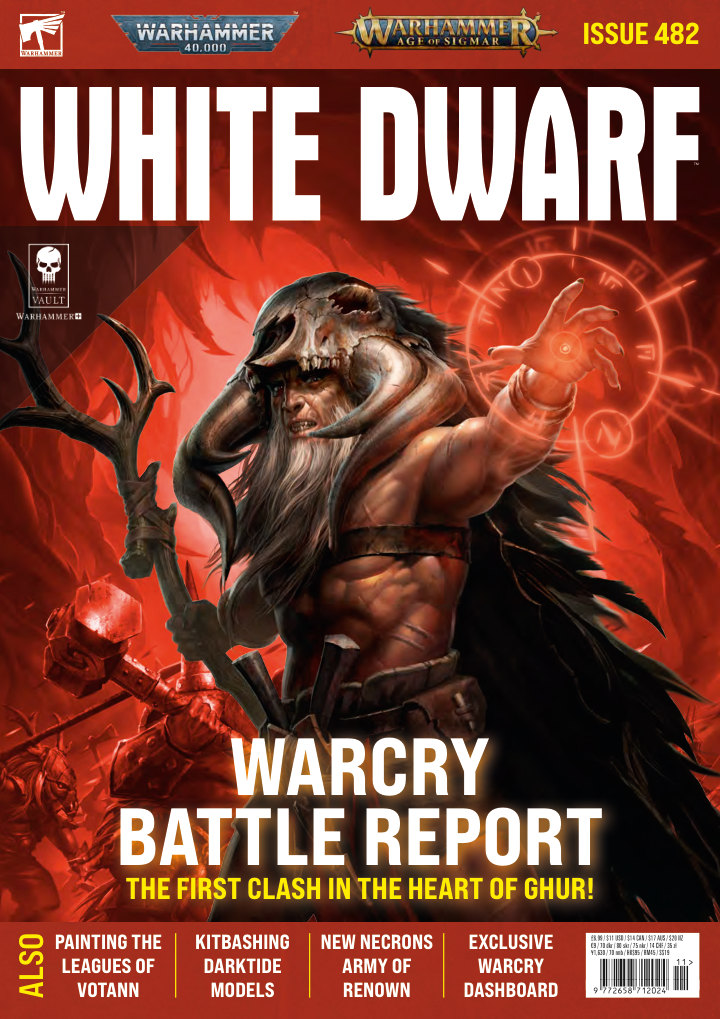
Mark Bedford’s Rotmire Creed defend their home terrain against Damien Pedley’s Horns of Hashut in an open-play Warcry battle. The Horns inflict frightening casualties but struggle to turn violence into positional control, while severed bridges and surviving fighters on high platforms let the Creed secure an 18–13 win.
WarcryRotmire Creed
ModellingWD 482 · pp. 86–89
A layered gaming dashboard keeps initiative groups, wild dice, round count and victory points separate from dice used for attacks. Templates and step-by-step instructions show how to mount paper on board, cut neat recessed compartments and finish the edges, turning a simple included card into a more durable table aid.
Warcry1 paint colour
RulesWD 482 · pp. 90–91
The article explains adding Gnarlwood’s Underworlds fighters to Warcry as ordinary faction members or allied heroes with their companions. Restrictions preserve their named identity and campaign treatment, while suggestions for renamed generic equivalents let collectors use the profiles as inspiration for personalised models.
Warcry
RulesWD 482 · p. 92
Four Slaves to Darkness fighters receive Warcry profiles and a set of shared abilities reflecting their violent possessing spirits. Sarrakkar’s command can trigger coordinated movement or attacks, while individual battle boosts give the small group ways to turn its ferocity into both durability and concentrated damage.
WarcrySlaves to Darkness
RulesWD 482 · p. 93
Velmorn and his undead sons enter Warcry through a five-fighter profile set. Their abilities reward supporting their king and coordinating minions, with command effects and triggered extra attacks turning the cursed family’s loyalty into a practical way to strengthen otherwise limited skeletal warriors.
WarcrySoulblight Gravelords
FictionWD 482 · pp. 94–97
Targug the Cleaver raids a Kharadron convoy while trying to ignore the supernatural rhythm drawing Destruction armies south. His Butcher interprets the drumming as Ghur’s summons, but a captured lockbox supplies a more persuasive motive: valuable deliveries heading towards Brinnock give the pirate captain a profitable reason to follow the same course.
Age of SigmarOgor Mawtribes
PaintingWD 482 · pp. 98–99
A pale undercoat and Contrast colours make the Brute’s textured armour, skin and equipment quick to establish. The guide recommends darker areas first so mistakes can be corrected before surrounding bright colours, with later highlights sharpening individual materials and battle damage adding character to the blue and white armour.
Age of SigmarIronjawz25 paint colours
PaintingWD 482 · pp. 100–101
A blue spray provides the foundation for a darker traditional Ironjawz scheme, followed by coordinated basecoats and shared washes to save time. Separate recipes cover green skin, cloth, leather, worn metal and teeth, while progressive blue and pale highlights lift the armour without losing its deliberately dingy appearance.
Age of SigmarIronjawz28 paint colours
LoreWD 482 · pp. 102–107
Weapons hidden after the Spirefall become dangerous prizes as ancient wards weaken and Tzeentch’s sorcerer Venestrati learns to unravel them. The Lumineth must return to the scarred Doomstretch to protect the Shackler of Peaks, confronting both their civilisation’s past arrogance and an enemy whose earlier contact with the artefacts has changed him.
Age of SigmarLumineth Realm-lords
CampaignWD 482 · pp. 108–112
A two-player campaign follows Tzeentch’s search for a forbidden vault and the Lumineth effort to delay or stop the advance. Secret deployments, location rewards and Doomstretch realm effects shape the route, with the possibility of an early defensive victory or a final unequal confrontation at the vault’s shifting portals.
Age of SigmarLumineth Realm-lords
RulesWD 482 · p. 113
The ruined city offers clues to the hidden weapon and a choice of opening scenarios for different battlepacks. A Tzeentch victory permits a powerful opening endless spell in the following game, while successful Lumineth defenders begin their next battle with additional aetherquartz reserves.
Age of SigmarLumineth Realm-lords
RulesWD 482 · p. 113
The broken remains of an ancient spire-city still hold spell lore behind active magical protection. Its campaign encounter uses a suitable battleplan from the players’ chosen mode, rewarding Tzeentch with improved casting next time or the Lumineth with improved unbinding, so control of knowledge shapes the following magical contest.
Age of SigmarLumineth Realm-lords
RulesWD 482 · p. 113
The haunted sun-towers contain valuable relics the Lumineth seek to recover and the Arcanites would sacrifice. Battlepack-specific scenario suggestions make the location adaptable, while the winner’s following game gains either rerolled Destiny Dice for Tzeentch or an extra Lumineth enhancement.
Age of SigmarLumineth Realm-lords
RulesWD 482 · pp. 114–115
Eight concealed doorways may open, collapse or reveal routes into the forbidden vault. A smaller Lumineth army tries to seal more entrances than the Tzeentch attackers can raid, with end-phase rolls and changing access points rewarding flexible control rather than assuming that every initial objective will remain useful.
Age of SigmarLumineth Realm-lords
TacticsWD 482 · pp. 116–119
The column introduces Nemesis as a limited deck-building format combining a warband’s own cards with one universal Rivals deck. It explains construction, rotation and the step from Rivals to more deliberate choices, using the Gnarlwood decks to show how a constrained card pool can support varied strategies without requiring an extensive collection.
Warhammer Underworlds
TacticsWD 482 · p. 120
Three Battle Doctrines missions focus on the Predator’s varied guns, squadron tactics and mobile hunting role. Restricted army selection keeps each exercise centred on the tank’s intended task, with short repeatable games and swapped roles encouraged so players can compare different approaches to the same tactical problem.
The Horus Heresy
RulesWD 482 · p. 121
Predators face a mixture of targets with different strengths, challenging the attacker to match each weapon to a useful role. Limited force choices and survival-based rewards make the exercise about target prioritisation and the tank’s versatility rather than relying on a full army’s usual specialist support.
The Horus Heresy
RulesWD 482 · pp. 122–124
A Predator squadron must advance aggressively and break through a defensive line. The attacker scores for mobile tanks reaching deep into enemy ground, while the defender benefits from immobilising or destroying them, turning weapon choice and supporting infantry into tools for a practical armoured breakthrough.
The Horus Heresy
RulesWD 482 · p. 125
Predators use speed and concentrated fire in an ambush against forces trying to pass through the battlefield. Destruction rewards the hunting side, while the opposing force seeks to reach the far edge, giving both commanders a reason to manoeuvre instead of settling into a stationary exchange of heavy weapons.
The Horus Heresy
CampaignWD 482 · p. 126
Three deliberately unequal scenarios offer struggling campaign gangs a dangerous way to change their fortunes. The introduction explains why these opportunities emphasise large rewards and genuine risk rather than equal skirmish conditions, with different battlefield types supporting a last stand, experimental drugs or a moving cargo raid.
Necromunda
RulesWD 482 · p. 127
The weaker gang challenges its enemy to an uncompromising fight in which the defenders cannot voluntarily bottle out. Restricted deployment, recovery treatment and substantial rewards make victory potentially transformative, but losing can finish the gang altogether, preserving the scenario’s intended desperation.
Necromunda
RulesWD 482 · p. 128
A desperate gang tests unreliable combat stimms against a stronger opponent. Each dose may injure the user, produce a flawed physical boost or grant an additional action, giving the underdog a tempting way to overcome disadvantage while making repeated reliance on the drugs a risky tactical choice.
Necromunda
RulesWD 482 · p. 129
An underdog raids a valuable shipment during an Ash Wastes Rolling Roads battle. The defender must keep at least one crate intact until the destination is reached, while opening crates destroys them for the attacker and losing them off the board is equally costly, making movement and escort positioning central to success.
Necromunda
CommunityWD 482 · pp. 130–131
The team expands the Tome Keepers through Jason Lee’s Fifth Company collection rather than repeating the already established Third. Discussion of its newly promoted captain and changing Primaris organisation provides the basis for another story, demonstrating how a reader and staff army can contribute fresh characters and conflicts to the shared Chapter background.
Warhammer 40,000Tome Keepers
FictionWD 482 · pp. 132–141
Captain Abhis bal Narath recounts his first campaign with a largely inexperienced Fifth Company after reluctantly receiving command. Fighting Orks forces him to confront resentment, casualties and the limits of leading every assault from the front; by the final campaign he recognises coordinated trust and responsibility as harder duties than personal battlefield prowess.
Warhammer 40,000Tome Keepers
CommunityWD 482 · pp. 142–143
The Season of Skirmish expands past forty participants as staff gain points for painting, terrain and games. Hobby Bingo updates follow several collections and new characters, with Andrew’s ragtag Mordor Orcs receiving a short account of dark base colours, pale highlights and glazed rust that suit their battered equipment.
Warhammer 40,000Age of Sigmar5 paint colours
CommunityWD 482 · p. 144
Matt’s filled cards collect a varied year of painted armies and projects rather than a single continuous collection. The spotlight shows how larger units, characters and vehicles contribute to completing different challenges, with further Imperial Fists still planned even after several substantial hobby milestones are reached.