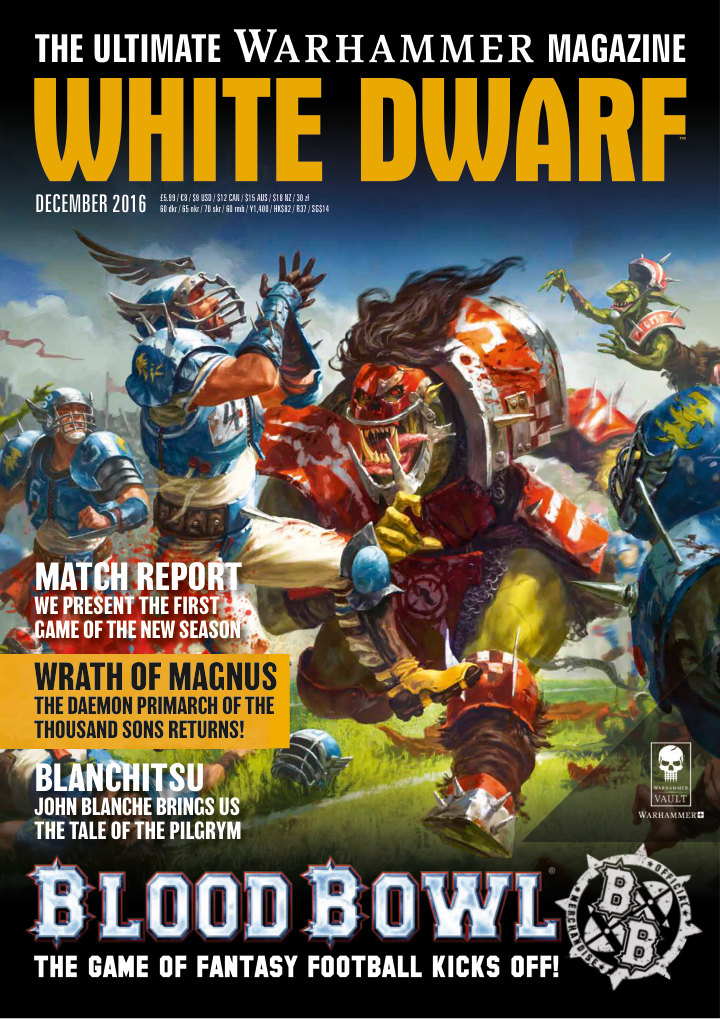
EditorialWD 413 · p. 1
Jim Johnson and Bob Bifford take over the welcome as Blood Bowl returns to the magazine. Their irreverent introduction previews the fantasy-football coverage and a clash between the Gouged Eye and Reikland Reavers, while Magnus and the Thousand Sons provide the month’s other major story.
Blood BowlWarhammer 40,000
ShowcaseWD 413 · p. 4
The Thousand Sons return with a complete wave of plastic miniatures and the concluding Fenris campaign. The preview contrasts these haunted and mutated warriors with their Heresy-era predecessors and introduces Magnus as the leader of their long-awaited revenge.
Warhammer 40,000Thousand Sons
ShowcaseWD 413 · pp. 5–7
The new Blood Bowl box brings Human and Orc teams, a double-sided pitch and the equipment for repeated matches. An annotated tour explains player positions, touchdowns, blocks, passing, the dugout and turn tracking, then introduces leagues and Star Players as ways to expand the basic game.
Blood BowlHumans
ShowcaseWD 413 · p. 5
A new printing of Space Hulk again pits Blood Angels Terminators against Genestealers in a derelict starship. The short introduction emphasises quick decisions, tactical positioning and the uncertainty of the dice in the claustrophobic missions.
Space HulkBlood Angels
ShowcaseWD 413 · p. 8
The first supplement adds more team types, player development and a league framework to the relaunched Blood Bowl. Exhibition play and famous players offer additional alternatives, allowing coaches to develop rookies over time or try an established team at full strength.
Blood Bowl
ShowcaseWD 413 · p. 9
The plastic Skaven team combines rapid runners, tougher Blitzers and underhanded habits. Its twelve players, tokens, coins and warpstone-like balls establish a distinctive team identity, while the included roster offers a route into play alongside the broader options in Death Zone.
Blood BowlSkaven
ShowcaseWD 413 · p. 10
A winter-themed Human and Orc pitch gives familiar teams a seasonal home ground. Its associated weather table adds consequences for the cold rather than simply changing the board’s appearance.
Blood Bowl
PaintingWD 413 · p. 10
Larger black and white undercoat cans are introduced for substantial projects, alongside a terrain spray and additional coloured sprays. The distinctions between undercoating and laying down a useful starting colour connect the new products to different stages of painting.
5 paint colours
ShowcaseWD 413 · p. 11
The Hobbit supplement continues the film campaign through Smaug’s destruction and the Battle of Five Armies, alongside earlier historical encounters. The preview highlights updated character profiles, linked scenarios and benefits for armies drawn from a single list.
Middle-earth Strategy Battle Game
ModellingWD 413 · p. 11
Space Wolves and Thousand Sons transfer sheets provide runes, Legion insignia and squad markings. The article presents them as a way to personalise Heresy collections while noting that their imagery can also serve the later descendants of both Legions.
The Horus HeresyWarhammer 40,000Space Wolves
ShowcaseWD 413 · p. 12
Aaron Dembski-Bowden’s novel addresses the Emperor’s hidden war and the question of what occupied him during the Heresy. The preview emphasises an ambiguous central figure whose revelations generate fresh mysteries, placing the conflict in the Webway within the wider series.
The Horus HeresyAdeptus Custodes
ShowcaseWD 413 · p. 13
Josh Reynolds follows the feared Clonelord when a former pupil offers a prospect that might bring either ascension or destruction. The notice introduces the standard and limited editions, including the latter’s additional story and author material.
Warhammer 40,000Emperor’s Children
ShowcaseWD 413 · p. 13
Matt Forbeck’s four Blood Bowl novels return together as a presentation hardback set. The introduction lists the linked sporting adventures as reading for coaches who want more of the game’s world between matches.
Blood Bowl
ShowcaseWD 413 · p. 13
Gav Thorpe explores the circumstances that made Azrael Supreme Grand Master of the Dark Angels. A war against the Night Lords provides the military setting for a story concerned with hidden rituals and Chapter secrets.
Warhammer 40,000Dark Angels
InterviewWD 413 · p. 13
Gav Thorpe explains how competing secrets make the Dark Angels fertile ground for fiction and why Azrael’s accession supplies a useful moment of change. Trials imposed by the Watchers push the novel towards fantasy, while Ezekiel’s enigmatic advice and invented Legion vehicles reveal further opportunities in the setting.
Warhammer 40,000Dark Angels
ShowcaseWD 413 · pp. 16–17
Space Hulk: Deathwing places a psychic Terminator inside a vast Genestealer-infested hulk, while Speed Freeks turns Ork driving into an endless chase. Console Mordheim, Tau reinforcements for Battlefleet Gothic: Armada, Sanctus Reach and an Ork Armageddon campaign extend the column’s range from personalised skirmish warbands to fleets and turn-based armies.
Warhammer 40,000MordheimDark Angels
ShowcaseWD 413 · p. 18
The first plastic Daemon Primarch towers over the battlefield with alternative faces and weapons. Annotated details emphasise eyes, runes, armour sockets and the book at his waist, connecting his new monstrous appearance to his former identity.
Warhammer 40,000Thousand Sons
ShowcaseWD 413 · p. 19
Ahriman’s new Disc-mounted model preserves familiar details while surrounding him with sorcerous movement. The campaign preview brings him back alongside Magnus and describes narrative and rules volumes covering the Thousand Sons, their formations and psychic powers.
Warhammer 40,000Thousand Sons
ShowcaseWD 413 · p. 20
The Rubric’s dust-bound Legionaries receive ornate plastic bodies, inferno boltguns or warpflamers, and a soulreaper cannon option. An Aspiring Sorcerer directs the squad, making the contrast between living psyker and animated armour central to both background and kit.
Warhammer 40,000Thousand Sons
ShowcaseWD 413 · p. 21
The Legion’s Terminator elite share the Rubricae’s fate, following a living Sorcerer in ornate Tartaros-derived armour. Khopesh-like blades, runic combi-bolters and specialist heavy weapons preserve links to Prospero beneath their later corruption.
Warhammer 40,000Thousand Sons
ShowcaseWD 413 · p. 22
A three-model kit makes the varied gifts of Tzeentch visible through avian heads, altered limbs, elaborate staffs and an optional Disc. Interchangeable details encourage distinct personalities rather than identical sorcerers.
Warhammer 40,000Thousand Sons
ShowcaseWD 413 · p. 23
Cruel and ambitious beastmen search the galaxy for arcane relics in the service of Tzeentch. The plastic kit combines archaic blades with modern pistols and chainswords, while horns and split heads distinguish the Twistbray leaders.
Warhammer 40,000Thousand Sons
ShowcaseWD 413 · p. 24
Two supplements expand smaller identities within the principal Chaos and Imperial armies. Traitor Legions gives the nine original renegade Legions distinct rules and equipment, while Imperial Agents gathers specialist Imperial organisations for use beside existing forces.
Warhammer 40,000Chaos Space Marines
PaintingWD 413 · p. 24
Two newly released paints support the turquoise-blue appearance of the new Thousand Sons range. The short notice identifies a covering base colour and a related layer colour as additions to the Citadel system.
2 paint colours
ShowcaseWD 413 · p. 25
Robbie MacNiven’s novel connects the two Fenris campaigns through a Space Wolves system under daemonic assault. The arrival of numerous fellow Chapters brings uncertainty rather than simple relief, because reports of the Wulfen have made the Wolves themselves suspect.
Warhammer 40,000Space Wolves
ShowcaseWD 413 · p. 25
Two retrospective volumes gather decades of illustration, concepts and background from earlier publications. The Chaos collection reaches back to Realm of Chaos, while its Imperial counterpart revisits the development of the Imperium’s distinctive imagery and history.
Warhammer 40,000
CommunityWD 413 · pp. 26–27
Readers ask for scenery workshops, campaigns and tactical advice, and the replies discuss starting with the reasons two armies are fighting. Existing army background, scenarios and fiction can supply a narrative without requiring an elaborate campaign, while further responses consider the deliberately unresolved lost Legions and the humanity of reforged Stormcast.
Warhammer 40,000Age of Sigmar
PaintingWD 413 · p. 27
Ben Humber clarifies that his homemade Raven’s Watch are intended as Raven Guard successors and describes their black and blue armour. The answer includes the actual paint sequence and explains how long campaigning has produced variation and weathering within the force.
Warhammer 40,000Raven Guard6 paint colours
ShowcaseWD 413 · pp. 28–29
A preview of Inferno brings the opposing Legions at Prospero together with the Talons of the Emperor. The article distinguishes the Heresy-era Wolves from their later legends, considers the Thousand Sons’ unusual psychic character, and examines Simon Egan’s charging Leman Russ model and Fenrisian ornament.
The Horus HeresySpace Wolves
InterviewWD 413 · pp. 30–31
Maxime Pastourel nominates Dale Stringer’s Killa Kans for the pleasure and flexibility of their construction. Cross-compatible limbs, readable mechanisms and spare armour parts make the builder feel like an Ork Mek, while the accessible surfaces and varied silhouettes keep assembling and painting repeated models enjoyable.
Warhammer 40,000Orks
LoreWD 413 · pp. 32–33
Jim and Bob introduce Blood Bowl from inside its own absurd sporting world. Sacred rules, unreliable equipment, flexible pitch measurements, violent spectators and dubious referees explain how familiar touchdowns and drives coexist with fantasy creatures and institutionalised cheating.
Blood Bowl
RulesWD 413 · p. 34
The history of the Reavers leads to their celebrated 2485 championship squad and the moments that established Zug and Griff’s reputations. A complete historical roster lists the players, skills and support staff for the team, preserving an earlier great side as an exhibition option.
Blood BowlHumans
LoreWD 413 · p. 34
A disastrous attempt to throw a Goblin becomes a scoring play when the same unfortunate teammate is hurled into an opposing ball carrier. The diagrammed anecdote celebrates the Orcland Raiders’ improvised violence and Blood Bowl’s ability to turn mistakes into spectacular outcomes.
Blood BowlOrcs
FictionWD 413 · p. 35
The Ogre star discusses rewards, broken faces and the practical benefits of throwing Goblins while repeatedly objecting to the reporter’s form of address. Beside this fictional interview, a ranking of violent players and even a murderous referee extends Spike!’s satire of sporting celebrity.
Blood Bowl
InterviewWD 413 · pp. 36–42
Jervis Johnson explains how Blood Bowl combines tactical decisions with warm-hearted satire of professional sport and fantasy conventions. Team strengths, player skills, formations, turnovers and league development reward different approaches; Andy Hoare and James Hewitt discuss the restrained updates and expanded play options, while Mark Bedford explains the sporting kit and physically built pitch.
Blood Bowl
TacticsWD 413 · p. 39
Three illustrated formations connect the opening set-up to a workable scoring plan. A screen protects an advancing Human catcher, stretch play exploits very fast receivers, and a cage trades speed for the durability needed to grind through the defence.
Blood BowlHumans
ModellingWD 413 · pp. 44–49
An international group turns an infant psyker’s arrival on Terra into a collaborative storytelling game full of competing Imperial faiths and covert agendas. Converted warbands, processional steps and a decayed Botanicarium make the narrative tangible, with rules subordinate to character and imagery; the article explains the preparation and the roles of several factions rather than reducing the event to a winner.
Warhammer 40,000Inquisition
InterviewWD 413 · pp. 52–57
The prize gallery examines how interaction and composition turn painted figures into a coherent scene. Matt Kennedy’s Giant and Carnosaur and David DeBlas’s Centurion duel lead discussions of restrained basing, opposing colours and reposing, with further entries showing an Arco-flagellant, Legion ambush, swamp duel and Eversor gunfight.
Warhammer 40,000The Horus Heresy
PaintingWD 413 · p. 59
Matt Hutson adds Drycha and Spite-Revenants whose autumnal flesh distinguishes them from the greener glade. Painting torsos and bark separately makes the contrasting finishes easier, and a game against Skryre reinforces his enjoyment of the new force.
Age of SigmarSylvaneth3 paint colours
PaintingWD 413 · p. 60
Andrew King adapts Bloab and Bilespurter to his army’s blue palette. A separately undercoated plume makes the vomit easy to colour, iridescent glazed flies enrich the hood, and names for the army’s units develop the Plaguewrought Brotherhood’s identity.
Age of SigmarMaggotkin of Nurgle8 paint colours
PaintingWD 413 · p. 61
James Karch replaces Mannfred’s supporting spirits with ruined masonry to match his army’s bases. Bright skulls deep inside the mount are worked towards darker outer flames, while ethereal weapons and a separate rider keep the complex centrepiece manageable.
Age of SigmarSoulblight Gravelords6 paint colours
PaintingWD 413 · p. 62
Phil Cowey paints both a Weirdnob Shaman and a converted Megaboss rather than choosing one hero. Unusual tattoos, purple magic and changed weapons create distinct personalities within the blue-armoured army, with damage and blood effects reinforcing the Megaboss’s brutal role.
Age of SigmarIronjawz1 paint colour
CampaignWD 413 · p. 63
The four collectors prepare a campaign flexible enough to accommodate busy lives and additional opponents. Borrowing the General’s Handbook’s ladder structure lets victories move a player upwards without requiring everyone to play a fixed schedule.
Age of Sigmar
ShowcaseWD 413 · pp. 64–65
April 2006 is recalled through the versatile plastic Giant, Tau reinforcements and the worldwide Medusa V campaign. Horus Rising’s arrival and Jervis’s predictions about digital sculpting supply a longer perspective on developments that were new at the time.
Warhammer 40,000The Horus Heresy
InterviewWD 413 · pp. 66–75
Ben Johnson’s dark-blue Stormcast collection grows from admiration for new models into chambers with their own names, campaigns and legends. He explains keeping every warrior masked, deriving stories from games and taking unusual collections to events, while straightforward unmixed paints make a very large army consistent and repeatable.
Age of SigmarStormcast Eternals18 paint colours
LoreWD 413 · p. 75
The spotlight explains Sigmar’s rescue and reforging of mortal heroes, their organisation into Stormhosts and chambers, and their eternal war against Chaos. Immortality comes with an uncertain cost, giving these apparently indomitable warriors a troubling future beneath their masks.
Age of SigmarStormcast Eternals
Battle reportWD 413 · pp. 78–89
Jervis Johnson’s Humans beat Matt Keefe’s Orcs 3–2 in a match explained drive by drive. An early Orc cage gives way to quick Human passing scores, but mounting casualties force the Reavers into desperate delaying defence; the last failed Orc dodge decides the match, and both coaches review starting formations, clock management and the importance of forcing risky rolls.
Blood BowlHumans
ShowcaseWD 413 · pp. 90–93
Jamie Forster and Gary Shaw build two connected displays showing Orruks fighting Khornate cavalry around a fortress from the Ironjawz background. Shared work keeps the scenery consistent, while a converted Khazek leads Gary’s army and airbrushed transparent red gives its mounted warriors lacquered armour.
Age of SigmarIronjawz4 paint colours
ShowcaseWD 413 · pp. 94–95
Andy Dunn builds a Mechanicus force that fits a continuing campaign against his friend’s armies. Cream robes, weathered plates and blue energy distinguish Metalica from Mars, existing Knights give the choice a geographical connection, and hidden Assassins add another collecting project.
Warhammer 40,000Adeptus Mechanicus5 paint colours
ShowcaseWD 413 · pp. 96–97
Laura Matarasso imagines two Ghoul Kings whose alliance conceals very different delusions of nobility. Mummified grey flesh and a barren throne-centred display unite their followers, while conversions distinguish the kings, messengers and courtiers and inspire a future mapped campaign.
Age of SigmarFlesh-eater Courts5 paint colours
RulesWD 413 · pp. 98–99
Lost Patrol becomes a cumulative multiplayer competition for up to six people. Scouts initially cooperate to find the dropship, but eliminated Scout players join the Genestealers, and separate achievement scores reward exploration, escape and hunting over several games.
Lost PatrolSpace Marines
RulesWD 413 · p. 100
An all-aircraft multiplayer battle awards points for destroying Flyers and creating aces. Returning destroyed units keep the skies crowded, and a changing Sky Marshal decides attack order for each team; the mission can incorporate Death from the Skies.
Warhammer 40,000
RulesWD 413 · p. 101
Each player controls a single tank within a points limit, gains a random crew trait and deploys according to vehicle cost. Random facing and a turn order favouring cheaper vehicles create a chaotic free-for-all where destroying rivals can repair lost hull points.
Warhammer 40,000
RulesWD 413 · p. 102
Deathwatch kill teams confront packs assembled from two alien units in a team multiplayer scenario. Variable command and returning xenos units sustain the battle, while objective values reward both sides and identify outstanding alien hunters and packs.
Warhammer 40,000Deathwatch
RulesWD 413 · pp. 103–105
Imperial Knights: Renegade gains profiles, location grids and critical-damage tables for an Eldar Wraithknight and Tau Stormsurge. Different advance distances and unique special actions replace the Knight’s ion-shield procedure, allowing either machine to fight Knights or one another.
Imperial Knights: RenegadeAeldari
RulesWD 413 · pp. 106–107
New Deathwatch Overkill profiles bring the expanded Acolyte and Neophyte kits into ambushes by substituting models on Broodmind cards. Mining tools, icons, flamers, seismic weapons and demolition charges add distinct attack effects while preserving the existing ambush framework.
Deathwatch OverkillGenestealer Cults
LoreWD 413 · pp. 108–113
The history follows Magnus from Prospero and the flesh-change through Nikaea, the disastrous warning to Terra and the destruction of his homeworld. Later events carry the consequences into Ahriman’s Rubric and Magnus’s schemes against Fenris, where manipulated Imperial suspicions become another weapon in his revenge.
The Horus HeresyWarhammer 40,000Thousand Sons
InterviewWD 413 · p. 110
Matt Holland discusses making the plastic Magnus recognisably continuous with his Primarch incarnation despite ten thousand years of corruption. An arrogant expression, immense scale, birdlike details and Prosperine imagery carry the character’s history into the miniature, while annotated ornaments leave room for interpretation.
Warhammer 40,000Thousand Sons
PaintingWD 413 · pp. 116–117
Max Faleij explains a modernised Thousand Sons palette that moves the familiar blue towards turquoise. Teal connects the range to sorcery, purple grows more prominent with a model’s importance, and carefully varied materials keep skin, silk, armour and inlaid gemstones distinct without losing the shared scheme.
Warhammer 40,000Thousand Sons
ShowcaseWD 413 · pp. 118–119
The team examines how Wil Davies combines precise painting with composition and knowledge of his subjects. Pale fallen Legionaries frame Angron, an altered Lord of Plagues exposes its painted details, and reflective red armour, converging ornaments and a tiny wanted poster demonstrate different ways to guide the viewer’s eye.
Warhammer 40,000The Horus HeresyWorld Eaters
ModellingWD 413 · pp. 120–125
Blake Spence explains the Forge World display of Autek Mor’s assault on a World Eaters recruiting facility. Cranes, a towering control room and a cargo hauler establish an industrial story through reused components, while correct clearances and visible internal detail make the immense constructions believable; travelling exhibitions require durable sections and an accompanying repair kit.
The Horus HeresyIron Hands
PaintingWD 413 · pp. 126–127
Paul Norton separates the blue armour into two stages so the intervening gold drybrushing can be tidied before the final highlights. Gloss shades warm the metal, gemstone paint gives eyes and runes a supernatural sheen, and further recipes cover pale cloth, yellow panels and weapon details; a separate sequence explains glossing, positioning and sealing transfers.
Warhammer 40,000Thousand Sons25 paint colours
PaintingWD 413 · pp. 128–129
James Gallagher paints recessed fur, metal and black clothing before the team’s bright red and green areas. Separate sequences cover skin, straps, teeth and claws, and the warpstone balls receive green highlights and brass bands; basing advice preserves the mounting hole and disguises the ball’s imperfect fit.
Blood BowlSkaven37 paint colours
ModellingWD 413 · p. 130
James Littler’s Gargoyle illustrates how the moulded guide holes beneath sculpted bases can receive a flying stem. Drilling from below and gradually widening the opening protects the finished surface, while blue-green ground and two kinds of metal connect the base to an industrial setting.
6 paint colours
PaintingWD 413 · p. 131
Three examples show a hero’s base contributing to the model’s story without overpowering it. Blood-smeared steps, rusted arcane mechanisms and toxic fluid in a broken pipe imply different environments, with named recipes for worn metal and a contrasting green gem.
9 paint colours
PaintingWD 413 · p. 132
James Littler combines thicker and thinner ground textures to create ash drifts, broken rock and differently weathered regions. Muted drybrushing ties the mixtures together, while stone, sparse green and toxic recesses distinguish a blighted landscape from a warm orange badlands recipe.
17 paint colours
PaintingWD 413 · p. 133
Snow is added after the rest of a base is complete, building against feet, scenery and grass according to the imagined direction of snowfall. A second demonstration presses tracks or feet into thick wet Texture paint, then washes and drybrushes the dried impressions to make a vehicle’s passage visible.
5 paint colours
PaintingWD 413 · p. 134
Tom Hibberd places a Knight among container parts and piled texture to suggest its weight sinking into the battlefield. Corrosion, repeated washes, coloured barrels and crates, and a final unifying drybrush turn spare scenery pieces into convincing industrial wreckage.
Warhammer 40,000Imperial Knights8 paint colours
ShowcaseWD 413 · p. 136
Chris Bilewicz adds a Ryza priest to his parade force, spending particular care on the robes rather than leaving all the fine machinery in bare metal. The cog transfer on the hood becomes a small but demanding finishing detail.
Warhammer 40,000Adeptus Mechanicus
ShowcaseWD 413 · p. 136
Chris Best returns to Ulthwé to practise highlighting black across curved armour, sweeping fins and flowing cloth. An angled flying stem adds movement to a model chosen partly as a tribute to his first Eldar collection.
Warhammer 40,000Aeldari
ShowcaseWD 413 · p. 137
Tom Moore reverses the studio flame scheme and lets metallic chips define the black armour’s edges. Brown dirt and rust complete an effect that keeps the favourite sculpt’s face framed by horns and spikes.
Age of SigmarIronjawz3 paint colours
ShowcaseWD 413 · p. 137
James Gallagher uses a simple metal-heavy scheme with red details and a large bone trophy as focal points. Rough highlights over two dark washes make the armour look battered rather than polished.
Age of SigmarIronjawz4 paint colours
ShowcaseWD 413 · p. 137
Natalie Slinn explores the contrast between warm cloth and cool gromril on her first duardin. Diluted gemstone paint in the armour’s recesses produces a clean blue sheen before a bright silver highlight.
Age of SigmarDispossessed2 paint colours
ShowcaseWD 413 · p. 138
James Littler chooses the Slaughterpriest as his favourite of five painted Chaos champions. A pink glaze warms the initially pale recesses and makes the exposed skin look more alive than that of its corrupted companions.
Age of SigmarBlades of Khorne1 paint colour
ShowcaseWD 413 · p. 138
Yellow glazes and crimson shading distinguish diseased flesh from the comparatively natural Slaughterpriest. Different placements around sores, pustules and exposed organs make the unhealthy palette read as varied corruption.
Age of SigmarMaggotkin of Nurgle3 paint colours
ShowcaseWD 413 · p. 138
Shared red, gold and black connect James Littler’s champions while leaving room for individual themes. The Sorcerer’s flesh deliberately matches his robes, suggesting a servant of Chaos gradually merging with his equipment.
Age of SigmarSlaves to Darkness
ShowcaseWD 413 · p. 139
A mounted champion becomes a warped counterpart to a noble knight through heraldry, fine cloth and a regal silhouette. Swirling freehand and a mottled mount add decoration, while recurring vials and weapon metal tie the character to the other champions.
Age of SigmarHedonites of Slaanesh
ShowcaseWD 413 · p. 139
The Arch-Warlock brings together green vials, red cloth, worn metal and the group’s restrained highlights. James imagines this particular hero as a solitary seeker of power rather than simply the commander of a large army.
Age of SigmarSkaven
CommunityWD 413 · pp. 140–143
The gallery presents reader-painted Imperial heroes and vehicles, Tau infantry, Stormcast and Bloodbound. Advice on neutral backgrounds, lighting, camera position and focus explains how to submit photographs that preserve the miniature’s detail.
Warhammer 40,000Age of Sigmar
ShowcaseWD 413 · p. 143
Dean Lecoq applies lessons from Darren Latham’s older Ork masterclass to a modern Warchanter. Brown foundations and shadows support a bright mixed-yellow armour colour, with white progressively added for the highlights.
Age of SigmarIronjawz5 paint colours
CommunityWD 413 · pp. 146–147
The introductory guide points prospective Chaos collectors towards their codex and explains the practical roles of the Citadel Paint System’s formulations. Further resources include Blood Bowl’s dedicated site, painting videos and parade galleries, providing several routes from this issue’s inspiration to a first project.
Warhammer 40,000Blood BowlChaos Space Marines
CommunityWD 413 · p. 148
Staff projects follow the month’s Blood Bowl enthusiasm, with Chris’s green-uniformed Orcs and deliberately nostalgic base rims. Matt adds Scarab Occult Terminators to Ahriman’s Exiles, while Martyn prepares richly decorated Grim Hammers for a Middle-earth doubles campaign.
Blood BowlWarhammer 40,000Orcs2 paint colours