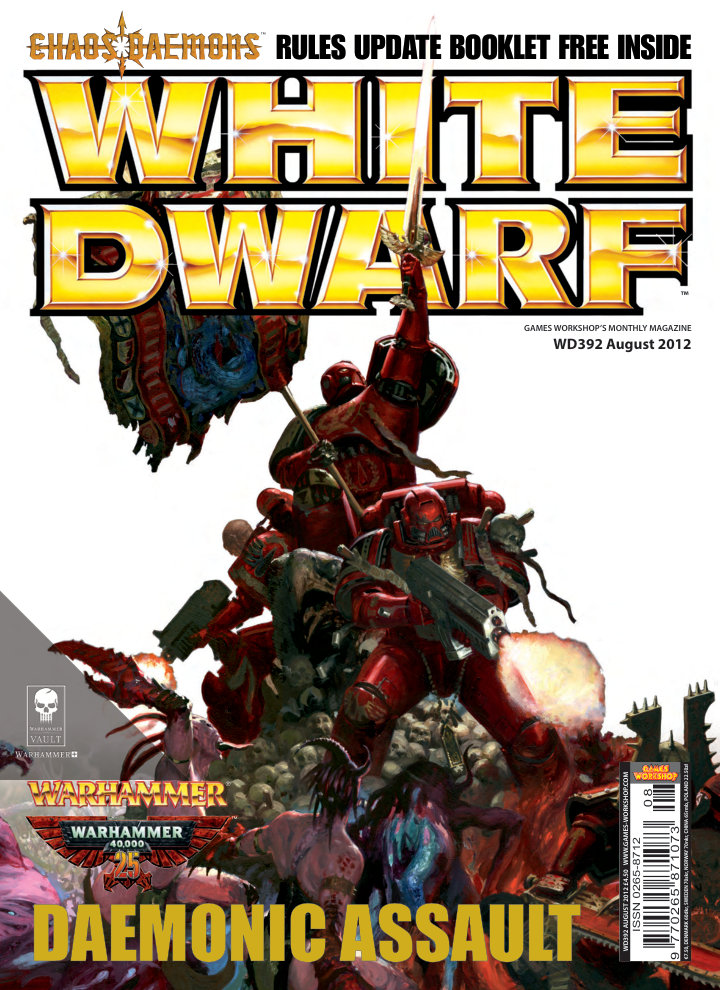
EditorialWD 392 · p. 4
Andrew Kenrick introduces the new Daemon models and the chance to use the same supernatural army in both major games. The Soul Grinder’s arrival in Warhammer particularly excites him, while two battle reports test the new forces against Eldar and High Elves. He also points to allied detachments, the returning Arena of Death and John Blanche’s exploration of plastic characters as the issue’s other major themes.
Warhammer 40,000Warhammer Fantasy BattlesChaos Daemons
TacticsWD 392 · pp. 26–37
Simon Grant introduces the four Chaos Gods through the distinct battlefield qualities of their servants, then compares how those qualities appear in Warhammer and Warhammer 40,000. Khorne supplies direct violence, Slaanesh speed, Nurgle endurance and Tzeentch magic and ranged power, with mixed hosts able to compensate for individual weaknesses. Daemon Princes, Furies and Soul Grinders broaden the selection beyond one patron, while five short painting recipes establish the corresponding flesh colours.
Warhammer 40,000Warhammer Fantasy BattlesChaos Daemons
TacticsWD 392 · pp. 28–29
Khorne’s Daemons rely on closing into combat, with Bloodletters and Bloodcrushers using their infernal blades against well-armoured foes while Flesh Hounds bring faster pursuit. Grant distinguishes their power-sword role in 40K from Killing Blow and magic resistance in Warhammer. In either setting the Bloodthirster sits at the top of the host, with flight and selected gifts turning its already formidable combat ability into a major threat.
Warhammer 40,000Warhammer Fantasy BattlesChaos Daemons
PaintingWD 392 · p. 29
Mephiston Red supplies a solid flesh base, Carroburg Crimson deepens the recesses and Evil Sunz Scarlet restores the raised anatomy. Wild Rider Red gives the final sharp highlights. The compact warm sequence establishes Khorne’s familiar saturated red while preserving enough shade to distinguish the creature’s muscles and face.
Warhammer 40,000Warhammer Fantasy BattlesChaos Daemons4 paint colours
TacticsWD 392 · pp. 30–31
Slaanesh combines grace and murderous speed through Daemonettes, Seekers and Fiends, using initiative, rending or armour-piercing attacks rather than raw resilience. The new chariots add a concentrated impact attack that can break a unit before its crew strikes. Grant compares their charge effects in the two games and highlights how Heralds or a Keeper of Secrets amplify the host’s ability to strike first and exploit flanks.
Warhammer 40,000Warhammer Fantasy BattlesChaos Daemons
PaintingWD 392 · p. 31
The Slaanesh recipe begins with Daemonette Hide and a Druchii Violet wash, then moves through Warpfiend Grey to Slaanesh Grey. Its cool, increasingly desaturated highlights create pale supernatural flesh without losing the purple shadows. The sequence gives a different physical character from the brighter red and pink servants of other gods.
Warhammer 40,000Warhammer Fantasy BattlesChaos Daemons4 paint colours
TacticsWD 392 · pp. 32–33
Nurgle’s diseased creatures compensate for their shambling appearance with exceptional resistance to harm and poisoned attacks. Plaguebearers form a durable core, Nurglings offer swarming numbers and Beasts are effective at pinning an enemy in place. The Great Unclean One combines the greatest endurance with serious combat and magical options, and the comparisons explain how Feel No Pain, Regeneration and other protections express the same identity differently in each game.
Warhammer 40,000Warhammer Fantasy BattlesChaos Daemons
PaintingWD 392 · p. 33
Deathworld Forest and Athonian Camoshade create a murky green foundation for diseased flesh. Nurgling Green lightens the raised surfaces before Screaming Skull defines the final pale details. The restrained progression preserves an unhealthy complexion while making small boils, folds and exposed anatomy readable.
Warhammer 40,000Warhammer Fantasy BattlesChaos Daemons4 paint colours
TacticsWD 392 · pp. 34–35
Tzeentch’s ever-changing creatures emphasise sorcery, magical fire and unusual movement. Horrors and Flamers provide ranged power, while the Lord of Change adds powerful spellcasting and flight; Screamers slash over opponents or bite larger targets. The article distinguishes the Horrors’ collective Wizard levels in Warhammer from the daemon host’s ranged attacks in 40K, showing several expressions of the same magical theme.
Warhammer 40,000Warhammer Fantasy BattlesChaos Daemons
PaintingWD 392 · p. 35
Tzeentch’s pink flesh starts in Screamer Pink, receives Carroburg Crimson shading and is raised with Pink Horror and Emperor’s Children. Each lighter layer leaves the darker colour in the creases, helping the model’s distorted body remain clear. The bright final hue supplies an overtly magical alternative to natural skin tones.
Warhammer 40,000Warhammer Fantasy BattlesChaos Daemons4 paint colours
TacticsWD 392 · pp. 36–37
Mixed Daemon armies use temporary divine cooperation to combine strengths that a single patron cannot provide. Grant then describes the more independent servants: ascended mortal Daemon Princes, scavenging Furies and Soul Grinders that join metal with infernal flesh. Their different roles and upgrade possibilities provide room for a host’s own identity, including the newly available Warhammer use of the Soul Grinder described by the magazine.
Warhammer 40,000Warhammer Fantasy BattlesChaos Daemons
PaintingWD 392 · p. 37
Caledor Sky gives the blue Daemon a strong base and Drakenhof Nightshade defines its shadows. Hoeth Blue and Fenrisian Grey then lighten the exposed forms, producing a cool finish with pale raised details. The four-colour sidebar complements the pink recipe and provides another visual expression of Tzeentch’s changing servants.
Warhammer 40,000Warhammer Fantasy BattlesChaos Daemons4 paint colours
ModellingWD 392 · pp. 40–43
The Studio demonstrates how the new plastic Daemon kits create opportunities beyond their standard assembly. Chad Mierzwa corrupts a Soul Grinder, Matt Hutson uses spare chariot parts for another Herald and Andrew Kenrick carries Plaguebearer details into his Death Guard. The examples connect conversions, leftover components and matching bases, showing how a new unit can change the character of an existing collection as well as add another model.
Warhammer 40,000Warhammer Fantasy BattlesChaos Daemons
ModellingWD 392 · pp. 40–41
Chad Mierzwa stipples Liquid Green Stuff onto the Soul Grinder’s smooth plates, then presses pock marks into the drying surface and adds small putty pustules. A Chaos Spawn tongue completes the impression of a sick, mutated machine. Separate painting assemblies keep the converted areas accessible, and the finished rust and rough texture match the Plaguebearers accompanying it.
Warhammer 40,000Warhammer Fantasy BattlesChaos Daemons1 paint colour
ModellingWD 392 · p. 42
After assembling a Hellflayer and a Seeker Chariot, Matt Hutson uses remaining components to create a Herald on foot. Spare heads and riders are reserved to vary other Daemonettes and Seekers in the army. The example shows the value of considering a kit’s unused parts across the whole collection rather than treating each finished vehicle as an isolated project.
Warhammer 40,000Warhammer Fantasy BattlesChaos Daemons
ModellingWD 392 · p. 43
Andrew Kenrick builds a Daemon allied contingent for his Death Guard, then uses spare Plagueswords, icons and severed heads to reinforce the Marines’ devotion to Nurgle. Nurglings appear on backpacks and a Forge World Dreadnought, with a pile of maggots added to its base. Matching the Plaguebearers’ basing to the existing army makes the visual connection as deliberate as the shared god.
Warhammer 40,000Chaos Daemons
Battle reportWD 392 · pp. 46–57
Matt Hutson combines Saim-Hann Eldar and Dark Eldar against Simon Grant’s two-thousand-point Daemon host in Big Guns Never Tire. The Daemons begin badly with the wrong arrival wave and a destroyed Soul Grinder, but later reinforcements appear behind the Eldar and shift the battle decisively. Lustfury’s Exalted Chariot, the Great Unclean One and a stubborn Horror unit overcome Matt’s specialised fighters, ending in a twelve-to-three Chaos victory. The players’ reflections identify positioning, poisoned firepower and the largely unopposed Razorwing as important lessons alongside exceptionally fortunate Daemon saves.
Warhammer 40,000Eldar
RulesWD 392 · pp. 60–67
The allies article explains how a primary detachment can be accompanied by a smaller force selected from one other codex, subject to compulsory units and the allies matrix. It gives both narrative motives, such as an unlikely alliance against a shared enemy, and the practical opportunity to use a collection too small to field alone. Three Studio examples then show how shared visual themes, a favourite god or complementary units can guide an allied project.
Warhammer 40,000
ShowcaseWD 392 · pp. 62–63
Phil Kelly’s Midgard 144th and the Company of the Lightning Wolf represent a collection developed over years rather than a newly engineered combination. Bearded heads, wolf trophies and Harald Deathwolf transfers on the Guardsmen visually link them to their Marine allies. The published 3,483-point collection combines ordinary soldiers, unusual specialists, armour and aircraft with Grey Hunters, Wolf Guard and Thunderwolves under Harald.
Warhammer 40,000Imperial Guard
ShowcaseWD 392 · pp. 64–65
Wade Pryce explains that his allied Daemons exist because he enjoys painting Khorne’s red servants and wants them on the table with his World Eaters. The 2,988-point published force joins Berzerkers and Terminators to a Bloodthirster, Bloodletters, Flesh Hounds and other infernal fighters. Its unifying idea is a devotion to violent close combat and a favourite visual theme, rather than correcting a calculated weakness in the primary army.
Warhammer 40,000World Eaters
TacticsWD 392 · pp. 66–67
Cruddace turns a small Grey Knights doubles-tournament collection into an allied contingent for his Howling Griffons. The two armies’ Terminators support each other, Interceptors complement Assault Marines and a Purgation Squad adds concentrated shooting. His two-thousand-point list illustrates allies as a way to bring an existing modest project into regular games while reinforcing roles already present in the primary force.
Warhammer 40,000Howling Griffons
LoreWD 392 · pp. 68–69
Mat Ward presents the Blue Scribes through Marius Hollseher’s account in the forbidden Liber Malefic. The two Horrors fight over a scroll until their long-suffering Disc intervenes, whereupon they abruptly become polite collaborators and continue their search. The framing explains Hollseher’s journey through the Mirror of Nightmares and the dangerous survival of his book, giving the Scribes’ absurd quarrel a place within the unsettling Realm of Chaos.
Warhammer 40,000Warhammer Fantasy BattlesChaos Daemons
RulesWD 392 · p. 69
The Warhammer profile lets P’tarix siphon energy from successfully cast enemy spells into the next friendly power pool. Xirat’p contributes a randomly determined spell from a chosen battle-magic lore, cast as a bound spell if a viable opportunity exists. The combination makes the Scribes both a response to an active enemy magic phase and an unpredictable source of flexible support.
Warhammer Fantasy BattlesDaemons of Chaos
RulesWD 392 · p. 69
The 40K profile treats the Scribes as a single Jump Infantry character with a broad catalogue of Daemonic Gifts. Their Watch This! rule can make the second ranged attack repeat the first instead of following the intended plan, translating the brothers’ rivalry into uncertain firepower. Their range of available effects gives versatility, but the duplication roll prevents complete control over how that versatility appears each turn.
Warhammer 40,000Chaos Daemons
Battle reportWD 392 · pp. 70–81
Andrew Kenrick’s 3,500-point High Elves defend Hoeth against Simon Grant’s Daemons in Meeting Engagement. Teclis initially dominates magic and the Elves eventually kill the Bloodthirster and Soul Grinder, but Bloodletters devastate the infantry and the surviving Daemons keep valuable units alive. Epidemius’s attack on Teclis breaks the magical defence, allowing the Blue Scribes and Horrors to decide the late battle. Chaos wins 3,800 to 2,426; the accompanying story leaves open whether the invaders faded through instability or escaped with what they sought from the Tower.
Warhammer Fantasy BattlesHigh Elves
Battle reportWD 392 · pp. 84–87
Andrew Kenrick and Matt Hutson return to character duels with six plastic Heroes equipped to a 125-point limit. Best-of-three contests test the value of magic items as well as raw profiles, and the players allow an equipment revision when one combination proves ineffective. The results favour an Empire Captain, a Savage Orc Big Boss and a Goblin Shaman, showing how a modest character or an opportunistic spell can overturn apparent superiority.
Warhammer Fantasy Battles
Battle reportWD 392 · p. 84
The Empire Captain uses Van Horstmann’s Speculum to exchange key characteristics with a stronger Saurus opponent, turning a numerical disadvantage into a genuine contest. Each wins an opening round, but the Captain survives the final bout through the Seed of Rebirth and lands the killing blow. The heading calls the Lizardman an Oldblood while the explanatory prose calls him a Scar-Veteran, so the printed identification remains ambiguous.
Warhammer Fantasy BattlesThe Empire
Battle reportWD 392 · p. 85
A great-weapon Savage Orc faces a Wight King whose first defensive combination proves poorly suited to the opponent’s strength. After losing the opening round, Matt changes to an Enchanted Shield and Sword of Antiheroes and wins the second, but the Orc takes the deciding fight. The exchange highlights the difference between a promising item interaction on paper and the protection or damage actually needed in a particular duel.
Warhammer Fantasy BattlesVampire Counts
Battle reportWD 392 · pp. 86–87
Two Level 2 Shamans fight with very different lores: the Beastman seeks direct attacks, self-enhancement or a summoned Ghorgon, while the Goblin relies on cunning spell choices. A miscast removes the Goblin in the first round, but Vindictive Glare kills the Bray-Shaman in both later bouts before his monster can reach combat. The Goblin wins by attacking the summoner rather than trying to defeat the summoned threat.
Warhammer Fantasy BattlesBeastmen
ShowcaseWD 392 · pp. 88–91
John Blanche explores why Brian Nelson’s plastic Nurgle Lord inspires so many painters and converters: its broad skin areas and strong character can sustain very different interpretations. Contributors contrast warm and cold tones, internal and external corruption, handmade Nurglings and Imperial conversions for Inquisitorial warbands. Blanche’s own Servitor and Luminark-based figures show the kit moving beyond its original fantasy identity, while Mike Anderson’s surgical inspiration demonstrates how real observation can inform disturbing painted flesh.
Warhammer 40,000Warhammer Fantasy BattlesWarriors of Chaos1 paint colour
ModellingWD 392 · pp. 96–99
The guide follows resin miniatures from cleanup and test fitting through assembly, gap filling, undercoating and basing. It distinguishes fine flash and frame joins from warped components, then shows warm-water or gentle heat correction and explains why resin needs super glue. Liquid Green Stuff handles small bubbles, ordinary putty fills larger joins and suitable basing materials finish the model, with tool examples tied to each actual task.
3 paint colours
ModellingWD 392 · p. 98
Small surface bubbles receive a dab of Liquid Green Stuff that can be filed smooth after drying. Larger assembly gaps are filled with two-part putty and blended into nearby detail using a sculpting tool. The guide distinguishes those repair sizes before applying an undercoat, making surface preparation a separate stage rather than hoping paint will hide a poor join.
3 paint colours
ShowcaseWD 392 · pp. 102–103
Matt Spencer begins his Bad Moonz display by marking a two-foot square on the dining table and testing how many models and vehicles fit. That planning develops into a layered board using ordinary packaging, a Skyshield and a converted Stormraven Ork aircraft with blue LED lighting. A Grot Mega Tank and improvised infantry details complete the collection that wins Edinburgh’s local parade vote.
Warhammer 40,000Orks
CommunityWD 392 · pp. 104–105
News introduces the next School League with expanded heats and encourages pupils to begin preparation with their teachers. Licensed roleplaying releases cover a daring Dark Eldar heist in The Soul Reaver and additional Space Marine Chapter options in Honour the Chapter. The accompanying summer page connects the new edition and paints to local games and preparation for forthcoming painting competitions.
Rogue TraderDeathwatch
CommunityWD 392 · pp. 108–109
Andrew Kenrick previews Games Day’s Studio displays as another celebration of the 25th anniversary and the recently launched sixth edition. Battleforce Challenge armies and ’Eavy Metal’s latest work accompany access to sculptors, painters and writers, with interactive demonstrations projected for visitors. The emphasis is on seeing models closely and discussing how they were created, alongside the usual promise of unrevealed future work.
CommunityWD 392 · p. 113
Leeds’ relocated store establishes itself as a hub for local clubs and newer hobbyists, with gaming tables, monthly campaigns and beginner sessions. Thursday evenings also welcome returning players, providing a route back into the community rather than assuming everyone already knows the current game. The profile links the larger premises to a varied schedule of regular activity.
CommunityWD 392 · p. 115
Southport’s gaming community helps staff build substantial themed terrain, from Warhammer towers and 40K palace gates to Middle-earth rivers and bridges. The scenery remains available for ordinary games, giving collective work a practical ongoing benefit. Campaigns, tournaments and painting or conversion competitions provide further ways for members to contribute and test their skills.