EditorialWD 357 · p. 1
Mark welcomes the return of the classic boarding-action game. Fictional combat transmissions repeatedly interrupt his attempts to discuss the issue. He also celebrates the long-awaited Azhag miniature. The playful format turns the editorial itself into a small part of the Blood Angels’ renewed campaign.
Space HulkWarhammer Fantasy Battles
ReviewWD 357 · pp. 2–3
Two players control Terminators and the aliens opposing their mission inside an ancient derelict. The box contains the figures, corridor network, counters and timer needed to play. Separate rule and mission books explain the tactical challenges. The notice introduces the complete self-contained game whose development and play are examined later.
Space HulkBlood Angels
ReviewWD 357 · p. 4
New metal models portray two particularly formidable Catachan veterans. Straken’s bionics and forward-leading pose emphasise his refusal to avoid danger. Harker carries a heavy bolter with the ease of an ordinary rifle. Their release accompanies background and tactical advice explaining the characters’ different forms of leadership.
Warhammer 40,000Astra Militarum
ReviewWD 357 · p. 5
The Orc warlord rides the heavily protected Wyvern Skullmuncha. Separate sculptors develop the rider and his enormous mount. The resulting metal centrepiece brings Azhag’s destructive reputation into the model range. The notice points forward to the issue’s account of his crown, campaign and eventual defeat.
Warhammer Fantasy BattlesOrcs & Goblins
ReviewWD 357 · p. 6
Resin base covers, slate and etched leaves provide different ways to personalise square bases. Two new grass colours extend the available ground effects. Mixing vegetation can suggest a more natural varied surface. The notice introduces materials whose use is demonstrated in the later basing workshop.
Warhammer Fantasy Battles
ReviewWD 357 · p. 7
The resin daemon engine combines an armoured insect-like body with weapons for close slaughter. Its low scuttling form distinguishes it from a conventional Dreadnought. The notice places the machine among the forces of Khorne. Complete background and rules remain in the third Siege of Vraks volume.
Warhammer 40,000Chaos
ReviewWD 357 · p. 8
Sigmar has united human tribes and driven back the Orcs, but political creation does not guarantee safety. Untamed lands and hostile neighbours still surround the new Empire. A northern Chaos invasion tests both Sigmar and his chieftains. The notice presents the novel as a trial of the fledgling nation after its founding.
Warhammer Fantasy BattlesThe Empire
ReviewWD 357 · p. 8
A prophecy leads the Chapter to a world that appears to contain an Iron Warriors outpost. More dangerous secrets and internal rivalries complicate the expedition. Endurance becomes as important as the initial military objective. The notice promises discoveries with consequences for the Salamanders’ understanding of themselves.
Warhammer 40,000Salamanders
NewsWD 357 · p. 9
The November preview announces a new Skaven army book and model wave. Plastic Clanrats demonstrate the range’s emerging appearance. Returning inventions and new units promise a broader assault from beneath the Old World. The page establishes the release timetable without presenting the forthcoming rules.
Warhammer Fantasy BattlesSkaven
CommunityWD 357 · p. 12
The new school year begins another league cycle with tutorials and practice before regional qualification. Successful teams progress toward the international event at Warhammer World. Teachers and librarians are invited to organise participation. The accompanying Hobby Bar update describes tuition, group booking and holiday activities as another route into the hobby.
InterviewWD 357 · pp. 13–23
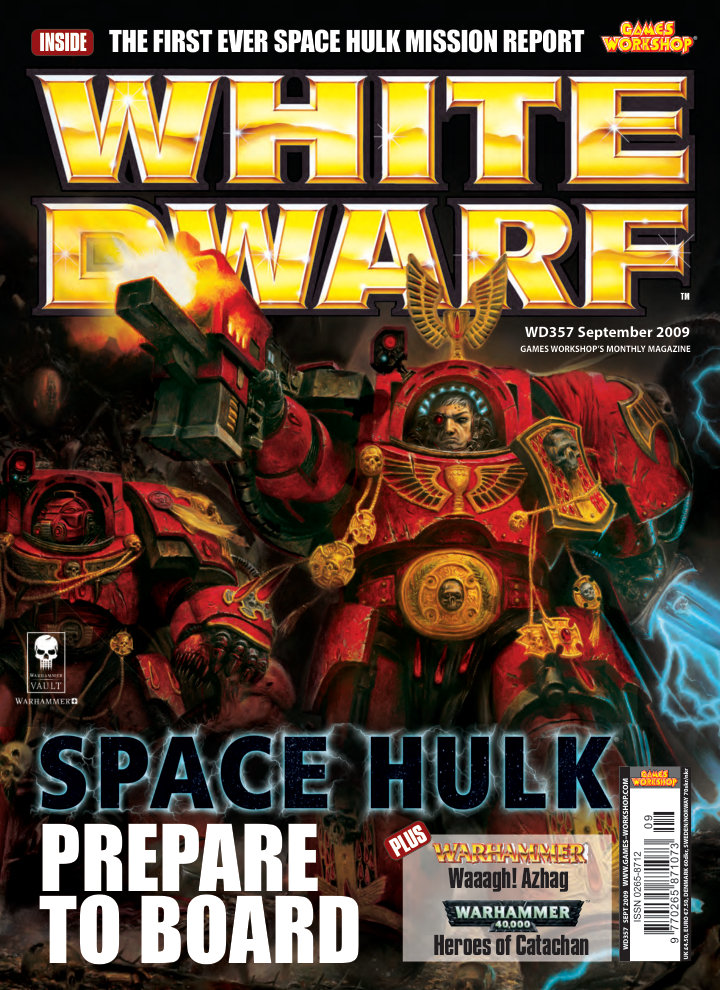
Andy opens the new game and discusses its development with Jervis and Alex. The rules return to the first edition’s timed tension while upgraded figures and board pieces push the presentation further. Individual Terminators receive personalities that influence their sculpts. A historical comparison explains what changed between the three editions and why familiar missions were retained.
Space HulkBlood Angels
BackgroundWD 357 · pp. 18–19
The twelve named figures represent veterans with different habits and histories. Lorenzo seeks redemption for a disaster centuries earlier, while Gideon retains his favoured close-combat equipment. Other brothers contribute marksmanship, steadfastness, ferocity or analytical curiosity. Calistarius’s psychic role sets him apart even within this elite force.
Space HulkBlood Angels
BackgroundWD 357 · pp. 22–23
The retrospective begins with the 1989 game and its Deathwing and Genestealer supplements. The 1996 version changes components and removes the timer. The 2009 release returns to the original structure, restores time pressure and includes selected expanded equipment. Mike McVey’s Deathwing diorama supplies a visual connection to the game’s earlier life.
Space Hulk
Battle ReportWD 357 · pp. 24–43
Andy’s Blood Angels attempt to cleanse two rooms before Tom’s Genestealers destroy their specialist weapons. Turn maps and Jervis’s commentary expose the consequences of deployment, time pressure and broken perimeters. Zael survives an unlikely attack and receives enough command points to reach the final room. A second game with reversed roles ends in another win for Andy, illustrating the value of playing both sides.
Space HulkBlood Angels
ScenarioWD 357 · pp. 25–26
Two differently armed squads must destroy the contaminated targets. Only the heavy flamer and assault cannon can finish the objective, making their preservation essential. The Terminator player chooses an initial marching order that will be difficult to change in narrow corridors. The Genestealer player aims to delay progress while gathering enough attackers to overwhelm those positions.
Space HulkBlood Angels
PaintingWD 357 · pp. 44–49
Anja paints one area to completion at a time, beginning with the Blood Angel’s defining red armour. The cloak, metals and stone badge receive contrasting finishes. Ageing highlights support Lorenzo’s background as an exceptionally old veteran. Gems, sword energy, hair and lenses complete a characterful result with recipes extending beyond the initial paint checklist.
Space HulkWarhammer 40,000Blood Angels34 paint colours
PaintingWD 357 · p. 45
A red-and-brown foundation gives Anja precise control of the armour’s colour. Dark recesses and progressively brighter edges establish the form before a red glaze ties the stages together. The advice explains why orange highlights work better than simply adding white. Alternative shading colours can also change the temperature of the finished red.
Space HulkWarhammer 40,000Blood Angels9 paint colours
PaintingWD 357 · p. 46
Warm pale lining contrasts with the black outer cloth. Thin layers build the lining through brown and bone to white. The darker fabric receives controlled grey edge work. Completing both sides carefully avoids contaminating already finished surfaces and preserves the sharp shape of the cloak’s streamers.
Space HulkWarhammer 40,000Blood Angels6 paint colours
PaintingWD 357 · pp. 46–47
The storm bolter starts with a dark metallic mixture and receives a black shade. Successive silver highlights define edges and exposed detail. Gold uses a brown foundation and wash before brighter metal restores the raised surfaces. The guide also recommends keeping metallic paint out of the water used for ordinary colours.
Space HulkWarhammer 40,000Blood Angels8 paint colours
PaintingWD 357 · p. 47
Anja treats the honour badge as a monumental stone object. Brown-grey foundations and a dark wash establish depth. Grey and Foundation highlights gradually move toward white on the most prominent points. The same method is later reused on the skull decorating the knee.
Space HulkWarhammer 40,000Blood Angels7 paint colours
PaintingWD 357 · p. 48
The face begins with an earthy flesh mixture and two separate brown shades. Increasingly pale highlights emphasise the sculpted ridges. Additional bone and white mark wrinkles without changing the whole face to a flat pale colour. The result supports the character’s centuries of service.
Space HulkWarhammer 40,000Blood Angels7 paint colours
PaintingWD 357 · pp. 48–49
Purple gems receive a bright point and narrow reflected highlights. Blue energy lines and a green-turquoise glaze make the sword stand apart from ordinary metal. Hair, lenses and cables add smaller contrasts using their own concise recipes. Several final notes explicitly reuse the earlier metal and stone methods rather than introducing unrelated finishes.
Space HulkWarhammer 40,000Blood Angels21 paint colours
CampaignWD 357 · pp. 52–61
The campaign report returns to the competing maps as the planetoid approaches Meridian. Shorter games show commanders adapting their attacking and defending styles. The finale draws enormous forces to the missile launch site. The invaders win the objectives, but the defenders are allowed to launch the rocket; the closing fiction has Deathleaper sabotage it and the Rok continue its descent.
Warhammer 40,000Imperium
TacticaWD 357 · pp. 56–57
Andrew’s Salamanders combine flame and melta weapons with a strong defensive complex. Honour markings record successful units as the campaign develops. Wade instead exploits attacking force selection with Terminators, Obliterators and Daemon Princes. Their accounts show two very different armies finding a particular role within the same invasion framework.
Warhammer 40,000Salamanders
Battle ReportWD 357 · pp. 58–61
Imperial tanks and Marines join Ulthwé against Tyranids and opportunistic Tau. The Revenant weakens the Hierophant before the Iron Saint delivers the killing shot. Concentrating on casualties leaves the defenders short of objectives, and the invaders take the battlefield. The adjudicated rocket launch creates one last fictional reversal when Deathleaper destroys its crew, leaving Meridian’s catastrophe imminent.
Warhammer 40,000Tyranids
CommunityWD 357 · pp. 62–67
Andy and Ted return with an Empire and High Elf alliance while Andrew and Glenn field Chaos and Skaven. Seven games expose the strengths and weaknesses of both plans. Accounts from a high-finishing team and the last-place pair broaden the view of the event. Andy’s team reaches fiftieth and the other Dwarfers fifty-seventh, with the social experience as prominent as the standings.
Warhammer Fantasy BattlesThe Empire
RulesWD 357 · p. 63
Two players each provide a force within a shared army limit. Each contributes a leader and basic troops, while the combined selections follow the stated army framework. Magic items and banners cannot simply be duplicated across both halves. The sidebar records the event’s contemporary restrictions alongside the two example lists.
Warhammer Fantasy Battles
TacticaWD 357 · pp. 68–69
Harker’s strength lets him carry Payback as other soldiers carry a rifle. His background follows the Catachan Devils through difficult raids and a Ravener ambush. Robin then explains how cover, movement and mobile heavy fire suit the veteran squad. Flamers and infiltrating options reinforce its ability to take and hold an objective.
Warhammer 40,000Catachan Jungle Fighters
TacticaWD 357 · pp. 70–71
Straken’s bionics follow a career of wounds suffered while fighting beside his men. The Dulma’lin account contrasts his regiment’s sacrifice with the credit claimed by a later officer. Robin describes the combat benefits he grants nearby troops and his own close-range threat. A supported command squad helps keep that aggressive leadership functioning at the front.
Warhammer 40,000Catachan Jungle Fighters
BackgroundWD 357 · pp. 72–74
The Crown of Sorcery brings Nagash’s ancient influence into an Orc warlord’s mind. Unusual tactics and dark magic make Azhag’s advance especially destructive. His defeat at Osterwald ends the campaign and sends the crown into guarded confinement. The final advice explains balancing a powerful flying character with the risks of artillery and the needs of the infantry below.
Warhammer Fantasy BattlesOrcs & Goblins
Battle ReportWD 357 · pp. 76–95
Ben Johnson’s greenskins face Ben Curry’s Dark Elves in a competitive pitched battle. Early artillery kills the Manticore while Elven shooting removes the Giant. March blocking, carefully chosen charges and opportunistic objective control matter as much as direct casualties. The Dark Elves finish ahead on points, but the gap falls short of the victory threshold and the battle ends in a draw.
Warhammer Fantasy BattlesOrcs & Goblins
ColumnWD 357 · pp. 96–97
Jervis introduces a series of scenarios intended to test tactical judgement beyond familiar pitched battles. Variety also supports immersion and gives different armies new problems to solve. The proposed format favours ordinary terrain and a small number of meaningful special rules. Readers are invited to contribute their own tactical responses to each challenge.
ScenarioWD 357 · pp. 98–99
Both commanders secretly choose how hard to march before the battle. A higher commitment may secure the first deployment and objective placement but leaves more units arriving late. Reinforcements enter on the second turn, forcing a balance between position and concentration. Jervis credits Nigel Stillman’s earlier scenario and explains why the opening decision has no obvious universally correct answer.
Warhammer Fantasy Battles
ModellingWD 357 · p. 100
Chad uses a resin base cover to imply a Black Orc’s recent victory. Etched leaves personalise a Wood Elf and curl around a weathered trebuchet. The examples treat bases as small pieces of narrative scenery. Suggested extensions include hidden snipers and camouflaged vehicles, without naming a particular paint recipe.
Warhammer Fantasy Battles
ShowcaseWD 357 · pp. 102–103
James builds armies around tournament deadlines and a particular skill he wants to develop. This force explores conversion across every plastic figure, often through changes subtle enough to be overlooked. Dark blue and rich decoration draw inspiration from Dave’s Marines. Scouts, Sternguard and a Dreadnought illustrate a consistent visual identity while preserving practical gaming roles.
Warhammer 40,000Ultramarines
CommunityWD 357 · pp. 106–108
The guide maps the expanded event across the NEC’s halls. Different areas accommodate gaming, studio work, seminars, sales and the Hobby Zone. Practical notes explain meeting points and finding assistance in the large venue. The feature records the organisation of the September 2009 event alongside its activities.
All substantive design features, histories, mission and battle reports, painting stages, rules, modelling and community articles in the supplied 124-page source are indexed. Space Hulk uses its 2009 third edition, distinct from Warhammer 40,000.