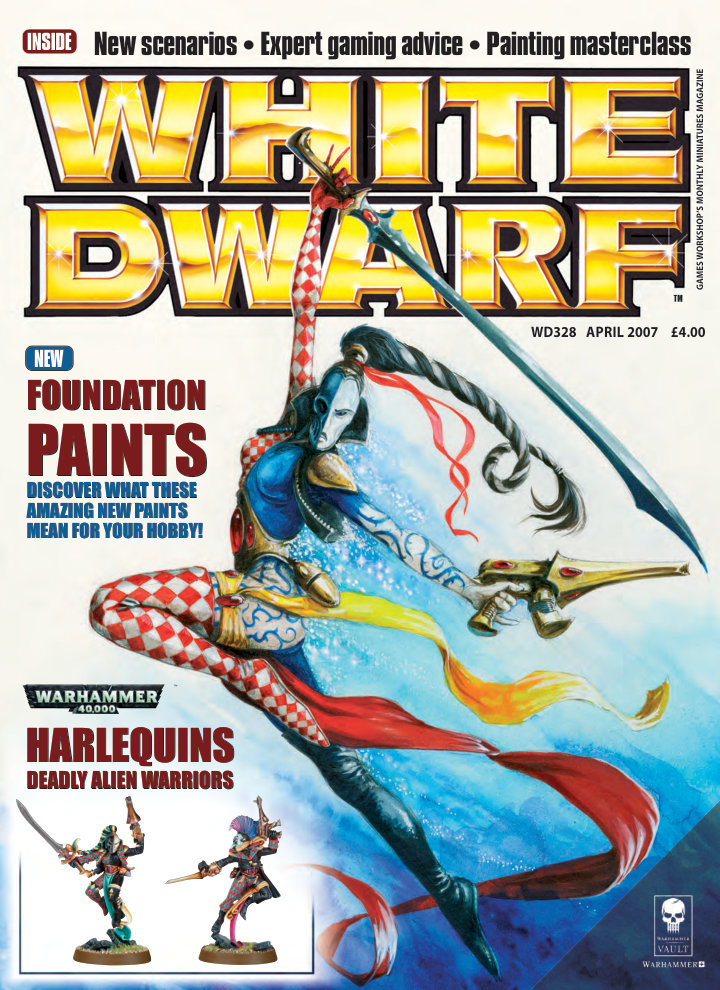
EditorialWD 328 · Inside cover
The editorial introduces the Harlequins as guardians of the memory of the Eldar Fall whose performances and warfare are inseparable. Holo-fields, flip-belts and exceptional training explain their elusive battlefield presence. Alongside these dramatic warriors, Foundation Paints promise a practical change to the hobby: solid basecoats that can speed either mass army painting or more elaborate display work.
Warhammer 40,000Eldar
ModellingWD 328 · p. 16
The forthcoming scenery range combines plastic trees, buildings and hills with a large ready-finished gaming board. Its six sections are intended to make a full battlefield easier to store, while the Fortified Manor supplies a particularly customisable Empire setting. The preview presents terrain as part of collecting and gaming, extending the same modular approach already familiar from miniature kits.
Warhammer Fantasy BattlesThe Empire
CommunityWD 328 · p. 18
Warhammer World’s gaming arena begins a programme of exhibitions displaying original paintings and miniatures normally seen only in reproduction. The first show draws on the Empire, followed by Dark Angels imagery and a personal selection from John Blanche. The article links these displays to the previous Nottingham Castle exhibition’s success, making the developing visual history of the hobby accessible alongside its gaming events.
Warhammer Fantasy BattlesWarhammer 40,000
PaintingWD 328 · p. 19
A painted goblin illustrates how four Foundation colours can establish distinct parts of a miniature directly over its undercoat. The short feature introduces the practical basecoating roles of green skin, brown equipment, red weaponry and yellow heraldry. It accompanies the range’s demonstration programme, showing the simple starting scheme that later highlights could develop.
Warhammer Fantasy BattlesOrcs & Goblins4 paint colours
InterviewWD 328 · pp. 24–29
Andy Hall speaks to Jes Goodwin and Phil Kelly about reviving the Harlequins after more than fifteen years. Cleaner sculpted surfaces leave painters room for patterns, while elevated poses and paired faces communicate movement and duality. The rules place a flexible but fragile troupe within the Eldar army, using psychic concealment, terrain freedom and repeated assault to preserve a theatrical identity without overshadowing Aspect Warriors.
Warhammer 40,000Eldar
PaintingWD 328 · p. 27
Fine crossing lines establish a regular diamond grid before alternating shapes are filled with flat colours. A small highlight at the top of each diamond gives the pattern definition without requiring an elaborate blend throughout. The illustrated method separates geometry from finishing, making the Harlequins’ signature costume pattern easier to reproduce consistently on curved miniature surfaces.
Warhammer 40,000Harlequins
TacticsWD 328 · pp. 28–29
Phil Kelly’s 2,000-point example force places Harlequins among several units able to strike hard and escape a counterattack. Psychic support improves their chances, mobile troops handle lighter enemies and heavy weapons remove tanks that threaten the infantry. The central decision is when to withdraw: escaping immediately can preserve a threatened unit, while remaining until the enemy turn permits a fresh charge with its bonuses.
Warhammer 40,000Eldar
PaintingWD 328 · pp. 30–31
A printable trouper drawing lets painters test costume designs before committing to the miniature. The examples move from simple black-and-white contrast through bold colour blocks to intricate diamonds and stripes. The guide warns that strongly competing hues can overwhelm a small figure and suggests softening one into a pastel, encouraging adventurous schemes whose contrasts remain deliberately controlled.
Warhammer 40,000Harlequins10 paint colours
Battle reportWD 328 · pp. 32–47
Phil Kelly’s Iyanden assault force contests ruined Veistopol with Christian Byrne’s Black Legion in a Cities of Death Firesweep mission. Eldar mobility secures buildings early, while Harlequins repeatedly leave combat and return where they can matter most. Chaos inflicts serious losses through daemons, Obliterators and a collapsing building, but its static deployment loses the objective race. The Eldar eventually claim every ruin, demonstrating the importance of movement even in a vicious close-range battle.
Warhammer 40,000Iyanden
PaintingWD 328 · pp. 52–59
Guy Haley explains why highly pigmented Foundation Paints complement the brighter and more translucent Citadel Colour range. Coverage comparisons show how they establish a smooth base over black or white, after which ordinary paints and inks can supply any desired finish. Brush-handling advice, a fast Blood Angels method and advanced Space Marine and Dwarf examples demonstrate a single system serving both efficient gaming armies and carefully layered display miniatures.
42 paint colours
PaintingWD 328 · pp. 56–57
Neil Hodgson begins by drybrushing metal across the black-undercoated models, then paints their armour with an opaque red base. Black areas are tidied before brown pouches, skin, seals and parchment receive their individual colours. A brown ink wash and matching drybrush finish the sandy bases, producing a coherent gaming unit with few stages and little need to revisit the metal details.
Warhammer 40,000Blood Angels8 paint colours
PaintingWD 328 · p. 58
Pete Foley takes a simply basecoated Marine to a display finish through selective washes and progressively finer layers. Orange highlights intensify the red armour, several metallic grades sharpen the weapons, and green lenses provide a focal contrast. Transfers are secured under gloss before an overall protective finish, showing how an efficient initial scheme can remain the foundation for much more elaborate work.
Warhammer 40,000Blood Angels20 paint colours
PaintingWD 328 · p. 59
Anya Wettergren develops the Dwarf’s Foundation basecoats through different treatments for beard, skin, cloth and metal. Inks establish rich shadows while the later layers move through brighter reds, greens and blues without losing the initial dark structure. Mixing Foundation Paints with ordinary colours requires proportionally more of the latter, making this example a practical demonstration of combining the two ranges.
Warhammer Fantasy BattlesDwarfs25 paint colours
CampaignWD 328 · pp. 64–70
The surviving Dwarfs escape their occupied mine as an Empire relief column answers their call. Night Goblins collide with the vanguard before Black Orcs join the race to capture the escaped prisoner. Two linked scenarios culminate in an alliance defending the maddened Dwarf, whose final revelation identifies the Nemesis Crown beneath the Howling Hills and connects the local rescue story to the coming worldwide campaign.
Warhammer Fantasy BattlesDwarfs
RulesWD 328 · pp. 66–67
An Empire vanguard and Night Goblin force unexpectedly meet while marching through the forest. Written orders of march control deployment, so units emerge along each column rather than adopting a freely chosen battle line. Six turns of ordinary victory points decide the encounter, and the winner receives reinforcements for the final battle, making deployment planning part of the campaign’s continuing consequences.
Warhammer Fantasy BattlesThe Empire
RulesWD 328 · pp. 68–69
Three-thousand-point armies converge on a central hill where a maddened Dwarf is restrained by his kin. The Empire may include Dwarf allies, while the greenskins must bring Durkol and Black Orcs. An uncertain ending prevents a perfectly timed final rush, and the nearest eligible unit wins control of the prisoner. Earlier campaign victories therefore matter by improving the forces available for this decisive objective battle.
Warhammer Fantasy BattlesThe Empire
EditorialWD 328 · pp. 71–73
A rediscovered 1988 miniature-painting book prompts Jervis to trace Citadel’s development from role-playing figures into complete armies and original settings. Rick Priestley’s Warhammer, John Blanche’s painting influence and Alan Merrett’s casting work each solve a different problem of the growing hobby. Acrylic colours, slotta bases and multipart plastics emerge as connected innovations that made large, varied and highly finished collections possible.
TacticsWD 328 · pp. 74–79
Adam Troke organises Evil heroes by the jobs they perform rather than by their impressive profiles alone. Destructive monsters need support to keep choosing fights, leaders and shamans maintain courage, and spellcasters dismantle formations before assassins finish isolated targets. Preserving a wraith’s last Will point can make its late-game presence more valuable than another spell, while Sauron demonstrates how a dominant hero can distract opponents from the rest of an objective-taking force.
Middle-earth Strategy Battle GameMordor
TacticsWD 328 · pp. 80–85
Pete Foley explains how a shooting army’s deployment determines the short window in which its weapons can work. Concentrated or overlapping fields of fire should match the enemy’s mobility, and targets must be selected for their actual threat rather than their appeal. The guide also covers artillery protection, deliberately induced Panic, practical casualty goals and ways assault armies can survive the approach, ending with a mobile Wood Elf force and less obvious missile threats.
Warhammer Fantasy BattlesThe Empire
TacticsWD 328 · p. 84
The two-thousand-point Wood Elf force combines long-range archers with mobile harassment and a protective Eternal Guard regiment. Glade Guard concentrate on major threats while scouts, Waywatchers and mounted units pressure the flanks. Wardancers, Warhawk Riders and a Great Eagle then finish weakened enemies, giving the missile army a coordinated combat phase rather than expecting arrows alone to win.
Warhammer Fantasy BattlesWood Elves
PaintingWD 328 · pp. 86–89
Layering creates depth by reserving the original base colour between darker creases and lighter raised surfaces. The guide distinguishes direct painted shading from a thin wash and explains why increasingly narrow highlights give a smoother finish. A colour chart pairs the new Foundation range with established shades and highlights, while an Orc Warboss and Stormtrooper demonstrate the method on skin, cloth, armour and camouflage.
Warhammer Fantasy BattlesWarhammer 40,000Orcs & Goblins59 paint colours
PaintingWD 328 · p. 88
The Warboss recipe establishes opaque blocks of colour before shaded metallics and narrow highlights define the equipment. A grey-white fur cloak contrasts with red cloth, while brown leather and bindings keep the smaller details distinct. The green face progresses through a dark wash to a mixed highlight, and individual teeth and horns receive pale finishing touches that make the expression readable.
Warhammer Fantasy BattlesOrcs & Goblins19 paint colours
PaintingWD 328 · p. 89
Grey carapace armour and dark boots are sharpened with restrained highlights above a green camouflage uniform. The face uses a separate stubble mix and carefully shaded eyes, mouth and ears, while a gold sword hilt supplies a small bright accent. The camouflage inset builds lighter green shapes inside broader patches, making a repeatable three-colour pattern suitable for the rest of the squad.
Warhammer 40,000Imperial Guard19 paint colours
PaintingWD 328 · pp. 92–97
Anya Wettergren works through Sammael in subassemblies, finishing each material before moving to the next. Differently shaded brass and gold, finely layered robes and subtly shaded white provide contrast against the jetbike’s black body. Facial glazes and small coloured details reward close inspection, while carefully limited grey edges preserve the black armour. A blue-black obsidian sword receives its own treatment to distinguish it from the surrounding machinery.
Warhammer 40,000Dark Angels30 paint colours
ShowcaseWD 328 · pp. 98–102
Painted heroes and warriors illustrate the distinct character of Middle-earth’s principal orc and goblin forces. Mordor’s crude equipment and red-eye devices contrast with Isengard’s organised Uruk-hai and White Hand markings, while Moria’s goblins populate the abandoned Dwarven depths. Named leaders, shamans, trackers, berserkers and warg riders broaden the visual survey without supplying a new painting recipe or rules system.
Middle-earth Strategy Battle GameMordor
PaintingWD 328 · p. 103
Purity Seal protects gaming miniatures through several light applications that preserve the painted finish. The guide stresses temperature, distance and a moving spray action, followed by clearing the nozzle after use. Ardcoat supplies a different effect: localised glossy surfaces for wet mouths, blood or similar details, demonstrated on Gobbla rather than applied indiscriminately over every material.
2 paint colours
ShowcaseWD 328 · pp. 106–108
The gallery presents allied collections from the previous season’s doubles tournament, including Richard Sherlock’s Wood Elves and Steve Mercer’s Bretonnians. Stephen Bennett and Gregory Aston pair woodland spirits with Dwarf artillery, while Phil Walter and Paul Given display carefully coordinated Elven characters. Event photographs and podium results place the painted armies in their social setting, where shared collecting and collaboration accompany competition.
Warhammer Fantasy BattlesWood Elves