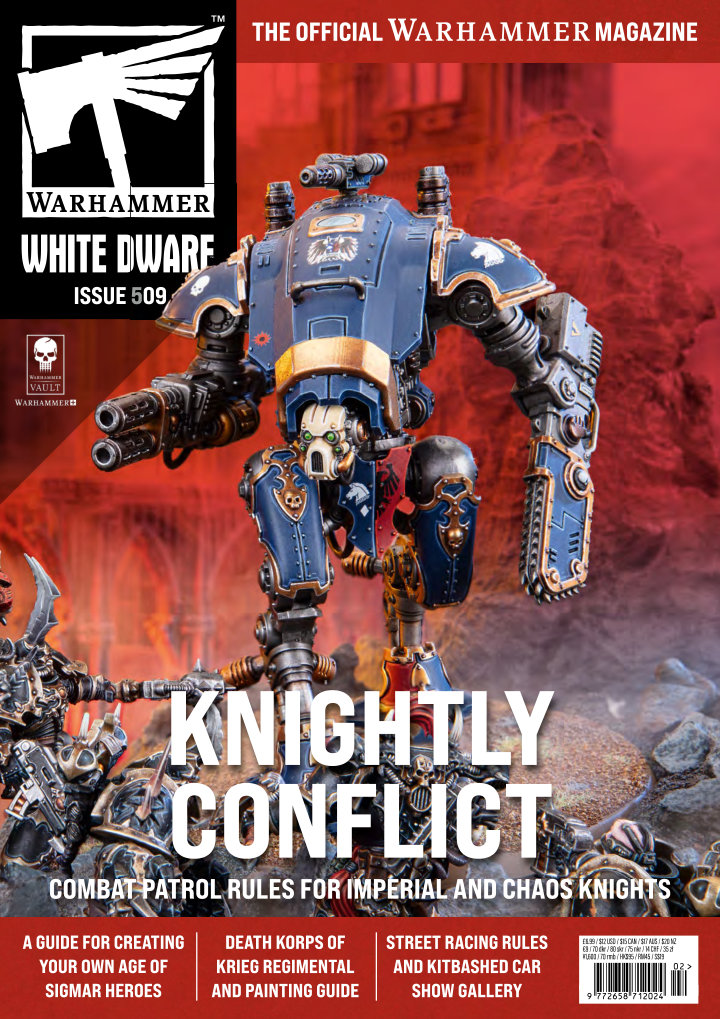
EditorialWD 509 · Inside cover
Lyle introduces the studio Car Show as a painting challenge that grew into an enthusiastic conversion competition and a day of Street Racing. He connects its imaginative kitbashes with this issue’s home-made Age of Sigmar heroes, and points readers towards Death Korps organisation, markings and the studio painters’ approach to weathering.
CommunityWD 509 · pp. 2–6
Readers discuss squeezing painting into the first months of parenthood, returning to the hobby after difficult years, and discovering unfamiliar Space Marine Chapters through store painting challenges. The gallery ranges from Ushoran and a Bad Moons Deff Dread to Mephiston and Holga Clovenhorn, while a news item celebrates the Tome Keepers’ appearance in Space Marine II.
Warhammer 40,000Age of Sigmar1 paint colour
PaintingWD 509 · p. 7
Marcin Kamiński turns a hornet spotted near his beehives into the starting point for a Tyranid colour scheme: yellow and red carapace, complementary purple flesh and turquoise psychic details. His process begins with a black-to-grey zenithal undercoat, then combines thinned Contrast mixtures and drybrushed highlights to create controlled gradients without making the creature a literal insect copy.
Warhammer 40,000Tyranids15 paint colours
LoreWD 509 · pp. 8–11
Colin explains how recurring “anchoring points” make a vast fictional setting coherent. Colours, psychology, military doctrine and reasons for fighting establish recognisable factions, from Codex-minded Ultramarines and the sacrifice of the Sisters of Battle to Ork superstition and T’au coordination. Exceptions gain their force from that shared baseline: Cawl, the Lamenters and the Farsight Enclaves work because the audience understands what they diverge from.
Warhammer 40,000Space Marines
RulesWD 509 · pp. 12–13
The Anvil of Apotheosis turns a converted model or a favourite miniature into a bespoke Path to Glory hero. Destiny points purchase archetypes, mounts, abilities and artefacts, while origins and flaws give the developing rules a narrative direction. The introduction frames the five following characters as worked examples of how a background can emerge alongside the rules, and encourages readers to adapt Underworlds, Warcry and commemorative models as well as ambitious conversions.
Age of Sigmar
RulesWD 509 · pp. 14–15
Jake’s mounted Tzeentch sorcerer began as a Collegiate Arcane mage abandoned during a failed relief mission. A bargain made beside an iridescent mountain pool transformed both him and his stolen horse, leaving him determined to bring down Vindicarum. The worked Anvil build spends an Aspiring Lord’s destiny points on a winged daemonic steed, anti-priest attacks and a foretelling ability that grants strike-first in a chosen or randomly determined round; arrogance removes his access to All-out Defence.
Age of SigmarSlaves to Darkness
RulesWD 509 · pp. 16–17
Nyle combines an Eshin assassin’s stealth with Masterclan sorcery in Krizzach Kraw, a deaf survivor of a disastrous Skryre explosion. His escape from an assassination mission leads to an uneasy bargain with a Grey Seer and a hunger for further magical power. The accompanying build uses the Eshin affiliation to relocate nearby units, adds a stronger warpstone blade and ward, and balances unusual good fortune against a flaw that can make commands cost extra.
Age of SigmarSkaven
RulesWD 509 · pp. 18–19
Dan’s self-proclaimed Arch-arch Warlock is an ambitious Skryre raider who steals Kharadron technology, nurses a grudge against the Sylvaneth and relies on an albino spotter rat. A Clan-Lord’s generous destiny-point allowance supports a resilient, heavily armed hero with an experimental incinerator and improved melee attacks. His Favoured Pack bodyguard and Incessant Tinkerer abilities turn the model’s entourage and engineering obsession into battlefield support rules.
Age of SigmarSkaven
RulesWD 509 · pp. 20–21
Phil’s rust-armoured Warchanter insists that ever-louder drumming earns the attention of Gork and Mork. His stolen shout stick and rivalry with the grots of Skrappa Spill establish a swaggering history behind the conversion. Built from the modest Ironjawz Yoof allowance, Aggrok gains priestly power through Da Choppas, extra resilience and mobility, but must charge nearby enemies; his Rousing Ruckus rewards keeping other Ironjawz close enough to join the noise.
Age of SigmarOrruk Warclans
RulesWD 509 · pp. 22–23
John’s Stormcast warrior carries two layers of disgrace: he once served Khorne, and after redemption his recklessness killed the Draconith bonded to him. Now one of the blood-stained Pillars of Remorse, he fights at the Abhorrent Breach while doubting that he deserved salvation. The Anvil build makes him a foot-bound Warrior Chamber swordsman with a ward and improved blade, combines nearby healing with his Redeemed origin, and represents his pride by forbidding retreats.
Age of SigmarStormcast Eternals
ModellingWD 509 · pp. 24–29
Dan demonstrates how to develop a character conversion by building a Freeguild Marshal from Aqshy. He tests heads and weapon poses before choosing a Stormcast head, a Knight-Draconis flaming sword, keys and braziers that suggest a destroyed shrine. Dry fitting, gentle filing and sprue-cut emberstone keep the process adaptable while ensuring that each extra detail contributes to the hero’s setting.
Age of SigmarCities of Sigmar12 paint colours
Battle reportWD 509 · pp. 30–49
Phil’s Ironjawz defend the encampment of Skrappa Spill against Jake’s Slaves to Darkness in Knife to the Heart, with Aggrok Irontoof and Ryyven All-seeing putting their Anvil rules into practice. Stubborn Gore-gruntas delay the Chaos advance, magical manifestations repeatedly reshape the fighting, and Jake achieves his personal goal of turning an Exalted Champion into a Daemon Prince. The report combines deployments, army lists and turn commentary with a narrative search for a hidden artefact.
Age of SigmarIronjawz
TacticsWD 509 · pp. 50–53
Louis unpacks the four playstyle icons of the new Underworlds edition: Strike rewards aggression, Take & Hold prioritises territory, Flex mixes approaches, and Mastery asks players to manage specialised mechanics. He relates those labels to warband abilities, fighter composition and Rivals objectives, then supplies reference lists for available warbands and decks. Matching icons offers a useful starting point, but unusual pairings, inspiration conditions and a preferred narrative can all justify experimenting in Nemesis.
Warhammer Underworlds
TacticsWD 509 · pp. 54–57
Stephen Box ranks the Pariah Nexus secondary missions by the difficulty of scoring them in the first battle round. He distinguishes positioning and actions that can be planned during deployment from kill objectives that depend heavily on the opponent, and explains how Scouts, Infiltrators, fast transports and Lone Operatives help achieve early points. The examples favour reliable partial scores over risky overextension, and show how one coherently spread unit can contribute to several objectives.
Warhammer 40,000
LoreWD 509 · pp. 58–67
Krieg’s radioactive history and inherited shame explain its Cult of Sacrifice, numbered soldiers and preference for grinding siege warfare. The article traces a Death Korps force from regimental command through infantry, armoured, artillery and Death Rider companies, showing how specialist engineers and attached support assets fit around them. Uniform, helmet, gas-mask and vehicle markings provide a practical guide for identifying rank and organisation on miniatures.
Warhammer 40,000Astra Militarum
PaintingWD 509 · pp. 68–73
Drew and Aidan explain how the ’Eavy Metal team made the Death Korps darker and more desaturated than the earlier Veteran Guardsmen, using blue-grey cloth, restrained metal and warm leather to preserve a tight palette. Glazed weathering links soldiers and artillery to churned muddy bases, while pale, sickly skin makes the vat-grown cavalry steeds look unsettling. Detailed recipes cover uniforms, equipment, mounts, guns, screens and weathering.
Warhammer 40,000Astra Militarum53 paint colours
RulesWD 509 · pp. 74–75
This introduction presents two unusually compact Combat Patrols built around smaller Knight suits: loyal Imperial Armigers and their Chaos War Dog counterparts. The paired collections set up the contrasting mission designs on the following pages, with the loyalists securing rallying points and the renegades choosing prey to destroy.
Warhammer 40,000Imperial Knights
RulesWD 509 · pp. 76–79
The Imperial Knights patrol pairs Dantos and Thauvir’s Helverin with Morrigan and Viridor’s Warglaive. Household Vanguard lets one suit shift each command phase between repair, increased objective control and firing after falling back; bespoke enhancements and stratagems support their different shooting and assault roles. Instead of normal primary scoring, Gouge a Foothold asks the players to designate rallying-point objectives, creating a focused contest over where these two valuable models commit.
Warhammer 40,000Imperial Knights
RulesWD 509 · pp. 80–83
Karthon and Firegheist’s War Dog Brigand support Zarkys and Helskarr’s Stalker in this Chaos Knights patrol. Hunter Pack offers movement, a melee surge or repair, while the two alternative enhancements favour an edge-arriving hunter or a Stalker that can fight after being destroyed. Ravening Onslaught replaces normal primary scoring with chosen enemy quarry, and the bespoke stratagems help the War Dogs pass through blockers, switch opponents and deliver concentrated melee attacks.
Warhammer 40,000Chaos Knights
ShowcaseWD 509 · pp. 84–91
Rob Higgins recounts the experiments and setbacks that led to his award-winning Sons of Horus. A salmon-pink weathered Luna Wolves attempt and a subdued Ogryn army convinced him to seek stronger colour and a repeatable process for a large force. His collection centres on Reavers, includes halved black-and-green Destroyers and a converted volkite Sicaran, and expands through event lists such as a Thunderhawk-themed force. Friends and lockdown painting helped turn an ambitious plan into a substantial army.
The Horus HeresySons of Horus
PaintingWD 509 · p. 89
Rob’s army-wide painting approach avoids mixing colours to keep a large collection consistent and efficient. A grey undercoat and layered airbrushed greens create vibrant armour before a recess wash, edge highlights and small stippled chips define the panels. The accompanying recipes extend the palette to red armour, hazard stripes, blue-black weapon casings and two gold finishes, allowing details to vary without losing the force’s visual unity.
The Horus HeresySons of Horus28 paint colours
ShowcaseWD 509 · pp. 92–97
Oscar Lars traces his Necromunda collection back to the original Goliath cover artwork and a later campaign with friends. His Goliaths draw on eighties punk, tattoos and neon hair, while his unexpectedly adopted Enforcers use familiar yellow-and-black authority with reflective blue glass. Both gangs exaggerate materials and personality, contrasting textured muscles and denim with disciplined, well-maintained policing equipment.
NecromundaHouse Goliath
PaintingWD 509 · pp. 94–95
Oscar gives individual Goliaths their own character through different hair crests, tattoos and hazard stripes while repeating saturated red armour and green stimms across the gang. Strong light-to-dark flesh contrast and selective red and blue glazes emphasise exaggerated anatomy; cross-hatched blue trousers read as worn denim rather than smooth cloth. Recipes distinguish light and dark skin alongside red armour, brass and denim, supporting variety within the shared punk palette.
NecromundaHouse Goliath18 paint colours
PaintingWD 509 · pp. 96–97
Oscar treats the Enforcers’ equipment as the centre of their visual identity, keeping most armour clean and adding only restrained damage to riot shields. Sharp highlights make black armour feel hard, green fatigues add a military note, and blue lights and reflective screens suggest familiar police imagery. The glass effect relies on many thin transitions from deep blue to bright highlights; recipes also cover warm yellow panels, leather and the supporting cloth colours.
NecromundaPalanite Enforcers20 paint colours
FictionWD 509 · pp. 98–107
William Crowe follows Gunner, a survivor of Cadia whose involuntary memories of the planet’s destruction interrupt the Tattershields’ mission on Gavaine. The squad breaches a fortified communications facility, overcomes its automated defences and searches for supplies while Cennovich restores access to the vox equipment. Gunner’s outward precision conceals a damaged sense of self, and the mechanical inhabitants repeatedly pull him back into memories of ash, daemons and the conviction that he should already be dead.
Warhammer 40,000Astra Militarum
CommunityWD 509 · pp. 108–109
The Bunker introduces a revised reusable rank card that records the month in each completed achievement box, allowing members to continue from their existing rank instead of restarting. A tracker links games, painting and club participation to military-style ranks, while the monthly painting calendar invites leaders and heroes this time. The article also recommends the studio Car Show as a local-club activity after its enthusiastic reception.
ShowcaseWD 509 · pp. 110–119
The studio’s conversion challenge turns an improbable assortment of kits into racers: a Goliath buggy, an insect-like Mechanicus machine, a skull-filled Khornate hot rod, Genestealer scout vehicle, illuminated tuk-tuk and paired Doomwheels. Builders explain the parts, poses and small engineering decisions behind their entries. Racing heats then narrow the field to four, where breakdowns leave Connor’s stripped-down Escher Chemrunner ahead of Wes’s road train and Paolo’s Steel Legion vehicle.
Warhammer 40,000Necromunda
RulesWD 509 · pp. 112–113
These reprinted club-game rules turn a model car into a push-your-luck drag racer on a straight track. Players spend a small pool of structure points on chassis, turbo and handling, then build speed by adding dice to a dashboard; matching results risk a damaging redline failure. Choosing when to stop rolling balances distance against breakdown, with handling rerolls and turbo offering different ways to manage danger. Position determines turn priority, and crossing the finish line can still count before a car finally fails.
ShowcaseWD 509 · pp. 120–123
Reader submissions celebrate leaders from Gordrakk and a Slaughterpriest to Ragnar Blackmane, Severina Raine and Thranduil. The studio’s companion selection adds a quartered Space Marine Captain, a reworked Neave Blacktalon and detailed painting notes for Imotekh, a Tyranid Prime, a High Elf mage and a Mymeara Autarch. The variety shows how a hero can stand out through heraldry, selective conversion or focused colour and texture decisions.
Warhammer 40,000Age of Sigmar24 paint colours
CommunityWD 509 · pp. 124–125
The White Dwarf team checks in on its hobby bingo with a Stygies VIII Skitarii Marshal, a brightly polished Steel Rook, a training-themed Ultramarines Firestrike turret and Matt’s Arco-flagellants. Short project notes connect the finished models with Grand Narrative preparation and the next units on each desk, while the bingo grids show how painting and gaming accumulate side by side.
Warhammer 40,000Age of Sigmar6 paint colours
TacticsWD 509 · p. 126
The answer to this issue’s Incursor deployment puzzle compares how five possible positions enable different first-turn Pariah Nexus secondaries. The recommended central position gives the widest range of potential cards, with a small detour into a nearby building adding Sabotage. The explanation stresses that objective control counts individual models’ OC, so a carefully spread five-model unit can reach two objectives and unlock higher scoring conditions.
Warhammer 40,000Space Marines