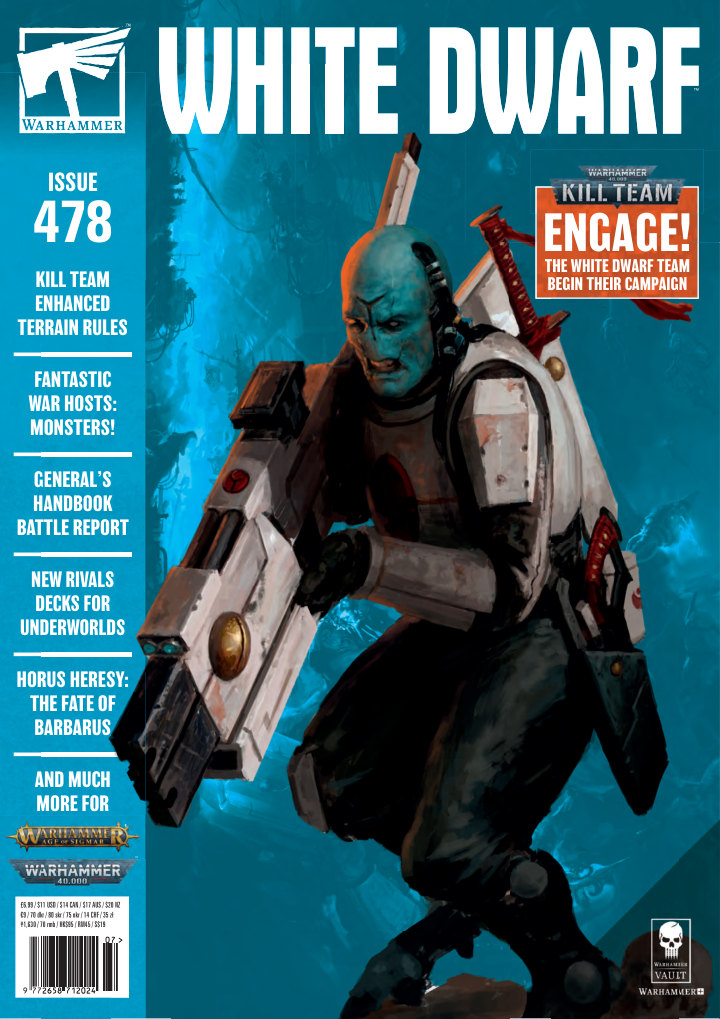
CommunityWD 478 · pp. 4–9
Readers celebrate completed hobby bingo challenges and continuing campaigns, with painted miniatures ranging from Harlequins to ancient machines. The feature combines practical paint advice with a green Kragnos and a substantial Mechanicum collection, showing how personal themes can grow into long-term projects.
Warhammer 40,000Age of Sigmar32 paint colours
PaintingWD 478 · p. 6
The ’Eavy Metal team explains the colours of a Squighog through carefully mixed shadows, layered skin and bright final highlights. The recipes separate fleshy textures, dark details and eyes, making a busy organic model readable without depending on one all-over shade.
Warhammer 40,000Orks21 paint colours
PaintingWD 478 · p. 7
Vanessa Cotineau paints Kragnos green to connect him to the Kruleboyz who venerate him. Fluorescent blue mushrooms, veins and eyes give his swamp base a supernatural story, suggesting either that he draws power from its growths or that his presence empowers them.
Age of SigmarDestruction10 paint colours
ShowcaseWD 478 · pp. 8–9
Andrew Swithinbank’s Mechanicum began with inspiration from Warhammer World and developed into a large force of automata, transports and specialist infantry. Thin brown-to-red layers establish a consistent Martian finish before transfers and weathering, with plans for a personal Kelbor-Hal conversion giving the collection a future focal point.
The Horus HeresyMechanicum4 paint colours
InterviewWD 478 · pp. 12–15
Robin Cruddace explains six-month mission updates, expanded faction secondaries and a redistribution of command points across the battle. Smaller starting pools make pregame upgrades more consequential, while regular income preserves later reactions and opportunities instead of concentrating too much power in a first-turn attack.
Warhammer 40,000
CommunityWD 478 · pp. 16–17
Five White Dwarf staff begin a Spec Ops campaign with teams built around different personal interests. The introduction establishes their shared goals and source rules, framing a series where painted operatives, narrative development and practical lessons will grow together through regular missions.
Kill Team
CommunityWD 478 · pp. 18–19
Lyle Lowery’s red-camouflaged Kommandos embrace an Orky interpretation of stealth, retaining bright details and enthusiastic violence. Early missions shape their equipment and reputation, while individually painted gauges and a developing Blitz operation make the campaign’s practical accessories part of the same project.
Kill TeamOrk Kommandos4 paint colours
CommunityWD 478 · pp. 20–21
Sophie Bostock gives her troupe a Blackstone Fortress base and plans to add increasingly elaborate patterns as its operatives gain experience. Converted magical-looking scenery supports the team’s theatrical identity, while early games and campaign purchases begin to turn the freshly painted group into an established cast.
Kill TeamHarlequins1 paint colour
CommunityWD 478 · pp. 22–23
Matt Hutson combines his existing Thousand Sons with converted Sorcerers and matching Tzaangor, giving the warband a search for the Black Library. Early games demonstrate the value of additional psychic leaders, influencing his requisitions and equipment as the team pursues an arcane artefact.
Kill TeamThousand Sons
CommunityWD 478 · pp. 24–25
Ben Humber adapts Cadian kits into individually identifiable veterans from the jungle world of Hutan. A difficult opening battle against resilient Rubric Marines exposes the team’s limitations, while specialist equipment, background documents and a bright common marking establish the Bullsharks’ identity.
Kill TeamAstra Militarum
CommunityWD 478 · pp. 26–27
Dan Harden’s D’yanoi Pathfinders pair bare-headed specialists with drones and carefully assigned roles. An initially promising game becomes a close defeat when Tzaangor intervene, encouraging him to value support abilities and campaign assets as much as the team’s obvious ranged firepower.
Kill TeamT’au Empire
RulesWD 478 · pp. 28–35
The Killzone Register expands terrain with traits for hazards, dense cover, supplies, inspiring objects and strategic machinery. Applying rules to specific parts of a model makes dramatic scenery functional, while flexible guidance encourages players to agree on details that suit their own battlefield rather than treating every similar structure identically.
Kill Team
RulesWD 478 · pp. 36–37
A trench-based killzone assigns different traits to floors, ramparts, bunkers and weapon positions. Fortified cover, gun emplacements and supply stores give the defensive works specific purposes, helping players use the same scenic system as a varied battlefield rather than one undifferentiated obstacle.
Kill Team
RulesWD 478 · pp. 38–39
Industrial platforms, chimneys and active plasma equipment combine height with environmental danger. The examples distinguish ladders, barriers, exposed coils and damaged machinery, allowing movement routes, volatile reactors and obscuring fumes to create meaningful positioning decisions throughout the compound.
Kill Team
FictionWD 478 · pp. 40–43
Watchmaster Veilgardt leads Krieg veterans through tunnels beneath a fortified heretic line. Deteriorating information and enemy contact leave the team with little chance of escape, but the survivors continue toward the objective and activate the enormous charge intended to break the stalemate above them.
Warhammer 40,000Kill TeamDeath Korps of Krieg
TacticsWD 478 · pp. 44–47
Elliot Hamer selects memorable operatives from Kill Team’s first year and explains the combinations that make them useful. Stealth, support, mobility and specialist violence all receive attention, with the modest Kommando Grot ultimately praised for how dramatically it can alter objective play.
Kill Team
LoreWD 478 · pp. 50–51
A monster can be a single collection centrepiece or the foundation of an entire army. Colour, anatomy and habitat offer ways to personalise these enormous models, with Kragnos demonstrating how exposed muscle, fur, trophies and limited armour communicate power before any background is read.
Age of SigmarDestruction
ShowcaseWD 478 · p. 52
Hydra necks dramatically change a Draconith’s height and silhouette, creating a sinuous multi-headed creature. Cold dark skin and fresh blood suggest the aftermath of a violent battle, allowing the conversion’s unusual anatomy to remain the focus rather than hiding it beneath excessive decoration.
Age of SigmarSlaves to Darkness1 paint colour
ShowcaseWD 478 · p. 53
An Arachnarok’s lava-cracked shell and crowded spider base transform a familiar monster into a fiery threat. Other cold-weather creatures use pale foundations and transparent colours, showing how texture and environmental details can establish contrasting habitats without replacing the underlying models.
Age of SigmarGloomspite Gitz7 paint colours
ShowcaseWD 478 · p. 54
Trees and an endless spell merge into a Lord of Change’s staff and scenic base, suggesting that its arrival reshapes the landscape. Natural bird colours and restrained brown shading keep the figure visually coherent, making the surrounding transformation the conversion’s strongest supernatural statement.
Age of SigmarDisciples of Tzeentch5 paint colours
ShowcaseWD 478 · p. 55
A flowing-haired rider and dark Draconith suit the Embers of Wrath’s volcanic home, while a contrasting Leviadon uses mossy shell tones and aquarium plants. Both projects connect a large beast to its army through habitat and colour choices rather than extensive structural conversion.
Age of SigmarStormcast Eternals5 paint colours
ShowcaseWD 478 · p. 56
A sculpted anglerfish lure and pallid transparent colours turn a Leviadon into a deep-sea creature. Nearby, molten effects and the natural recesses of a Magmadroth demonstrate another use of Contrast paints, showing how anatomy can guide both a conversion and its painting method.
Age of SigmarIdoneth Deepkin7 paint colours
ShowcaseWD 478 · p. 57
Mark Bedford reshapes Kragnos’s equipment toward Kruleboyz imagery and gives the god green skin. Torch-lit reference photographs guide an eerie underglow, while natural swamp materials and a shared totem make the enormous figure belong beside his worshippers.
Age of SigmarDestruction
ShowcaseWD 478 · p. 58
Lauka Vai’s body and a Sludgeraker head create a carrion-inspired homage to an old Wyvern. A contrasting undead monster uses transparent colours and oily grime for rotten flesh, with sickly yellow added to highlights to unify its wounds and exposed anatomy.
Age of SigmarOrruk Warclans5 paint colours
ShowcaseWD 478 · p. 59
A damaged eye, torn wings and exposed bone transform Karazai into a dead mount. Dark drybrushed scales keep the silhouette imposing, while blood around its neck suggests that the vampire first drained the dragon before raising it to serve as a steed.
Age of SigmarSoulblight Gravelords1 paint colour
ShowcaseWD 478 · p. 60
Real vultures and storks guide pale dirty feathers against darker straps, fabrics and metal. Restricted metallic paints and a bright yellow shield preserve focal points, while the milky eye and stained beak help the giant mount feel like a convincing scavenger.
Age of SigmarKruleboyz9 paint colours
ShowcaseWD 478 · p. 61
Wet-blended red, orange and yellow make an Akhelian King’s mount look fiery against its dark body. A separate monster conversion uses hooked chains and Fanatics to imply barely controlled momentum, showing how dynamic attachments can give a large creature a distinctive story.
Age of SigmarIdoneth Deepkin8 paint colours
LoreWD 478 · pp. 62–67
Rampaging beast-spirits threaten Nagash’s control as well as the mortal settlements of Shyish. Awlrach’s Nighthaunt attack the Ulrung lodgelands and their ancestral fires, bringing the Fyreslayers’ intense reverence for their dead into direct conflict with a power that claims every departed soul.
Age of SigmarNighthaunt
CampaignWD 478 · pp. 68–73
Fyreslayers return to liberate an abandoned magmahold from Awlrach’s spectral procession. Three linked battles and a secret strategy matrix govern the contest, while new quests and graded campaign rewards distinguish total, decisive and costly victories in the struggle over the lodge’s sacred flames.
Age of SigmarNighthaunt
TacticsWD 478 · pp. 74–77
Louis Aguilar explains the General’s Handbook 2022 focus on Battleline infantry. Proving grounds, Expert Conquerors and Bounty Hunters make the same units valuable objectives holders and tempting victims, while fighting in ranks and new commands give players tools to exploit or counter the seasonal emphasis.
Age of Sigmar
Battle reportWD 478 · pp. 78–95
Sam Pearson’s Khorne infantry face Matthew Rose’s monster-led Flesh-eater Courts as amberbone objectives activate across Gallet. Careful flank movement and summoned support let the ghouls avoid some dangerous Bounty Hunters, while their enormous creatures break key opposition and secure a convincing victory in the seasonal rules’ debut battle.
Age of SigmarBlades of Khorne
TacticsWD 478 · pp. 96–98
This fixed Rivals deck rewards fighters willing to advance into danger and turn risky positioning into attacks and glory. John Bracken explains the supporting cards and suitable warband characteristics, encouraging players to judge survivability, speed and offensive reach together when choosing a team.
Warhammer Underworlds
TacticsWD 478 · pp. 99–101
Patient Lurkers invites enemies into carefully prepared attacks rather than rushing straight across the board. Objectives, pushes and card draw help arrange profitable fights in friendly territory, with accurate ranged attacks and multiple cooperating fighters making a tempting target into the centre of an ambush.
Warhammer Underworlds
LoreWD 478 · pp. 102–109
A timeline follows the Lion’s campaign of vengeance through the southern Imperium as Horus’s main forces attack Terra. Loyalist raids, the destruction of Traitor home worlds and the gathering of surviving armies lead toward Barbarus, placing the coming invasion within a broad and contested military history.
The Horus HeresyDark Angels
CommunityWD 478 · pp. 110–111
Six studio collectors prepare opposing Legion armies for a recreation of the fall of Barbarus. The introduction links their hobby targets to the new Age of Darkness models and the campaign’s historical setting, promising a large final battle built from several months of painting.
The Horus Heresy
PaintingWD 478 · p. 112
An elite Raven Guard force uses skirmishing specialists to represent Corax’s limited contribution to the invasion. White accents distinguish it from allied black-armoured Dark Angels, while weathering and subtle variations of black replace an exhaustive reliance on sharp edge highlights.
The Horus HeresyRaven Guard19 paint colours
PaintingWD 478 · p. 113
A force of Trisolian survivors prepares to follow the Lion, keeping wolf decorations restrained enough to preserve its Heresy identity. Cool grey armour, warm leather and red markings establish a clean palette, with consistent brown chips and pale lower edges recording campaign wear.
The Horus HeresySpace Wolves16 paint colours
PaintingWD 478 · p. 114
Dimitrios Tampakoudis varies the finish by battlefield role, weathering front-line infantry more heavily than characters and vehicles. Layered transfers and controlled black, red and white areas make established Legion heraldry a practical source of individuality across the developing force.
The Horus HeresyDark Angels16 paint colours
PaintingWD 478 · p. 115
Les Martin chooses the Warmaster’s Legion for its iconic role and sea-green armour. A regular military appearance and efficient airbrushing support the collection, while simplified highlights avoid spending time on lower legs that will later disappear beneath dirt and wear.
The Horus HeresySons of Horus16 paint colours
PaintingWD 478 · p. 116
A battered Iron Warriors force leaves its lost tanks behind and seeks reinforcement on Barbarus. Automata and Dreadnoughts replace armour, while mixed equipment, tarnished steel and rust-stained hazard stripes communicate a force rebuilding from the survivors of a brutal campaign.
The Horus HeresyIron Warriors17 paint colours
PaintingWD 478 · p. 117
Tim Flanders represents defenders left on Barbarus with a clear Legion palette and relatively restrained damage. Complex thin washes give the pale armour depth, while clean iconography, green panels and subtly dirty bases distinguish the garrison from the more obviously exhausted invasion forces.
The Horus HeresyDeath Guard25 paint colours
ShowcaseWD 478 · pp. 118–119
Stippled red cloth gives the Inner Circle Knights a rich visible texture, with purple-red recess shading increasing its contrast. Related green treatments on weapons repeat the same method, allowing characters and veteran infantry to share a recognisable approach without identical colours.
The Horus HeresyDark Angels15 paint colours
ShowcaseWD 478 · pp. 120–121
A long-held interest in the Legion grows into characters, Terminators and Dreadnoughts. Carefully highlighted dark armour and aged metallic trim support the sea-green collection, with restrained oxidation and repeated colour choices holding its many important personalities together.
The Horus HeresySons of Horus8 paint colours
ShowcaseWD 478 · p. 122
White and blue armour provides a stark reminder of the World Eaters before their later red-and-brass identity. Heat effects and fine three-dimensional scratches add service wear while preserving deliberate colour modulation across the Dreadnought’s large armour panels.
The Horus HeresyWorld Eaters1 paint colour
ShowcaseWD 478 · p. 123
Transparent blue over silver creates teal metallic armour, with further washes and controlled highlights shaping its depth. Sponge damage, separately highlighted chips and oily weathering make the effect feel like a worn painted surface rather than pristine coloured metal.
The Horus HeresyAlpha Legion7 paint colours
ShowcaseWD 478 · p. 124
Ahriman retains the familiar studio palette but uses non-metallic treatments to control its reflections. A separate armoured project employs masked airbrushing, browned heat marks and paint sponged across decals, showing two approaches to adding personal technique without abandoning recognisable Legion colours.
The Horus HeresyThousand Sons7 paint colours
ShowcaseWD 478 · p. 125
A reposed plastic Contemptor gains movement through careful cuts and a red scheme shaped by wet blending. Runes in pale and darker tones add layers of meaning across the armour, with selected marks echoing parchment so that elaborate decoration remains visually connected.
The Horus HeresyWord Bearers7 paint colours
ModellingWD 478 · pp. 126–129
Ashley Hamstead-Reid expands the Dol Guldur ruins into large scenic structures inspired by the films. Cork bark, textured ground and carefully chosen kit combinations make the fortress appear built into its rocky hill, while sufficient room for models preserves the terrain’s usefulness during games.
Middle-earth Strategy Battle GameDol Guldur
PaintingWD 478 · pp. 130–131
Dark brown foundations and successive grey drybrushes build the ruined fortress’s stone, with varied washes suggesting age and damp. Warm corroded banding, natural dead branches and real preserved spiderwebs add contrast and atmosphere, while leftover components become useful matching scatter terrain.
Middle-earth Strategy Battle GameDol Guldur19 paint colours
FictionWD 478 · pp. 132–141
An aelf negotiates with Krult Lardihands to recover a mining town from Ossiarch occupation, using a dubious chef and the promise of an extraordinary meal. Ogor appetite repeatedly threatens the alliance, forcing the rescuers to exploit ambition, improvisation and a Stormcast’s dangerous demonstration of divine lightning.
Age of SigmarOgor Mawtribes
CommunityWD 478 · pp. 142–145
New Tyranids, Word Bearers and personal Heresy projects expand the studio collections. Hobby bingo tracks cel-shaded figures and metallic Sisters, while Dean Lettice’s Novokh reinforcements use increasing amounts of gold to mark status within a red-armoured Necron force.
Warhammer 40,000The Horus Heresy16 paint colours