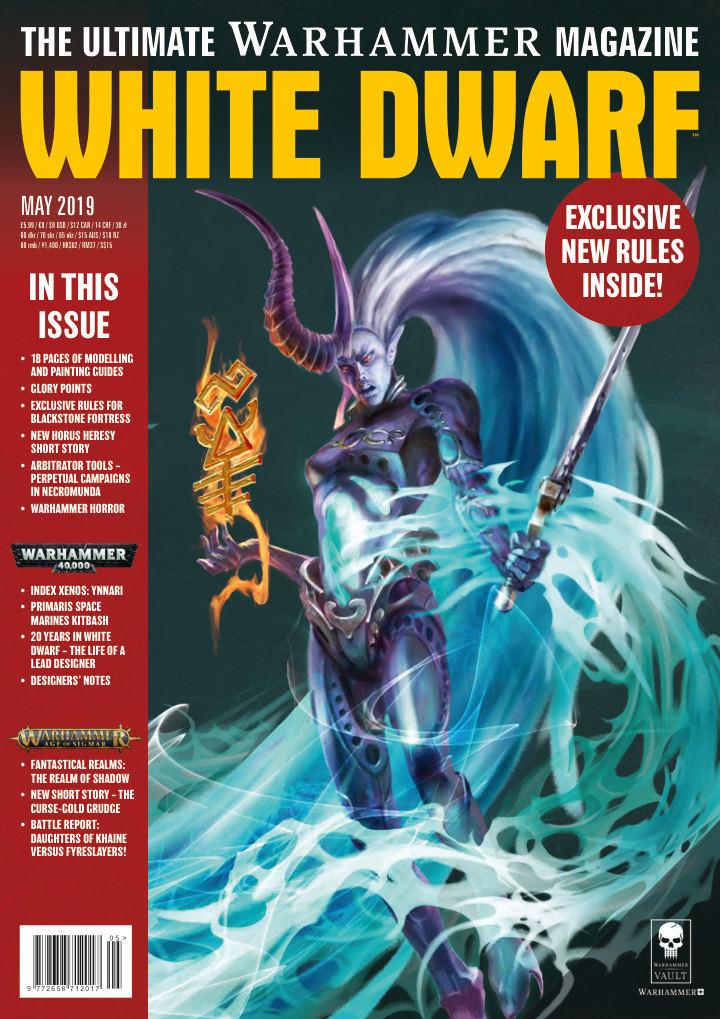
EditorialWD 442 · p. 1
Matt Hutson celebrates twenty years of magazine work with a guest-edited issue built around favourite article traditions. Ynnari background and rules sit alongside Primaris conversions, fiction and an Ulgu battle, showing the range of stories and hobby projects that continuing contact with the Design Studio makes possible.
CommunityWD 442 · pp. 6–7
Matt answers a returning hobbyist’s questions about starting games with younger family members and shares readers’ early painting. A glowing-skull recipe explains controlled green and blue-green shading over pale bone, while Grombrindal responds to a question about warpstone’s place in the realms.
8 paint colours
CommunityWD 442 · pp. 8–9
Matt selects a gallery dominated by his favourite Space Marines, including carefully personalised vehicles and a broad range of Chapter schemes. The chosen Repulsor combines extra kit detail, heraldry and convincing wear, while the accompanying photography advice helps readers show similar work clearly.
Warhammer 40,000Space Marines
LoreWD 442 · pp. 10–13
Nick Horth describes turning brief setting concepts into places where ordinary people can live and stories can unfold. Excelsis and Lethis illustrate how novels, background books and new campaign developments enrich one another, while the Stormvaults connect present discoveries to Sigmar’s troubled mythical past.
Age of Sigmar
InterviewWD 442 · pp. 16–19
Seb Perbet explains redesigning Abaddon while preserving the silhouette and symbolic details that make him recognisable. Optional heads, sharper weapons and layered construction add opportunities for expression, while subtle visual links to Guilliman present the two commanders as heirs to a much older conflict.
Warhammer 40,000Black Legion
FictionWD 442 · pp. 20–23
The Radiant Light searches for guidance through the darkened warp, only to emerge above a world already in enemy hands. The navigator’s collapse and a Chaos warlord’s offer strip away the bridge crew’s hope, leaving the captain to choose resistance despite the overwhelming force threatening her ship.
Warhammer 40,000Imperial Navy
LoreWD 442 · pp. 24–31
The rise of Ynnead’s followers promises salvation through death but divides the Aeldari as much as it unites them. Yvraine’s awakening, the devastation of Biel-Tan and the hunt for the Croneswords establish a movement caught between desperate hope, ancient prophecy and suspicion of its own dangerous powers.
Warhammer 40,000Ynnari
LoreWD 442 · pp. 32–33
Yvraine’s changing paths take her from Aspect Warrior to outcast and Commorrite gladiator before her death and impossible rebirth. Her accumulated experience helps her survive the upheaval that follows, but her role as death’s prophet leaves both enemies and potential allies questioning what she has become.
Warhammer 40,000Ynnari
LoreWD 442 · p. 34
The Visarch serves as Yvraine’s guardian, teacher and confidante, his ancient armour carrying echoes of former warriors. His history as an Exarch who once taught her complicates this role, making loyalty and hidden identity central to a figure who appears both familiar and unsettling.
Warhammer 40,000Ynnari
LoreWD 442 · p. 35
The avatar erupts into reality where death releases enough spiritual energy to summon it. Its beautiful but frightening form and uncanny resemblance to forbidden powers unsettle outsiders, while the Ynnari regard the entity as their god’s sacred manifestation rather than a reason to abandon their cause.
Warhammer 40,000Ynnari
LoreWD 442 · pp. 36–37
A chronology follows the Ynnari through awakenings, craftworld disasters, uneasy alliances and the rescue of Guilliman. Their actions repeatedly avert catastrophe while provoking new divisions, showing a movement whose significance extends beyond the Aeldari even when it fails to bring its own people together.
Warhammer 40,000Ynnari
RulesWD 442 · pp. 38–41
Replacement Ynnari rules explain which Aeldari units can join a Reborn detachment and how that changes their former faction benefits. Strength from Death rewards fighting after a unit is destroyed, and updated named-character datasheets and points establish the leaders available to the army.
Warhammer 40,000Ynnari
RulesWD 442 · pp. 42–43
The Reborn gain a dedicated set of Command Point options supporting mixed Aeldari forces, aggressive melee and resistance to their ancient enemy. Their access restrictions matter as much as the individual effects, because joining the Ynnari changes which former faction tricks can support a unit.
Warhammer 40,000Ynnari
RulesWD 442 · p. 44
New traits define a Reborn commander through resilience, speed, combat ability and the manipulation of fate. Named leaders have assigned choices, while other characters can be tailored to an army plan rather than inheriting their previous faction’s command identity.
Warhammer 40,000Ynnari
RulesWD 442 · p. 45
Ynnari psykers exchange their former disciplines for powers connected to death, renewal and shared purpose. The selection supports friendly fighters as well as damaging enemies, turning spiritual unity into a practical part of the army’s battlefield coordination.
Warhammer 40,000Ynnari
RulesWD 442 · p. 46
Weapons and protective artefacts drawn from the scattered Aeldari give Reborn characters new personal tools. Several rewards grow stronger through successful killing or interfere with an opponent’s attacks, reinforcing a force whose momentum comes from the deaths around it.
Warhammer 40,000Ynnari
RulesWD 442 · p. 47
Six replacement objectives link scoring to psychic activity, spirit energy and the destruction wrought by Reborn units. The cards encourage players to pursue the faction’s particular combat rhythm while remaining within the normal Tactical Objective mission structure.
Warhammer 40,000Ynnari
ShowcaseWD 442 · pp. 48–51
Aeldari converts display their allegiance in different ways, from complete crimson armour to a concealed rune or a small change to an older symbol. Character close-ups show the spiritual and martial meaning of costume, spirit stones and ancient armour, connecting varied models through a common creed without requiring identical colours.
Warhammer 40,000Ynnari
ShowcaseWD 442 · pp. 52–53
Chris Merrick gives an entire force crimson armour to express complete commitment to the death god. Freehand markings retain the riders’ Saim-Hann heritage, while a converted Mistweaver Farseer and jetbike-heavy collection give the force its own history within the larger movement.
Warhammer 40,000Ynnari
PaintingWD 442 · pp. 54–55
A Reborn Dire Avenger demonstrates crimson armour with immediate edge highlights over a dark wash. Black, pale bone and white secondary areas keep the red dominant, while small gold and lens details provide a scheme that can transfer across very different models in a Ynnari collection.
Warhammer 40,000Ynnari26 paint colours
PaintingWD 442 · pp. 56–57
Separate assemblies and a white undercoat make the avatar’s pale hair and spectral storm easier to paint. Drybrushed ectoplasm is completed before the cleaner purple body and equipment, with controlled blue-green recesses and bright highlights defining the swirling spirit forms without highlighting every tiny curve individually.
Warhammer 40,000Ynnari29 paint colours
ModellingWD 442 · pp. 58–59
The Primaris range becomes a starting point for personalised leaders when combined with older Space Marine and other kits. Advice on pose, weapon fit, head choice and narrative purpose precedes a worked Captain conversion, showing how a planned silhouette makes a collection of spare parts look like one character.
Warhammer 40,000Space Marines
ModellingWD 442 · p. 60
Matt’s first Primaris squad uses chained weapons, reliquaries and cross-shaped Chapter details to join an existing crusade force. Auto bolt rifles and a power-fist Sword Brother keep the unit’s appearance aggressive, while red parchment makes its active crusading status visible.
Warhammer 40,000Black Templars
ModellingWD 442 · p. 61
A Primaris Captain receives a Dark Angels sword and a skull-filled memento mori in place of the iron halo. Extra skulls on the base continue the devotional theme, turning a small number of swaps into a distinctly Templar leader.
Warhammer 40,000Black Templars
ModellingWD 442 · p. 61
Lieutenant Zakariah becomes a Deathwatch sergeant with replacement arms, head and equipment. Selecting parts from several Primaris sets changes the figure’s role while preserving the confident stance of the original sculpt.
Warhammer 40,000Deathwatch
ModellingWD 442 · p. 61
A bionic Hellblaster arm and Deathwatch components identify an Intercessor as an Iron Hands veteran serving the long vigil. The conversion uses a single mechanical replacement to communicate Chapter philosophy as well as battlefield experience.
Warhammer 40,000Deathwatch
ModellingWD 442 · p. 61
A Hellblaster’s scarred head and bionic arm help create a veteran for an Indomitus Crusaders unit. Combining sections of two bolt rifles allows a convincing one-handed hold, demonstrating how a weapon can be rebuilt around the intended pose.
Warhammer 40,000Iron Hawks
ModellingWD 442 · p. 62
Harvey’s own Chapter receives a sword-bearing sergeant and a servo-skull from a Guard command set. A dark pink mixture and bright highlights provide the personal heraldry, showing how conversion and a distinctive colour scheme work together.
Warhammer 40,000Knights of Byzantium3 paint colours
ModellingWD 442 · p. 62
An exposed scarred face replaces the Chaplain’s hood to give a familiar model an individual veteran’s identity. Worn robes reinforce that history, demonstrating how a modest head swap and painting choices can establish a grizzled character.
Warhammer 40,000Iron Hawks
ModellingWD 442 · p. 62
Krom’s upper body joins a Primaris Captain’s legs after careful cutting below the belt. Existing cloth and ornaments conceal the adjusted join, giving a larger Wolf Lord a natural silhouette without losing the original model’s characteristic equipment.
Warhammer 40,000Space Wolves
ModellingWD 442 · p. 63
Calgar’s body becomes an imposing Watch Master after unwanted Chapter symbols are removed and replaced. The surrounding Primaris veterans receive varied Deathwatch weapons and equipment, building a shared specialist identity from an unusually broad assortment of kits.
Warhammer 40,000Deathwatch
ModellingWD 442 · p. 64
A Black Library illustration inspires a near-direct model recreation. A Dark Imperium Lieutenant gains a spear and cape from Stormcast cavalry, using a cross-range combination to reproduce the Chapter’s distinctive heroic appearance.
Warhammer 40,000Emperor’s Spears
ModellingWD 442 · p. 64
Sanguinary Guard wings and backpacks replace the Inceptors’ usual flight equipment with surprisingly little alteration. Death masks and Chapter shoulder pads complete the angelic silhouette, while ruined architecture provides a dramatic setting below the airborne unit.
Warhammer 40,000Blood Angels
ModellingWD 442 · p. 65
A command-squad head, shield and banner turn an Intercessor into a decorated veteran. Spare Captain components complete a pose imagined as parrying an overhead attack, making the character’s equipment serve the action rather than simply add ornament.
Warhammer 40,000Silver Templars
ModellingWD 442 · p. 65
Sanguinary Guard torso components are widened to fit Primaris legs, keeping the sculpted heroic physique on a larger body. A cradled rifle and cloak create a composed Captain whose proportions depend on carefully filling the mixed-kit join.
Warhammer 40,000Blood Angels
ModellingWD 442 · p. 65
A Primaris Apothecary is reworked to echo the classic Corbulo miniature. Lieutenant Tolmeron’s head and arm help hold the Red Grail naturally, while the Priest’s chainsword reinforces the recognisable combination of healer and warrior.
Warhammer 40,000Blood Angels
ModellingWD 442 · p. 66
A Primaris Captain gains winged heraldry through carefully cut and resculpted upgrade parts. Sword, pistol, shield and buckle come from the same Chapter frame, creating an internally consistent Fourth Company officer.
Warhammer 40,000Dark Angels
ModellingWD 442 · p. 66
Reiver arms alter a Primaris Chaplain’s stance, with sculpted repairs hiding the joints. A skull-faced Reiver head and handmade Chapter symbol connect Paul’s first Space Marine to the Relictors’ sinister reputation.
Warhammer 40,000Relictors
ModellingWD 442 · p. 66
Removing the Apothecary’s medical equipment reveals a tabarded body suitable for a crusade banner bearer. A new banner arm, pointing hand and scenic pillar transform the pose into a clear battlefield command gesture.
Warhammer 40,000Black Templars
ModellingWD 442 · p. 67
A classic John Blanche illustration guides the pose and details of a Primaris Ancient. Reposed legs, sculpted armour joints and a carefully arranged scenic group reproduce the image’s stance, while the banner bearer’s cleaner finish contrasts with weathered comrades beneath him.
Warhammer 40,000Black Templars
InterviewWD 442 · pp. 68–73
Matt recalls discovering the hobby, finding regular opponents and entering magazine production after university. Favourite battles, design changes and the return to close studio collaboration chart twenty years of work, while his love of painting substantial armies explains the projects shown in the following retrospective.
ShowcaseWD 442 · pp. 74–77
Matt’s army retrospective follows changing interests from Black Templars and Red Corsairs to yellow Imperial Fists, slow-growing Thousand Sons and an autumnal Sylvaneth host. Collecting challenges often provide the initial push, but many forces continue to expand long after their original magazine appearances.
Warhammer 40,000Age of SigmarBlack Templars
EditorialWD 442 · pp. 80–83
Jervis explains the movement from early warscroll summoning through reinforcement points to faction-specific second-edition systems. The goal is to keep the setting’s iconic arrival of new troops useful without upsetting matched-play balance, with summoning costs reflected through unit prices and allegiance abilities rather than one universal mechanism.
Age of Sigmar
ModellingWD 442 · pp. 84–87
Ulgu’s scarce light and uncertain forms inspire armies whose identity depends on contrast rather than simply painting everything black. Pale magical accents, unnatural creatures and muted environments give different routes into the realm, while examples from established factions show how familiar figures can acquire a new regional character.
Age of Sigmar
PaintingWD 442 · p. 87
Matt adapts an illustrated Fyreslayer lodge into a dark Order army from Ulgu. Sooty details interrupt the usual orange fire colours, and layered dusty greys on the bases make the setting visible while staying close to the muted palette he enjoys painting.
Age of SigmarFyreslayers4 paint colours
ModellingWD 442 · p. 88
Ben Johnson converts a Mistweaver into a floating Hag Queen, replacing the head and arms and removing small trinkets to simplify the outline. A chalice identifies her role, while the sculpted smoke gives the Daughters of Khaine character an immediate connection to Ulgu.
Age of SigmarDaughters of Khaine
ModellingWD 442 · p. 89
Stuart builds a ruined Manse of Melkoth around a pale Magmadroth, using Realmgate smoke to evoke the Liar’s Mist. Faces hidden in architectural cracks suggest spectral inhabitants, turning a short piece of realm lore into both a converted monster and an atmospheric scenic base.
Age of SigmarFyreslayers
PaintingWD 442 · p. 90
Contrasting inner and outer greys make a familiar spell appear formed from Ulgu’s grey magic. A common blue wash unifies the surfaces, while the messy interior drybrushing is completed before the cleaner outside layers.
Age of Sigmar5 paint colours
PaintingWD 442 · p. 90
Progressively lighter smoke suggests jaws emerging from shadowstone rather than a uniformly black magical beast. Glazed teeth and blue washes concentrated around the gums create an eerie inner glow that separates the fangs from the trailing spectral body.
Age of Sigmar8 paint colours
PaintingWD 442 · p. 91
Deep blue stone makes a Shattered Temple feel darker than ordinary grey ruins, with successive drybrushes defining its edges. Purple vegetation succeeds where trial green washes disappear against the stone, and violet-stained ground completes an unsettling Ulgu environment.
Age of Sigmar10 paint colours
FictionWD 442 · pp. 92–95
Morathi’s followers and an embattled Fyreslayer lodge pursue the same hidden treasure for sharply different reasons. Schemes within the Khainite ranks and old duardin grievances accompany their dangerous journeys through Ulgu, until their forces meet before the revealed prize and both sides prepare to fight.
Age of SigmarDaughters of Khaine
Battle reportWD 442 · pp. 96–115
Ben’s Daughters of Khaine and Kevin Chin’s Fyreslayers compete to uncover an Ulgu Stormvault while wild troggoths and predatory darkness disrupt their plans. Huge infantry losses and a forceful duardin counterattack keep the fight close, but Morathi and mobile Khinerai secure the aelves a 22–19 victory.
Age of SigmarDaughters of Khaine
RulesWD 442 · pp. 98–99
Rival armies must light four Umbral Torches to expose the hidden central objective. Protected pools of light offer safety from the realm’s predatory shadows, and the later-revealed Stormvault becomes a valuable scoring position, producing a battle whose important locations change as the mystery is solved.
Age of Sigmar
RulesWD 442 · pp. 100–101
Optional uncontrolled monsters act according to proximity and a behaviour roll rather than either general’s normal orders. They can hold, charge or rampage, adding threats that both armies must account for, while interaction rules leave opportunities to turn these unpredictable inhabitants into temporary allies.
Age of SigmarTroggoths
CommunityWD 442 · pp. 116–119
Dave presents organised events as a chance to fit in many games, meet opponents and learn new uses for familiar cards. Practical preparation includes checking restrictions and bringing a comfortable deck, while prizes are valued as souvenirs rather than essential advantages unavailable to casual players.
Warhammer Underworlds
RulesWD 442 · pp. 120–123
Expanded hostile-player rules give Blackstone Fortress’s antagonist control over exploration choices, initiative and additional actions. Destiny dice spent by the explorers can become nemesis resources, turning the party’s own powerful options into a timing dilemma and making the hostile role more active throughout an expedition.
Warhammer Quest
ModellingWD 442 · pp. 124–127
Jason Lee treats Battle Companies as a reason to build a small group of highly individual Orcs and Goblins. Detailed examples explain new drums, repositioned weapons, flowing cloth and swapped bodies, with staged putty work and parallel conversions making ambitious alterations manageable.
Middle-earth Strategy Battle GameGundabad
ModellingWD 442 · p. 125
Plastic tubes and sculpted coverings form a pair of drums, while new hands and a repositioned arm make the Goblin look as though he is actually playing. The demonstration shows how a support role can be communicated through an entirely physical conversion.
Middle-earth Strategy Battle GameGundabad
ModellingWD 442 · p. 126
Spare upgrade weapons give Berserkers paired blades, using either a complete hand swap or a carefully cut weapon join. Resculpted hair and repositioned limbs add movement, and working on several figures together makes efficient use of putty curing time.
Middle-earth Strategy Battle GameGundabad
ModellingWD 442 · p. 127
Swapped torsos and legs provide an easy first layer of variety before more involved spear and shield changes. Cutting matching shapes from the original arm and replacement shield lets the new equipment fit naturally, with putty repairs finishing a group of distinct warriors.
Middle-earth Strategy Battle GameGundabad
CampaignWD 442 · pp. 128–131
A campaign can continue indefinitely if gang size, territory and disparities in wealth are actively managed. Crew limits and House Patronage give weaker opponents a chance to compete, while refreshed territories and temporary triumph rewards provide periodic renewal without discarding every gang’s history.
Necromunda
RulesWD 442 · pp. 132–133
A powerful retiring gang attempts to seize a ship while its accumulated enemies unite to stop it. Fighters must reach the transport and struggle with its unfamiliar controls under pressure, giving a long-lived force a final spectacular exit whose consequences matter beyond ordinary campaign rewards.
Necromunda
FictionWD 442 · pp. 134–137
Malcador seeks a hopeful future through forbiddenly powerful divination as Horus arrives at Terra. The visions expose him to hostile powers and force a painful conversation about hope, sacrifice and the uncertain path between the present catastrophe and any eventual salvation.
The Horus Heresy
FictionWD 442 · pp. 138–141
An ageing scribe’s longing for the family taken by the Imperial tithe becomes unbearable when forgotten records reveal their fate. His grief and anger draw him towards an impossible reunion, and the thing that follows him home turns the comfort he desired into a deeply personal horror.
Warhammer 40,000
CommunityWD 442 · pp. 142–143
Studio projects include a newly painted Thanquol, an Ork Stompa and continuing games around Vigilus. A conversation about villains exposes the different loyalties behind favourite armies, while the team’s digital diversion explores a different expression of the Warhammer setting.
Warhammer 40,000Age of Sigmar
CampaignWD 442 · p. 144
Nick Horth’s Genestealer Cults suffer a difficult start to the studio campaign but finally take revenge on the Mechanicus. Bastion-world origins justify numerous corrupted Guardsmen, while black and red link the force to his Hive Fleet Kronos collection and make the human and alien armies parts of one story.
Warhammer 40,000Genestealer Cults