EditorialWD 414 · p. 1
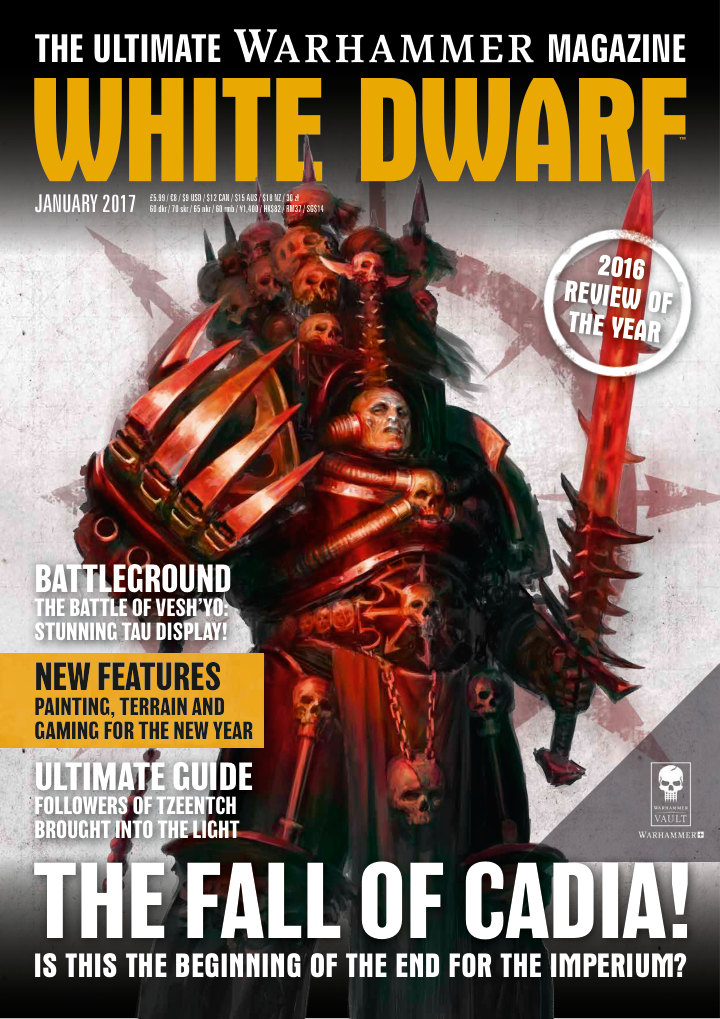
The first editorial of 2017 introduces the Gathering Storm and a year in which the Imperium’s story is moving forward. Alongside the ominous new developments, the team looks back at 2016 and introduces further collecting, gaming and scenery features.
ShowcaseWD 414 · pp. 4–5
Abaddon’s Thirteenth Black Crusade becomes the setting for a new series of campaign books, with Cadia’s fall announced as a certainty whose means and consequences remain to be discovered. The three accompanying character models embody different Imperial responses: Cawl’s ancient technology, Celestine’s faith and Greyfax’s suspicion.
Warhammer 40,000Black Legion
ShowcaseWD 414 · p. 6
The new battletome unites Arcanite cults and Daemons under one patron. The preview highlights allegiance abilities, distinct spell lores, campaign options and matched-play profiles that support several ways to assemble Tzeentch’s followers.
Age of SigmarDisciples of Tzeentch
ShowcaseWD 414 · p. 7
Outwardly ordinary cultists become masked, physically transformed warriors when the Arcanite cult reveals itself. The plastic kit’s cursed weapons, shields, dark scrolls and magic-eating vulcharcs give the new infantry a distinctive combination of martial and sorcerous imagery.
Age of SigmarDisciples of Tzeentch
ShowcaseWD 414 · p. 8
Two Silver Tower characters become individually available for the Mortal Realms. The Gaunt Summoners balance service to Archaon with their own designs, while the powerful Ogroid sorcerers provide cults with both magical knowledge and brute force; neither creature’s mysteries are fully explained.
Age of SigmarDisciples of Tzeentch
ShowcaseWD 414 · p. 9
Natalie Slinn recreates Michael Steer’s winning Freeblade computer-game design as a painted Imperial Knight. The tower-and-maces heraldry and carefully sponged damage demonstrate how a personalised digital collection can become a physical miniature.
Warhammer 40,000Imperial Knights
PaintingWD 414 · p. 10
Nine compact sets provide faction-specific colours and a guide intended to complement the Build + Paint Set. The page lists the actual six paints in each selection, showing how shared basic equipment can branch into distinct Imperial, alien and Chaos colour schemes.
28 paint colours
ShowcaseWD 414 · p. 11
New Iron Hills infantry use kneeling, standing and running poses to build a convincing shieldwall. Their ballista fires chained bolts that threaten ranks and incoming missiles, with distinct crew models helping present it as a working siege engine.
Middle-earth Strategy Battle GameIron Hills
ShowcaseWD 414 · pp. 12–13
The huge assault lander carries infantry, vehicles or heavy support into dangerous landing zones while its own guns clear the approach. The article connects the rare Stormbird to its more common Thunderhawk successor and introduces a compatible Imperial landing-pad board.
The Horus HeresyLegiones Astartes
ShowcaseWD 414 · pp. 16–17
Eternal Crusade’s launch offers multiple factions and large online battles, while Dark Future reimagines highway combat for computers. Other updates add Flesh Tearers to Battlefleet Gothic: Leviathan, Wood Elves to Total War and new kit and balls to Blood Bowl 2.
Warhammer 40,000Battlefleet GothicFlesh Tearers
ShowcaseWD 414 · p. 18
Robbie MacNiven sends the Carcharodons to a prison world already being harvested by the Night Lords. Their intervention is no rescue: both forces want the population for their own purposes, revealing the unsettling character of an ostensibly loyal Chapter.
Warhammer 40,000Carcharodons
ShowcaseWD 414 · p. 18
Chris Wraight’s standard hardback returns to Dulan and the conflict behind the famous rivalry of the Lion and the Wolf. The preview distinguishes the actual Great Crusade encounter from its later legend and points towards the contrasting characters of both Legions.
The Horus HeresySpace Wolves
ShowcaseWD 414 · p. 19
Graham McNeill places Magnus at the height of his Great Crusade powers before a decision that may condemn him in others’ eyes. The limited edition introduces the third Primarchs volume as another perspective on the tragedy of Prospero.
The Horus HeresyThousand Sons
ShowcaseWD 414 · p. 19
Andy Smillie’s linked audio stories examine Azkaellon and Amit in ritual combat and encounters with other Legions. Their differing temperaments provide two views of the Blood Angels in the apparently more hopeful years of the Great Crusade.
The Horus HeresyBlood Angels
ShowcaseWD 414 · p. 19
Rob Sanders’s novella returns to a blockaded Mars so corrupted that Malcador and Dorn contemplate exterminating its life. The preview presents the conflict as a question of how far the Loyalists will go when conventional recovery appears impossible.
The Horus HeresyMechanicum
InterviewWD 414 · p. 19
Graham McNeill recalls the unexpected scale of the Horus Heresy series and the pleasure of writing changing characters such as Perturabo. Magnus offers the challenge of an extraordinarily clever protagonist and opportunities for arcane research, while the writer deliberately leaves Horus’s experiences on Molech unresolved.
The Horus Heresy
ShowcaseWD 414 · p. 20
The boxed set brings Swifthawk Agents and Skaven together with a short story, profiles and battalions. The introduction presents it as a complete first step into Age of Sigmar or a source of reinforcements for established armies.
Age of SigmarSwifthawk Agents
RulesWD 414 · p. 21
Optional Blood Bowl rules make the new referee figures track growing frustration with unpunished fouls. A Goblin referee eventually inflicts injury, while a Halfling interferes with team re-rolls; punishment or a bribe resets their attention, adding another risk to persistent dirty play.
Blood BowlGoblins
CommunityWD 414 · pp. 22–23
Letters celebrate the monthly relaunch while asking for numbering, more scenery and simpler painting guidance. The replies explain how models can first receive only basecoats and washes and later acquire more detail, and discuss continued support for self-contained games.
2 paint colours
LoreWD 414 · p. 23
Grombrindal weighs the reputed strength of iron, ithilmar, fyresteel, gromril and sigmarite through a characteristically duardin perspective. Grungni’s role in forging Sigmar’s metal lets the answer combine a practical hierarchy with partisan pride.
Age of Sigmar
LoreWD 414 · pp. 24–25
Veteran referee Thoron Korensson explains the difference between Nuffle’s supposedly immutable laws and the shifting rulings applied by mortal officials. Ball materials, fouls, weapon-like protective equipment and local customs reveal how legal niceties become another part of Blood Bowl’s comic corruption.
Blood Bowl
Battle reportWD 414 · p. 25
A brief match report follows an early Skaven score, a Human cage equaliser and the death of catcher Jordi Hamfist. Neither side finds a winner, even when two balls enter play; accompanying statistics capture the rather different possession and casualty patterns.
Blood BowlHumans
FictionWD 414 · p. 25
The Dwarf Giants stop the Grudgebearers through enthusiastic mining by their own supporters. A seam opened beneath the pitch becomes a chasm just as the visitors threaten to score, turning a football phrase into a very literal defensive manoeuvre.
Blood BowlDwarfs
InterviewWD 414 · pp. 26–31
Jes Bickham explains why Cadia’s doom marks a beginning as much as a climactic war. Cawl’s hidden commitments, Celestine’s difficult visions, Greyfax’s anachronistic certainty and Trazyn’s obscure motives create conflicting routes through the disaster, while new missions and Empyric Storms turn the unfolding narrative into tabletop events.
Warhammer 40,000Astra Militarum
InterviewWD 414 · p. 27
Steve Buddle draws on John Blanche’s art to create a female witch-hunter displaced from another age. Archaic equipment and Sororitas-like armour suggest possible histories without settling them, while the candle, bionic eye and condemnor gun give her an uncompromising identity.
Warhammer 40,000Inquisition
InterviewWD 414 · p. 28
Steve Buddle makes Cawl’s accumulated augmentations deliberately varied, as though countless years of rebuilding have replaced a consistent body plan. Different viewing angles reveal human, centaur-like and mechanical qualities, and the annotated equipment makes his seemingly chaotic construction purposeful.
Warhammer 40,000Adeptus Mechanicus
InterviewWD 414 · p. 30
Brian Nelson preserves the calm of Jes Goodwin’s original Celestine while adding wings, psychic doves and two Seraphim guardians. The three figures form an intended holy triptych, balancing peaceful imagery against the saint’s huge blade and martial role.
Warhammer 40,000Adepta Sororitas
RulesWD 414 · pp. 32–33
Imperial Fists led by a Captain representing Tor Garadon make a last stand inside Phalanx against Be’lakor’s Chaos host. The defenders win by surviving, aided by Fearless resistance and the Legion of the Damned, while Be’lakor drives nearby Daemons forward without access to fresh conjurations.
Warhammer 40,000Imperial Fists
ShowcaseWD 414 · p. 36
The review begins with the Fyreslayers, their ur-gold search and the Magmadroth. Corax, Grand Alliance: Chaos and the first Start Collecting boxes complete a month remembered as a beginning for several collecting projects.
Age of SigmarThe Horus HeresyFyreslayers
ShowcaseWD 414 · p. 37
The Wulfen’s return begins a crisis whose later consequences reach far beyond Fenris. A new Ulrik and Balance of Power provide other highlights, including conflict between Stormcast and Nagash and an unusual redemption from Chaos.
Warhammer 40,000Age of SigmarSpace Wolves
ShowcaseWD 414 · p. 38
Dracothian Guard and Stardrakes give Stormcast their own monstrous allies. The month also recalls Clans Pestilens and the reappearance of Deathwatch and Genestealer Cults through the claustrophobic Overkill game.
Age of SigmarWarhammer 40,000Stormcast Eternals
ShowcaseWD 414 · p. 39
The Ironjawz arrive beside Godbeasts and the broader Destruction alliance. A Space Marine anniversary celebrates a redesigned classic figure, while Imperial Knights: Renegade grows from an earlier magazine game about huge walkers fighting.
Age of SigmarWarhammer 40,000Ironjawz
ShowcaseWD 414 · p. 40
Silver Tower restores Warhammer Quest with new heroes, familiars and Tzeentchian adversaries. The team also recalls Flesh-eater Courts, Total War’s launch and the airborne battles encouraged by Death from the Skies.
Warhammer QuestAge of SigmarDisciples of Tzeentch
ShowcaseWD 414 · p. 41
Armoured Containers and sculpted city bases put scenery in the spotlight. The staff remember repeated, usually disastrous attempts to escape Lost Patrol’s jungle and short, eventful Stormcloud Attack dogfights.
Warhammer 40,000Lost Patrol
ShowcaseWD 414 · p. 42
Alarielle and the expanded Sylvaneth range transform the Realm of Life, while Bonesplitterz receive a battletome. The General’s Handbook’s three ways to play, newer battletome structures and Shattered Dominion board make the month significant beyond its miniature releases.
Age of SigmarSylvaneth
ShowcaseWD 414 · p. 43
Deathwatch become a complete army with specialist kits and a Corvus Blackstar. Death Masque moves Eldrad and Artemis into the developing story, while Beastclaw Raiders and an unusual gap in White Dwarf publication round out the retrospective.
Warhammer 40,000Age of SigmarDeathwatch
ShowcaseWD 414 · p. 44
The monthly magazine returns with familiar columns, extensive new rules and a Slaughterpriest gift. Khârn, Traitor’s Hate, a plastic Void Shield Generator, Kill Team and Gorechosen supply a particularly violent backdrop to the relaunch.
Warhammer 40,000Age of SigmarWorld Eaters
ShowcaseWD 414 · p. 45
Genestealer Cults emerge with infantry, a Goliath and infiltrated Imperial units, becoming a complete army. The review also recalls a new editor, Will of Iron’s comic debut and the Stormcast Lord-Veritant.
Warhammer 40,000Age of SigmarGenestealer Cults
ShowcaseWD 414 · p. 46
A second Heresy board game brings Mk III marines, Tartaros Terminators and plastic Talons of the Emperor into collections. The end of the month also sees Blood Bowl return with new Human, Orc and Skaven models and its first supplement.
The Horus HeresyBlood BowlSpace Wolves
ShowcaseWD 414 · p. 47
The enormous plastic Magnus leads a revived Thousand Sons range against Fenris. Ahriman’s changed appearance and two Apocrypha compilations link this advancing story to almost three decades of background and illustration.
Warhammer 40,000Thousand Sons
CommunityWD 414 · p. 48
The team invites readers to choose five favourite Citadel releases from 2016. Examples and personal staff choices illustrate how monsters, small familiars, scenery and returning heroes can compete for attention for quite different reasons.
InterviewWD 414 · pp. 50–55
David Soper reflects on three decades of painting, three Slayer Swords and a long interval away from competitions. His accounts of a Nurgle Predator, vertically rebuilt Scourges and Gutrot Spume connect artistic growth to experimentation, constructive feedback, personal style and the pursuit of an evocative story rather than a guarantee of winning.
Warhammer 40,000Age of SigmarMaggotkin of Nurgle
PaintingWD 414 · pp. 56–57
Darren Latham explains the judging priorities behind competition painting: consistent technical care, appropriate effects, readable materials, sympathetic bases and a distinctive but believable subject. Examples show how interaction gives a diorama meaning and how selective contrast directs attention to a miniature’s face.
PaintingWD 414 · pp. 60–61
James Littler demonstrates getting a Bloodbound army painted with efficient basecoats and washes before returning to it later. The Bloodreaver sequence groups areas sharing a shade and completes messier drybrushing early, showing how short sessions or a dedicated weekend can both produce a playable collection.
Age of SigmarBlades of Khorne14 paint colours
PaintingWD 414 · p. 62
The Blood Warriors first receive a simple complete paint job, then selected extra details and highlights. Thin controlled lines deepen red armour and leather without obscuring the base colours, demonstrating that improving a centrepiece unit need not delay playing with the whole army.
Age of SigmarBlades of Khorne16 paint colours
PaintingWD 414 · p. 63
Korghos Khul receives the most extensive attention after the army is already usable, with refined shading, highlights and selected replacement colours. A separate Flesh Hound palette and lists for armour, cloth, mutation and teeth let painters choose how far to develop their own general without imposing the same workload on every warrior.
Age of SigmarBlades of Khorne24 paint colours
Battle reportWD 414 · pp. 64–69
Melissa Holland learns Age of Sigmar through a small Seraphon battle against Dan Harden’s Skaven. Their conversation translates summoning, unit cohesion, mortal wounds, combat order and priority into events on the battlefield; her Carnosaur destroys the Verminlord and the Seraphon win, illustrating how actual play makes unfamiliar rules easier to understand.
Age of SigmarSeraphon
ModellingWD 414 · pp. 70–71
The new scenery series treats the battlefield as a collecting project in its own right, beginning with a few useful small kits. Its assembly workshop dry-fits pieces, removes obstructions, holds glued parts with rubber bands and fills gaps before a final clean-up, adapting familiar miniature-building methods to larger structures.
PaintingWD 414 · pp. 72–73
A simple pipe recipe combines a starting colour, pale drybrushing, brown streaks and sponged chips. Nine alternative base colours demonstrate how the same technique can support very different terrain collections, while the discussion recommends planning textures and keeping the scenery from overpowering the armies.
Warhammer 40,00014 paint colours
PaintingWD 414 · p. 73
Red pipes acquire pale worn highlights and contrasting brass banding. Localised corrosion and verdigris accumulate around joins and vents, giving a restrained weathered finish rather than covering every surface.
Warhammer 40,0006 paint colours
PaintingWD 414 · p. 73
Copper, brass and steel basecoats separate the functional parts before repeated brown and black washes unify them. Medium-based verdigris streaks and sponged brown damage complete the richly coloured metallic scheme.
Warhammer 40,0009 paint colours
PaintingWD 414 · p. 73
Layered brown and orange stains over a steel foundation establish rust before green paint is added in incomplete patches. More chips, grime and pale runoff connect the remaining finish to the corroded material underneath.
Warhammer 40,00011 paint colours
PaintingWD 414 · p. 74
A Baleful Realmgate demonstrates how subdued stone, metallic reliefs, glowing magic and varied steps can coexist in one terrain piece. Complete recipes distinguish sandstone, a violet glow, floating masonry and magical sands, with further examples encouraging experimentation across the Mortal Realms.
Age of Sigmar21 paint colours
Battle reportWD 414 · pp. 76–89
Erik Niemz’s Imperial alliance fights Dan Harden’s Black Legion in a huge final defence of Cadia. Empyric Storms alter powers and survivability throughout the battle, Greyfax and Cawl confound attempts to kill them, and Celestine finally defeats Abaddon after his own blade rebels; the Imperial victory follows a game full of costly losses and dramatic character moments.
Warhammer 40,000Astra Militarum
LoreWD 414 · pp. 90–97
The guide reveals how ambition turns ordinary citizens into masked cultists and how overlapping covens spread through the Cities of Sigmar. Magisters, Fatemasters, Tzaangor warflocks and Gaunt Summoners combine different kinds of power, but every hierarchy remains vulnerable to betrayal and bargains whose true beneficiary is uncertain.
Age of SigmarDisciples of Tzeentch
PaintingWD 414 · p. 99
Matt Hutson completes his Sylvaneth range with Alarielle, carefully dividing the beetle and goddess into subassemblies. Red links the mount to the army’s spites and green connects its queen to the revenants, while a separate account recalls another hard-fought victory over Andrew’s Nurgle army.
Age of SigmarSylvaneth
PaintingWD 414 · p. 100
Andrew King expands his blue Nurgle army with another Maggoth Lord, Blightkings and converted heroes. Swapped heads and weapons create distinct silhouettes, while mixed game results prompt him to consider how to make the army’s units work together more effectively.
Age of SigmarMaggotkin of Nurgle
PaintingWD 414 · p. 101
Forty-two Ghouls reinforce James Karch’s growing undead collection through a quick grey-flesh recipe. His victory over Andrew combines objective control, fast Flayers and Mannfred’s destructive combats, with both players acknowledging the role of unfortunate dice.
Age of SigmarFlesh-eater Courts4 paint colours
PaintingWD 414 · p. 102
Phil Cowey adds two Gargants with different natural skin tones and inverted white-and-blue tribal markings. The pair represent Gork and Mork, although neither they nor their Orruk commander can agree which is which.
Age of SigmarSons of Behemat
CampaignWD 414 · p. 103
The ladder campaign enters its final month with Matt undefeated, James second, Andrew third and Phil fourth. Photographs of James’s victory underline how Flayers and Mannfred dismantled the Nurgle force while a debate continues over aggression, objectives and bad luck.
Age of SigmarSylvaneth
InterviewWD 414 · pp. 104–105
Martin Waller explains his first Slayer Sword winner, keeping Gordrakk recognisable while increasing contrast, weathering and texture. Reference photographs under a desk lamp guide the lighting, separate components keep detail accessible, and layered scratches, worn cloth and liver-spotted flesh distinguish the materials.
Age of SigmarIronjawz3 paint colours
ShowcaseWD 414 · p. 106
Rob McLeod contrasts green non-metallic armour with pale bruised flesh and rusty equipment. Judges discuss how the placement of purple avoids clashing directly with the armour, while powders and verdigris give the polished painting a suitably decayed subject.
Age of SigmarMaggotkin of Nurgle1 paint colour
ShowcaseWD 414 · p. 107
Ricky Upjohn builds an eerie, almost monochrome Megaboss from blue-green black armour and muted flesh. A brighter green glaze rescues the skin from disappearing, while pale mixed highlights give the dark armour depth without sacrificing its restrained character.
Age of SigmarIronjawz5 paint colours
ShowcaseWD 414 · p. 108
Dan Harden chooses quartered black and white rather than his initially planned garish colours. A brown spray and shared wash speed the team, three-colour sequences establish the dark cloth and pale plates, and claw-like numbers maintain a Skaven identity.
Blood BowlSkaven8 paint colours
ShowcaseWD 414 · p. 109
Chris Webb gives his Orcs a worn green-and-white sporting kit with deliberately varied placements and small conversions. Freehand numbers and sprayed blood add character to a team intended to look scruffier than his normally immaculate Marines.
Blood BowlOrcs1 paint colour
ShowcaseWD 414 · p. 110
Matt Hutson adapts his favourite football colours into a colourful, slightly cartoonish Orc team. Different skin tones separate Black Orcs, and mid-tone guide lines become useful shading and highlights within chequered patterns and dags.
Blood BowlOrcs3 paint colours
ShowcaseWD 414 · p. 111
Nick Bayton changes from Orcs to Humans and develops a mustard-and-green uniform around Solar Auxilia helmet transfers. Varied colour placements and skin tones keep repeated players distinct, while sponged metal chips make the team look well travelled.
Blood BowlHumans7 paint colours
ShowcaseWD 414 · p. 112
James Gallagher puts his Orcs in purple away colours, using pale green flesh and white trousers to contrast with dark armour. Separate darker Black Orc skin and carefully painted numbers distinguish individuals while keeping a strong team identity.
Blood BowlOrcs10 paint colours
ShowcaseWD 414 · p. 113
Matt Keefe gives an itinerant, repeatedly bankrupt Human team quartered blue, yellow, black and white. Batch painting and changed detail colours create useful variety, while inconsistent quartering is absorbed into the team’s history of improvised equipment and failed predecessors.
Blood BowlHumans
ModellingWD 414 · pp. 114–121
Owen Patten and the Warhammer World team turn a brief background entry into a vast clash between Tau colonists and the Mechanicus. Models of the layout, bespoke Tau architecture and carefully placed miniature duels make the huge machines serve a story; the interview also explains scheduling, transportable effects and the compromises needed to finish such an ambitious display.
Warhammer 40,000T’au Empire
ShowcaseWD 414 · pp. 122–123
The retrospective revisits October 2012’s redesign, digital edition and expanded studio interviews. Chaos Daemon Engines, the first Forge World Heresy book, Ben Johnson’s Skaven and a renewed Blanchitsu format show how several familiar strands of the contemporary magazine began.
Warhammer 40,000The Horus Heresy
InterviewWD 414 · pp. 124–127
Joe Oliver’s five Knights form an accurately marked Exalted Court suitable for both the Heresy and later battles. Painting the machines together keeps gradients consistent; masking fluid, layered metallic treatments and selective damage create a used finish, and the project unexpectedly becomes a Golden Demon-winning entry.
The Horus HeresyWarhammer 40,000Imperial Knights9 paint colours
InterviewWD 414 · pp. 128–131
Joe Oliver’s jetbike-heavy Wych Cult treats raids as high-speed performance, joining the models through red armour and repeated heads. Masking reveals worn material beneath airbrushed red, blue recess shades enrich the shadows, and hair-supported droplets of green water effect make selected blades visibly weep poison.
Warhammer 40,000Drukhari8 paint colours
ModellingWD 414 · pp. 134–135
Jakob Rune Nielsen contributes a hovering tree-machine and a small band of pilgrims to the collaborative Pilgrym story. The centrepiece combines extensive sculpting with technological relics, while quieter human mercenaries and faded Dutch-painting colours provide a grounded viewpoint on the surrounding madness.
Warhammer 40,000Adeptus Mechanicus
ModellingWD 414 · pp. 136–137
Tim Molloy imagines an outwardly orthodox feminine Mechanicus sect pursuing botanical heretics on Terra. Khalida, Myrmidon and Mechanicus parts create its transhuman characters, while a textured ancient automaton and a minimally changed old Chaos Sorcerer connect the band to the hobby’s long history.
Warhammer 40,000Adeptus Mechanicus1 paint colour
ModellingWD 414 · pp. 138–139
Stefan Darlan Boris develops plant-oriented bio-explorers from ideas about artificial moons, ancient forests and Imperial neglect. Dryad components and tangled cables join flesh to vegetation, while cracking texture paint and layered natural colours give the Thorn Guard bark-like skin of differing apparent ages.
Warhammer 40,000Adeptus Mechanicus2 paint colours
PaintingWD 414 · pp. 140–143
Paul Norton paints Celestine in separate components, using carefully controlled gloss shades for polished armour and thin layers for soft cloth. Full sequences cover wings, roses, doves, pale skin, hair, parchment and the lightning-lit Ardent Blade; the freehand note explains tiny angled writing and recommends practising on a spare component first.
Warhammer 40,000Adepta Sororitas39 paint colours
ModellingWD 414 · pp. 142–143
Chris Peach recommends four practical subassemblies for Cawl rather than separating every delicate appendage. Leaving the hood and base off gives access to the face and legs, and a metallic spray handles much of the intricate machinery before brushwork begins.
Warhammer 40,000Adeptus Mechanicus1 paint colour
CommunityWD 414 · pp. 144–147
Reader submissions include Primarchs, flyers, Stormcast cavalry and a converted rogue psyker. The accompanying photography guidance explains neutral backgrounds, lighting, viewing angle and focus so the painted work can be judged clearly.
Warhammer 40,000The Horus Heresy
ShowcaseWD 414 · p. 147
Sam Jones follows the Hammers of Sigmar’s traditional gold appearance but makes smooth transitions a particular strength. The commentary singles out the black-to-red wings and deep shadows against bright metal as the features that bring the model to life.
Age of SigmarStormcast Eternals
PaintingWD 414 · p. 148
Dan Harden’s Goff Stompa wins its first duel against a Renegade Knight before falling to a Maulerfiend. A sprayed metal foundation, repeated black washes and thin brown rust create the large machine’s dirty finish, with checked black-and-white panels completing its Goff identity.
Warhammer 40,000Orks3 paint colours