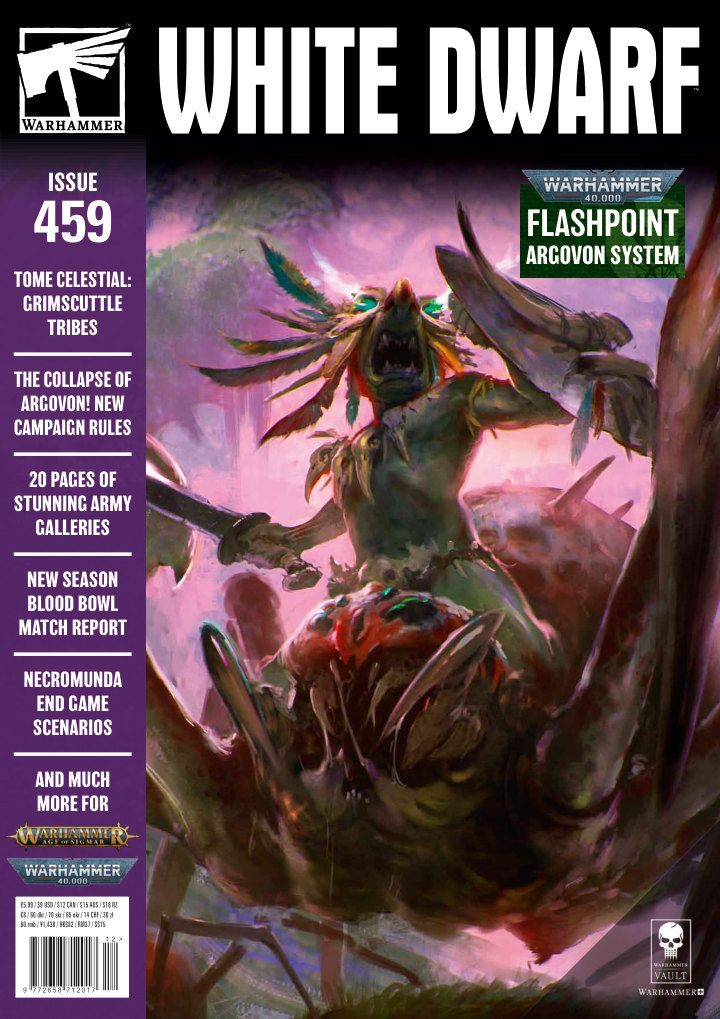
EditorialWD 459 · p. 1
The editor looks towards a new year through hobby resolutions and the pleasure of setting ambitious collecting goals. His plan to prepare a small force for every current Warhammer game leads into the magazine’s Hobby Bingo challenge, inviting readers to track progress and compare their achievements with the team throughout the year.
CommunityWD 459 · pp. 4–9
Readers share renewed family enthusiasm for Warhammer, colourful Underworlds warbands and ambitious modelling projects. Andy Hicks’s enormous Aeldari Pegasus and Mikal van Leeuwen’s recreation of the Eternity Gate receive extended explanations, while armour recipes and Rob Davis’s yellow reinterpretation of Ghazghkull provide painting ideas alongside the gallery.
Warhammer 40,000Age of Sigmar18 paint colours
LoreWD 459 · pp. 10–13
Phil Kelly continues the Mortal Realms chronology through invasion, broken alliances and the collapse of once-great civilisations. The timeline follows Chaos triumphs, desperate refuges and Sigmar’s withdrawal to Azyr, setting the origins of familiar factions against a long history of loss and explaining how the Stormcast project begins amid widespread catastrophe.
Age of Sigmar
LoreWD 459 · pp. 16–23
Jordan Green and Louis Aguilar explore the Spiderfang tribes of Neferatia, their treacherous bargains and devotion to a ravenous Spider God. Arachnaroks and Skitterstrands are intelligent predators rather than simple mounts, while tribal history and the Deff Grotz’s Shyishan imagery connect their raids to the realm’s particular supernatural dangers.
Age of SigmarGloomspite Gitz
RulesWD 459 · pp. 24–25
Spiderfang armies gain a themed allegiance package with enhanced venom, a mandatory shaman trait, an artefact and replacement Spider Rider units near a Loonshrine. Three warscroll battalions give different Arachnarok formations improved melee accuracy or movement tricks, turning the tribes’ supernatural ambushes into concrete battlefield options.
Age of SigmarGloomspite Gitz
PaintingWD 459 · pp. 26–27
The classic Spider Rider guide uses separate red and green spray undercoats for the spider and rider before assembling the finished model. Layered highlights distinguish chitin, pale underparts, grot skin, wood, metal and small details, with drybrushing offered as an accessible alternative where the many legs make precise brushwork difficult.
Age of SigmarGloomspite Gitz29 paint colours
PaintingWD 459 · pp. 28–29
A Wraithbone undercoat supports a quick Contrast approach to both spider and rider, kept separate for easier access. Different recipes cover vivid carapace, pale belly and grot details, while alternative yellow or blue Contrast colours encourage readers to adapt the scheme rather than assume that every giant spider must be red.
Age of SigmarGloomspite Gitz24 paint colours
ShowcaseWD 459 · pp. 30–33
Nick Horth builds a fast, threatening Spiderfang force around several large Arachnaroks, including the shaman Ziggit Scablegs and his mount Queen Fangstabba. Painted for a team event, the force combines Spider Riders and suddenly appearing Skitterstrands, with named leaders and playful battle memories giving the scuttling collection a distinct identity.
Age of SigmarGloomspite Gitz
PaintingWD 459 · p. 33
A lurid wasp-like scheme gives Nick’s spiders yellow and orange bodies with black markings over a pale undercoat. Fast Contrast recipes establish the principal colours, while simple grot skin, wooden parts and pale details keep the tournament project achievable without sacrificing its aggressive appearance.
Age of SigmarGloomspite Gitz12 paint colours
EditorialWD 459 · pp. 34–37
Louis Aguilar explains how questions and play experience become designers’ commentary, errata and scheduled balance reviews. The Seraphon Realmshaper Engine provides a worked example of testing intended use against actual deployment rules, while practical submission advice helps players provide specific, useful feedback instead of leaving developers to guess the problem.
Age of Sigmar
ShowcaseWD 459 · pp. 38–45
Steve Wren’s Tzeentch collection centres on four large daemons encouraged by the Omniscient Oracles formation, with differently coloured Horrors making their associations clear in games. Converted mortals, elaborate bases and freehand flames show the project’s continued development, while his reflections connect army painting, changing techniques and enjoyment of tournaments.
Age of SigmarDisciples of Tzeentch22 paint colours
PaintingWD 459 · p. 41
Steve shares the brighter recipes behind his mortal followers, including warm acolyte skin, blue armour and gold details. A contrasting purple treatment for Chaos Warriors and a pale fur recipe reinforce the army’s clean, colourful style while allowing several distinct materials and units to belong in the same collection.
Age of SigmarDisciples of Tzeentch16 paint colours
LoreWD 459 · pp. 48–53
The cardinal world’s temples, relics and religious hierarchy become the setting for prolonged Necron assaults. Defensive improvements, improvised engineering and remarkable courage complicate easy assumptions about inexperienced local zealots, while Adepta Sororitas and Black Templars feature in a war narrated through the biases and qualifications of an Imperial historian.
Warhammer 40,000Astra Militarum
FictionWD 459 · pp. 54–57
Ecclesiarchal servants shelter with exhausted soldiers in a ruined chapel, relying on discipline and barricades to keep Necrons outside. An acolyte’s horror at sacrificing those still beyond the doors clashes with the defenders’ survival instincts, and their mounting argument threatens to expose the entire refuge to the enemy.
Warhammer 40,000Astra Militarum
LoreWD 459 · pp. 58–63
Task Force XI reaches a capital world simultaneously threatened by Necrons, entrenched Genestealer Cults and the complacency of its own institutions. Forest warfare and the siege of the tiered Argovonya show how each enemy exploits different terrain, while an account of the Blessed Raised traces a new cult’s origins among neglected prospectors.
Warhammer 40,000Astra Militarum
FictionWD 459 · pp. 64–67
Two vignettes contrast the methods needed against Argovon’s alien enemies. Atlantian Spears hold sewage tunnels against a cultist flood with psychic fire and disciplined resistance, while a local Forester waits motionless above a Necron column, turning patience, camouflage and carefully synchronised grenades into the beginning of a jungle ambush.
Warhammer 40,000Atlantian Spears
CampaignWD 459 · pp. 68–71
Remaining Xenotech totals determine alliance ranks for the last campaign phase, replacing further collection with earned battlefield advantages. Ranked access to stratagems and Crusade relics rewards earlier restraint, while campaign honours give successful warriors lasting benefits once the struggle for the system has ended.
Warhammer 40,000
RulesWD 459 · p. 72
A Strike Force battle centres on protecting relic-bearing positions until the conflict is decided. Progressive control combines with final ownership of the four objectives, while the sacred setting affects the defenders’ resolve and mission stratagems provide ways to contest the struggle around the treasured sites.
Warhammer 40,000
RulesWD 459 · p. 73
An Incursion attacker must destroy deforestation devices before they strip away the woods sheltering a forest defence. The devices progressively remove dense cover, making the battlefield change as turns pass; performing the destruction action becomes both a scoring opportunity and a way to preserve the army’s ability to survive.
Warhammer 40,000
CommunityWD 459 · p. 74
James Gallagher describes a staff painting challenge designed to prepare new armies for the ninth edition’s narrative Crusade system. Starting with roughly 25 Power and then expanding gives participants an achievable structure, while their freedom to choose units and invent background helps rivalries and campaign stories develop before the first games.
Warhammer 40,000
ShowcaseWD 459 · p. 75
James Gallagher’s Cadians seek vengeance for their lost world, led by Colonel Feodor Kolm and adapted with older Forge World parts. Desert and ash-waste colours, selective bright details and sponge chipping give the force a coherent campaign environment, while its narrative links the new Crusade collection to the survivors of the Thirteenth Black Crusade.
Warhammer 40,000Astra Militarum4 paint colours
ShowcaseWD 459 · p. 76
Calum McPherson starts a Genestealer Cult whose appeal lies as much in its background and character as its battlefield possibilities. Contrast colours establish a fast pale-armoured scheme, while bikes and Ridgerunners support an outrider theme; early games already give the Kelermorph a reputation and a personal name.
Warhammer 40,000Genestealer Cults6 paint colours
ShowcaseWD 459 · p. 77
Jon Flindall uses the release of Contrast paints to make a long-desired White Scars army manageable. A lightly shaded white scheme, numerous personal and tribal details and shared basing connect the strike force to his wider collection, while the Third Company identity and mobile reinforcements provide direction for its future expansion.
Warhammer 40,000White Scars4 paint colours
ShowcaseWD 459 · p. 78
Peter McMullin assembles Raven Guard from several reserve companies under a single covert command. Phobos-armoured troops and converted officers support the special-operations theme, with dark bases and selective object source lighting suggesting night fighting rather than relying on black armour alone to establish the army’s identity.
Warhammer 40,000Raven Guard2 paint colours
ShowcaseWD 459 · p. 79
Matt Hutson returns to Word Bearers years after his Eye of Terror collection, combining dark red power armour with a growing body of subordinate followers. Trophies painted in other hobbyists’ schemes and relationships between the Dark Apostle and Traitor Guard turn the collection into a personal campaign project as well as a striking Chaos force.
Warhammer 40,000Word Bearers4 paint colours
ShowcaseWD 459 · p. 80
Elliot Hamer’s custom Hive Fleet Kaetus sends a gestation brood beneath a planet’s surface to drain its resources. Fast Contrast and drybrushing recipes create pale organisms with brown carapaces, a Zoanthrope-headed Hive Tyrant adds individuality, and drought-stricken bases reinforce the background of a world being consumed from below.
Warhammer 40,000Tyranids7 paint colours
ShowcaseWD 459 · p. 81
Harvey Snape’s Knights of Byzantium combine purple armour and bronze hands with the mechanical details of their Iron Hands ancestry. A Phobos-led forward reclamation force, supported by Reivers, an Invictor and Eliminators, expresses the Chapter’s efficient ranged warfare while giving a pre-existing personal Chapter a new Crusade direction.
Warhammer 40,000Knights of Byzantium4 paint colours
EditorialWD 459 · pp. 82–85
Robin Cruddace examines less conspicuous ninth-edition changes whose effects spread through the whole game. Modifier limits, coherency, engagement range, fighting order and Combat Attrition illustrate efforts to make units behave plausibly and keep interactions manageable, while the new Command phase provides room for abilities in future army books.
Warhammer 40,000
InterviewWD 459 · pp. 86–93
Richard Gray discusses his return to Golden Demon and the large models that earned recognition, from a Thanatar to Titans and a Tzeentchian Knight. His Mortarion’s watching eyes receive particular attention through work-in-progress images, with advice on reference, freehand geometry, weathering and directing attention towards the model’s face.
Warhammer 40,000The Horus HeresyDeath Guard
TacticsWD 459 · pp. 94–97
Dave Sanders chooses individual fighters whose personality, design and card combinations make them stand out. Examples from several warbands show how a seemingly secondary fighter can become an effective attacker or scoring piece, with suggestions limited to Beastgrave-era cards even as the next season approaches.
Warhammer UnderworldsSkaeth’s Wild Hunt
Battle reportWD 459 · pp. 98–111
Jay Clare’s Imperial Nobility Barons meet Rich Butler’s Black Orc Thunder Valley Greenskins in the new season’s opening match. Griff Oberwald’s speed repeatedly answers brutal Orc pressure and a successful thrown Goblin, but a final attempted aerial score fails, leaving both teams with a dramatic 2–2 draw and lessons about their new skills.
Blood BowlImperial Nobility
LoreWD 459 · pp. 112–113
An Imperial intelligence briefing warns officers about stolen aircraft, from crude Ork modifications to deceptively neat human auxiliaries serving the T’au. The introduction frames these anomalies as optional, agreed additions to aerial battles, with conversion ideas turning the background into unusual squadrons rather than simply new paint schemes.
Aeronautica ImperialisImperial Navy
RulesWD 459 · pp. 114–115
T’au forces can include a limited proportion of human-crewed Imperial aircraft while retaining their original weapons and authorised upgrades. The allowance depends on game size and the number of T’au aircraft present, providing a controlled way to represent gue’vesa allies without giving Imperial craft access to T’au-specific equipment.
Aeronautica ImperialisT’au Empire
RulesWD 459 · pp. 116–117
Ork squadrons gain restricted access to looted Thunderbolt fighters and Marauder bombers with their own aircraft profiles. Additional rokkits, wing bombs and larger ordnance let players emphasise the machines’ scavenged identity, while limitations on how many can join the force preserve a predominantly Ork squadron.
Aeronautica ImperialisOrks
CampaignWD 459 · pp. 118–119
Campaign finales give dominant gangs a last opportunity to prove themselves while bringing rivals together for a memorable conclusion. Suggested end games range from assaults on the strongest gang to riots and Enforcer intervention, with advice on scale and narrative stakes leading into three purpose-built multiplayer scenarios.
Necromunda
RulesWD 459 · pp. 120–121
The most powerful gang celebrates in a drinking hole when its enemies launch a surprise attack. The defenders can field their full strength but face scarce ammunition and a vulnerable interior, while the attackers’ nerve and the possibility of burning the bar down keep the finale from becoming a simple test of total gang rating.
Necromunda
RulesWD 459 · pp. 122–123
A pursued gang waits for a massive ash gate to open while its enemies close in. Worsening visibility and the approaching ash storm make the escape increasingly dangerous, and suggested variations let an Arbitrator replace the rival gangs with waves of creatures or reverse the struggle around a gate that is closing.
Necromunda
RulesWD 459 · pp. 124–125
Several gangs endure a sector-wide power failure that brings darkness, freezing conditions and prowling monsters. Keeping fighters alive until the artificial dawn matters more than a conventional objective, while random threats and optional Arbitrator-controlled horrors can make each movement through the abandoned sector a difficult survival choice.
Necromunda
TacticsWD 459 · pp. 126–129
Jay Clare shows how to use the Balrog’s combat power, resistance and fiery whip without neglecting positioning or the Goblins supporting it. The Depths of Moria Legendary Legion gives additional reasons to build around Durin’s Bane, while careful target selection and nearby Goblin fighters help turn an imposing centrepiece into a functioning army.
Middle-earth Strategy Battle GameMoria
FictionWD 459 · pp. 130–141
LaHayn turns Vaun into fuel for the Engine before claiming its power, forcing Miriya and Verity to resist psychic terror through shared faith. Their victory leaves the machine catastrophically unstable and requires a desperate rescue; the aftermath brings censure for Miriya’s disobedience, yet also a lasting bond between the two survivors.
Warhammer 40,000Adepta Sororitas
CommunityWD 459 · pp. 142–143
The team reviews games, new projects and resolutions as another hobby year approaches. Matt’s pastel Noise Marine and Dan’s mottled Legio Xestobiax armour supply contrasting painting notes, while Underworlds results, a new Obliterator and personal collecting targets show how staff keep several strands of their hobby moving together.
Warhammer 40,000Age of Sigmar15 paint colours
CommunityWD 459 · p. 144
A printable challenge card turns the year’s painting projects into a simple game of completed boxes, rows and columns. Tasks range from individual heroes and monsters to units, scenery and kitbashes, with points encouraging varied projects and repeated cards allowing ambitious hobbyists to keep extending their score.