EditorialWD 454 · p. 1
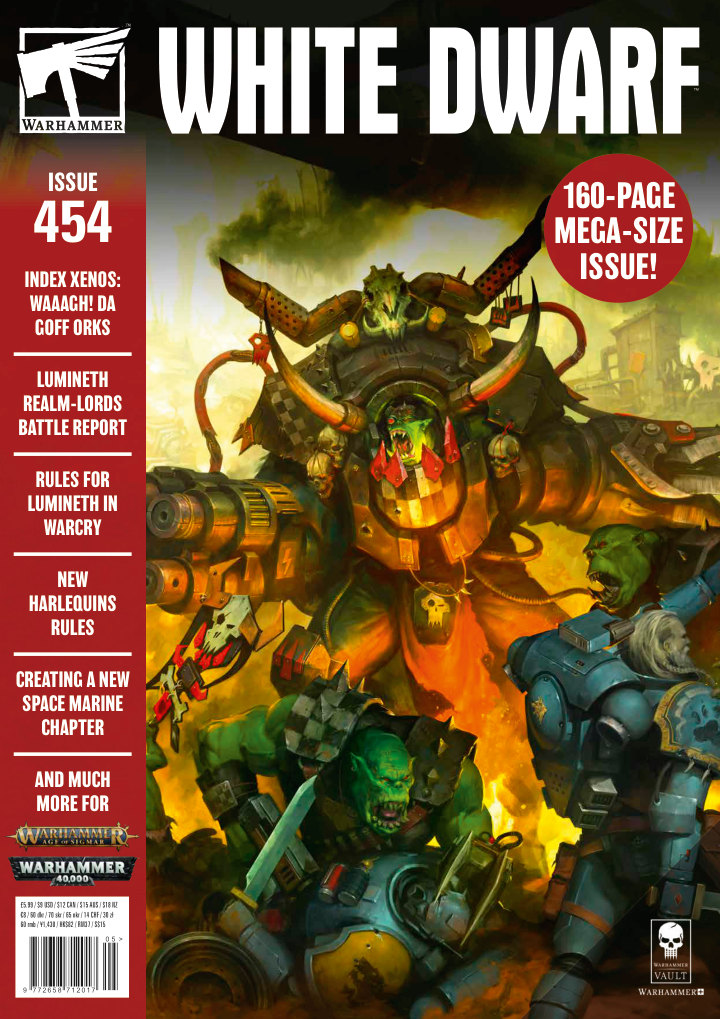
The editor welcomes the Lumineth Realm-lords by recalling a much-loved High Elf army from the Old World. Their first White Dwarf battle and Warcry rules join Goff Orks and further Tome Keepers development, introducing an issue focused on both new collections and familiar favourites.
CommunityWD 454 · pp. 4–9
Reader projects include a miniature inspired by codex artwork, a club’s shared painting experiment and an ambitious collection of converted shipping containers. Questions cover pronunciation, Chapter creation and painting, with named recipes for a red-scaled model and a detailed Horticulous Slimux showcase.
Warhammer 40,000Age of Sigmar10 paint colours
EditorialWD 454 · pp. 10–13
Phil Kelly follows memorable miniatures between skirmishes, larger armies and entirely different games. A heroic grot, Chaos warbands, converted ogors and Underworlds fighters show how new basing, shared colours and a little imagination can refresh an existing collection and give old models further stories.
Warhammer 40,000Age of Sigmar
LoreWD 454 · pp. 16–25
The Goffs’ culture prizes brute strength, close combat and severe black wargear over ostentatious display. Their hierarchy, battle organisation and iconic leaders frame a chronicle of destructive campaigns, including Ghazghkull’s resurgence, Grukk Face-rippa and Boss Zagstruk, with Imperial reports conveying the threat behind the greenskins’ exuberance.
Warhammer 40,000Orks
RulesWD 454 · pp. 26–27
Three open and narrative play profiles introduce Grukk Face-rippa, Skrak’s Skull-Nobz and a Goff Rokker. Named equipment and special abilities make the warboss and elite Nob mob distinctive, while the musician’s selectable performance boosts nearby Goff infantry in suitably loud style.
Warhammer 40,000Orks
PaintingWD 454 · pp. 28–29
James Perry paints a Goff Nob with dark skin, black clothing and varied metal, using the clan’s restrained palette without making every surface identical. Basecoats and shades establish a playable finish, while additional highlights separate materials and small coloured details give the otherwise dark warrior a focal point.
Warhammer 40,000Orks25 paint colours
PaintingWD 454 · pp. 30–31
A light Wraithbone foundation supports quick Contrast skin, dark clothes and equipment on a second Goff Nob. James compares lighter and darker greenskins, uses conventional highlights where useful and explains simple dirt and damage, showing how the method can coexist with classic painting in the same army.
Warhammer 40,000Orks24 paint colours
ModellingWD 454 · pp. 32–33
Compatible fittings across Nobz, Flash Gitz and Meganobz make a richly equipped Nob and a Kustom Force Field Big Mek straightforward kitbashes. The guide also explains selected Goff characters, including building a Rokker’s guitar pose through carefully chosen hands and a little finger resculpting.
Warhammer 40,000Orks
ShowcaseWD 454 · pp. 34–37
Stu Black and Dan Harden show two established Goff armies united by dark skin, black armour and red accents. Stu uses metallic edge highlights and compatible orruk parts, while Dan discusses recording recipes, blue-green energy effects and a propeller Dakkajet weathered with a combination of salt and hairspray.
Warhammer 40,000Orks11 paint colours
EditorialWD 454 · pp. 38–41
Elliot Hamer explains how narrative descriptions, miniature details and the environment inspire game mechanics. Harlequin masks provide one worked example, while existing rules create further possibilities through exceptions and combinations; narrative and competitive testing then refine the thematic idea into a balanced, evocative tabletop tool.
Warhammer 40,000
FictionWD 454 · pp. 42–43
Representatives of three related Blood Angels successors meet according to an ancient custom to recount victories and losses. The Charnel Guard’s Mordath argues that preserving the past is no longer enough in a collapsing galaxy, and the conclave gives way to plans for a united host assembled out of necessity.
Warhammer 40,000Charnel Guard
RulesWD 454 · pp. 44–49
Harlequin characters gain alternative Pivotal Roles that change how Troupe Masters, Shadowseers, Death Jesters and Solitaires influence a battle. New stratagems and Enigmas of the Black Library add further combinations, letting players personalise their performers while preserving the faction’s emphasis on mobility, deception and carefully timed violence.
Warhammer 40,000Harlequins
PaintingWD 454 · pp. 50–53
Hive-world armies draw on overcrowded industrial cities whose inhabitants are accustomed to danger and deprivation. The article connects gang equipment, hazard markings and worn colours to Imperial recruits and cultists, then uses contrasting accent colours to keep dark underhive schemes readable on individual models.
Warhammer 40,000NecromundaAstra Militarum
ModellingWD 454 · pp. 54–55
Compact weapons, extra protection and scavenged equipment give warriors a believable role in cramped industrial fighting. Examples include dynamically posed Ork infiltrators, John Bell’s close-combat Genestealer Cult and a mixed-kit underhive band, illustrating how conversions and subdued paintwork can communicate a shared environment.
Warhammer 40,000NecromundaOrks4 paint colours
PaintingWD 454 · pp. 56–57
James Perry demonstrates quick underhive terrain painting through metallic foundations, accumulated rust, chipped colour and dust. Small applications of blood, glowing lights and graffiti add narrative detail, with practical advice on transfers and matte finishing so the scene remains convincing rather than uniformly shiny.
Warhammer 40,000Necromunda18 paint colours
ModellingWD 454 · pp. 58–61
James Acons builds a sprawling Necromunda table from modular base boards and layers of industrial kits, recycled objects and connecting walkways. Textured rust, mixed metallics and blue object-source lighting suggest an underhive dome awakening, while the construction keeps every level accessible and allows the scenery to be rearranged for play.
Necromunda15 paint colours
LoreWD 454 · pp. 62–67
The Tome Keepers’ short-lived recruiting population gives a practical reason for preserving knowledge in exhaustive personal chronicles. The team debates ancestry, founding and uncomfortable secrets, then shows Lyle’s first bone-armoured models; unresolved mysteries deliberately leave room for future adventures instead of fixing every detail immediately.
Warhammer 40,000Tome Keepers6 paint colours
RulesWD 454 · pp. 68–73
Sisters of Silence receive Kill Team backgrounds, name tables, specialist demeanours, faction tactics and profiles for Prosecutors, Vigilators and Witchseekers. Psychic null abilities and witch-hunting rerolls make them a focused anti-psyker force, while complete weapons and points tables support assembling a playable team.
Kill TeamSisters of Silence
EditorialWD 454 · pp. 76–79
Jervis Johnson traces Warhammer scenery from books beneath blankets and homemade hills through cardboard buildings to detailed modular kits. Better terrain production changes both the look of games and their rules, culminating in integrated faction scenery whose abilities make it an active part of an army.
Age of SigmarWarhammer 40,000
LoreWD 454 · pp. 80–81
The mausoleum city grew around Hallost’s old gathering place, where the living and heroic dead once shared a prosperous capital. Its hidden Neverstone grants a champion’s desire at the eventual cost of their soul; the necroquake exposes the Stormvault and leaves the remaining spirits jealously guarding a city emptied of living inhabitants.
Age of Sigmar
CampaignWD 454 · pp. 82–83
Hallost’s campaign expands to a four-player struggle around Vaddenheim. The new map adds city and temple locations, and the victory condition rewards connected territory, encouraging players to build a coherent domain while contesting the region’s valuable strongpoints.
Age of Sigmar
RulesWD 454 · p. 84
Both armies try to penetrate the enemy line and send units off the opposite battlefield edge to devastate hostile territory. Committing troops to raiding removes them from the local fight, and their combined points value at the end determines which general has accepted that risk more effectively.
Age of Sigmar
RulesWD 454 · p. 85
Heroes must claim sequential trial sites before attempting the final shared challenge at the centre. The structure makes progress depend on preserving eligible champions and controlling the route through the field, with a decisive final trial offering a clearer objective than simple attrition.
Age of Sigmar
RulesWD 454 · p. 86
Six possible graves hide the resting place of a legendary hero. Friendly champions investigate barrows until the correct site is revealed, after which it becomes the key objective; the search forces both armies to adapt as uncertainty gives way to a concentrated struggle for the discovered tomb.
Age of Sigmar
RulesWD 454 · p. 87
Armies contest three arcane nexuses while wild endless spells prowl the field as new quarry for Hallost’s heroes. The battleplan combines objective control with unpredictable magical threats, turning the realm’s unstable energies into obstacles that both sides must manage as the fight develops.
Age of Sigmar
CampaignWD 454 · pp. 88–97
The second campaign instalment records all four bands passing their first convergences after costly retries. Lyle races ahead in games played, Jonathan improves his use of the Blissful One, Matt learns to protect treasure runners and Dan finally wins a narrow escape through better positioning rather than relying on damage alone.
WarcryCypher Lords
PaintingWD 454 · p. 89
Dan Harden finally pushes his Cypher Lords through their first convergence after repeated defeats, learning to exploit movement and two-inch attacks. Complete recipes record the warband’s blue robes, metallic details and bases so the growing Jade Eye can remain consistent as more fighters and Furies join.
WarcryCypher Lords20 paint colours
PaintingWD 454 · p. 90
Jonathan Stapleton completes his Unmade convergence and strengthens the Blissful One with an artefact that amplifies her already dangerous attacks. Alongside the campaign lessons, he records the red, pallid, metallic and blood-stained recipes used to keep the warband’s mutilated appearance coherent.
WarcryThe Unmade12 paint colours
PaintingWD 454 · p. 91
Matt Hutson’s Corvus Cabal gain thralls and learn how to combine hard-hitting elites with expendable objective runners. His dark palette is documented in skin, feather, leather, bone and metallic recipes, while the account looks ahead to spending campaign glory on a stronger convergence attempt.
WarcryCorvus Cabal17 paint colours
PaintingWD 454 · p. 92
Lyle Lowery’s Splintered Fang become the first of the four bands to pass a convergence and continue hunting stronger poisons. Full colour recipes accompany a newly painted Shattered Stormvault battlefield, whose marbled stone comes from spraying through a stretched dried baby wipe used as a stencil.
WarcrySplintered Fang17 paint colours
Battle reportWD 454 · pp. 98–115
Jervis Johnson’s Lumineth defend a Realmgate in Ghur against Louis Aguilar’s reinforcing Ravagers. Teclis eventually turns the magical battle decisively, but Chaos troops damage the portal badly enough that annihilating the attackers does not guarantee the aelves’ strategic success; the final outcome is a draw.
Age of SigmarLumineth Realm-lords
CampaignWD 454 · pp. 116–119
A Lumineth campaign follows a stolen Hyshian artefact into the Eightpoints before its captors can unleash its destructive power. Three convergences lead from geomantic investigation to the lair of Gorston Lorezza, with themed traits, treasures and a final reward for recovering and safely quieting the relic.
WarcryLumineth Realm-lords
RulesWD 454 · pp. 120–121
New fighter cards and abilities bring the Lumineth into Warcry, including Vanari infantry and cavalry, Alarith warriors and mages. Formation bonuses, emotional transference and gravitic effects reward coordinated placement, letting the small warband combine martial skill with disruptive magic.
WarcryLumineth Realm-lords
TacticsWD 454 · pp. 122–125
Dave Sanders explains how a flexible Underworlds strategy combines reliable surge objectives, compatible end-phase goals and threats that make opponents react. Card choices should support several routes to scoring without diluting the plan, and examples show how efficient actions can advance multiple objectives at once.
Warhammer Underworlds
TacticsWD 454 · pp. 126–131
Ironsoul’s three Stormcasts use strong attacks and resilience to pressure the enemy, but modest speed demands carefully chosen mobility cards and starting positions. Fighter-by-fighter advice links inspiration, knockback and extra attacks to aggressive scoring, with endurance objectives offering rewards for surviving the retaliation.
Warhammer UnderworldsIronsoul’s Condemnors
TacticsWD 454 · pp. 132–135
Fast but vulnerable Myrmourn Banshees improve through inspiration and exploit movement through fighters and terrain. Dave combines selective attacks with holding a few objectives, recommending accuracy, damage and defensive support so the four ghosts can isolate opponents without sacrificing their own scoring opportunities.
Warhammer UnderworldsLady Harrow’s Mournflight
RulesWD 454 · pp. 136–139
The Talabecland Eagles discover that an Ogre festival means crowd violence, Gnoblar interference and an unwanted Slave Giant teammate. Classic Plays retells the match and provides both rosters, predetermined opening disturbances and Giant Rodeo rules so players can reproduce the chaotic contest.
Blood BowlHumans
TacticsWD 454 · pp. 140–143
Jay Clare treats Éomer as a powerful combat investment who should spend as much of the battle fighting as possible. Equipment, Heroic Actions, throwing spears and support from Gandalf or other Rohan heroes maximise his impact, with separate advice for the risks and advantages of his Legendary Legions.
Middle-earth Strategy Battle GameRohan
FictionWD 454 · pp. 144–157
Verity faces Vaun and learns enough to doubt the official account of his escape and Lord LaHayn’s innocence. A search through Neva’s records uncovers manipulated histories and missing information, prompting an assassin’s attack; Miriya’s rescue and further revelations push the Sisterhood towards decisive action against Metis.
Warhammer 40,000Adepta Sororitas
CommunityWD 454 · pp. 158–160
Studio hobby updates cover marine conversions, a new Necromunda campaign and further Warcry projects. A Sylvaneth test model suggests another possible warband, while Steve Bowerman’s Cypher Lords provide a detailed example of bright metallics and blue cloth painted for a scenery-team campaign.
Warhammer 40,000Age of Sigmar21 paint colours