EditorialWD 281 · Inside cover
Paul Sawyer visits Robin Dews and the Warhammer Online team, considering how the Old World can work as a persistent online setting. The proposed journeys between cities and wilderness, the playable peoples and lessons drawn from existing online games give him an early view of a different way to inhabit Warhammer.
Warhammer Fantasy Battles
EditorialWD 281 · Inside cover
A new Imperial Guard range threatens to distract Paul Sawyer from his Ultramarines project. Craig Bodycote suggests linking the two collections through an Ultramar-associated Guard force, turning the temptation to begin another army into a possible extension of an existing one.
Warhammer 40,000Ultramarines
LoreWD 281 · p. 2
The news introduction presents Abaddon’s approaching invasion as a rare unification of rival Chaos forces. Old grievances are temporarily subordinated to the coming assault, establishing the threat behind the next month’s Eye of Terror coverage.
Warhammer 40,000Chaos Space Marines
RulesWD 281 · pp. 10–16
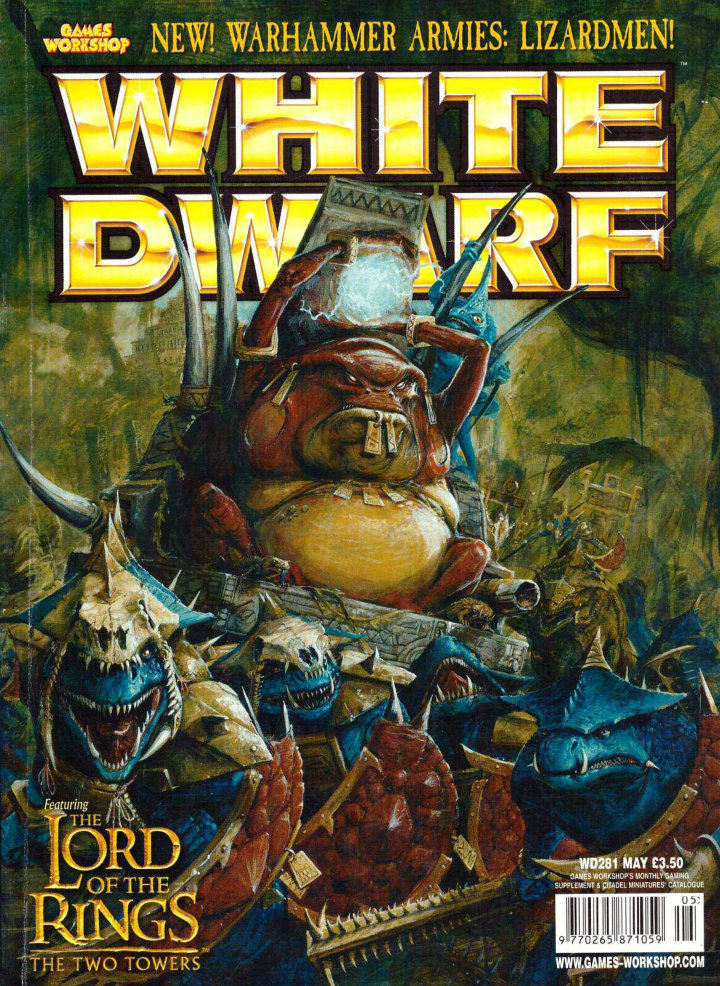
Anthony Reynolds explains the new Lizardmen army book through its background, models and battlefield roles. The distinction between spawned warrior Saurus, adaptable Skinks and the ancient Slann informs the redesign, while feedback on the earlier list helps shape a broader selection of armies. His account follows the changes from ordinary troops to monsters, characters, sacred spawnings and the Southlands alternative.
Warhammer Fantasy BattlesLizardmen
RulesWD 281 · p. 12
Saurus spearmen combine strong front-rank attacks with more limited supporting attacks, while Temple Guard remain tied to the protection of a Slann. Skink scouting becomes an option rather than a universal role, giving blowpipes and javelins different uses, and the Swarm changes support the army’s new movement and deployment choices.
Warhammer Fantasy BattlesLizardmen
RulesWD 281 · pp. 12–13
Kroxigor can charge through Skinks under controlled conditions, allowing the two units to cooperate without becoming a single formation. Chameleon Skinks, new Saurus cavalry and Terradons occupy distinct specialist roles; the Terradons’ hit-and-run rule lets them strike and withdraw without a normal pursuit.
Warhammer Fantasy BattlesLizardmen
RulesWD 281 · pp. 13–14
The Stegadon relies on stubbornness and cold-blooded discipline rather than a high Leadership value. Salamanders move towards close support with a shorter-ranged spray attack and a chance of devouring their handlers, deliberately surrendering their earlier long-range anti-armour role.
Warhammer Fantasy BattlesLizardmen
RulesWD 281 · pp. 14–15
The Oldblood and Scar-Veteran provide different levels of combat leadership without the old restrictions on character slots. Slann remain vulnerable fighters but gain protected positions within Temple Guard and can use Skink wizards’ sight, while generation upgrades and sacred plaques represent their extraordinary age and power.
Warhammer Fantasy BattlesLizardmen
RulesWD 281 · pp. 15–16
Sacred spawnings give Saurus units and characters chosen supernatural advantages, with additional blessings moving units into more restricted army-list categories. The examples link the gods’ gifts to extra attacks, protection and movement, while the Itzl blessing governs the appropriate character mounts.
Warhammer Fantasy BattlesLizardmen
RulesWD 281 · p. 16
The revised treasures combine ancient technology and magical effects rather than following ordinary human expectations of enchanted equipment. Reynolds highlights items that defeat supernatural protection, alter attack order or improve mundane weapons, explaining how they support recognisably Lizardmen tactics.
Warhammer Fantasy BattlesLizardmen
RulesWD 281 · p. 16
The official Southlands list emphasises Skink cohorts, mobile troops and a different balance of ancient leaders and Saurus. Reynolds explains why the list avoids combined Skink-and-Kroxigor regiments: their advantages would undermine the role of Saurus in the wider army.
Warhammer Fantasy BattlesLizardmen
RulesWD 281 · p. 17
The official answers resolve spell targeting, magic resistance and the treatment of characters and mounts under area effects. They also clarify regeneration in challenges, the deployment of separately chosen units, restrictions on joining units and the interaction between weapon bonuses and a Slayer’s Strength, giving practical rulings on several easily confused core rules.
Warhammer Fantasy Battles
PaintingWD 281 · pp. 18–19
Paul Rudge builds pale blue Skink skin through successive drybrushing stages, then separates green scales, bone weapons, gold fittings and red mouth details. Reptilian eyes receive narrow pupils and the mouth receives a glossy finish. The base recipe uses layered browns and a green rim, while a small arm conversion accommodates a shield.
Warhammer Fantasy BattlesLizardmen17 paint colours
ModellingWD 281 · p. 19
Removing the weapon from a spare arm and adjusting the hand creates a clean mounting point for the Skink shield. The shield’s scales reuse the creature’s green treatment, bringing the converted equipment into the same visual scheme as the unit.
Warhammer Fantasy BattlesLizardmen
FictionWD 281 · pp. 20–25
A Cathayan invasion fleet’s destruction sends Yin-Tuan across an unknown continent, where stolen sacred plaques bring repeated attacks from the Lizardmen. Returning the loot offers only a temporary reprieve: a later crossing to the Southlands ends in capture and an interrupted sacrifice, with a dragon tattoo unexpectedly saving him. His eventual return to Cathay leaves the historian to consider whether the Slann had directed both catastrophic storms as part of their Great Plan.
Warhammer Fantasy BattlesLizardmen
LoreWD 281 · pp. 28–31
The Fire Claws’ discovery of a usable daemon weapon begins their transformation into the Relictors. Their conviction that Chaos can be turned against itself leads to secret collections, Inquisitorial punishment and a century-long penitent crusade, without extinguishing the practice that brought them disgrace. The account covers recruitment, uncertain gene-seed origins and a hidden conclave that controls the Chapter’s forbidden arsenal.
Warhammer 40,000Relictors
LoreWD 281 · p. 30
Bardane’s rise begins with the capture of the Screaming Flail from a Slaaneshi champion and continues through a disastrous expedition from which he alone returns. His confidence in forbidden weapons shapes his command, while visions associated with Angron’s monolith draw the Chapter away from ordinary Imperial objectives on Armageddon.
Warhammer 40,000Relictors
LoreWD 281 · p. 31
The Relictors ignore Dante’s operational demands in favour of investigating a jungle monolith associated with Angron. Their withdrawal during the ceasefire prompts an Imperial confrontation, but the Chapter is allowed to depart and subsequently resupplies before heading towards the Cadian Gate.
Warhammer 40,000Relictors
RulesWD 281 · p. 31
The Relictors variant permits a randomly determined daemon weapon and a forbidden standard within an otherwise conventional Space Marine force. Restrictions on allies reflect the Chapter’s outcast status, while the Chaos icon supplies fearlessness without turning the army into a daemon-summoning force.
Warhammer 40,000Relictors
ShowcaseWD 281 · pp. 38–39
The Eye of Terror codex preview introduces four forces assembled around the coming invasion: Cadians, the Lost and the Damned, an Ulthwé strike force and the returning Space Wolves 13th Company. The accompanying cover presents the conflict as the next major confrontation between Abaddon and the Imperium.
Warhammer 40,000Astra Militarum
FictionWD 281 · pp. 40–41
A visitor carrying two pistols enters Abaddon’s council after killing a bodyguard and reports unrest that will draw the Dark Angels into action. Cypher asks that the Tower of Angels be left to him, while Abaddon weighs the usefulness of the stranger against his concealed motives. Their bargain links the coming assault on Cadia to a second, less visible struggle.
Warhammer 40,000Black Legion
CampaignWD 281 · pp. 42–43
Matt Hutson begins a compact Space Wolves 13th Company force for the studio’s 400-point games. A small collection of Grey Slayers, Long Fangs and Wulfen combines his interest in pre-Heresy colours with scavenged Chaos armour, while the force’s limited numbers make reaching close combat a central concern.
Warhammer 40,000Space Wolves2 paint colours
ModellingWD 281 · p. 43
Mixing standard Marine, Chaos and Space Wolves components gives the Grey Slayers their scavenged appearance. Restrained use of enemy armour keeps the figures recognisably Space Wolves, while the forthcoming Wulfen models will provide the force’s more visibly transformed warriors.
Warhammer 40,000Space Wolves
RulesWD 281 · p. 43
The studio’s compact format uses a 400-point force with a compulsory Troops choice and an optional single HQ. Limits on wounds, armour saves and combined vehicle armour keep unusually resilient models out of the small game, while painted figures and a written roster form part of the event’s requirements.
Warhammer 40,000
PaintingWD 281 · p. 43
The 13th Company recipe highlights grey armour towards white and uses red equipment and bone decoration to break up the figure. An ink wash shades the bone, darkened metal forms the weapons and fittings, and an urban base reinforces the force’s harsh appearance.
Warhammer 40,000Space Wolves9 paint colours
LoreWD 281 · pp. 44–45
An intelligence-style order of battle assembles the disparate armies behind Abaddon’s invasion. Traitor Legions and renegade Guard appear alongside cults, mutants, corrupted Titan forces and several major naval concentrations, with uncertain loyalties and incomplete estimates showing how difficult it is to measure the threat. Named formations connect the coming campaign to earlier rebellions and wars.
Warhammer 40,000Chaos Space Marines
LoreWD 281 · pp. 46–47
The Imperial order of battle brings together Space Marine Chapters, Guard regiments, Sisters of Battle, Titan Legions and sector fleets. Short formation histories explain unusual recruitment, recent losses and political complications, while estimated strengths distinguish the immediate defenders from reserves and independent commands. The collection gives campaign armies specific places within the wider defence.
Warhammer 40,000Space Marines
LoreWD 281 · pp. 52–53
Ian Hawkes follows Huss’s growing disillusionment with the hierarchy of Sigmar’s church and the consequences of Volkmar’s death. Rumours of purges and protest culminate in his journey to Lachenbad, where reports of a young blacksmith’s extraordinary defence persuade him that Sigmar has returned. Huss’s recognition of Valten gives the approaching crisis a new religious dimension.
Warhammer Fantasy BattlesThe Empire
LoreWD 281 · pp. 54–55
Valten grows up as a blacksmith’s son marked by a comet-shaped birthmark and exceptional strength. When Beastmen attack Lachenbad, his defence of the village with two hammers turns private stories of his abilities into a public legend. The narrative establishes the event that brings Luthor Huss to recognise him as Sigmar’s champion.
Warhammer Fantasy BattlesThe Empire
RulesWD 281 · p. 55
Valten occupies two Hero choices and fights with paired hammers, supported by unusual resilience and immunity to psychology. His presence prevents certain combat-resolution bonuses against him, and wounds he inflicts can inspire nearby Imperial combats. The rules distinguish that inspirational effect from the normal Leadership benefits of an army general.
Warhammer Fantasy BattlesThe Empire
ModellingWD 281 · p. 56
A Missionary’s reliquary replaces the Dreadnought’s central sarcophagus, while a Terminator shield, sculpted Chapter details and an altered incinerator establish its Grey Knights identity. Rod, an Empire finial and putty create the banner structure; thin foil supports the hanging cloth, and inset lettering gives the leg armour a carefully finished appearance.
Warhammer 40,000Grey Knights
PaintingWD 281 · pp. 56–57
Blue-tinted metal distinguishes the armour from dark mechanical parts, with controlled washes and increasingly bright highlights preserving the model’s definition. Gold ornament, aged bone, cloth and parchment receive separate treatments. Fine script, blue gems and careful preparation of repeatable colour mixtures complete the large model’s densely decorated surfaces.
Warhammer 40,000Grey Knights21 paint colours
RulesWD 281 · pp. 58–63
Andy Chambers clarifies the new Chaos codex’s equipment limits, followers, veteran skills and interactions with the main rules. The answers distinguish the various kinds of daemon, explain possession and summoning timing, and resolve Defiler firing and movement. Further sections work through the individual gods’ gifts and marked units, including psychic powers, Thralls and weapon restrictions.
Warhammer 40,000Chaos Space Marines
CommunityWD 281 · pp. 64–67
Mark Chambers and Chris Bone introduce the refurbished Warhammer World and its medieval-inspired gaming hall. The account connects the redesigned surroundings, purpose-built battlefields, demonstrations and events with the aim of making the venue a destination for several kinds of hobby visit. The exhibition and store extend that experience through miniatures, artwork and access to unusual parts.
ShowcaseWD 281 · p. 66
Chris Bone describes an exhibition combining a life-sized Lurtz, studio dioramas, original artwork and cabinets of prize-winning miniatures. Loans from celebrated painters place individual models alongside larger narrative displays, including a Tomb Kings scene, giving visitors several scales of craftsmanship to examine.
Warhammer Fantasy BattlesWarhammer 40,000
ShowcaseWD 281 · pp. 68–71
A retail managers’ display competition brings together heavily converted and carefully staged miniatures from eight stores. The gallery includes an Ultramarines Dreadnought fighting Tyranids, an Inquisitorial retinue, Word Bearers, a Chaos Land Raider, an Orc Giant, a mounted Slaaneshi champion, a winged Daemon Prince and a Weathertop diorama. The photographs emphasise narrative basing, substantial conversion work and distinctive army identities.
Warhammer 40,000Warhammer Fantasy BattlesUltramarines
TacticsWD 281 · pp. 72–77
Pete Haines explores the Daemonhunter adversary rules as a way to create a specific story and a different kind of opposing army. Agreement between players matters, and daemonic additions must preserve the original army’s compulsory choices and character. The tactical advice shows how recycled daemon packs and a possessed leader can change four armies without assuming that every faction would embrace Chaos in the same way.
Warhammer 40,000Astra Militarum
TacticsWD 281 · p. 73
Guard forces can fall through cult activity, corrupted artefacts, warp travel or resentment of Imperial authority. A Greater Daemon provides a dangerous counterattack, while returning daemon packs protect the firing line or emerge from mobile icons; the advice warns against sacrificing too many of the guns that make the original army effective.
Warhammer 40,000Astra Militarum
TacticsWD 281 · p. 74
Orks are reluctant vessels for conventional Chaos worship, but a possessed boss and summoned creatures can still serve a suitably contrived conflict. Haines examines the threat of a heavily armed Warboss who becomes a Greater Daemon and the speed of summoning from a transported icon, with recycled packs sustaining pressure on the Grey Knights.
Warhammer 40,000Orks
TacticsWD 281 · pp. 75–76
Tau involvement is framed through ignorance of dangerous artefacts and contact with already bound entities rather than ordinary psychic corruption. The adversary rules can produce an unexpected possessed leader, while daemon packs serve as renewable obstacles in front of the shooting force; excessive investment would weaken the Tau’s central strength.
Warhammer 40,000T’au Empire
TacticsWD 281 · pp. 76–77
Eldar awareness of Chaos makes possession especially difficult to justify, but a hidden Farseer vessel or a misunderstanding around the Avatar can create a story. Keeping useful psychic support alive before the daemon emerges and combining returning packs with Aspect Warriors offer tactical possibilities within that premise.
Warhammer 40,000Aeldari
PaintingWD 281 · pp. 80–81
Neil Green separates the Casket’s gold guardians, piled bones and dark blue structure from turquoise armour and the priest’s dried flesh. Layered browns and washes age the bone and cloth, while bright gold edges and individual gems pick out the ornament. Red organs, bloody cups and a glossy finish provide a concentrated contrast to the otherwise ancient, desiccated palette.
Warhammer Fantasy BattlesTomb Kings19 paint colours
EditorialWD 281 · pp. 82–83
Jervis Johnson previews Necromunda’s return with a darker visual direction, new Goliath and Orlock models and refreshed cover art. The column also discusses Mordheim releases, plans to celebrate Blood Bowl tournament winners within the setting, and the use of Mighty Empires-style map tiles with Warmaster and other campaigns.
NecromundaMordheim
RulesWD 281 · p. 83
The new Underhive book is described as a practical revision rather than a replacement game. Available plastic templates replace discontinued components and existing corrections are incorporated, while the six original gangs remain central and Outlander material is planned separately. Owners of the earlier rules can therefore understand precisely what the revision changes.
Necromunda
CampaignWD 281 · pp. 84–93
Ty Finocchiaro and John Shaffer connect a Black Templars ground assault to a later fleet engagement. Three generators power a planetary macro cannon, and the speed with which the attackers capture them determines its participation in the space battle. The linked reports show how a clear physical objective can make two different games feel like stages of the same operation.
Warhammer 40,000Battlefleet GothicBlack Templars
RulesWD 281 · p. 84
An attacking army has half again the defender’s points and eight turns to capture three generator bunkers. Capturing all three early produces a decisive result, while delayed success or surviving generators changes both the ground outcome and the fire available in the linked fleet game.
Warhammer 40,000
ModellingWD 281 · p. 85
John Shaffer’s macro cannon combines plumbing components with model parts, mounted above a cliff and reinforced bunkers. Foam and sheet materials produce the surrounding fortifications, giving the linked campaign an imposing physical objective that can be represented consistently on the battlefield.
Warhammer 40,000Battlefleet Gothic
ModellingWD 281 · p. 86
John Shaffer combines Fabius Bile’s body with an Iron Warriors head to establish his Word Bearers commander. An Epic Chaos Titan component and braziers from the Vampire Counts coach add height and religious menace to the silhouette.
Warhammer 40,000Word Bearers
Battle reportWD 281 · pp. 86–89
Ty’s 1,500-point Black Templars attack John’s 1,000-point Word Bearers to silence the cannon’s generators. Transports and a Land Raider carry the assault forward while Raptors, Havocs and summoned daemons attempt to disrupt it. Despite dangerous fighting around the Emperor’s Champion, the Templars secure all three bunkers by the fourth turn and carry a substantial advantage into orbit.
Warhammer 40,000Black Templars
RulesWD 281 · p. 90
The second game adapts a standard fleet engagement by placing the macro cannon on a planet. Its firing schedule depends on how many generators remain active at the corresponding stage of the ground battle, and it uses nova-cannon fire without the usual minimum range. The cannon cannot itself be attacked, so the earlier ground operation supplies the means of neutralising it.
Battlefleet Gothic
Battle reportWD 281 · pp. 90–93
Ty borrows Jason Foley’s Imperial Fists fleet for the 1,000-point space battle against John’s Chaos ships. The macro cannon’s limited opportunity produces little damage, while the Marine battle barge holds the centre and Strike Cruisers threaten the flanks. A dangerous fireship attack fails to reverse the wider result: concentrated broadsides destroy key Chaos cruisers and force the surviving fleet to withdraw.
Battlefleet GothicImperial Fists
ShowcaseWD 281 · pp. 94–95
The ship gallery ranges from richly trimmed Imperial vessels to conversions dedicated to individual Chaos gods and a carefully matched Necron fleet. Contributors use Man O’ War components, added infestation, unusual bridges and clear supports to personalise small models. Other examples tie fleets to existing armies or adapt familiar ship profiles to a distinct collection’s story.
Battlefleet GothicImperial Navy
ShowcaseWD 281 · pp. 98–99
Thomas Brutscher presents a Speed Freeks collection built around the conversion possibilities of plastic Orks. Red vehicles, checks, crowded platforms and industrial additions give the army a consistent improvised character, with the Battlewagon and Big Mek singled out as favourite pieces. A looted Basilisk and numerous smaller details show how the collection grew through practical modelling experiments.
Warhammer 40,000Orks
LoreWD 281 · pp. 104–107
The destruction of Caliban and the scattering of the Fallen provide the background to Cypher’s unexplained appearances across the Imperium. Accounts portray him as a catalyst for rebellion and violence, carrying a broken sword and apparently moving towards Terra, but leave his allegiance and purpose unresolved. Conflicting testimony includes a theologian’s denial, a mysterious encounter during an expedition and reports that draw the Dark Angels towards the coming Eye of Terror crisis.
Warhammer 40,000Dark Angels
RulesWD 281 · p. 107
Cypher can accompany a Chaos Space Marine or Imperial Guard force, optionally bringing Fallen Marines with their own loyalties. His paired pistols work unusually in both shooting and combat, and his ability to disappear complicates his capture. Animosity towards other troops and compulsory aggression from Dark Angels characters translate the surrounding mystery into battlefield restrictions.
Warhammer 40,000Fallen
Battle reportWD 281 · pp. 108–127
Anthony Reynolds’ new Lizardmen face Gareth Hamilton’s Skaven in a 3,000-point Meeting Engagement. The army’s order of march shapes the opening, while a powerful Slann, resilient Saurus and several specialised creatures confront an unstable mixture of ratmen, magic and machinery. A failed assassination attempt, repeated Skaven mishaps and decisive close combats help the Lizardmen secure a solid victory; the post-battle account stresses the Slann’s leadership and support as much as its direct magical damage.
Warhammer Fantasy BattlesLizardmen
RulesWD 281 · p. 116
The battle-report sidebar explains how a Slann can use another friendly wizard’s line of sight to cast. Range is still measured from the Slann, allowing the army’s dispersed Skink priests to open targeting opportunities without relocating its central wizard.
Warhammer Fantasy BattlesLizardmen
EditorialWD 281 · p. 132
Alessio Cavatore reports from the European premiere of The Two Towers and explains why repeated viewings reveal details that feed the miniature game’s development. His enthusiasm for the Ents, Gollum, the Nazgûl and the battle scenes sits alongside the completion of Shadow and Flame and the next stage of work on The Return of the King.
Middle-earth Strategy Battle Game
TacticsWD 281 · p. 134
Matthew Ward discusses the final battle of the linked Osgiliath campaign as a mobile fight among ruins. The Orcs should exploit their initial strength and concentrate on breaking the Gondorian force, while the defenders use obstacles to survive until help arrives. Faramir and Damrod’s entry positions make the timing and direction of the Rangers’ intervention decisive.
Middle-earth Strategy Battle GameGondor
RulesWD 281 · p. 135
Gondorian warriors hold the ruins between two Orc approaches while Rangers arrive to support them. The campaign version carries survivors and losses forward from the preceding games, with a separate force list for a standalone battle. Breaking the enemy wins the encounter, and Damrod’s uncertain arrival allows the Good player to exploit a useful table edge when reinforcements become available.
Middle-earth Strategy Battle GameGondor
PaintingWD 281 · p. 136
Kirsten Mickelburgh develops a pale horse through progressively lighter grey highlights, then treats the bridle, hooves, headguard and metal fittings separately. Brown weathering around the feet and a warmer sweat stain keep the finished mount from appearing uniformly clean.
Middle-earth Strategy Battle GameThe Fellowship14 paint colours
PaintingWD 281 · pp. 136–137
Legolas receives subdued clothing, dark leather and carefully graduated flesh tones, keeping the face readable against the layered greens and greys. Separate mixtures distinguish his jerkin, sleeves and leggings, while pale hair, a weathered bow and small gold fittings provide restrained points of contrast.
Middle-earth Strategy Battle GameThe Fellowship17 paint colours
PaintingWD 281 · p. 137
Gimli’s warm face, reddish clothing and dark beard contrast with the cooler colours of his companion. Washed silver and brass distinguish the different metal fittings, while leather bracers and individually highlighted beard strands preserve the detail of the compact seated figure.
Middle-earth Strategy Battle GameThe Fellowship17 paint colours
PaintingWD 281 · p. 137
A shared muted green cloak scheme unites the two riders. Dark washes establish the folds before the raised areas are rebuilt, and a drybrushed brown edge adds accumulated dirt without changing the overall colour balance.
Middle-earth Strategy Battle GameThe Fellowship6 paint colours
RulesWD 281 · pp. 138–139
Matthew Ward supplies a standalone game for Gandalf’s fight with the Balrog on an exposed mountain summit. Each combatant balances movement, attacks and limited power points, with unique spells and special attacks creating very different strengths. Slipping near the edge can be as dangerous as losing the duel itself, and either falling or exhausting a fighter’s wounds ends the game.
Middle-earth Strategy Battle GameThe Fellowship
ModellingWD 281 · pp. 140–141
Daren Parrwood builds an illuminated Balrog by casting transparent parts and concealing bulbs and wiring within the creature and its base. Opaque areas control where the light emerges, while a colour filter gives the exposed flame its glow. The construction account covers hollow legs, a ventilated mouth, a second light in the sculpted ground flames and a wooden base containing the power supply and switch.
Middle-earth Strategy Battle GameMoria
TacticsWD 281 · pp. 142–144
Matthew Ward explores the different armies available under Isengard’s banner, from compact Uruk-hai forces to mixed infantry and Warg-heavy collections. Heroes, supporting Orcs and Dunlendings each need a role that complements the expensive fighters rather than merely adding numbers. The concluding formations show how the same models can concentrate attacks, extend a battle line or build a defensive shooting position.
Middle-earth Strategy Battle GameIsengard
TacticsWD 281 · p. 142
Saruman’s spell selection works best from a protected supporting position, while Lurtz, Sharku and ordinary captains supply different kinds of combat power and crucial Might. Gríma can make nearby enemy heroes spend more of that resource, but needs protection and positioning to exert his disruptive influence.
Middle-earth Strategy Battle GameIsengard
TacticsWD 281 · pp. 142–143
Strong Uruk-hai fighters and supporting pikes concentrate several combat dice into a narrow frontage. Berserkers offer flexible two-handed attacks and are best used to defeat ordinary warriors before committing to more dangerous heroes.
Middle-earth Strategy Battle GameIsengard
TacticsWD 281 · p. 143
Cheap Orcs and mobile Warg Riders broaden the army beyond elite infantry, while Dunlendings add useful numbers if their vulnerability is respected. The advice favours supporting attacks and reserves over wasting fragile warriors as an arrow screen, and uses cavalry to exploit isolated enemies.
Middle-earth Strategy Battle GameIsengard
TacticsWD 281 · p. 144
Shield-bearing Uruk-hai protect two ranks of supporting pikes, with cheaper troops guarding the rear and flanks. The formation concentrates force effectively but needs room to reform and supporting attacks to remove enemy spear support.
Middle-earth Strategy Battle GameIsengard
TacticsWD 281 · p. 144
A spread line of cheaper warriors, strengthened by Uruk-hai and Berserkers, covers more ground than a dense column. Its spacing and local concentrations can exploit numerical superiority without giving up all of the army’s stronger fighting models.
Middle-earth Strategy Battle GameIsengard
TacticsWD 281 · p. 144
Warg Riders turn the extended line into a flanking formation, seeking rear attacks and trapped opponents. The cavalry must preserve the army’s own flanks while removing the support that makes an enemy front line difficult to defeat.
Middle-earth Strategy Battle GameIsengard
TacticsWD 281 · p. 144
Crossbowmen form a defensive front with pikes behind them, combining shooting with a credible response to a charge. Their inability to move and fire creates a positional commitment, and the arrangement remains vulnerable to superior bow fire and attacks on its flanks.
Middle-earth Strategy Battle GameIsengard
RulesWD 281 · p. 145
Rohan and Lothlórien forces converge on an Isengard army near the Limlight. The allies must destroy the Uruk-hai, whose loss causes the remaining enemy troops to flee, while Isengard can win by reducing either allied contingent to a quarter of its starting strength. Separate breaking tests make cooperation essential without allowing the two Good forces to ignore their own casualties.
Middle-earth Strategy Battle GameRohan
Covers, contents, advertisements, sales catalogues, store directories, event listings and art-only dividers are excluded. Substantive articles and separately titled rules, scenarios and tutorials are indexed.