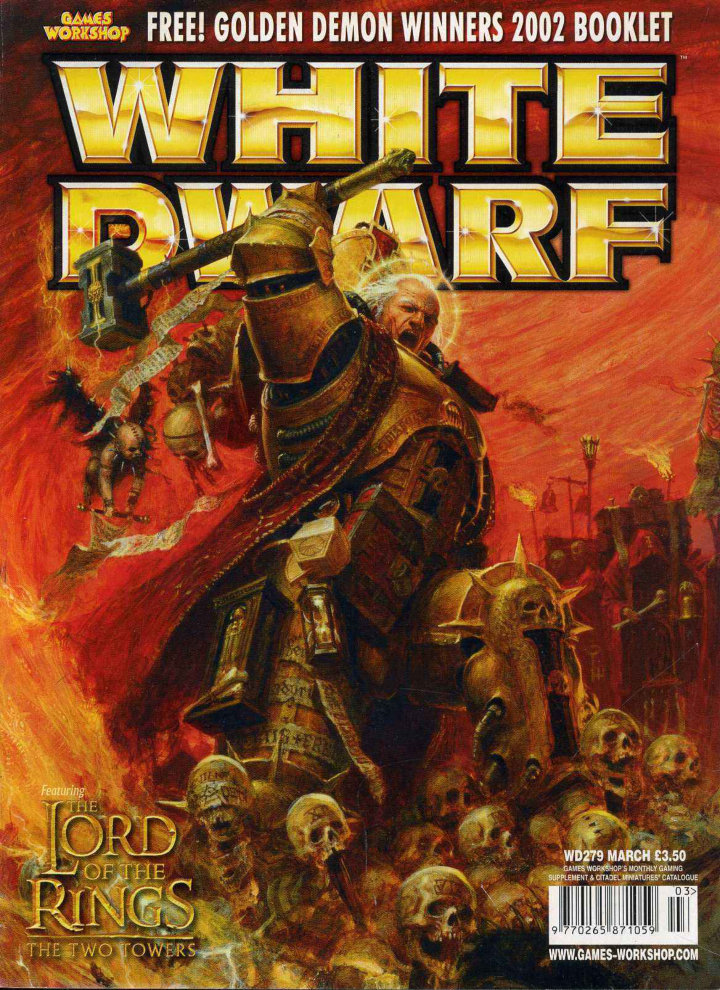
EditorialWD 279 · Inside cover
Paul Sawyer reports on a visit to Sabertooth Games in Seattle and his introduction to its card games. He also previews the wider strategic scope of the Eye of Terror campaign, where players will choose where to commit their results and discuss plans within faction forums.
CommunityWD 279 · pp. 2–4
The news pages introduce the Eye of Terror campaign and new characters for the Empire and Elven armies. A Forge World report examines Darren Parrwood’s Valkyrie transport, including its interior and weapon options, while other announcements cover the first British Lord of the Rings Grand Tournament and Black Library’s Riders of the Dead.
Warhammer 40,000Warhammer Fantasy Battles
InterviewWD 279 · pp. 8–13
Andy Chambers, Graham McNeill and Phil Kelly explain how Inquisitor’s characterful warbands grew into a full Warhammer 40,000 army. Grey Knights provide a disciplined core, while henchmen, adversaries, allied troops and narrative missions preserve the personal character of an Inquisitor’s secret war. The discussion follows the balance between specialised daemon fighting and usefulness against ordinary opponents, with psychic powers and equipment reinforcing the army’s gothic atmosphere.
Warhammer 40,000Grey Knights
PaintingWD 279 · pp. 14–15
Kirsten Mickelburgh and Seb Perbet paint Coteaz’s elaborate armour with warm gold layers and a yellow glaze, then contrast it with deeply shaded red cloth and dark cloak lining. Separate instructions cover the hourglass, hammer, book, face and Psyber-eagle, using controlled highlights and thin washes to distinguish metal, fur, feathers and fabric.
Warhammer 40,000Inquisition31 paint colours
PaintingWD 279 · p. 15
The Cherub’s dark wings receive grey drybrushing followed by restrained blue and green glazes. The guide contrasts these feathers with bright syringes and layered parchment, then finishes the scroll with fine writing, symbols and red wax seals.
Warhammer 40,000Inquisition15 paint colours
PaintingWD 279 · p. 15
A short recipe builds the servo-skulls’ aged bone from brown through leather and bone tones to a pale final highlight. Dark ink shades the metal fittings before brighter metallic highlights restore their edges.
Warhammer 40,000Inquisition9 paint colours
PaintingWD 279 · p. 15
Layered browns give the Acolyte’s robes a worn appearance, with red books and cloth providing brighter accents. The staff combines bronze and gold, while the collar gem uses progressively lighter blue and carefully placed white reflections to suggest a polished surface.
Warhammer 40,000Inquisition14 paint colours
PaintingWD 279 · p. 15
The Sage’s red robes are highlighted towards flesh tones and unified with a thin red glaze. A contrasting grey flesh recipe produces the pallid faces of both the Sage and Gun-servitor, establishing a deliberately unhealthy contrast with the rich fabric.
Warhammer 40,000Inquisition8 paint colours
InterviewWD 279 · pp. 16–19
Paul Sawyer and Mark Chambers visit Sabertooth Games and meet the designers, artists and production staff behind its collectible card games. Staff profiles connect their earlier gaming experience to their current roles, while discussion of artwork and Games Workshop’s involvement explains how the team develops games within the established worlds.
WarCry Collectible Card Game
InterviewWD 279 · pp. 17–19
Sabertooth’s designers describe WarCry as a game of armies whose changing fortunes should resemble a Warhammer battle. Players can combine allied factions or concentrate on one army, while the planned Winds of Magic and Siege of Darkness expansions introduce further aspects of the setting. The interview also explains the intended relationship between the cards, established characters and Black Library fiction.
WarCry Collectible Card GameHigh Elves
FictionWD 279 · pp. 20–23
Eltharion takes his vengeance into Naggaroth with Alith Anar’s guidance, forcing Malekith to send Shadowblade against the blind Swordmaster. Although Eltharion wounds the assassin, poison nearly ends his campaign. Rescue and reinforcements bring orders to return to Ulthuan, but he refuses to abandon his war and invites his companions to remain.
Warhammer Fantasy BattlesHigh Elves
RulesWD 279 · p. 24
Eltharion’s profile represents his transformation into a blind master of Hoeth. Four fighting styles let him alter his combat strengths, and a great leap changes his position within a fight. His presence also affects Swordmaster selection and leadership, while his particular hatreds and compulsions shape how the army must engage its enemies.
Warhammer Fantasy BattlesHigh Elves
RulesWD 279 · p. 25
The Dark Elf assassin can begin a battle concealed among enemy troops, emerging to strike from within their ranks. His profile combines poison and assassin abilities with a strength-enhancing potion and the explosive Heart of Woe, making his death a threat as well as his initial attack. Background passages preserve the uncertainty surrounding his identity and origins.
Warhammer Fantasy BattlesDark Elves
LoreWD 279 · pp. 26–31
Ian Hawkes surveys the Old World’s gods and the ways regional loyalties coexist with worship of a broader pantheon. The account links religion to government, everyday occupations and warfare, from Sigmar’s uniquely Imperial cult to Bretonnia’s Lady and the older traditions of druids. Temples, priests and military orders show how belief takes institutional form.
Warhammer Fantasy BattlesEmpire
LoreWD 279 · p. 29
Temple architecture and priestly duties reflect the character of each deity rather than following one universal model. The discussion distinguishes martial clergy from other religious roles and leaves open whether divine miracles differ fundamentally from wizardry. The new Grand Theogonist’s cautious policy is contrasted with Luthor Huss’s militant protest.
Warhammer Fantasy BattlesEmpire
LoreWD 279 · p. 30
The survey distinguishes secular knightly orders from religious brotherhoods that serve particular gods. Examples include the zealots of the Twin-tailed Orb, Myrmidia’s Knights of the Blazing Sun, Ulric’s White Wolves and Morr’s Black Guard, with their origins and duties explaining the different forms of holy warfare.
Warhammer Fantasy BattlesEmpire
RulesWD 279 · p. 31
Ulrican priests join an Empire army as heroes with their own equipment, religious restrictions and battle prayers. They strengthen magical defence, favour aggressive combat and refuse certain companions. Four prayers support charges, inflict close-range damage, hinder enemies or steady allies against fear.
Warhammer Fantasy BattlesEmpire
CommunityWD 279 · pp. 34–39
Space McQuirk and Che Webster examine a Lincoln club’s scheme for encouraging completed armies. Members submit a roster and present a substantial painted force for inspection, with minimum standards for colour, bases and model numbers adjusted where an army demands it. Four members explain how deadlines, campaigns and encouragement helped them complete very different collections.
Warhammer 40,000Warhammer Fantasy Battles
ShowcaseWD 279 · pp. 34–35
Neil Chapman describes returning to Tyranids and keeping an older force in play while he completed models for the newer army. Converted monsters and a dark palette give the collection its identity, with bright teeth and a deliberately restrained treatment of the eyes accentuating the creatures’ alien appearance.
Warhammer 40,000Tyranids
ShowcaseWD 279 · p. 36
A club campaign gave Anna Delafield the impetus to replace borrowed troops with a Sisters of Battle army of her own. Working in batches over three weeks produced the core force, while shoulder-crest colours identify squads and more individual treatment distinguishes its characters.
Warhammer 40,000Adepta Sororitas
ShowcaseWD 279 · pp. 36–37
Andy Dodd develops an older collection into a fast, mounted Dark Elf army after finding its original formations too slow. Dark Riders and Cold One Knights dominate the revised force, with a converted Malus model providing a focal point. The club accepts a model-count exception appropriate to the army’s elite composition.
Warhammer Fantasy BattlesDark Elves
ShowcaseWD 279 · pp. 38–39
James Allen traces his progress from an early painting set through Warmaster and competition entries to a Grand Tournament army. Advice and a fixed deadline encourage him to develop a limited palette into a coherent Orc force that earns a place among the event’s best armies, with further Goblin units planned.
Warhammer Fantasy BattlesOrcs & Goblins
Battle reportWD 279 · pp. 40–42
Paul Sawyer’s Chaos army and its dragon ally face Pete Haines’s unusually concentrated force of Dwarf Slayers in Dylan Owen’s campaign. Rune weapons and the dragon’s compulsory aggression undo much of Paul’s plan, while repeated magical attacks gradually reduce the Dwarfs. The points produce a draw, but the dragon dies and Vradchuk’s campaign injury leaves him subject to bouts of madness.
Warhammer Fantasy BattlesWarriors of Chaos
ModellingWD 279 · p. 43
Paul Sawyer converts shield arms, standard-bearer parts and spare blades to give a Slaaneshi regiment paired weapons. Careful pinning and altered weapon heads add variety, while wider regiment bases help the bulky models rank up. He also corrects earlier mistakes concerning chariot crew strength and the use of additional hand weapons while mounted.
Warhammer Fantasy BattlesWarriors of Chaos
RulesWD 279 · pp. 48–53
Andy Hoare, Graham McNeill and Phil Kelly provide trial rules for creating an army from the ill-fated Twenty-first Founding or adding its warriors to a standard Space Marine force. Restricted resources and unreliable allies balance unusual Chapter traits, while Cursed Knights and Abominations represent different extremes of genetic corruption. The rules deliberately leave room for players to invent their own mysterious Chapters.
Warhammer 40,000Space Marines
RulesWD 279 · p. 50
The Black Dragons’ abnormal bone growth produces the blade-covered Dragon Claws and raises suspicions about their supposedly pure gene-seed tithe. Their assault squads gain lethal natural weapons, and a modelling example uses Tyranid talons and Catachan arms to represent the mutation.
Warhammer 40,000Black Dragons
RulesWD 279 · p. 50
The Minotaurs’ savage assaults make them effective but unreliable allies, exemplified by their attack on the Lamenters during the Badab Uprising. The Berserkers trait grants fearlessness and additional attacks at the cost of compulsory pursuit of the nearest enemy.
Warhammer 40,000Minotaurs
RulesWD 279 · p. 51
Reports link the ghostly legionnaires to the lost Fire Hawks without resolving their identity. The Apparitions trait gives infantry and vehicles unusual deep-strike deployment and a protective invulnerable save, allowing their mysterious arrival to define the army’s behaviour.
Warhammer 40,000Legion of the Damned
RulesWD 279 · p. 51
The Lamenters appear to have escaped the usual defects of Sanguinius’s descendants only to suffer persistent misfortune. Their disastrous involvement in Badab and encounter with Hive Fleet Kraken frame the Aura of Doom rule, which forces enemies to test before charging them.
Warhammer 40,000Lamenters
RulesWD 279 · pp. 51–52
The chapter’s spontaneous, harmless self-immolation is hailed as a miracle by its commander but condemned by the Inquisition, leading to a Grey Knight assault on Lethe. Their Immolation trait provides protection and the defensive benefits of cover, while preventing transport use.
Warhammer 40,000Flame Falcons
RulesWD 279 · p. 52
Eyewitness accounts describe unusually large and resilient Marines, including their stand against Eldar pirates beside the Subjugators. Augmented Skeleton increases Toughness while preserving the ordinary threshold for instant death, translating the mysterious Chapter’s durability into a purchased trait.
Warhammer 40,000Sons of Antaeus
RulesWD 279 · p. 53
Apparently flawless warriors conceal a potentially fatal genetic instability. Their pre-battle corruption roll can produce a stable enhancement, a berserk outbreak or short-lived superhuman performance that costs the unit its lives after the battle.
Warhammer 40,000Space Marines
RulesWD 279 · p. 53
The most severely corrupted brethren fight as fearless squads whose violent mutations can strike their own companions. The accompanying conversion examples combine Spawn, Ork and Tyranid parts to represent sudden biological change in Sons of Antaeus and Black Dragon models.
Warhammer 40,000Space Marines
EditorialWD 279 · pp. 56–57
An introduction to Battlefleet Gothic explains how ship classes, special orders, ordnance and space phenomena create fleet battles. The boxed game’s modular cruisers lead into discussion of scenarios, campaigns and supporting components, setting up renewed coverage ahead of the Eye of Terror campaign.
Battlefleet GothicImperial Navy
ShowcaseWD 279 · pp. 58–59
John Shaffer builds opposing Imperial and Chaos fleets from the starter game, choosing complementary cruiser classes before expanding each to roughly fifteen hundred points. His account connects weapon layouts to battlefield roles and explains how quick assembly and drybrushing made the project accessible, while the game’s need for advance planning kept him interested.
Battlefleet GothicImperial Navy
LoreWD 279 · pp. 62–68
Matt Keefe and Andy Chambers trace the fleet actions of the Third Armageddon War from the defeat at Pelucidar to Parol and Helbrecht’s improvised blockade. Coordinated Navy and Space Marine actions exploit the Orks’ eagerness to land, while silent-running attacks and a search for tellyporta vessels gradually reduce their advantage. Parol’s disappearance and the later return of Imperial bureaucracy leave the hard-won position precarious.
Battlefleet GothicWarhammer 40,000Imperial Navy
RulesWD 279 · p. 68
The article adapts Battlefleet Gothic’s ten standard scenarios to incidents around Armageddon, from pirate raids and convoy attacks to blockade fighting. A specific Exterminatus variant uses Ork Roks attempting to land, while other suggestions change force sizes or opponents to match the campaign’s broader naval history.
Battlefleet GothicImperial Navy
LoreWD 279 · pp. 72–75
Space McQuirk reconstructs Nehekhara as a living civilisation before describing its ruined present. Divine kingship, priestly administration, pyramid labour and funerary sacrifice underpin its cities, whose regional identities range from militarised Numas to wealthy southern trading centres and the sacred White Palace. Narrative scenes show both everyday punishment and organised defence, making the later undead kingdoms the remnants of a recognisable society.
Warhammer Fantasy BattlesTomb Kings
EditorialWD 279 · pp. 78–79
Jervis Johnson introduces configurable Dwarf Treasure Hunters and new Ogre players, then reports on rules reviews and development across Specialist Games. A longer answer explains the forthcoming Tau fleet and why freelance sculpting and supporting background take time. Other updates cover countryside adventures for Mordheim, Warmaster campaigns and the final major stage of Epic Armageddon rules development.
MordheimBlood Bowl
RulesWD 279 · pp. 80–81
Anthony Reynolds presents a multiplayer struggle for an ancient Chaos temple. Randomised player order and shared magic, shooting and combat phases create shifting alliances, while special procedures resolve pooled dispelling and fights involving several sides. Control of the temple brings additional favour and a randomly determined relic or supernatural consequence.
Warhammer Fantasy BattlesWarriors of Chaos
Battle reportWD 279 · pp. 82–83
Anthony Reynolds, Graham McNeill, Phil Kelly and Dylan Owen test the temple scenario with rival Chaos warbands. Illusory movement and temporary alliances disrupt the contest, but Dylan’s strong Undivided force survives the final clash to claim the objective and a Warrior Familiar. Random turn order repeatedly changes who can exploit a position.
Warhammer Fantasy BattlesWarriors of Chaos
CommunityWD 279 · p. 84
Northern Europe’s beginner course combines six weeks of games and painting lessons around a single miniature. A membership card records progress through twelve stages, after which participants can move on to more advanced store advice and developing a full army.
Warhammer 40,000Warhammer Fantasy Battles
Battle reportWD 279 · pp. 86–103
Adrian Wood’s Orks defend against Tom Hibberd’s Crimson Fists in a fifteen-hundred-point Blitz mission, reversing both armies’ usual roles. An exceptionally stubborn Ork Dreadnought absorbs fire and destroys its Imperial counterpart, while the Marines force their way through successive mobs. Two surviving Assault Marines shelter behind a Rhino in the second defence line and secure the decisive victory points.
Warhammer 40,000Orks
LoreWD 279 · pp. 105–114
Graham McNeill and Andy Hoare recount Angron’s invasion, the collapse of Armageddon Prime and the defenders’ stand near the River Chaeron. A sustained narrative follows Logan Grimnar, Sergeant Kohler and the Grey Knights through the battle that banishes the Daemon Primarch. Victory is followed by the sterilisation and enslavement of survivors, leaving Grimnar permanently hostile to the authorities who erase their sacrifice.
Warhammer 40,000World Eaters
LoreWD 279 · p. 107
A short profile links Angron’s martial pride and early support for Horus to his adoption of Khorne. After the Heresy he leads the World Eaters into the Eye of Terror, where mutation transforms him into a gigantic daemon champion armed with a rune-marked blade.
Warhammer 40,000World Eaters
LoreWD 279 · p. 108
Grimnar’s leadership in the First Armageddon War establishes his reputation as Great Wolf. The profile connects his later distrust of Imperial administrators to the war’s aftermath and describes the aged warrior’s formidable presence, Terminator armour and Axe of Morkai.
Warhammer 40,000Space Wolves
LoreWD 279 · p. 113
Aurellian’s biography follows his recruitment from Posul, where Grey Knights seize him from the Mortifactors, through the exploits that establish his psychic and martial ability. A prophecy concerning his death hangs over his final journey to answer Grimnar’s plea from Armageddon.
Warhammer 40,000Grey Knights
LoreWD 279 · p. 113
A purported extract from suppressed military records groups Angron’s invasion force into World Eaters companies, mutant cohorts, daemonhost covens, traitor Titans, civilian cults and rebellious Guard formations. The compiler’s notes distinguish these categories and acknowledge the uncertainty created by summoned daemons.
Warhammer 40,000World Eaters
EditorialWD 279 · p. 116
Alessio Cavatore reflects on his first Games Day as the principal developer of the Middle-earth game. Readers’ enthusiasm reassures him about its place alongside the established systems, while meeting illustrator John Howe connects the miniatures to the visual development of the films.
Middle-earth Strategy Battle Game
RulesWD 279 · pp. 118–120
Matthew Ward builds a scenario by choosing participants, setting, objectives, terrain and a small number of special rules. Faramir’s Escape supplies a worked example of fitting an invented encounter into the story and balancing escape against pursuit. The advice emphasises room to manoeuvre, clear terrain effects and changing one variable at a time during playtesting.
Middle-earth Strategy Battle Game
RulesWD 279 · p. 121
Faramir and his Rangers try to cross a river while fighting off Orc patrols on their way to warn a Gondorian column. Victory requires both inflicting sufficient casualties and escaping with half the force, making the ford a tactical constraint rather than a simple exit. Campaign rules preserve survivors and heroic resources for two later encounters.
Middle-earth Strategy Battle GameGondor
PaintingWD 279 · p. 122
Neil Green, Seb Perbet and Tammy Haye give Frodo subdued brown clothing and a green-grey Elven cloak, with pale shirt and flesh highlights distinguishing the face and hands. Thin washes and careful eye shading add character without overwhelming the small model.
Middle-earth Strategy Battle GameThe Fellowship14 paint colours
PaintingWD 279 · p. 122
Sam’s clothes use related brown and green mixtures with distinct highlight colours to separate jacket, trousers and cloak. The accompanying fire receives a warm glaze over pale highlights, while darkened metal and a drybrushed tree establish the surrounding camp scene.
Middle-earth Strategy Battle GameThe Fellowship21 paint colours
PaintingWD 279 · p. 123
Gollum’s skin is built from dark flesh through greyed flesh mixtures to white, giving a pallid contrast with his dark hair and loincloth. Metallic blue-grey mixtures suggest fish scales, and small coloured washes distinguish the exposed fish bones, eyes and rocky setting.
Middle-earth Strategy Battle Game14 paint colours
PaintingWD 279 · p. 124
The Faramir guide separates several kinds of leather and fabric within a restrained woodland palette. Repeated additions of bone colour control the highlights, while the Silver Tree, sword and small gold details supply contrast. Face, hair, quiver and arrow flights receive their own recipes.
Middle-earth Strategy Battle GameGondor17 paint colours
PaintingWD 279 · p. 125
Damrod’s cloak and tabard share the Rangers’ green mixture, while warmer washed leather distinguishes his tunic and pouches. The guide treats the boots, sleeves, hair, face and quiver separately, using dark basecoats to maintain depth and small metallic details to finish the figure.
Middle-earth Strategy Battle GameGondor19 paint colours
PaintingWD 279 · p. 125
A common set of colour recipes gives the Rangers cohesion while distributing the colours differently across each model’s clothes. Dark glazes distinguish cloth from leather, pale highlights pick out gauntlet designs, and sand, a brown wash and drybrushing provide a shared grassy base treatment.
Middle-earth Strategy Battle GameGondor15 paint colours
RulesWD 279 · pp. 126–127
David Smith stages a Second Age assault on an outpost visited by Isildur. The attackers probe with successive Orc groups before committing their leader, bodyguard, Troll and surviving warriors to a final attack. Withdrawal thresholds and a prohibition on shooting retreating probes preserve troops for the climax, while alternative points forces let the structure serve other settings.
Middle-earth Strategy Battle GameGondor
Covers, contents, advertisements, sales catalogues, store directories, event listings and art-only dividers are excluded. Substantive articles and separately titled rules, scenarios and tutorials are indexed.