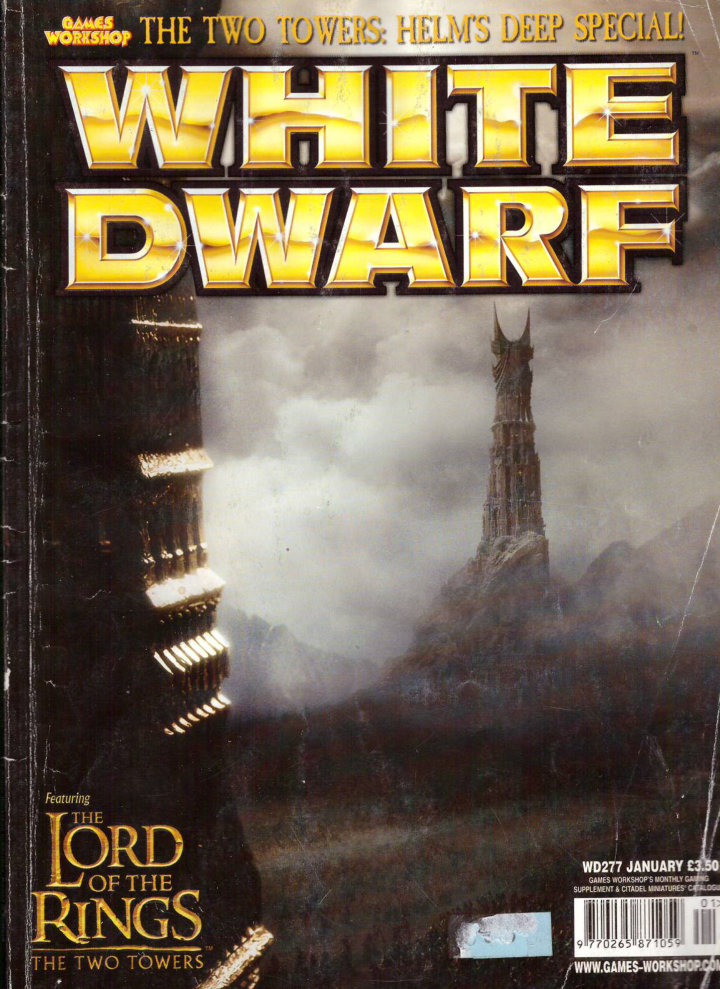
EditorialWD 277 · Inside cover
Returning to his Dwarfs for a planned multiplayer battle reminds Paul Sawyer why an established favourite army can be as motivating as a new release. His renewed enthusiasm produces converted crossbowmen and fresh war machines, while the resulting pause in Chaos painting offers an honest view of how competing hobby projects affect the magazine’s long production schedule.
Warhammer Fantasy BattlesDwarfs
CommunityWD 277 · pp. 2–5
The opening news introduces the Ordo Malleus and Grey Knights ahead of the Daemonhunters book and points Tomb Kings players towards additional online material. Brief reports preview the Kroot Beast, new Lizardmen plastics, Black Library art and a planned Golden Demon booklet, while campaign and Blood Bowl notices show the growing range of organised play.
Warhammer 40,000Warhammer Fantasy Battles
InterviewWD 277 · pp. 10–15
Gav Thorpe, Alessio Cavatore and Anthony Reynolds explain how they gave the Tomb Kings a distinct identity through disciplined skeleton formations, reliable shooting and ritualised incantations. Separating the military leader from the Hierophant changes the army’s risks, while light chariot units, animated constructs and the Casket of Souls create choices beyond another Vampire Counts list. The account follows the project through playtesting, background research, adjustments that encouraged taking a Tomb King, and final production.
Warhammer Fantasy BattlesTomb Kings
LoreWD 277 · p. 13
A background introduction describes Nehekhara’s rulers as ancient conquerors whose intended glorious afterlife was disrupted by Nagash’s awakening spell. Their armies and sacred statues return alongside them, and the half-decayed monarchs continue the rivalries and imperial ambitions of their living kingdoms rather than accepting the ruin around them.
Warhammer Fantasy BattlesTomb Kings
PaintingWD 277 · pp. 16–17
Several bone recipes show how a simple undercoat, ink wash and drybrush can create distinct skeleton finishes. The studio method adds more deliberate highlights and brass weapons, while contrasting shields help distinguish regiments within an army dominated by pale bone. The examples make clear that changing the shade and warmth of the wash can alter the whole force without greatly increasing painting time.
Warhammer Fantasy BattlesTomb Kings11 paint colours
PaintingWD 277 · p. 17
Dave Andrews explains how he finished a coherent Tomb Kings force by applying each painting stage across the entire army. His bone treatment builds pale drybrushed layers over a dark undercoat, reserving the brightest accents for teeth; reduced photocopies of hieroglyphs provide convincing decoration on shields and scrolls without laborious freehand work.
Warhammer Fantasy BattlesTomb Kings5 paint colours
TacticsWD 277 · pp. 18–23
Pete Scholey describes how his long-standing Undead collection became a Tomb Kings army and how playtesting changed his understanding of its strengths. His preferred force uses a chariot-mounted King, protected Liche Priests, mobile constructs and selective shooting to coordinate attacks through incantations. The advice emphasises preserving irreplaceable units, exploiting restoration magic and choosing a clear plan instead of treating the army as a variant of Vampire Counts.
Warhammer Fantasy BattlesTomb Kings
EditorialWD 277 · pp. 26–29
Andy Chambers reviews the development team’s changing roles and recent work in the voice of an Imperial archivist. Cityfight, Tau, Necrons and the expanded Chaos Space Marines book lead into plans for Daemonhunters, the Eye of Terror campaign and a revised Imperial Guard codex. The feature explains how the enlarged team shares projects and links the coming campaign to the Cadian Gate and several new army lists.
Warhammer 40,000
RulesWD 277 · p. 30
A straightforward warband encounter provides the baseline for the new Path to Glory scenarios. Opposing forces deploy across the table, alternate placing their units and fight until the time limit or the defeat of a warband; voluntary retreat gives a battered force an alternative to being wiped out.
Warhammer Fantasy BattlesWarriors of Chaos
RulesWD 277 · p. 30
One Chaos warband occupies a sacred circle while a rival attacks from a chosen table edge. The attacker can win by clearing and occupying the monument, so the defenders must maintain a presence at the objective instead of simply chasing casualties across the battlefield.
Warhammer Fantasy BattlesWarriors of Chaos
CampaignWD 277 · pp. 30–31
Anthony Reynolds expands the Chaos warband campaign with encounters that reward more than a straight fight, accompanied by a random scenario selector. Objective control, breakthrough and surprise deployment give small collections different tactical problems, and the issue also supplies a roster for tracking followers, favour and a champion’s changing abilities.
Warhammer Fantasy BattlesWarriors of Chaos
RulesWD 277 · p. 31
An attacking warband attempts to push a substantial part of its force through an enemy screen and off the far side of the battlefield. The defender has broad freedom to establish blocking positions, creating a choice between concentrating on a vulnerable route and spreading out to deny escape.
Warhammer Fantasy BattlesWarriors of Chaos
RulesWD 277 · p. 31
Two rival warbands contest a sacred location at the centre of the table. If neither force breaks, occupation at the end determines the result, making survival and the timing of the final advance more important than merely inflicting losses.
Warhammer Fantasy BattlesWarriors of Chaos
RulesWD 277 · p. 31
A dispersed defending warband is surprised by an enemy force arriving from an undisclosed table edge. The opening conditions make concentration and mutual support difficult for the defenders, while the attacker must exploit its choice of entry before the scattered units recover.
Warhammer Fantasy BattlesWarriors of Chaos
Battle reportWD 277 · pp. 32–33
Anthony Reynolds uses speed and feigned retreats to divide Space McQuirk’s stronger Nurgle warband, but repeated Poxes and the arrival of Yabba Foulstinka overturn his attempted local advantage. The battle ends in defeat for Kol Shaargol’s followers, yet the post-game sequence shows how favour and injury rerolls can leave the losing force stronger, with a newly recruited sorcerer offering hope for the next game.
Warhammer Fantasy BattlesWarriors of Chaos
CampaignWD 277 · pp. 34–35
The two-page campaign sheet provides places to record a warband’s patron, available favour and overall rating alongside its champion and followers. Equipment, injuries, mutations and special rules can be kept beside the relevant profiles, turning the evolving campaign force into a practical reference for later battles.
Warhammer Fantasy BattlesWarriors of Chaos
LoreWD 277 · pp. 36–37
Two new Space Marine character models are introduced through accounts of their extraordinary resolve. An Apothecary describes Captain Cortez surviving injuries that should have ended any warrior’s service, while a short story follows the Emperor’s Champion Bethuel into a doomed orbital hive to confront a renegade Techno-Magus as the structure falls towards the planet below.
Warhammer 40,000Crimson Fists
EditorialWD 277 · pp. 38–39
Jervis Johnson previews Genestealer characters for Inquisitor, Amazon warriors for Mordheim and additions to Blood Bowl and Battlefleet Gothic. The studio update discusses the new Blood Bowl handbook, the Secret Wars campaign, modular Ork battleships and extensive Epic Armageddon playtesting; a reader question explains the practical limitations of obtaining small-print-run Specialist Games magazines.
InquisitorMordheim
RulesWD 277 · p. 40
The scenario divides the Orc force between the tombs and a nearby oasis, then brings an Undead army out of the ground between them. Restricted movement during the Undead arrival gives the raiders a brief opportunity to react, and the unusual victory conditions make returning troops to safety more important than destroying the enemy. The Undead cannot be broken through ordinary losses while their general survives.
WarmasterTomb Kings
Battle reportWD 277 · pp. 40–43
Ewan Lamont and Tom Merrigan fight a Warmaster escape battle after Orc tomb robbers steal the Sceptre of Damnation. The Undead rise between the scattered raiders and their oasis, but repeated command failures prevent their cavalry from exploiting the initial trap. Trolls destroy the Bone Giant and Sphinx while Wolf Riders evade the fighting, allowing enough Orcs to escape for a narrow victory just before their army would break.
WarmasterTomb Kings
FictionWD 277 · pp. 44–45
A daemon-possessed Iron Warriors Predator advances through Imperial defenders and engages a pair of loyalist tanks. The crew’s apparent defeat becomes a demonstration of the machine’s unnatural resilience as its damaged weapon repairs itself and returns fire. A short accompanying introduction places the Predator’s long history alongside the newly released Chaos model.
Warhammer 40,000Iron Warriors
CampaignWD 277 · pp. 50–53
Paul Sawyer takes his growing Chaos army to Calgary, where games against Empire and Skaven opponents test a force still learning to combine its magic, cavalry and chariots. The account contrasts a curtailed draw with a decisive Chaos victory, includes flail conversions for Marauder Horsemen and returns to the studio’s territorial campaign. New Daemonettes and a possible mounted version of Vradchuk provide the next collecting decisions.
Warhammer Fantasy BattlesWarriors of Chaos
LoreWD 277 · pp. 56–63
Graham Davey examines the Alpha Legion through deliberately uncertain Imperial evidence, linking Alpharius’s discovery by Horus with a doctrine of coordinated deception and independent command. The account follows the Legion through its rivalry with Guilliman, the disputed battle of Eskrador and its continuing use of hidden bases and human agents inside the Imperium. Doubts about the principal investigator’s loyalty make the apparent revelations part of the Legion’s mystery.
Warhammer 40,000Alpha Legion
LoreWD 277 · p. 61
An imported locust infestation destroys an agricultural world’s harvest and helps trigger unrest, mutiny and the destruction of arriving Mordian troops. The ensuing food shortages destabilise neighbouring systems, illustrating how an Alpha Legion operation might exploit ecological and political pressures long before a conventional military attack.
Warhammer 40,000Alpha Legion
LoreWD 277 · p. 63
Inquisitor Kravin argues that the Alpha Legion must be recruiting new Space Marines within the Imperium, then disappears after being accused of aiding the very traitors he studies. The dispute casts doubt on the evidence used to reconstruct the Legion’s history and leaves its strength and methods unresolved.
Warhammer 40,000Alpha Legion
RulesWD 277 · p. 63
The Alpha Legion rules make infiltration and organised cultists central to the army. Cults can specialise as scouts, assassins or saboteurs, while restrictions on marks and summoning distinguish the Legion from forces based in the Eye of Terror. The accompanying cultist profile and equipment options allow these human agents to join a Chaos Space Marine army.
Warhammer 40,000Alpha Legion
EditorialWD 277 · pp. 66–69
Gav Thorpe reviews the High Elf, Skaven, Chaos and Tomb Kings projects and explains his aim of giving each army a distinctive style of play as well as a distinctive appearance. Looking forward, he discusses new Lizardmen plastics, interchangeable Beastmen and mortal Chaos forces, Kislev’s role in Archaon’s invasion and a planned Bretonnian revision. The column also outlines continuing character stories and the possibility of figures drawn from earlier periods of Warhammer history.
Warhammer Fantasy Battles
Battle reportWD 277 · pp. 72–91
Four thousand-point forces converge on a single objective in a multiplayer battle shaped by temporary alliances and an uncertain finishing turn. Matt Hutson’s Word Bearers and Owen Rees’s Dark Angels combine against Phil Kelly’s Tyranids, while Alex Boyd’s Orks struggle to bring their slow-moving Warboss into the fight. The Tyranids delay Chaos effectively but lose their chance at the objective; a depleted Dark Angels command squad claims victory when the game ends on turn five.
Warhammer 40,000Word Bearers
EditorialWD 277 · p. 98
Alessio Cavatore welcomes the arrival of The Two Towers film and the newcomers it will bring to the game. He explains why individual model movement suits siege warfare, introduces the Helm’s Deep terrain and associated warriors, and sets this issue’s beginner guidance alongside material for players already exploring the new rules.
Middle-earth Strategy Battle Game
ShowcaseWD 277 · pp. 102–103
An illustrated introduction opens The Two Towers starter set and describes how its rules manual moves from the basic turn sequence through heroes, cavalry and siege warfare. The contents include profiles, linked scenarios and hobby guidance alongside Riders of Rohan, Uruk-hai and a ruined building, giving newcomers a picture of both the models and the kinds of battles the set supports.
Middle-earth Strategy Battle Game
ModellingWD 277 · pp. 106–107
Dave Andrews and Mark Jones finish their fortress with a buttressed cardboard-tube Hornburg, an MDF backboard and a rock face built over foam formers. Plaster bandage creates a durable landscape, while individually applied card stones cover the walls, courtyards and battlements. Black undercoating marks completed sections before large-scale drybrushing brings out the stonework.
Middle-earth Strategy Battle Game
PaintingWD 277 · p. 108
The starter-set painting guide uses a dark undercoat and metallic drybrushing to produce worn Uruk-hai armour quickly. Separate flesh, leather and tooth colours keep the figures readable with few stages, and the instructions explain how to correct mistakes before finishing the base edge.
Middle-earth Strategy Battle GameIsengard6 paint colours
PaintingWD 277 · p. 109
A simple sequence separates a Rider of Rohan’s metallic armour, green cloak and brown leather before adding gold trim and flesh. Leaving the eye recesses dark and using a single warm colour for hair gives beginners a clear finish without fine facial detailing.
Middle-earth Strategy Battle GameRohan8 paint colours
PaintingWD 277 · p. 109
The accompanying horse guide builds a brown mount over a black undercoat, separates the reins and saddle cloth, and picks out the metal fittings and teeth. A sand base painted dark and overbrushed pale supplies a quick textured finish for the completed cavalry model.
Middle-earth Strategy Battle GameRohan6 paint colours
RulesWD 277 · pp. 110–111
A worked duel between a Rider of Rohan and an Uruk-hai teaches the order of a turn through four successive examples. Priority determines whether the archer can retreat or is caught in combat; the account then introduces shooting, wound rolls, tied Fight rolls and the consequences of being engaged. It closes by pointing new players towards a complete scenario once these basic interactions are familiar.
Middle-earth Strategy Battle GameRohan
PaintingWD 277 · p. 112
Seb Perbet and Tammy Haye explain the layered leather, mail and weathered equipment of Aragorn’s Helm’s Deep model. Restrained grey and bone highlights separate several dark surfaces, while thin glazes and stippled stubble give the face and clothing a worn appearance. The guide treats the sword, scabbard and Gondorian arm-brace motif as distinct focal details.
Middle-earth Strategy Battle GameThe Fellowship18 paint colours
PaintingWD 277 · pp. 112–113
Théoden’s tutorial distinguishes scalemail, gilded armour and dark leather before adding a red undershirt and green inner robe. Layered flesh and carefully highlighted hair frame the face, while the sword, patterned armour and equipment receive their own contrasting metallic and warm brown finishes.
Middle-earth Strategy Battle GameRohan19 paint colours
PaintingWD 277 · p. 113
This section refers readers to the earlier Haldir tutorial for the Elven warriors themselves and concentrates on the new banner. A muted brown ground supports light green, dark green and blue panels, with bone added to each colour family for harmonious highlights and fine decoration.
Middle-earth Strategy Battle GameLothlórien7 paint colours
PaintingWD 277 · pp. 113–114
Gamling combines a dark green cloak with decorative trim, weathered mail and individually treated leather armour. The guide uses controlled mixtures to distinguish similarly coloured straps, trousers and hair, while a carefully layered face and highlighted sword provide the strongest points of attention.
Middle-earth Strategy Battle GameRohan19 paint colours
PaintingWD 277 · p. 114
Gimli’s warm red clothing and beard are balanced against steel mail and a copper-toned axe. Dark washes reinforce the recesses, while cross-hatched highlights suggest wear on the gauntlets. The flesh and subdued cloak recipes complete a model whose different brown surfaces remain distinct despite their close relationship.
Middle-earth Strategy Battle GameThe Fellowship16 paint colours
PaintingWD 277 · p. 115
Legolas’s layered greens and greys keep his cloak and jerkin related while separating their edges and folds. Muted leather, a blue-grey under-robe and carefully finished flesh avoid overwhelming the figure; the rock, quiver and decorated bow receive matching restrained highlights.
Middle-earth Strategy Battle GameThe Fellowship14 paint colours
PaintingWD 277 · p. 115
Éowyn’s pale blue-grey skirt and blond hair contrast with a dark leather jerkin and boots. Successive bone highlights soften the cloth and trim, a yellow glaze enriches the hair, and conventional silver stages finish the sword without distracting from the figure’s face.
Middle-earth Strategy Battle GameRohan14 paint colours
Battle reportWD 277 · pp. 116–127
Rowland Cox’s sixty Uruk-hai attack Matthew Ward’s twenty defenders in the opening game of a linked Helm’s Deep campaign. Divided assaults, ladders and demolition charges stretch the Elves and Rohirrim while their heroes hurry from the Hornburg. Haldir falls to crossbow fire and a charge breaches the wall, but Gimli’s final heroic combats halve the attacking force in time to save the defenders; their depleted Might and casualties carry forward to the next scenario.
Middle-earth Strategy Battle GameIsengard
Covers, contents, advertisements, sales catalogues, store directories, event listings and art-only dividers are excluded. Substantive articles and separately titled rules, scenarios and tutorials are indexed.