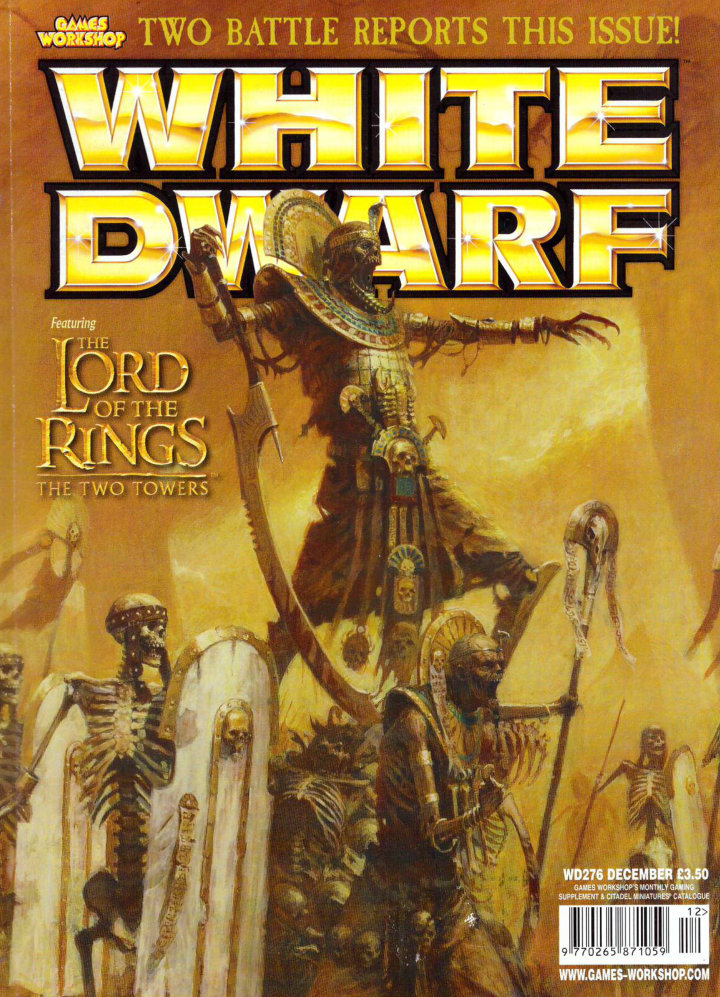
EditorialWD 276 · Inside cover
Paul Sawyer reflects on Games Day as a chance to see the hobby through readers’ enthusiasm and to gather useful criticism of the magazine. His visit to Calgary’s inaugural Grand Tournament also revealed strong support for Specialist Games, prompting a promise of regular Fanatic coverage alongside anticipation for The Two Towers.
CommunityWD 276 · pp. 2–5
The news pages report Matt Parkes’s third Slayer Sword and preview Kevan Downey’s award-winning battle scene, alongside the magazine team’s aerial participation game at Games Day. Short items cover online army resources, a Warhammer World campaign weekend, the emerging Fire Warrior computer game, Specialist Games support and Black Library projects, capturing the wider hobby activity surrounding this issue’s releases.
Warhammer 40,000Warhammer Fantasy Battles
LoreWD 276 · pp. 6–11
Graham McNeill and Erick Kilmer trace the Raven Guard from Corax’s rebellion against Kiavahr’s slave-masters to the devastation at Isstvan V and the desperate experiments used to rebuild his Legion. Their account connects the Chapter’s depleted numbers, unstable gene-seed and reverence for Corax with its reliance on reconnaissance, rapid deployment and precisely targeted violence. Heraldry diagrams distinguish earlier and contemporary armour markings.
Warhammer 40,000Raven Guard
LoreWD 276 · p. 9
Solari’s ancestry reaches back to the slaves of Deliverance, and his reputation rests on personally leading assault troops with ferocity and little patience for formality. The portrait emphasises a gambler’s approach to command: his ability to seize an opportunity produces spectacular successes, but luck and an uneven record have repeatedly brought him close to disgrace.
Warhammer 40,000Raven Guard
LoreWD 276 · p. 10
A Space Wolves tradition recalls an apparently hopeless siege against the Iron Warriors after the Heresy. Raven Guard attackers arrive with deformed, savage creatures whose assault opens the fortress, only to slaughter those same creatures afterwards; the story gives a disturbing external glimpse of the consequences of Corax’s rebuilding experiments.
Warhammer 40,000Raven Guard
RulesWD 276 · p. 11
The Raven Guard variant army list turns the Chapter’s mobile doctrine into deployment and roster restrictions. Deep-striking infantry can correct their landing, Scouts help reserves arrive, and jump-pack command squads provide a suitably equipped striking force; the limits on heavy support and the Chapter’s particular hatred of the Isstvan traitors complete the identity of the list.
Warhammer 40,000Raven Guard
CampaignWD 276 · pp. 14–17
Paul Sawyer returns to his monthly Chaos army project by completing a sorcerer, chariot and additional cavalry while taking part in the studio’s territorial campaign. A defeat against Gareth Harvey’s elusive Dark Riders exposes the army’s inability to force combat, whereas Dylan Owen’s Night Goblins largely destroy themselves with uncontrolled Fanatics. The account ties those experiences to future purchases, the importance of magic and the practical problem of a chariot-mounted commander keeping up with the advance.
Warhammer Fantasy BattlesWarriors of Chaos
CampaignWD 276 · pp. 20–23
Anthony Reynolds adds campaign advancement to the Chaos warband rules. Favour rewards both general battlefield success and behaviour appropriate to a chosen god, and can recruit followers or influence a champion’s development. Separate divine rewards, mutations, casualty recovery and warband ratings allow a small force to change between games, with the possibility of daemonhood balanced by the danger of becoming an uncontrolled Spawn.
Warhammer Fantasy BattlesWarriors of Chaos
CommunityWD 276 · p. 24
A report from Northern Europe explains a six-week beginners’ course that combines regular games with preparing and painting a first miniature. Its staged lessons progress through different battlefield unit types and basic painting operations, using a stamped membership card to track attendance before graduates move on to ordinary store gaming and more advanced advice.
Warhammer Fantasy BattlesWarhammer 40,000
Battle reportWD 276 · pp. 26–41
Andy Hoare’s Necrons and Owen Rees’s Dark Angels fight a Cleanse mission in Armageddon’s equatorial jungle, pairing the first battle-report appearance of the new Monolith with the revised Dark Angels army. The Necron phalanx relies on resurrection, teleportation and supporting Scarabs, while the Marines combine a shooting base with Deathwing and a transported command squad. A tank shock and psychic assault destroy a Necron unit through crossfire, and the improbable survival of the Land Raider helps turn the battle decisively towards the Dark Angels.
Warhammer 40,000Necrons
FictionWD 276 · p. 27
An Inquisitor’s dated field notes describe a mysterious pyramid in Armageddon’s jungle, its apparent immunity to investigation and its sudden awakening during an Ork Hunter patrol. The observer survives as the structure becomes a weapon and gateway for Necron warriors, then calls on the Dark Angels while concealing his discovery from the Inquisition.
Warhammer 40,000Necrons
RulesWD 276 · pp. 46–48
Andy Chambers and Pete Haines clarify how Necron self-repair interacts with nearby models, Resurrection Orbs, falling back and the Monolith’s portal. Other answers address vehicle movement and firing, particle-whip targeting, Scarab and Tomb Spyder interactions, the C’tan and the calculation of victory points, resolving several situations that arise when the new codex meets the core rules.
Warhammer 40,000Necrons
RulesWD 276 · p. 49
The Tau answers distinguish markerlights from searchlights and explain their interaction with cover, night fighting and line of sight. They also resolve Pathfinder deployment, seeker missiles, battlesuit movement after deep strike, drone protection and weapon options, giving players a compact reference for the codex’s unusual equipment and unit arrangements.
Warhammer 40,000T’au Empire
ShowcaseWD 276 · pp. 50–51
A first look at the new Tomb Kings range introduces Nehekhara’s rulers as defenders of an ancient civilisation destroyed by Nagash and reawakened through magic. Photographs and concept drawings show the emerging army’s regal chariots, skeleton formations and monumental desert setting ahead of the full army-book coverage.
Warhammer Fantasy BattlesTomb Kings
FictionWD 276 · pp. 52–53
Space McQuirk follows Bretonnian knights who steal a supposed sacred chalice from a Nehekharan tomb and discover that the dead will not let their prize depart. Massed archery, swarms and relentless skeletons dismantle their escape, while the Duke’s apparent victory over Rakaph III releases a curse that ages him to death and buries the stolen treasure with him.
Warhammer Fantasy BattlesBretonnia
EditorialWD 276 · pp. 54–55
Jervis Johnson responds to requests for a more visual Fanatic column and illustrates forthcoming Specialist Games models. He also reports on staff changes, Necromunda miniatures, Epic playtesting and the Mordheim rules committee, then explains why direct email feedback is more manageable for the small team than participating in numerous public forums.
InquisitorWarmaster
Battle reportWD 276 · pp. 56–59
Andy Hall, Adam O’Brien and Matt Keefe stage a three-sided fleet battle around Naxmi: Dark Eldar raiders must escape an approaching Tyranid swarm while Eldar corsairs spring their own ambush. Different objectives and uncertain deployment give each force a distinct problem. The divided raiders evade some threats but suffer badly from the Tyranids, whose instinctive aggression proves much more effective at close range than the Eldar’s poorly positioned interception.
Battlefleet GothicDrukhari
PaintingWD 276 · pp. 60–61
The studio Daemon Prince is painted to make armour and flesh appear to merge, with red skin blended into the Black Legion’s black plates and warm gold edging. The guide explains separate preparation of inaccessible parts, directional horn texture, contrasting green trophies and a rune-covered weapon that seems lit from within. Thin ink glazes soften transitions and preserve the distinction between sharp armour edges, living tissue and bone.
Warhammer 40,000Black Legion26 paint colours
PaintingWD 276 · pp. 62–63
Tammy Haye converts the Daemon Prince with an axe, sculpted visor and Legion insignia, a gun barrel worked into the arm and plastic dragon wings. Metallic armour is weathered with ink, pale flesh is blended into machinery, and yellow-black chevrons establish the Iron Warriors identity. The tutorial also treats the contrasting eye details, wing membranes, glossy horns and a neutral scenic base.
Warhammer 40,000Iron Warriors23 paint colours
LoreWD 276 · pp. 66–69
Anthony Reynolds combines the histories of the Tomb Kings and Vampire Counts in a single chronology, beginning with Settra’s empire and the birth of Nagash. The sequence connects forbidden magic, Lahmia’s vampires, the destruction and awakening of Nehekhara, and later undead wars across the Old World. It also places the major vampire bloodlines, the von Carsteins, Kemmler and Settra’s renewed ambitions within that shared history.
Warhammer Fantasy BattlesTomb Kings
LoreWD 276 · pp. 70–73
Ahriman’s pursuit of control over Chaos leads from the scholarship of Prospero to the disastrous Rubric, which protects his Legion from mutation by reducing most of its warriors to spirits inside sealed armour. The profile follows his banishment, collection of arcane knowledge and search for Inquisitor Czevak as a route into the Eldar’s Black Library. An accompanying scene shows a savant uncovering these connections shortly before Ahriman arrives to silence him.
Warhammer 40,000Thousand Sons
PaintingWD 276 · pp. 74–75
The Devilfish masterclass demonstrates how thin coats and controlled panel lining produce smooth colour across a vehicle’s broad curved hull. Stippled camouflage gives the Tau tank a softer desert finish, with darker panels and understated weathering breaking up the silhouette. Separate engines and drones improve access during painting, while exhaust scorching, lenses, the visible pilot and repeated markings complete the model.
Warhammer 40,000T’au Empire14 paint colours
Battle reportWD 276 · pp. 76–95
Mark Raynor’s thousand-point High Elf rearguard tries to prevent Dan Tunbridge’s Goblin army, twice its points and roughly six times its models, from escaping past a coastal landing. Great Eagles and Shadow Warriors disrupt movement while cavalry and chariots attempt local counter-attacks; Fanatics, magic and the congested terrain make the struggle unpredictable. The Elves delay the horde almost long enough, but an extra final turn lets the Goblins break through, illustrating how the scenario’s objective matters more than casualties.
Warhammer Fantasy BattlesHigh Elves
EditorialWD 276 · p. 100
Alessio Cavatore opens a regular development column by welcoming Matthew Ward to the expanding Lord of the Rings team. He describes work on Shadow and Flame, early planning for The Return of the King, a coming Grand Tournament and the need for reader scenarios, explaining how an active community and additional development capacity will support the growing game.
Middle-earth Strategy Battle Game
ModellingWD 276 · pp. 102–105
Dave Andrews and Mark Jones describe the opening construction stages of their large Helm’s Deep battlefield, adapting the film-set plans to a manageable gaming table. Full-size paper templates establish the curved walls before Styrofoam, card and foamboard form the ramp, courtyard, gatehouse and hall. The article stresses the relationship between impressive scale and practical miniature access, then shows how layered battlements and openings turn the rough volumes into recognisable architecture.
Middle-earth Strategy Battle GameRohan
PaintingWD 276 · pp. 108–109
An introductory workshop explains steady handling, choosing an order for applying colour and using progressively lighter layers to reveal shape. Photographic examples compare ways of picking out chainmail, drybrushing hair and fur, painting faces and making small details visible without attempting every eye or fingernail. The finishing advice presents varnish as a choice about protection and surface appearance.
Middle-earth Strategy Battle Game4 paint colours
PaintingWD 276 · pp. 110–111
Tammy Haye uses layered browns, greys and carefully placed ink glazes to give the Wargs textured fur and a restrained natural appearance. The riders receive deliberately different skin and clothing treatments to avoid a uniform Orc force, while Sharku’s paler face and detailed pelts distinguish the leader. Preparation includes filling joins and rebuilding missing fur texture before painting.
Middle-earth Strategy Battle GameIsengard18 paint colours
ShowcaseWD 276 · pp. 112–113
The Warhammer World team presents a wooded diorama of Boromir’s final defence of Merry and Pippin against Lurtz and the Uruk-hai. Close views set the central fight among scattered fallen warriors, rockwork and a broad canopy, showing how the placement of figures and terrain carries the scene’s story.
Middle-earth Strategy Battle GameThe Fellowship
ModellingWD 276 · pp. 114–115
A conversion workshop turns ordinary warriors into standard bearers by replacing or extending their weapons with wire or brass banner poles. Paper flags are glued around the pole and shaped while damp with PVA to create natural folds; the accompanying Rohan designs provide finished examples and outlines for custom decoration. A crosspiece option adapts the same method to hanging standards.
Middle-earth Strategy Battle GameRohan
PaintingWD 276 · pp. 118–119
Paul Rudge paints a group of Riders of Rohan with coordinated blue clothing and shields, varied horse colours and weathered brown equipment. The sequence combines drybrushing and washes for broad textures with careful highlighting of faces, metalwork and shield motifs. Leaving riders and shields separate improves access, and the horse guide supplies grey, black and brown alternatives before the completed figures receive grassy bases.
Middle-earth Strategy Battle GameRohan21 paint colours
Covers, contents, advertisements, sales catalogues, store directories, event listings and art-only dividers are excluded. Substantive articles and separately titled rules, scenarios and tutorials are indexed.